


The Greenland ice sheet (GIS or GrIS) is the second-largest ice body globally, averaging 1,673 meters in thickness and reaching a maximum of over 3,488 meters. It stretches approximately 2,900 kilometers north-south and has a maximum width of 1,100 kilometers. Covering 1,710,000 square kilometers, it encompasses about 80% of Greenland's surface, which equates to roughly 12% of the Antarctic ice sheet's area. Its vast size and significance make it a critical focus in climate change research.
1900: Warming and ice loss trends
From 1900, a trend of warming and ice loss started after the start of the Industrial Revolution and its impact on global carbon dioxide levels.


1901: Sea level rise
Between 1901 and 2018, sea level rise from all sources was 15–25 cm.
1962: Largest Arctic iceberg
In August 2010, Petermann Glacier lost a 260 square kilometres iceberg calving from ice shelf. This became the largest Arctic iceberg since 1962.
1964: Retreat of Jacobshavn Isbræ
Between 1850 and 1964, Jacobshavn Isbræ retreated around 30 km.
1972: Ice sheet contribution to sea level rise
Since 1972, the Greenland ice sheet contributed about 13.7 mm to sea level rise.
1979: Trend of strong warming
Around 1979, a trend of strong warming started in line with concurrent observed Arctic sea ice decline.
1979: Start of Detailed Melting Zone Measurements
Detailed measurements of Greenland's melt zone began in 1979, showing an accelerating expansion.
1980: Average annual mass loss
From 1980 to 1990, there was an average annual mass loss of ~51 Gt/y in the Greenland ice sheet.
1980: Increase in rain instead of snow in northwest Greenland
Since 1980, there has been a fourfold increase in rain instead of snow in northwest Greenland.
1986: Jacobshavn effect
In 1986, the "Jacobshavn effect" was first described: thinning causes the glacier to be more buoyant, reducing friction that would otherwise impede its retreat, and resulting in a force imbalance at the calving front, with an increase in velocity spread across the mass of the glacier.
1988: Observed ice flow speed
Between 1988 and 1995, the observed ice flow speed of Kangerlussuaq Glacier was 5–6 km per year.
1989: Ice core drilling
In 1989, scientists started drilling 3 km long ice cores into the summit of Greenland's ice sheet. The research informed studies on tipping points such as in the Atlantic meridional overturning circulation (AMOC).
1989: Temperatures at the summit have risen above freezing
Since 1989 temperatures at the summit have risen above freezing only three times and it had never rained there before August 2021.
1990: Average annual mass loss
From 1980 to 1990, there was an average annual mass loss of ~51 Gt/y in the Greenland ice sheet.
1991: Rising winter temperature
Between 1991 and 2004, average winter temperature at one location, Swiss Camp, rose almost 6 °C.
1992: Recovery of Glacier Girl
In 1992, the Lockheed P-38 Lightning fighter plane "Glacier Girl", which had crashed early in World War II, was recovered after being buried under 268 ft of ice, showcasing ice accumulation rates.
1993: Height loss near the coast
Between 1993 and 1998, parts of the Kangerlussuaq Glacier within 5 km of the coast lost 50 m in height.
1993: Greenland Meltwater Entering the Seas
In 1993, Greenland's melt resulted in 300 cubic kilometers of fresh meltwater entering the seas annually, which was substantially larger than the liquid meltwater input from the Antarctic ice sheet, and equivalent to 0.7% of freshwater entering the oceans from all of the world's rivers. It contains iron which is a nutrient for phytoplankton.
1993: Completion of ice core drilling
In 1993, the scientists completed drilling 3 km long ice cores into the summit of Greenland's ice sheet. The research informed studies on tipping points such as in the Atlantic meridional overturning circulation (AMOC).
1993: Increase in glacial earthquakes
The ice loss from Helheim Glacier culminated in rapid retreat in 2005, associated with a marked increase in glacial earthquakes between 1993 and 2005.
1994: Ice sheet's interior thickened.
In 1994, Greenland's ice sheet interior thickened by an average of 6 cm each year.
1995: Observed ice flow speed
Between 1988 and 1995, the observed ice flow speed of Kangerlussuaq Glacier was 5–6 km per year.
1995: Central Greenland warmer than in the 1950s
In 1995, central Greenland was already 2 °C warmer than it was in the 1950s.
1996: Last year of net mass gain
1996 was the last year the Greenland ice sheet saw net mass gain.
1996: Snowfall not keeping up
Since 1996, snowfall has not kept up with the melting of the Greenland ice sheet, which is occurring two to five times faster than before 1850 due to global warming.
1997: Switch to rapid mass loss
After 35 years of balance, Jacobshavn Isbræ switched to rapid mass loss after 1997.
1997: Potential "point of no return" passed
Around 1997, some estimates suggest that the most vulnerable and fastest-receding parts of the ice sheet may have already passed "a point of no return," committing them to eventual disappearance even if temperatures stop rising.
1997: Shift in circulation
From 1997 onwards, the overall acceleration of Jacobshavn Isbrae and other glaciers had been attributed to the warming of North Atlantic waters which melt the glacier fronts from underneath. 1997 also saw a shift in circulation which brought relatively warmer currents from the Irminger Sea into closer contact with the glaciers of West Greenland.
1998: Height loss near the coast
Between 1993 and 1998, parts of the Kangerlussuaq Glacier within 5 km of the coast lost 50 m in height.
1998: Thinning of coastal glaciers
Between 1998 and 2006, thinning occurred four times faster for coastal glaciers compared to the early 1990s, falling at rates between 1 m and 10 m per year.
1998: Increased flow
In 1998 and 1999, the mechanism of increased meltwater causing larger amounts to flow through the ice sheet down to bedrock, lubricating the base of the glaciers and generating higher basal pressure, which collectively reduces friction and accelerates glacial motion, was observed at Sermeq Kujalleq. Flow increased by up to 20% for two to three months.
1999: Increased flow
In 1998 and 1999, the mechanism of increased meltwater causing larger amounts to flow through the ice sheet down to bedrock, lubricating the base of the glaciers and generating higher basal pressure, which collectively reduces friction and accelerates glacial motion, was observed at Sermeq Kujalleq. Flow increased by up to 20% for two to three months.
1999: Central Greenland warmer than in the 1950s
In 1999, central Greenland was already 2 °C warmer than it was in the 1950s.
2000: Climate conditions timeframe
A 2022 paper found that the 2000-2019 climate would result in the loss of ~3.3% volume of the entire ice sheet in the future, committing it to an eventual 27 cm of SLR, independent of any future temperature change.
2000: Accelerated ice losses
Annual ice losses from the Greenland ice sheet accelerated in the 2000s, reaching ~187 Gt/yr in 2000–2010.
2000: Loss of floating ice
Between 2000 and 2001, Petermann Glacier lost 85 square kilometres of floating ice.
2000: Increase in regions covered in dust, soot, and microbes/algae.
Between 2000 and 2012, the regions covered in dust, soot, living microbes, and algae increased, impacting ice-albedo feedback. In 2018, it was found that these regions grew by 12%.
2000: Average annual ice loss
The period 1990–2000 showed an average annual loss of 41 Gt/y of ice in Greenland.
2001: Loss of floating ice
Between 2000 and 2001, Petermann Glacier lost 85 square kilometres of floating ice.
2001: Shedding of ice
Between 2001 and 2005, Jacobshavn Isbræ shed 94 square kilometres of ice.
2001: IPCC Third Assessment Report
When the IPCC Third Assessment Report was published in 2001, analysis showed a net loss of −44 ± 53 gigatonnes per year in the Greenland ice sheet.
2002: Expansion of Melt Zone
By 2002, Greenland's melt zone had increased by 16% since 1979, with the annual melting season breaking all previous records.
2003: Doubled ice flow speed
By 2003, the average annual ice flow speed of Jacobshavn Isbræ had almost doubled since 1997.
2004: Rising winter temperature
Between 1991 and 2004, average winter temperature at one location, Swiss Camp, rose almost 6 °C.
2005: Shedding of ice
Between 2001 and 2005, Jacobshavn Isbræ shed 94 square kilometres of ice.
2005: Ice sheet's interior thickened due to increased snowfall.
By 2005, Greenland's ice sheet interior thickened by an average of 6 cm each year, partially due to a North Atlantic oscillation phase increasing snowfall.
2005: Rapid retreat of Helheim Glacier
In 2005, the ice loss from Helheim Glacier culminated in rapid retreat, associated with a marked increase in glacial earthquakes between 1993 and 2005.
2005: Fastest known ice flow speed
In 2005, the observed ice flow speed of Kangerlussuaq Glacier reached 14 km per year, which was then the fastest known flow of any glacier.
2006: Thinning of coastal glaciers
Between 1998 and 2006, thinning occurred four times faster for coastal glaciers compared to the early 1990s, falling at rates between 1 m and 10 m per year.
2006: Estimation of ice sheet disappearance at 3.1°C
In 2006, it was estimated that the Greenland ice sheet is most likely to be committed to disappearance at 3.1 °C, with a plausible range between 1.9 °C and 5.1 °C.
2008: Iceberg breaking off
In 2008, a 28-square-kilometre iceberg broke off from Petermann Glacier.
2008: Slowdown of Kangerlussuaq Glacier retreat
The retreat of Kangerlussuaq Glacier slowed down by 2008.
August 2010: Calving of large iceberg
In August 2010, Petermann Glacier lost a 260 square kilometres iceberg calving from ice shelf. This became the largest Arctic iceberg since 1962.
2010: Accelerated ice losses
Annual ice losses from the Greenland ice sheet accelerated in the 2000s, reaching ~187 Gt/yr in 2000–2010.
July 2012: Loss of major iceberg
In July 2012, Petermann glacier lost another major iceberg, measuring 120 square kilometres.
2012: Increase in regions covered in dust, soot, and microbes/algae.
Between 2000 and 2012, the regions covered in dust, soot, living microbes, and algae increased, impacting ice-albedo feedback. In 2018, it was found that these regions grew by 12%.
2012: Revised estimates for ice sheet disappearance threshold
In 2012, estimates for the temperature threshold leading to the disappearance of the Greenland ice sheet were drastically reduced, suggesting that the threshold may lie anywhere between 0.8 °C and 3.2 °C, with 1.6 °C being the most plausible global temperature.
2012: Melting event of the same magnitude as in 1889
In 2012, ice cores indicated that the last time a melting event of the same magnitude occurred in Greenland was in 1889.
2012: Record melting and its impact on sea level rise
In 2012, record melting was observed on the Greenland ice sheet, and a paper estimated that if this became the new normal, the ice sheet would be committed to around 78 cm of sea level rise.
2012: Ice flow speed reached
In 2012, the ice flow of Jacobshavn Isbræ reached 45 metres per day.
2013: Estimates of glacier contribution to sea level rise by 2200
In 2013, estimates suggested that by 2200, the three largest glaciers (Jacobshavn, Helheim, and Kangerlussuaq) and another large glacier would contribute 29 to 49 millimeters to sea level rise under RCP 8.5, or 19 to 30 millimeters under RCP 4.5.
2015: Slowdown of Jacobshavn Isbrae
After 2015, an influx of cooler ocean water to the location of Jacobshavn Isbrae was responsible for its slowdown, in large part because the sea ice and icebergs immediately off-shore were able to survive for longer, and thus helped to stabilize the glacier.
2016: Mass gain
Between 2016 and 2019, Jacobshavn Isbræ showed mass gain.
2016: Net contribution to sea level rise
For the 2012–2016 period, Greenland's net contribution to sea level rise was equivalent to 37% of sea level rise from land ice sources (excluding thermal expansion).
2016: More rapid ice loss
From 2016 to 2018, Kangerlussuaq showed more rapid ice loss.
2016: Hansen's claim of faster ice sheet disintegration
In 2016, James Hansen claimed that Greenland ice loss could add around 33 cm to sea levels by 2060 if CO2 concentration exceeded 600 parts per million, which was immediately controversial.
2016: Study Improving Forecasts of Future AMOC Changes
In 2016, a study attempted to improve forecasts of future Atlantic Meridional Overturning Circulation (AMOC) changes by incorporating better simulation of Greenland trends into projections from eight state-of-the-art climate models.
2018: Sea level rise
Between 1901 and 2018, sea level rise from all sources was 15–25 cm.
2018: Increase in regions covered in dust, soot, and microbes/algae.
In 2018, it was found that regions covered in dust, soot, living microbes, and algae on Greenland's ice sheet grew by 12% between 2000 and 2012, impacting ice-albedo feedback.
2019: Climate conditions timeframe
A 2022 paper found that the 2000-2019 climate would result in the loss of ~3.3% volume of the entire ice sheet in the future, committing it to an eventual 27 cm of SLR, independent of any future temperature change.
2019: Mass gain
Between 2016 and 2019, Jacobshavn Isbræ showed mass gain.
2019: Snowfall increase in southwest Greenland, decrease in western Greenland
In 2019, it was found that while snowfall increased over southwest Greenland, precipitation substantially decreased over western Greenland. More precipitation in the northwest fell as rain instead of snow.
2019: Research claiming maximum sea level rise under worst-case climate change scenario.
In 2019, research from different scientists claimed a maximum of 33 cm of sea level rise by 2100 under the worst-case climate change scenario, contrasting Hansen's claims.
2019: Larger Mass Melting Event
In the summer of 2019, Greenland experienced an even larger mass melting event than in 2012, covering over 300,000 square miles and setting a new record of 586 Gt net mass loss.
2020: Algae increase annual melting.
In 2020, it was demonstrated that the presence of algae on the Greenland ice sheet, which is not accounted for by ice sheet models, had been increasing annual melting by 10–13%.
2020: Recognition of the 1991 temperature record
In 2020, the record temperature of -69.6 °C recorded in December 1991 was finally recognized as the lowest temperature ever recorded in the Northern Hemisphere.
July 2021: Record Mass Melting Event
In July 2021, Greenland experienced another record mass melting event, covering 340,000 square miles and leading to daily ice losses of 88 Gt.
August 2021: Rain at Greenland's Summit Station
In August 2021, rain fell for 13 hours at Greenland's Summit Station, the first recorded instance of rain there. The melt extent was at 337,000 sq mi.
2021: Initial Claim of High Mercury Concentrations in Meltwater
In 2021, research claimed there were mineral deposits of mercury beneath the southwestern ice sheet, due to exceptional concentrations in meltwater entering the local fjords.
2021: IPCC Sixth Assessment Report on Greenland Ice Sheet Melt
In 2021, the IPCC Sixth Assessment Report estimated that under the highest global warming scenario (SSP5-8.5), Greenland ice sheet melt would add around 13 cm to global sea levels.
2022: Sea level rise estimates and ice loss reversibility
A 2022 paper found that since warming passed 0.6 °C degrees, ~26 cm of sea level rise became inevitable. The paper also suggested that ice losses from Greenland may be reversed by reducing temperature to 0.6 °C or lower, up until the entirety of South Greenland ice melts, which would cause 1.8 m of sea level rise and prevent any regrowth unless CO2 concentrations are reduced to 300 ppm.
2022: Climate commitment to future ice loss
A 2022 paper found that the 2000-2019 climate would result in the loss of ~3.3% volume of the entire ice sheet in the future, committing it to an eventual 27 cm of SLR, independent of any future temperature change.
2022: Continuous ice loss and highest temperatures
As of 2022, the Greenland ice sheet had been losing ice for 26 years in a row, and temperatures there had been the highest in the entire past last millennium – about 1.5 °C warmer than the 20th century average.
2022: Review of scientific literature on climate tipping points
In 2022, a review of scientific literature on tipping points in the climate system suggested that the threshold for Greenland ice sheet disintegration would most likely be at 1.5 °C, with the upper level at 3 °C and the worst-case threshold of 0.8 °C remaining unchanged.
2022: Meltwater Plumes Impact on Underwater Melting
In 2022, research indicated that warming from meltwater plumes had a greater impact on underwater melting across northwest Greenland, particularly for glaciers with shallow grounding lines.
2023: Glacier's ice shelf loss
As of 2023, the Petermann glacier's ice shelf had lost around 40% of its pre-2010 state, and it is considered unlikely to recover from further ice loss.
2023: Doubled rate of ice loss
By 2023, the rate of ice loss across Greenland's coasts had doubled in the two decades since 2000, in large part due to the accelerated losses from smaller glaciers.
2023: Model-based projections on Greenland ice sheet stability
Model-based projections published in 2023 indicated that the Greenland ice sheet could be more stable than earlier estimates suggested, with the threshold for ice sheet disintegration more likely to lie between 1.7 °C and 2.3 °C. The study suggested that sustained collapse could be averted if warming were reduced to below 1.5 °C.
2024: Study Finds Low Mercury Concentrations in Meltwater
In 2024, a follow-up study found only 'very low' concentrations of mercury in meltwater from 21 locations, suggesting the 2021 findings were due to accidental sample contamination.
2055: Potential for surface melting to outweigh ice accumulation
Around 2055, under the highest-emission scenario, the surface melting in Greenland during the summer could consistently outweigh ice accumulation during winter, even before all coastal glaciers are lost.
2060: Projected Sea Level Rise by Hansen
In 2016, James Hansen claimed that by 2060, Greenland ice loss could add around 33 cm to sea levels if CO2 concentration exceeded 600 parts per million, which was immediately controversial.
2090: Projected Weakening of AMOC by 2090-2100
Research from 2016 projects that by 2090–2100, the AMOC would weaken by around 18% under Representative Concentration Pathway 4.5.
Mentioned in this timeline

NASA the National Aeronautics and Space Administration is the U...
World War II - was a global conflict between the...

Canada is a North American country spanning from the Atlantic...

War is defined as an armed conflict involving the armed...
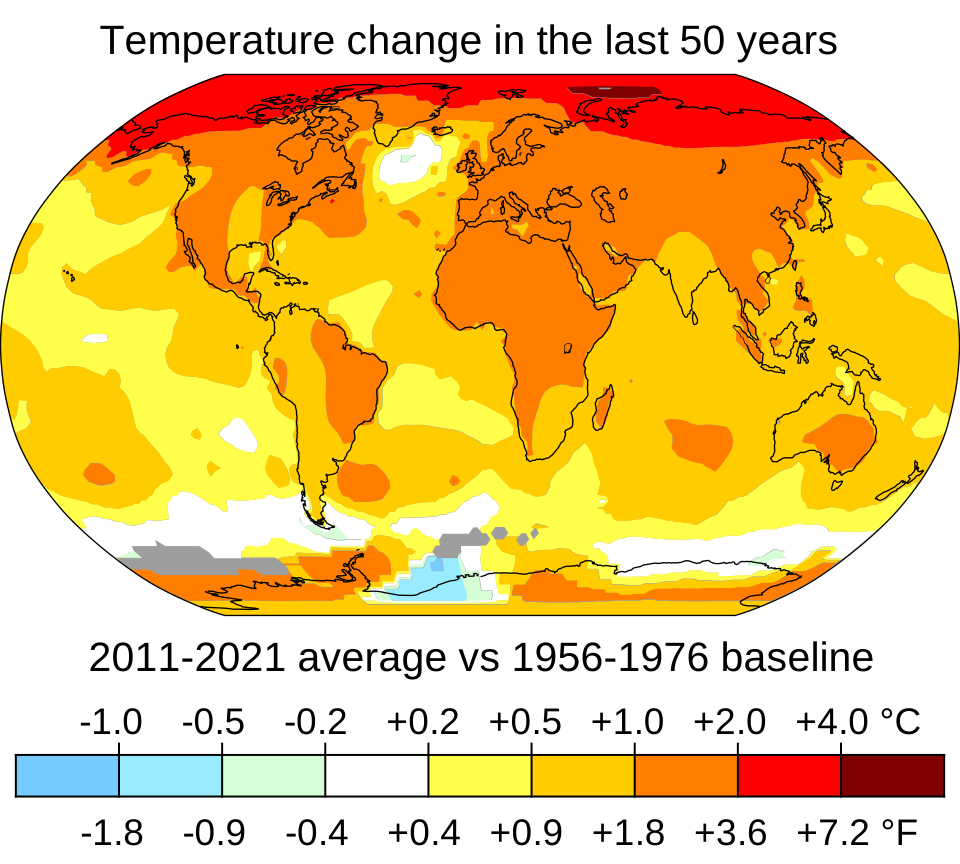
Climate change refers to long-term shifts in global temperatures and...

Greenland is an autonomous territory within the Kingdom of Denmark...
Trending

3 hours ago Arthur Fery Secures Victory Over Marin Cilic at Shanghai Masters Debut

3 hours ago Health Officials Urge Seasonal Vaccinations Amid Flu and Respiratory Virus Concerns

3 hours ago Frances Tiafoe Competes at the ATP Shanghai Masters Tournament

3 hours ago Florida Health Officials Debate Childhood Vaccination Plans Amid Rising Concerns Over Declining Rates
3 hours ago HHS Launches New Agency-Wide Initiative to Strengthen Vaccine Injury Research and Patient Care
3 hours ago FC Barcelona Prepares for Getafe Match Amid Raphinha Training and Roster Updates
Popular

Ken Paxton is an American politician and lawyer serving as...

Cristiano Ronaldo widely considered one of the greatest footballers captains...

Elon Musk is a visionary entrepreneur and engineer known for...

Michael Joseph Jackson the King of Pop was a highly...

Shakira Isabel Mebarak Ripoll the Queen of Latin Music is...

Jameis Winston is an American football quarterback currently playing for...