


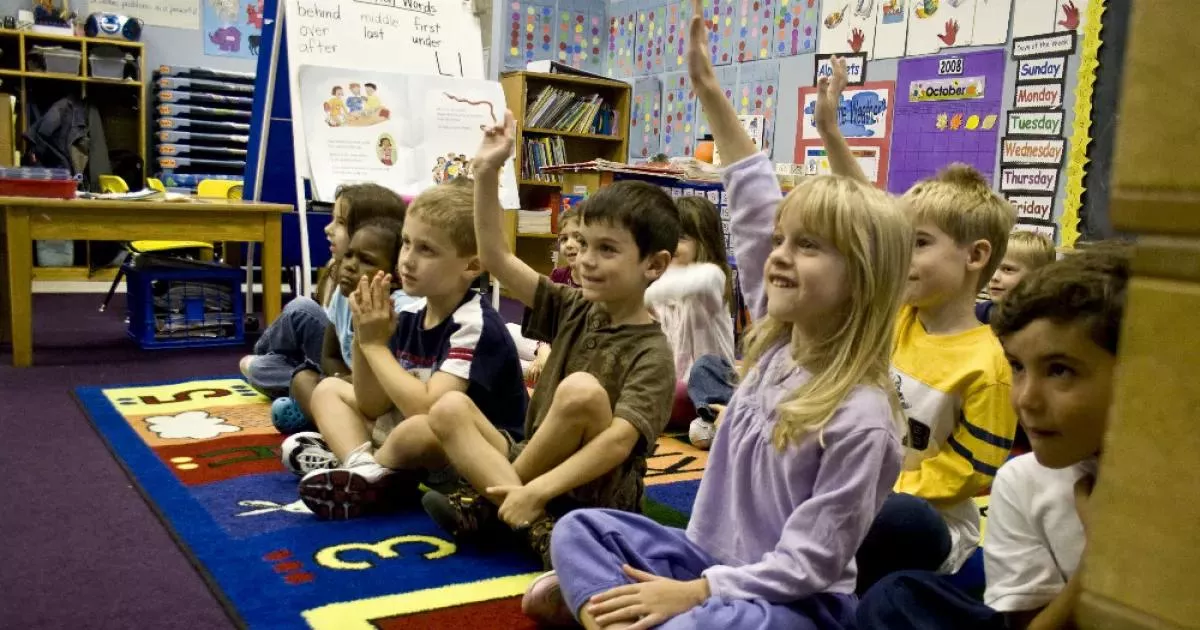
Kindergarten is an early childhood educational approach emphasizing play, practical activities, and social interaction to ease the transition from home to school. Originating in late 18th-century Germany to care for children of working parents, the concept and term were developed by Friedrich Fröbel. His methods profoundly influenced early-years education worldwide. Today, the term describes diverse learning environments for children aged two to six across many countries, utilizing various teaching methods.
1902: First Kindergarten in Peru
In Peru, in 1902 the teacher Elvira García y García organized the first kindergarten for children two to eight years old, Fanning annex to the Lyceum for ladies.


1920: Kindergartens in Finland
By 1920, there were approximately 80 kindergartens in operation across Finland, accommodating around 6,000 children.
1945: Start of the K-10 Educational System
In the Philippines, in 1945 the K-10 educational system started which would be phased out later.
1968: Establishment of Maternal Schools in Italy
In Italy, maternal schools (scuola materna) were established in 1968 after State Law n. 444 and are a full part of the official Italian education system, though attendance is not compulsory.
1971: Official Institution of Asilo Nido in Italy
In Italy, asilo nido (nursery schools) were officially instituted in a 1971 state law (L. 1044/1971), initially established to allow mothers the opportunity to work outside the home, and now serving the purpose of general education and social interaction.
1980: Establishment of Urban Preschools
In 1980, during the Soviet occupation of Afghanistan, the first early childhood development programs were introduced with the establishment of 27 urban preschools.
1985: Integration of Kleuterschool and Lagere School
In the Netherlands, in 1985, kleuterschool (kindergarten) and lagere school (primary school) were integrated into one form of education called basisonderwijs 'primary education'.
1990: Peak of Preschool Growth in Afghanistan
In 1990, the number of preschools in Afghanistan peaked at more than 270 during the Soviet occupation. These facilities, primarily located in Kabul, were attended by over 21,000 children and staffed by 2,300 teachers.
1990: Ministry of Education's Course of Study for Preschools
In Japan, the Ministry of Education's 1990 Course of Study for Preschools, which applies to both kindergartens and nursery schools, covers areas such as human relationships, health, environment, language, and expression.
1995: Kindergarten Decline in Afghanistan
By 1995, the number of functioning kindergartens in Afghanistan had dropped to 88, serving only 2,110 children, due to the onset of civil war after the Soviet withdrawal and Taliban restrictions.
1999: Growth of English Immersion Preschools in Taiwan
In Taiwan, there has been a significant increase in the number of privately owned and operated English immersion preschools since 1999.
2000: Development of Performance Indicators for Pre-Primary Institutions
In Hong Kong, to help establish the culture of self-evaluation in kindergartens and to provide reference for the public in assessing the quality and standard of pre-primary education, the Education Bureau has developed performance indicators for pre-primary institutions starting in 2000.
2000: Early Childhood Care and Development Act
In the Philippines, early childhood education was strengthened through the creation of the Early Childhood Care and Development Act of 2000 (Republic Act No. 8980).
2001: Quality Assurance Inspection Launched
Commencing in the 2000-2001 school year, quality assurance inspection was launched in Hong Kong to further promote the development of quality early childhood education.
2002: Law of Obligatory Pre-schooling Approved
In 2002, the Congress of the Union approved the Law of Obligatory Pre-schooling in Mexico, making preschool education for three to six-year-olds obligatory, and placing it under the federal and state ministries of education.
2007: Kindergarten/Preschool Centers Serving Children
In 2007, Afghanistan had approximately 260 kindergarten/preschool centers serving over 25,000 children.
March 2008: New Revision of Curriculum Guidelines
Starting from March 2008 the new revision of curriculum guidelines for kindergartens as well as for preschools came into effect in Japan.
2009: Mandatory Kindergarten Classes in Denmark
In Denmark, kindergarten classes (grade 0) were made mandatory in 2009 and are offered by primary schools before a child enters first grade.
August 2010: Preschool Attendance in Ukraine
In August 2010, the Education and Science Ministry of Ukraine reported that 56% of children aged one to six years old had the opportunity to attend preschool education.
June 6, 2011: Kindergarten Education Act Implementation
On June 6, 2011, the Department of Education disseminated copies of the Kindergarten Education Act through Republic Act No. 10157 in the Philippines, making Kindergarten compulsory and mandatory, and serving as a requirement for the implementation of the K–12 curriculum.
April 24, 2012: Phase-out of K-10 Educational System
In the Philippines, on April 24, 2012, the 1945–2017 K–10 educational system was phased out as part of the K–12's 9-year implementation process.
2012: Compulsory Preschool Education in Bulgaria
In Bulgaria, since 2012, two years of preschool education are compulsory and can be attended either in kindergarten or in preparatory groups at primary schools.
August 2013: New Law Affecting Childcare Availability in Germany
In Germany, a new law came into effect in August 2013 to address the difficulty of securing places in crèches and kindergartens, though childcare availability still varies greatly by region.
September 2013: Kindergarten Statistics in Mongolia
As of September 2013, there were approximately 152 kindergartens registered in Mongolia, with 142 being state-owned.
2017: End of the K-10 Educational System
In the Philippines, in 2017 the K-10 educational system ended which had started in 1945.
2018: Compulsory Preschool Education in France
In France, preschool education (école maternelle) became compulsory in 2018 for all children aged three, though almost all children in the three-to-five age range already attended.
2020: Compulsory Kindergarten Attendance in Romania
In Romania, attending the last year of kindergarten became compulsory in 2020.
Mentioned in this timeline
Ukraine is a country in Eastern Europe the second-largest on...
Hong Kong is a densely populated special administrative region of...
Germany officially the Federal Republic of Germany is located in...
The Taliban also known as the Islamic Emirate of Afghanistan...
Japan is an East Asian island country located in the...
France officially the French Republic is primarily in Western Europe...
Trending
3 hours ago Don Mattingly Set to Become Permanent Philadelphia Phillies Manager

3 hours ago Lisa Vanderpump Hosts Scottsdale Event and Shares Updates on Son Max

3 hours ago Zizou Bergs Stuns Carlos Alcaraz at Shanghai Masters
3 hours ago Victoria Ruffo Addresses Relationship and Parenting With Eugenio Derbez
4 hours ago Morgan Stanley Q3 Earnings Beat Expectations With Strong Equities Trading Revenue Growth

4 hours ago Chuck Schumer Faces Leadership Uncertainty Amid Midterm Elections and 2028 Political Challenges
Popular

Ken Paxton is an American politician and lawyer serving as...

Ilhan Omar is a prominent American politician currently serving as...

Jameis Winston is an American football quarterback currently playing for...

Cristiano Ronaldo widely considered one of the greatest footballers captains...

Michael Joseph Jackson the King of Pop was a highly...

Kimberly Guilfoyle is an American television personality and former prosecutor...