


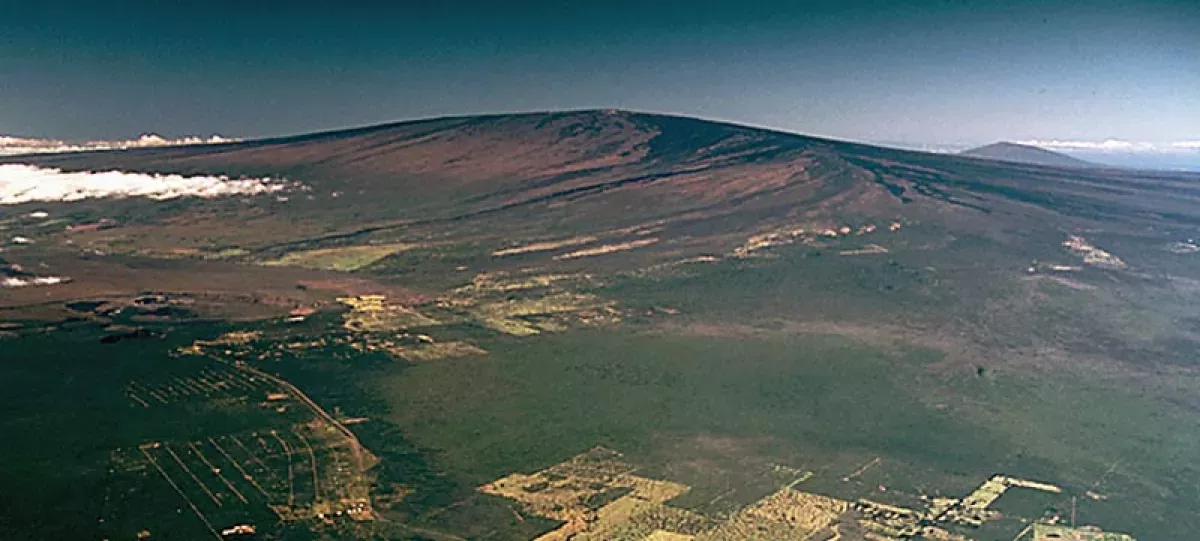
Mauna Loa, situated on the Island of Hawaii, is one of the Earth's most massive volcanoes. Although previously considered the largest, it is surpassed in size by Tamu Massif. This shield volcano features gentle slopes and an estimated volume of 18,000 cubic miles. Despite its immense size, its peak sits lower than its neighbor, Mauna Kea. Mauna Loa is known for its non-explosive eruptions due to its fluid, silica-poor lava.
1903: Multiple Eruptions
Mauna Loa erupted twice in 1903, indicating a period of heightened volcanic activity.


1907: Mauna Loa Eruption
Continuing its active phase, Mauna Loa erupted in 1907, adding to its history of frequent eruptions.
1912: Monitoring Begins
Recognizing the potential hazards of Mauna Loa, the Hawaiian Volcano Observatory began intensively monitoring the volcano in 1912.
1912: Establishment of the Hawaiian Volcano Observatory
The Hawaiian Volcano Observatory (HVO) was established in 1912 on Kilauea. Its primary mission is to monitor and study Hawaiian volcanoes.
1914: Mauna Loa Eruption
Mauna Loa erupted in 1914, marking another event in its series of eruptions during the early 20th century.
1914: Attempted Summit Expedition to Mauna Loa by Thomas A. Jaggar
Thomas A. Jaggar, founder of the HVO, made an unsuccessful attempt to reach Mauna Loa's summit to observe its eruption in 1914 due to the difficult journey.
1915: Construction of a Route to Mauna Loa's Summit
In 1915, with support from Lorrin A. Thurston and the US Army, a route to Mauna Loa's summit was completed, simplifying access for scientific study and public use.
1916: Mauna Loa Eruption
Adding to its active period, Mauna Loa erupted once again in 1916, showcasing its consistent volcanic activity.
1916: Mokuʻāweoweo Becomes Part of Hawaii Volcanoes National Park
In 1916, Mokuʻāweoweo was included in the Hawaii Volcanoes National Park, leading to the construction of a new trail from the park headquarters at Kilauea.
1919: Partially Subaerial Eruption
Mauna Loa experienced a partially subaerial eruption in 1919, characterized by both underwater and above-ground activity.
1924: Volcanic Fatality
A rare fatality from volcanic activity in Hawai'i occurred in 1924 at Kilauea, underscoring the potential dangers despite the typically slow-moving lava flows.
1926: Village Destruction
A notable eruption of Mauna Loa occurred in 1926 when lava flows destroyed villages, highlighting the potential danger of the volcano.
1926: Village Overrun by Lava
The 1926 eruption of Mauna Loa resulted in the destruction of the village of Ho'ōpūloa Makai, highlighting the destructive power of lava flows, even if they are generally slow-moving.
1933: Mauna Loa Eruption
Mauna Loa erupted again in 1933, continuing its trend of frequent eruptions during this era.
1934: Summit Shelter Construction
A summit shelter was built in 1934 using stones from the Wilkes' camp site and mortar.
1934: Volcanic Activity Shift
An interesting observation noted that when Kilauea became dormant in 1934, Mauna Loa became more active. This suggests a possible interaction between the two volcanoes.
1935: Hilo Threatened by Lava Flows
The 1935 eruption of Mauna Loa posed a serious threat to Hilo when lava flows started heading toward the city, leading to intervention efforts to divert the flows.
January 2, 1936: Lava Flow Stops
After a bombing operation aimed at diverting lava flows from Mauna Loa's 1935 eruption, the lava stopped flowing on January 2, 1936. However, the effectiveness of the bombing remains a subject of debate.
1940: Summit-Bound Eruption
In contrast to the more impactful 1935 eruption, a summit-bound event in 1940 was relatively less consequential, as the lava flows were confined to the summit area.
1942: WWII Eruption and Bombing
Mauna Loa's 1942 eruption coincided with World War II. Concerns about the eruption's glow being used by the Japanese led to a news blackout and bombing attempts to divert lava flows, showcasing the intersection of natural events and wartime anxieties.
1949: Mauna Loa Eruption
Mauna Loa erupted in 1949, a precursor to the more significant eruption that would follow in 1950.
1950: Rapid Lava Flow
Mauna Loa's 1950 eruption demonstrated the potential for rapid lava flow, reaching sea level in just four hours. This event challenged the perception that Hawaiian eruptions always involve slow-moving lava.
1950: Largest Rift Event
Mauna Loa's 1950 eruption holds the record for the largest rift event in its recorded history, emitting a massive amount of lava and reaching the ocean in a remarkably short time. This event significantly impacted the landscape and destroyed the village of Ho'okena-mauka.
1950: Village Destruction
Similar to the 1926 eruption, Mauna Loa's eruption in 1950 resulted in the destruction of villages. These events underscore the destructive power of the volcano.
1952: Volcanic Activity Shift
Reinforcing the observed trend, when Mauna Loa became quiet in 1952, Kilauea became more active, further hinting at a link between the activities of the two volcanoes.
February 20, 1962: Lowest Temperature Recorded on Mauna Loa
On February 20, 1962, the lowest temperature ever recorded on Mauna Loa was documented, plunging to a frigid 18°F (-8°C).
July 24, 1974: Wilkes Expedition Camp Site Listed on National Register of Historic Places
On July 24, 1974, the camp site of the Wilkes expedition was officially recognized for its historical importance and added to the National Register of Historic Places.
1974: Volcanic Activity Shift
Continuing the pattern, Mauna Loa's quiet period from 1952 to 1974 coincided with heightened activity at Kilauea, solidifying the observed correlation between the two volcanoes.
1974: Seismic Unrest Precedes Mauna Loa Eruption
Starting in 1974, Mauna Loa showed signs of increased seismic activity, providing a warning signal for its eruption in the following year.
July 1975: Mauna Loa Eruption
Mauna Loa erupted in July 1975, an event that was anticipated due to over a year of seismic unrest, leading to public warnings from late 1974.
1975: Brief Summit Eruption
After the substantial 1950 eruption, Mauna Loa experienced a long period of dormancy, punctuated only by a small, single-day summit eruption in 1975.
1975: Magma Chamber Model
Geophysical models of Mauna Loa's magma chamber were created using data from the 1975 eruption. These models provide insights into the volcano's internal structure.
1975: Hilina Slump
In 1975, the Hilina Slump on Mauna Loa shifted several meters, causing a 7.2 magnitude earthquake and a tsunami that reached heights of 14 meters. The tsunami tragically resulted in the loss of two lives at Halape.
1975: Ground Deformation Measurement
In the year leading up to the 1975 eruption of Mauna Loa, a survey line across the caldera indicated a 76 mm increase in width, highlighting the significance of ground deformation monitoring.
1983: Volcanologists Predict Eruption
By 1983, volcanologists had observed significant seismic activity on Mauna Loa, accurately predicting an eruption within two years.
1984: Simultaneous Eruption
Contradicting the typical pattern, Mauna Loa erupted in 1984 during an ongoing eruption at Kilauea, demonstrating that the two volcanoes don't always operate in a strictly inverse manner.
1984: Magma Accumulation Begins
Following the 1984 eruption, magma began accumulating beneath Mauna Loa, a natural process as the volcano recharged. This accumulation continued until the next eruption in 2022.
1984: Hilo Threatened Again
Hilo faced another close call during the 1984 eruption of Mauna Loa when lava flows came close to the city. This event served as a reminder of the city's location on lava flows from a previous eruption and the inherent risks associated with its position.
1984: Previous Mauna Loa Eruption
Prior to the 2022 eruption, Mauna Loa's most recent eruption occurred in 1984.
1984: Magma Chamber Model
Refining previous understanding, the 1984 eruption of Mauna Loa contributed to improved geophysical models of the volcano's magma chamber, enhancing our knowledge of its internal workings.
1984: Ground Deformation Precedes Eruption
Similar to the events preceding the 1975 eruption, a comparable increase in ground deformation was observed in the year before Mauna Loa's 1984 eruption.
1984: Near Miss for Hilo
The 1984 eruption of Mauna Loa saw lava flows come dangerously close to Hilo, highlighting the city's vulnerability to the volcano's activity. Fortunately, natural levees diverted the flows, preventing a potential disaster.
1985: Longest Quiet Period Begins
Following the 1984 eruption, Mauna Loa entered its most extended quiet period in recorded history, lasting until 2022. This dormancy, while lengthy, was not unexpected, as the volcano was recharging after the previous eruption.
September 26, 1990: Highest Temperature Recorded on Mauna Loa
On September 26, 1990, the highest temperature ever recorded on Mauna Loa was measured, reaching 78°F (26°C).
October 2006: Establishment of the Yuan-Tseh Lee Array for Microwave Background Anisotropy (AMiBA)
In October 2006, the Academia Sinica Institute of Astronomy and Astrophysics (ASIAA) established the Yuan-Tseh Lee Array for Microwave Background Anisotropy (AMiBA) on Mauna Loa to study cosmic microwave background radiation.
2019: Increased Unrest Observed
Starting in 2019, scientists observed an uptick in unrest at Mauna Loa, signaling a potential shift in the volcano's activity and hinting at the possibility of a future eruption.
February 2021: Elevated Unrest
In February 2021, the U.S. Geological Survey reported heightened signs of unrest at Mauna Loa since 2019, including increased inflation at the summit, indicating the potential for future eruptions.
November 27, 2022: Mauna Loa Eruption Begins
Mauna Loa's most recent eruption commenced on November 27, 2022. This marked the volcano's first eruption in 38 years since 1984.
December 13, 2022: Mauna Loa Eruption Ends
Mauna Loa's eruption, which began on November 27, 2022, ended on December 13, 2022.
2022: Longest Quiet Period Ends
Mauna Loa's long period of quiet, which began in 1985, finally ended in 2022 with the volcano's most recent eruption, marking the end of its longest recorded dormancy.
2022: Simultaneous Eruption
Similar to the 1984 event, the 2022 eruption of Mauna Loa occurred during an ongoing eruption at Kilauea, further illustrating that the two volcanoes can erupt simultaneously.
Mentioned in this timeline

The rapid advancement of artificial intelligence continues to dominate the...
An earthquake is a sudden intense shaking of the Earth's...

Inflation in economics signifies a rise in the average price...
A tsunami is a series of powerful waves caused by...
War is defined as an armed conflict involving the armed...
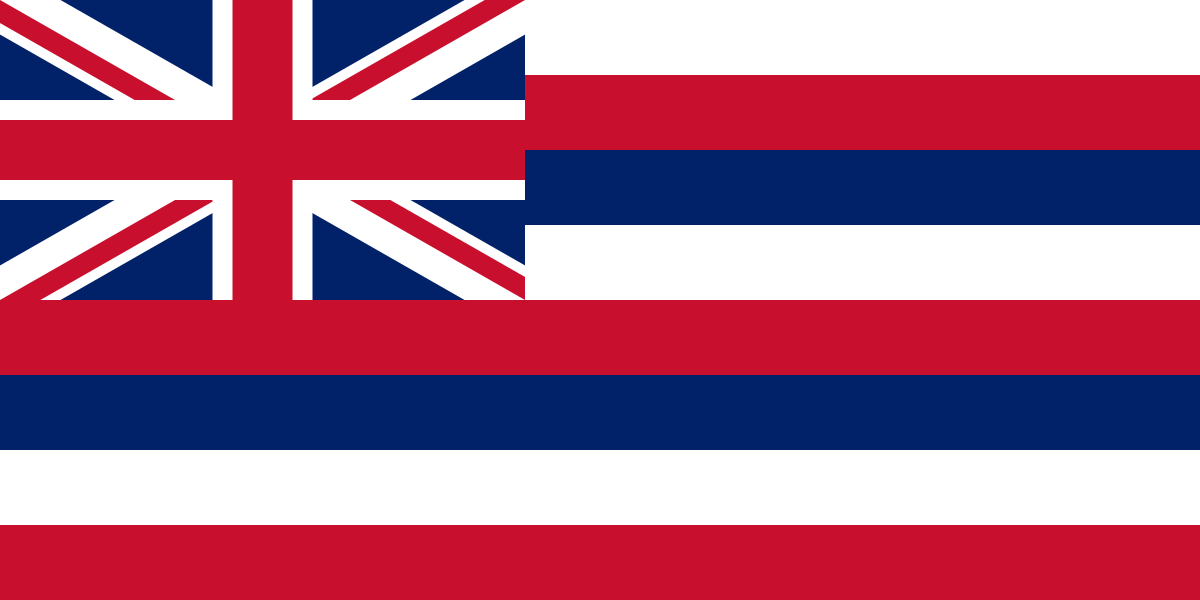
Hawaii is a non-contiguous U S state located in the...
Trending

4 hours ago Breaking Bad Named Greatest Television Show of the 21st Century

4 hours ago Learner Tien Faces Casper Ruud at Rolex Shanghai Masters

4 hours ago Nicolas Cage Refuses Amazon AI Waiver and Teases True Detective Season 5 Role
4 hours ago Alex Eala Prepares for Wuhan Open First Round Match Against Shi Han
4 hours ago Fatal DWI Crash Claims Life of 22-Year-Old Passenger on San Antonio Loop 1604

4 hours ago Sonay Kartal Faces Anhelina Kalinina in WTA Wuhan Open First Round Match
Popular

Ken Paxton is an American politician and lawyer serving as...

Jameis Winston is an American football quarterback currently playing for...

Cristiano Ronaldo widely considered one of the greatest footballers captains...

Michael Joseph Jackson the King of Pop was a highly...

Elon Musk is a visionary entrepreneur and engineer known for...

Bernie Sanders is a prominent American politician and the senior...