


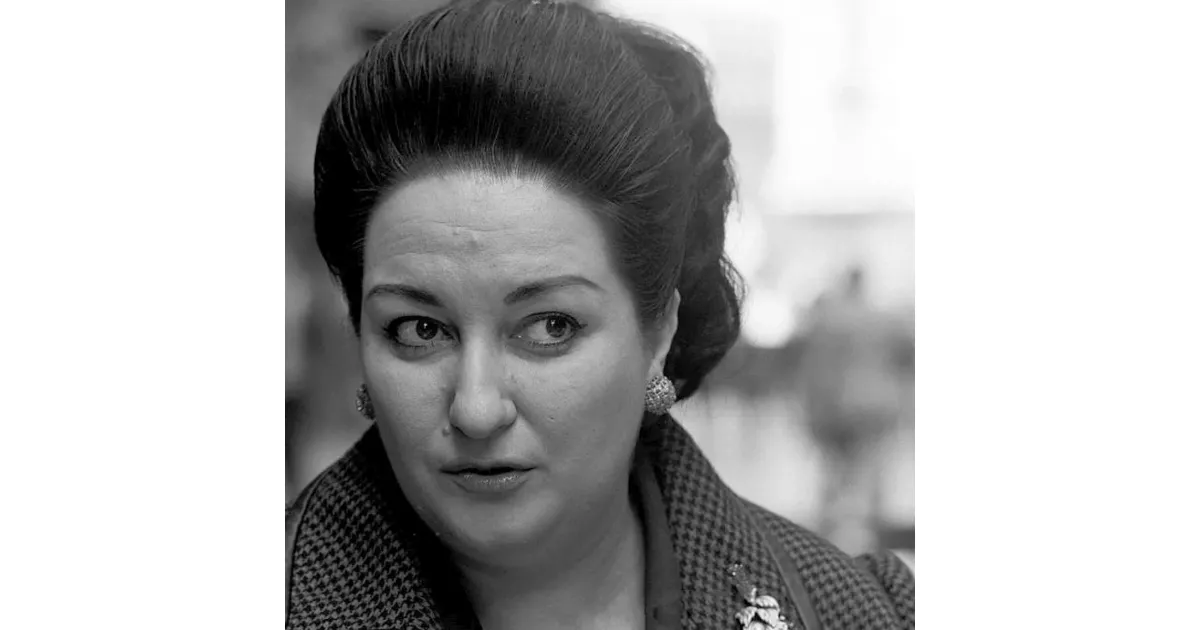
María de Montserrat Bibiana Concepción Caballé i Folch, commonly known as Montserrat Caballé, was a renowned Spanish operatic soprano from Catalonia. Celebrated as one of the finest sopranos of the 20th century, Caballé enjoyed a prolific six-decade career during which she won numerous musical awards, including three Grammy Awards.
1928: Birth of Bernabé Martí
Bernabé Martí, Caballé's future husband, was born in 1928.


1954: Graduation from Liceu Conservatory
Montserrat Caballé graduated with a gold medal from the Liceu Conservatory in 1954.
1956: Professional Debut in "La bohème"
Montserrat Caballé made her professional debut in 1956, performing as Mimì in Puccini's "La bohème" in Basel, Switzerland.
1957: Joining Basel Opera Company
Montserrat Caballé joined the Basel Opera company in 1957.
1959: Performance in "Die Zauberflöte" and "Salome"
In 1959, Montserrat Caballé performed as Erste Dame in Mozart's "Die Zauberflöte" and as Salome in Strauss's opera.
1961: Performance in "Iphigénie en Tauride"
Montserrat Caballé starred as Iphigénie in Gluck's "Iphigénie en Tauride" at the National Theatre of S. Carlos in Lisbon in 1961.
1962: Engagement with Bremen Opera
Montserrat Caballé's time at the Bremen Opera came to an end in 1962.
August 1964: Marriage to Bernabé Martí
Caballé married Spanish tenor Bernabé Martí on August 1964 at Santa Maria de Montserrat Abbey.
December 1965: Performance in "Roberto Devereux" and Metropolitan Opera Debut
Montserrat Caballé returned to Carnegie Hall in December 1965 to sing the role of Queen Elizabeth I in Donizetti's "Roberto Devereux". That same month, she debuted at the Metropolitan Opera as Marguerite in Gounod's "Faust".
1965: Glyndebourne Festival Debut and "Der Rosenkavalier"
In 1965, Montserrat Caballé debuted at the Glyndebourne Festival, singing her first Marschallin in Richard Strauss' "Der Rosenkavalier" and performing the role of Countess Almaviva in Mozart's "Le nozze di Figaro".
1965: International Breakthrough at Carnegie Hall
Montserrat Caballé rose to international fame in 1965 after her performance of Donizetti's Lucrezia Borgia at Carnegie Hall, New York, where she received a standing ovation.
1966: Debut with Philadelphia Lyric Opera and Italian Debut
Montserrat Caballé made her first appearance with the Philadelphia Lyric Opera Company as Maddalena di Coigny in Giordano's "Andrea Chénier" and debuted in Italy at the Maggio Musicale Fiorentino as Leonora in Verdi's "Il trovatore" in 1966.
1967: Performance in "Il pirata" and Verdi Roles
In 1967, Montserrat Caballé performed in Bellini's "Il pirata" in Florence and returned to Philadelphia to sing the title roles in Puccini's "Tosca" and "Madama Butterfly". She also performed various Verdi roles at the Met.
1968: Return to Philadelphia for "Il pirata" and "Lucrezia Borgia"
Montserrat Caballé returned to Philadelphia in 1968 and 1969 to perform in Bellini's "Il pirata" and "Lucrezia Borgia".
1969: Performance in "Don Carlo" and Teatro Corallo Recital
Montserrat Caballé appeared in a production of Verdi's "Don Carlo" at the Arena di Verona and gave a recital at the Teatro Corallo in Verona in 1969.
1969: Performance in "Turandot" and "Luisa Miller"
Montserrat Caballé performed as Liù in Puccini's "Turandot" at the Met and in the title role of Verdi's "Luisa Miller" in 1969.
1970: La Scala Debut and "Un ballo in maschera"
Montserrat Caballé debuted at La Scala in the title role of "Lucrezia Borgia" and performed as Amelia in Verdi's "Un ballo in maschera" at the Met in 1970.
1972: Recording Bellini's "Norma"
Caballé recorded the title role in Bellini's "Norma" for RCA Red Seal in 1972, featuring Plácido Domingo as Pollione.
1972: Covent Garden and Lyric Opera of Chicago Debuts
Montserrat Caballé made her debut with both Covent Garden and the Lyric Opera of Chicago, performing as Violetta in "La traviata", in 1972. That same year, she returned to the Met as Elisabetta in "Don Carlo" and sang the title role of Bellini's "Norma" in Philadelphia.
1973: Performance in "Maria Stuarda" and "Norma"
Montserrat Caballé performed the title role in Donizetti's "Maria Stuarda" in Chicago and Bellini's "Norma" at the Met in 1973.
September 1974: Surgery and Recovery
In September 1974, Montserrat Caballé underwent major surgery and returned to the stage in 1975.
1975: Return to Stage After Surgery
Montserrat Caballé resumed performing onstage in 1975 after recovering from surgery.
1976: Performances in "Norma", "Aida", "Ariadne auf Naxos", and "La bohème"
Montserrat Caballé performed various roles at the Met in 1976, including Norma in "Norma", Aida in "Aida", the title role in "Ariadne auf Naxos", and Mimì in "La bohème".
1977: Debut with the San Francisco Opera
Montserrat Caballé debuted with the San Francisco Opera in 1977, singing the title role in Puccini's "Turandot".
1978: Dramatic Roles and Collaborations
Caballé embraced more dramatically expressive singing, performing as Tosca in San Francisco with Pavarotti, Norma in Madrid, and Adriana Lecouvreur at the Met with José Carreras in 1978.
1980: Notable Tosca Performances
Caballé continued her success with the role of Tosca at the Met in 1980.
1981: Concert Performances
In addition to her operatic roles, Caballé gave concert performances in 1981.
1983: Continued Concert Success
Caballé continued to perform in concerts, showcasing her versatility as an artist, in 1983.
1984: Recording "Norma" as Adalgisa
In 1984, Caballé recorded the role of Adalgisa in Bellini's "Norma" with Joan Sutherland as Norma for Decca, conducted by Richard Bonynge.
October 1985: Final Performances at the Met
In October 1985, Caballé gave her final performances at the Metropolitan Opera as Tosca alongside Pavarotti and Cornell MacNeil.
1986: Film Debut in "Romanza final"
Caballé took on a role in the biographical film "Romanza final," directed by José María Forqué, in 1986.
1987: Collaboration with Freddie Mercury
Caballé ventured into pop music, releasing the duet "Barcelona" with Freddie Mercury of Queen in 1987, inspired by her home city.
1991: Posthumous Performance of "Barcelona"
Following Freddie Mercury's death in 1991, Caballé performed "Barcelona" live with his recording at the 1999 UEFA Champions League final.
1992: "Barcelona" as Olympic Anthem
"Barcelona" became an official theme song for the 1992 Olympic Games, hosted in Caballé's native city.
1992: "Barcelona" for the Olympics
"Barcelona", the duet by Montserrat Caballé and Freddie Mercury, was chosen by the International Olympic Committee for the 1992 Olympic Games.
1994: Recognition as a True Diva
Fiammetta Rocco, writing for The Independent in 1994, recognized Caballé as "one of the last of the true divas" in the opera world.
1995: Collaboration with Vangelis
Caballé collaborated with composer Vangelis on his album "El Greco" in 1995, a tribute to the Greek painter.
1997: "Friends For Life" Album Release
The album "Friends For Life," produced by Mike Moran and featuring duets with various artists, including Caballé, was released in 1997.
1999: Champions League Final Performance
Caballé performed "Barcelona" with a recording of Freddie Mercury at the 1999 UEFA Champions League final in Barcelona.
2002: Performance as Catherine of Aragon
Caballé appeared as Catherine of Aragon in Saint-Saëns' "Henri VIII" at the Liceu in 2002.
2003: Documentary Film and Charitable Work
Caballé starred in her documentary, "Caballé: Beyond Music," featuring prominent opera singers, in 2003. She was also a dedicated philanthropist, serving as a UNESCO Goodwill Ambassador and founding a foundation for children in need in Barcelona.
2003: Gramophone Feature
Patrick O'Connor wrote about Montserrat Caballé in Gramophone in 2003.
2004: Performance in "Cléopâtre"
She took on the title role in Massenet's "Cléopâtre" at the Liceu in 2004.
2010: Tax Residency in Andorra
Caballé registered as a resident of Andorra in 2010, despite living in Spain, to avoid paying taxes in Spain.
June 2013: Declared Persona Non Grata in Azerbaijan
Caballé was declared persona non grata in Azerbaijan in June 2013 after visiting Nagorno-Karabakh and meeting with its leaders, despite warnings from the Azerbaijani embassy in Spain.
December 2015: Tax Evasion Conviction
A Spanish court found Caballé guilty of tax fraud in December 2015. She received a six-month suspended jail sentence, a fine of €254,231, and an 18-month ban from public subsidies. She had registered in Andorra to avoid Spanish taxes in 2010.
September 2018: Hospitalization for Gallbladder Issue
Caballé was hospitalized for a gallbladder problem in September 2018.
October 2018: Death and Tributes
Montserrat Caballé died on October 6, 2018, at 85 in Barcelona. The cause of death was not disclosed. King Felipe VI of Spain hailed her as "the best of the best," and Prime Minister Pedro Sánchez recognized her as a great ambassador for Spain. She was laid to rest in Barcelona's Cementiri de Sant Andreu.
October 2018: Death of Montserrat Caballé
Montserrat Caballé passed away in October 2018.
Mentioned in this timeline

Freddie Mercury was a British singer and songwriter globally recognized...

Azerbaijan officially the Republic of Azerbaijan is a transcontinental landlocked...

San Francisco is the fourth-most populous city in California and...

The modern Olympic Games are a leading international sporting event...
Philadelphia the largest city in Pennsylvania holds a pivotal role...
Music involves arranging sounds to create form harmony melody rhythm...
Trending

4 hours ago Keke Palmer Jokes About Future Sports Parenting and Celebrates Ebony Power 100 Inclusion

4 hours ago San Francisco 49ers Announce Key Roster Updates Before Matchup Against Seattle Seahawks

4 hours ago Nick Bosa Reveals Foster Baby While Sharing Romantic Moment With Girlfriend Ella Ailiff

4 hours ago Security Guard Killed and Woman Injured in South Seattle Nightclub Drive-By Shooting

4 hours ago Marissa Ayers Announces Major Life Change Amid Jaxson Dart's Injury Recovery

4 hours ago Jacoby Brissett Analyzed as Fantasy Football Quarterback Value Option for Week 5
Popular

Ken Paxton is an American politician and lawyer serving as...

Jameis Winston is an American football quarterback currently playing for...

Cristiano Ronaldo widely considered one of the greatest footballers captains...
Michael Joseph Jackson the King of Pop was a highly...

Elon Musk is a visionary entrepreneur and engineer known for...

Shakira Isabel Mebarak Ripoll the Queen of Latin Music is...