History of New Zealand in Timeline


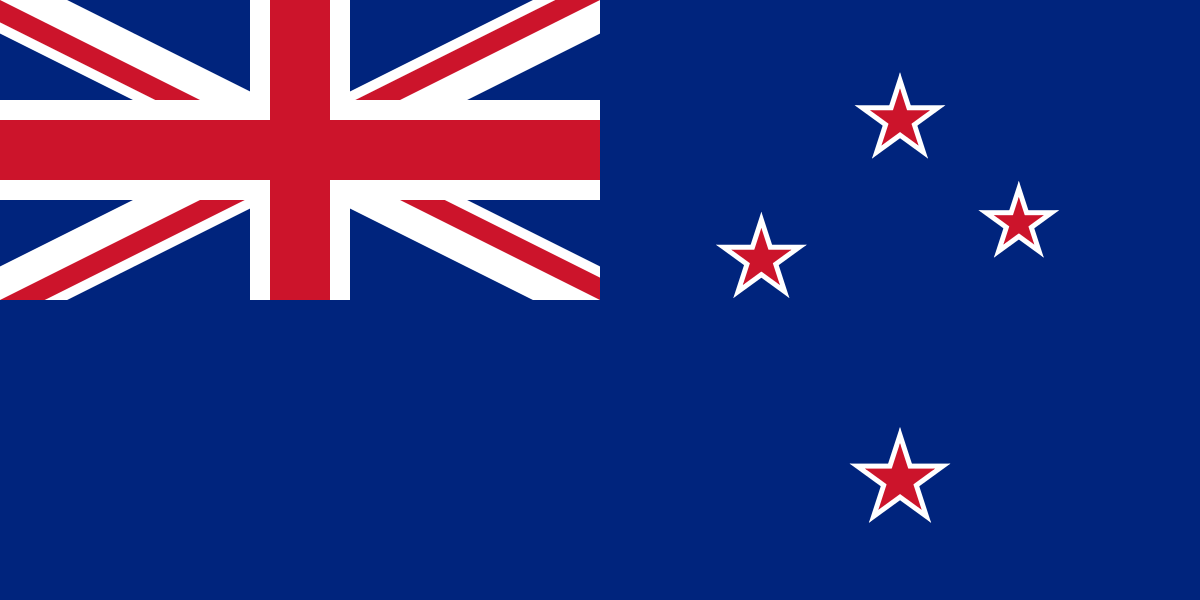
New Zealand is an island country in the southwestern Pacific Ocean, comprised of the North and South Islands, and over 600 smaller islands. Situated east of Australia and south of New Caledonia, Fiji, and Tonga, it's known for its varied topography, including the Southern Alps, shaped by tectonic activity and volcanic eruptions. Wellington is the capital city, while Auckland is the most populous.
3 hours ago : Cyclone Vaianu Hits New Zealand: Thousands Flee as 32-Foot Swells Pummels Coasts
Cyclone Vaianu has made landfall near the Maket? Peninsula in New Zealand, causing dangerous conditions and prompting thousands to evacuate from coastal areas. The cyclone brought with it massive 32-foot swells.


1907: North and South Island distinction accepted
By 1907, the use of "North" and "South" to distinguish New Zealand's two largest islands had become the accepted norm in mapmaking.
1907: New Zealand proclaimed a Dominion
In 1907, King Edward VII proclaimed New Zealand a Dominion within the British Empire at the request of the New Zealand Parliament.
1908: Summer Olympics participation
New Zealand participated at the Summer Olympics in 1908 as a joint team with Australia.
1912: Summer Olympics participation
New Zealand participated at the Summer Olympics in 1912 as a joint team with Australia.
1920: First participation in Summer Olympics
New Zealand first participated on its own in the Summer Olympics in 1920.
1921: Median Centre of Population
In 1921, the country's median centre of population was in the Tasman Sea west of Levin in Manawatū-Whanganui.
1922: Introduction of public radio
Public radio was introduced in New Zealand in 1922.
1923: Imperial Conferences
The 1923 Imperial Conferences decided that New Zealand should be allowed to negotiate its own political treaties.
1926: Imperial Conferences
The 1926 Imperial Conferences decided that New Zealand should be allowed to negotiate its own political treaties.
1928: Commercial treaty ratified with Japan
In 1928, New Zealand's first commercial treaty was ratified with Japan.
1937: Kermadec Islands become uninhabited
Since 1937, the Kermadec Islands have been largely uninhabited except for a small number of people at Raoul Island station.
September 1939: New Zealand declares war on Germany
On 3 September 1939, New Zealand allied itself with Britain and declared war on Germany.
1940: Development of the New Zealand recording industry
The New Zealand recording industry began to develop from 1940 onwards.
1947: New Zealand gains full statutory independence
In 1947, New Zealand achieved full statutory independence, solidifying its autonomy while maintaining the monarch as head of state.
1947: New Zealand adopts the Statute of Westminster
In 1947, New Zealand adopted the Statute of Westminster, confirming that the British Parliament could no longer legislate for the country without its consent.
1950: Legislative Council Abolished
In 1950, the Legislative Council, the upper house of the New Zealand Parliament, was abolished.
1951: ANZUS Treaty signed
In 1951, New Zealand, Australia, and the United States signed the ANZUS Treaty.
1960: Start of state-owned television
A state-owned television service began in New Zealand in 1960.
1965: First New Zealand Music Awards
The first New Zealand Music Awards were held in 1965 by Reckitt & Colman as the Loxene Golden Disc awards.
1970: Samoan Quota Scheme
The 1970 Samoan Quota Scheme was established to regulate migration, allowing up to 1,100 Samoan nationals to become permanent New Zealand residents each year.
1973: Export Market Reduction
In 1973, New Zealand's export market was reduced when the United Kingdom joined the European Economic Community, leading to a severe economic depression.
1975: Waitangi Tribunal established
In 1975, the Waitangi Tribunal was set up to investigate alleged breaches of the Treaty of Waitangi.
1975: Many municipalities exist
In 1975, there were 249 municipalities in New Zealand.
1978: New Zealand Film Commission started
In 1978, the New Zealand Film Commission started assisting local film-makers.
1979: Energy Crisis
The 1979 energy crisis, along with other compounding factors, led to a severe economic depression in New Zealand.
1982: UNCLOS contribution to exclusive economic zone
After the 1982 UNCLOS (United Nations Convention on the Law of the Sea), the Kermadec Islands significantly contributed to New Zealand's exclusive economic zone.
1982: Lowest Per-Capita Income
By 1982, New Zealand had the lowest per-capita income of all the developed nations surveyed by the World Bank.
1984: Deregulation of Agricultural Sector
In the mid-1980s, specifically 1984, New Zealand deregulated its agricultural sector by phasing out subsidies over a three-year period.
1985: Waitangi Tribunal enabled to investigate historic grievances
In 1985, the Waitangi Tribunal was enabled to investigate historic grievances related to the Treaty of Waitangi.
1986: British government's residual legislative powers removed
In 1986, the British government's remaining legislative powers over New Zealand were removed through the Constitution Act.
1987: Telecom New Zealand Formation
In 1987, Telecom New Zealand was formed, ending the New Zealand Post Office's monopoly over telecommunications.
1987: Māori language declared official language
In 1987, the Māori language was declared one of New Zealand's official languages.
1987: Share Market Crash
The 1987 share market crash led to a peak in unemployment in subsequent years.
1989: Local government reorganised
In 1989, the New Zealand government reorganised local government into the current two-tier structure of regional councils and territorial authorities.
1990: Increase in Dairy Farming
Between 1990 and 2007, the number of dairy cows in New Zealand doubled, leading to dairy farming becoming the country's largest export earner.
1990: Telecom New Zealand Privatisation
In 1990, Telecom New Zealand was privatised.
1991: Peak Unemployment
Unemployment peaked just above 10% in 1991, following the 1987 share market crash.
1992: Formation of Crown Research Institutes
In 1992, Crown Research Institutes (CRIs) were formed from existing government-owned research organisations.
1992: High Unemployment Rate
In 1992, unemployment peaked just above 10%, following the 1987 share market crash.
1993: End of First-Past-The-Post System
Almost all general elections in New Zealand between 1853 and 1993 were held under the first-past-the-post voting system.
1993: Railway Privatisation
New Zealand's railways were privatised in 1993.
1994: Press Freedom ranking
Since 1994, Freedom House has consistently ranked New Zealand's press freedom in the top twenty.
1995: Sailing success in the America's Cup
New Zealand has seen regular sailing success in the America's Cup regatta since 1995.
1996: Introduction of MMP
Since the 1996 election, New Zealand has used a form of proportional representation called mixed-member proportional (MMP).
1997: Forest cover at 23% of land
By 1997, forest cover in New Zealand had decreased to 23% of the land, following deforestation after both Polynesian and European settlement.
2000: Life Expectancy in 2000
In 2000, the life expectancy in New Zealand was 78.6 years.
2000: Growth of local fashion industry
The local fashion industry in New Zealand has grown significantly since 2000, doubling exports and increasing from a handful to about 50 established labels.
2001: Exhibition in Venice Biennale
In 2001, New Zealand art was exhibited in the Venice Biennale.
2002: International students increase
In 2002, the number of fee-paying international students and international exchange students studying in public tertiary institutions increased to over 20,000.
2002: Pacific Access Category established
The 2002 Pacific Access Category was established to regulate migration, allowing up to 750 other Pacific Islanders to become permanent New Zealand residents each year.
2003: Final rights of appeal to British courts abolished
In 2003, New Zealand abolished the final rights of appeal to British courts, marking a complete severing of judicial ties.
2004: "Paradise Now" Exhibition in New York
In 2004, New Zealand art was showcased in the "Paradise Now" exhibition in New York.
2004: Railway Renationalisation Begins
The re-nationalisation of the railways began in 2004 and continued in stages until 2008.
2006: Sign language official language
In 2006, New Zealand Sign Language became one of New Zealand's official languages.
2006: Discovery of ancient land mammal bones
In 2006, bones from a unique, mouse-sized land mammal at least 16 million years old were discovered in New Zealand, providing evidence of native land mammals.
2007: Seasonal workers scheme introduced
In 2007, a seasonal workers scheme for temporary migration was introduced in New Zealand.
2007: Wine Industry Growth
In 2007, the number of vineyards doubled over the period since 1990, overtaking wool exports for the first time.
2007: Low Unemployment Rate
In 2007, the unemployment rate in New Zealand fell to 3.7%, ranking third from twenty-seven comparable OECD nations.
April 2008: Free Trade Agreement with China
On 7 April 2008, New Zealand and China signed the New Zealand–China Free Trade Agreement, the first such agreement China has signed with a developed country.
2008: Financial Crisis Impact
The 2008 financial crisis had a major effect on New Zealand, causing the GDP to shrink for five consecutive quarters.
2008: Railway Renationalisation Complete
The re-nationalisation of the railways was completed in 2008.
2009: Ultra-Fast Broadband Rollout
A large-scale rollout of gigabit-capable fibre to the premises, branded as Ultra-Fast Broadband, began in 2009.
2009: Pacific Islanders employed under seasonal workers scheme
In 2009, about 8,000 Pacific Islanders were employed in New Zealand under the seasonal workers scheme.
2009: New Zealand Geographic Board discovers island names were never formalized
In 2009, the New Zealand Geographic Board discovered that the names of the North Island and South Island had never been formally established.
2009: New Zealand Immigration Service target
In 2009, the New Zealand Immigration Service set an annual target of 45,000–50,000 permanent residence approvals.
2009: Rising Unemployment
In late 2009, as a result of the 2008 financial crisis, unemployment in New Zealand rose back to 7%.
2011: Chorus Split from Telecom
In 2011, Chorus was split from Telecom (now Spark).
2012: Partnership with NATO
In 2012, New Zealand established a partnership arrangement with NATO under the Partnership Interoperability Initiative.
2013: New Zealand citizens living in Australia
In 2013, approximately 650,000 New Zealand citizens were living in Australia.
2013: Island names formalized
In 2013, the names of New Zealand's North and South Islands were formalized as North Island or Te Ika-a-Māui, and South Island or Te Waipounamu.
2013: Reference to net migration
In 2025, New Zealand's net migration fell to its lowest level in more than a decade, marking the smallest annual increase since 2013, according to Statistics New Zealand.
2014: Food Products Export
In 2014, food products made up 55% of the value of all the country's exports.
2015: 19th freest media
As of 2015, Freedom House ranked New Zealand's press freedom as the 19th freest media.
2015: Renewable Energy Generation
In 2015, renewable energy generated 40.1% of New Zealand's gross energy supply.
2015: R&D Expenditure as Proportion of GDP
In 2015, the total gross expenditure on research and development (R&D) as a proportion of GDP was 1.23%.
2015: Gold Production
New Zealand's gold production in 2015 was 12 tonnes.
2016: City Livability Ranking
In 2016, Auckland was ranked the world's third most liveable city and Wellington the twelfth by the Mercer Quality of Living Survey.
2016: New Zealand Space Agency Creation
In 2016, the New Zealand Space Agency was created by the government for space policy, regulation, and sector development.
2016: Tourism Contribution to GDP
In 2016, tourism contributed $12.9 billion (or 5.6%) to New Zealand's total GDP and supported 7.5% of the total workforce.
2017: International Telecommunication Union Ranking
As of 2017, the United Nations International Telecommunication Union ranked New Zealand 13th in the development of information and communications infrastructure.
2017: Population Shift
By 2017, the country's median centre of population had moved 280 km (170 mi) north to near Kawhia in Waikato from its 1921 location.
2017: Other Exports
In 2017, Other exports included meat (8.8%), wood and wood products (6.2%), fruit (3.6%), machinery (2.2%) and wine (2.1%).
2017: US Department of State human rights report
In 2017, a human rights report by the United States Department of State noted concerns regarding the social status of the Māori population in New Zealand.
2017: Increase in International Visitor Arrivals
In 2017, international visitor arrivals were expected to increase at a rate of 5.4% annually up to 2022.
June 2018: Dairy Products Export
In the year to June 2018, dairy products accounted for 17.7% ($14.1 billion) of total exports.
2018: 2018 census religion statistics
According to the 2023 census, 51.6% of the population had no religion, up from 48.2% in the 2018 census, where Christians comprised 36.5% of the population.
2018: Samoan most spoken non-official language
As of the 2018 census, Samoan is the most widely spoken non-official language (2.2%).
2018: Electorate data from census
Based on the 2018 census data, there are 72 electorates in New Zealand. The remaining seats are assigned to reflect the party vote.
2018: R&D Expenditure Increase
In 2018, the total gross expenditure on research and development (R&D) as a proportion of GDP rose to 1.37%.
2018: 2018 census
In the 2018 census, it was recorded that 27.4% of people counted were not born in New Zealand.
2018: Median Age at Census
The median age of the New Zealand population at the 2018 census was 37.4 years.
September 2019: Population Exceeds 5 Million
In September 2019 the population of New Zealand climbed above 5 million people, according to population estimates based on the 2018 census.
2019: Low Voter Turnout
In 2019, New Zealand experienced a low 42% voter turnout in local council elections.
2019: Life Expectancy
Life expectancy in New Zealand during 2017-2019 was 80.0 years for males and 83.5 years for females.
June 2020: Population Growth Rate
New Zealand's population increased at a rate of 1.9% per year in the seven years ended June 2020.
September 2020: Population Above 5 Million
In September 2020, Statistics New Zealand reported that the population had climbed above 5 million people in September 2019, based on population estimates from the 2018 census.
2020: Poverty Rate for Ethnic Minorities
As of 2020, poverty has a disproportionately high effect in ethnic-minority households, with a quarter (23.3%) of Māori children and almost a third (28.6%) of Pacific Islander children living in poverty.
2020: Fertility Rate
In 2020, New Zealand was experiencing sub-replacement fertility, with a total fertility rate of 1.6.
September 2021: Youth Unemployment Rate
During the September 2021 quarter, the general unemployment rate was around 3.2%, while the unemployment rate for youth aged 15 to 24 was 9.2%.
December 2021: Lowest Unemployment Rate
In December 2021, during the COVID-19 pandemic, New Zealand recorded its lowest unemployment rate using the current methodology, at 3.2%.
2021: Education Statistics
In 2021, among the population aged 25–64, 13% had no formal qualification, 21% had a school qualification, 28% had a tertiary certificate or diploma, and 35% held a bachelor's degree or higher.
2021: Life Expectancy in 2021
In 2021, the life expectancy in New Zealand improved to 82.2 years from 78.6 years in 2000.
2021: Border closures during Covid-19
In 2025, New Zealand's net migration fell to its lowest level in more than a decade, outside 2021, when borders were largely closed during the Covid-19 outbreak.
June 2022: Child Poverty Rate
As of June 2022, New Zealand had 12.0% of children living in low-income households that have less than 50% of the median equivalised disposable household income.
July 2022: Health New Zealand Established
On 1 July 2022, the New Zealand Government established Health New Zealand – Te Whatu Ora, replacing the country's 20 district health boards (DHBs).
2022: Ultra-Fast Broadband Target
By 2022, the Ultra-Fast Broadband rollout had a target of being available to 87% of the population.
2022: Expected Increase in International Visitor Arrivals
In 2017, it was predicted that international visitor arrivals would increase at a rate of 5.4% annually up to 2022.
2022: Historically low voter turnout in local elections
In 2022, New Zealand experienced a historically low 36% voter turnout in local council elections.
2022: Human Development Index Ranking
In 2022, New Zealand was ranked 16th in the Human Development Index and fourth in the Index of Economic Freedom.
July 2023: Free Trade Agreement with European Union
In July 2023, New Zealand and the European Union entered into the EU–New Zealand Free Trade Agreement, which eliminated tariffs on several goods traded between the two regions.
October 2023: Record net migration gain
New Zealand achieved a record net migration gain of 135,500 people in the year ended October 2023.
November 2023: Christopher Luxon becomes Prime Minister
Since 27 November 2023, Christopher Luxon is the 42nd and current prime minister of New Zealand.
2023: 2023 census religion statistics
According to the 2023 census, 51.6% of the population had no religion, an increase from 48.2% in the 2018 census. Christians remained the largest religious group, comprising 32.3% of the population.
2023: New Zealand ranked second in democratic institution strength
As of 2023, New Zealand is ranked second globally for the strength of its democratic institutions.
2023: Nominal GDP per capita
As of 2023, New Zealand's nominal gross domestic product (GDP) per capita was United States dollar48,071.
2023: Healthcare Spending
In 2023, New Zealand allocated about 9.6 percent of its GDP to healthcare, slightly above the OECD average of 8.8 percent.
2023: 2023 census results
In the 2023 census, it was reported that 62.1% of residents identified as ethnically New Zealand European, and 17.8% as ethnically Māori. Other major ethnicities included Chinese (5.2%), Indian (5.1%), Samoan (4.3%), Filipino (2.2%), Tongan (2.0%), Cook Islands Maori (1.9%), and English (1.4%).
2023: Census Enumeration
The 2023 New Zealand census enumerated a resident population of 4,993,923.
2024: Global Peace Index Ranking
According to the 2024 Global Peace Index, New Zealand was ranked as the 4th most peaceful country in the world.
June 2025: Population Distribution
As of June 2025, approximately 76.4% of New Zealand's population lived in the North Island and 23.6% in the South Island.
2025: Cricket Team Ranking
In 2025, New Zealand is ranked fifth in the International Cricket Council Men's Test Team Rankings with a rating of 100.
2025: Net migration at lowest level in a decade
In 2025, New Zealand's net migration fell to its lowest level in more than a decade, recording a net migration gain of 14,200, a decrease of 9,600 from the previous year, marking the smallest annual increase since 2013 (excluding 2021 when borders were largely closed due to the Covid-19 outbreak).
2025: Global Innovation Index Ranking
New Zealand was ranked 26th in the Global Innovation Index in 2025.
April 2026: Estimated Population
As of April 2026, the total population has risen to an estimated 5,345,910.
2050: Projected Median Age
By 2050, the median age of the New Zealand population is projected to rise to 43 years and the percentage of people 60 years of age and older to rise from 18% to 29%.
Mentioned in this timeline
Germany officially the Federal Republic of Germany is located in...
China officially the People's Republic of China PRC is located...
Japan is an East Asian island country located in the...
The World Bank is an international financial institution offering loans...
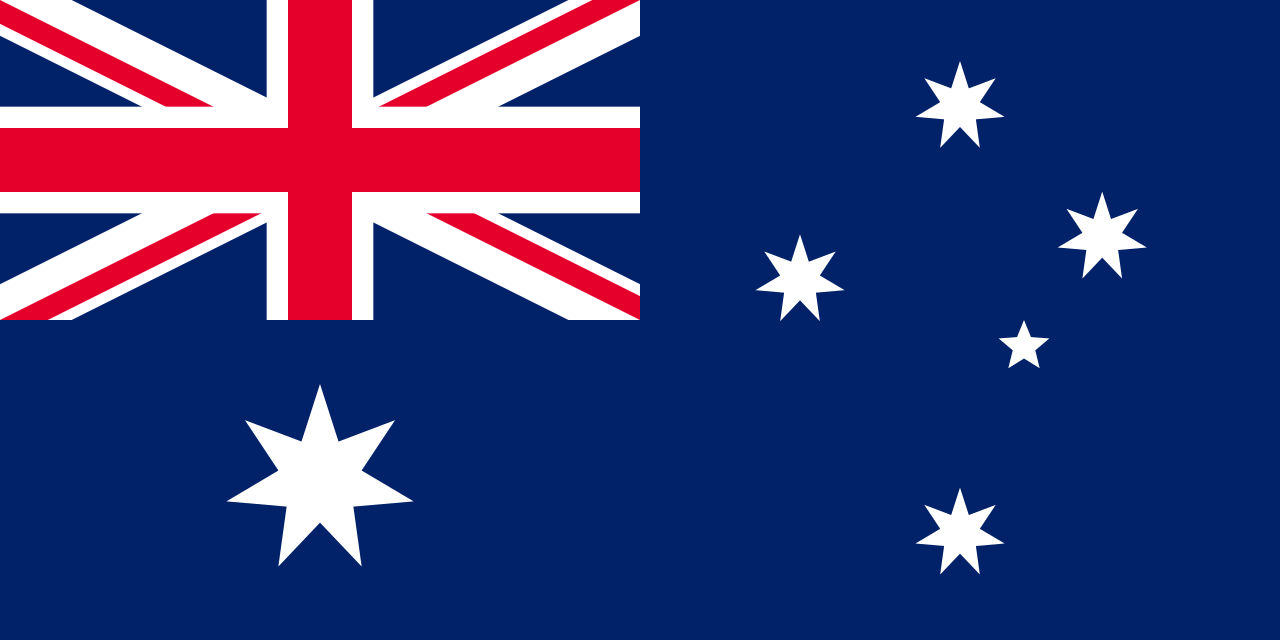
Australia officially the Commonwealth of Australia encompasses the Australian mainland...
Music is a cultural universal involving the arrangement of sound...
Trending

12 minutes ago Taylor Swift and Travis Kelce's wedding date is revealed; New York proposal.

1 hour ago Paulina Rubio returns to Chile, Morat debuts at Coachella, Karol G in Coachella

1 hour ago David Byrne at Coachella 2026: Livestream, Guide, and Performances Highlights

1 hour ago Ben Affleck gifts Jennifer Lopez his share of their $60M Beverly Hills mansion.
13 minutes ago Sabrina Carpenter's Dazzling "Sabrinawood" Headlining Set Thrills Coachella with Surprise Guests.

1 hour ago Lollapalooza 2026: Tickets, Lineup, and Chicago's Own John Summit Highlight the Festival.
Popular

Paula White-Cain is a prominent American televangelist and key figure...

William Franklin Graham III commonly known as Franklin Graham is...

Melania Trump is a Slovenian-American former model who served as...

Eric Swalwell is an American lawyer and politician currently serving...

J D Vance is an American politician and author He...

XXXTentacion born Jahseh Dwayne Ricardo Onfroy was a controversial yet...