History of Ohio in Timeline


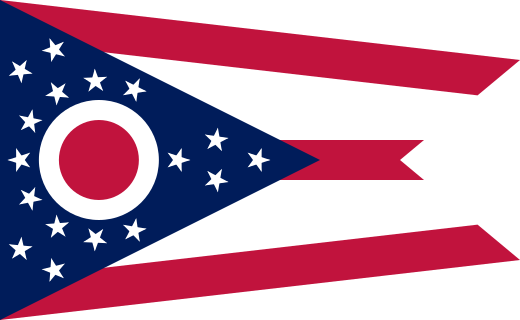
Ohio, located in the Midwestern United States, is the 34th-largest state by area and the seventh-most populous, with almost 11.9 million residents. Columbus serves as both its capital and largest city. Other significant metropolitan areas include Cleveland, Cincinnati, Dayton, Akron, and Toledo. Known as the "Buckeye State" after its native buckeye trees, Ohio borders Ontario (Canada), Pennsylvania, West Virginia, Kentucky, Indiana, and Michigan.
4 hours ago : Ohio State nurse recounts workplace assault; OSU Wexner enhances safety measures.
An Ohio State nurse describes a workplace assault, raising concerns about staff safety. OSU Wexner Medical Center locks down, implementing new workplace safety measures and prioritizing improvements by 2026.


May 17, 1901: Earthquake near Portsmouth
On May 17, 1901, an earthquake of magnitude 4.2 occurred near Portsmouth.
May 9, 1902: Ohio Adopts State Flag
On May 9, 1902, the state legislature officially adopted the flag of Ohio.
December 17, 1903: Wright Brothers Invent First Airplane
On December 17, 1903, Dayton natives Orville and Wilbur Wright invented the first successful airplane, making four brief flights at Kitty Hawk, North Carolina.
1910: Canals Carry Bulk Freight
As late as 1910, interior canals in Ohio carried much of the state's bulk freight.
1913: Great Flood of 1913
In 1913, Ohio experienced its greatest natural disaster, the Great Flood of 1913, which resulted in at least 428 fatalities and caused hundreds of millions of dollars in property damage, especially around the Great Miami River basin.
1913: Lincoln Highway Selected
In 1913, the Main Market Route 3 was chosen to become part of the historic Lincoln Highway, the first road across America.
1919: Reds World Series Title
The Cincinnati Reds won the World Series in 1919.
October 3, 1920: First NFL Game
On October 3, 1920, the first official game of the National Football League (NFL) occurred, with the Dayton Triangles defeating the Columbus Panhandles 14–0 in Dayton.
1920: Indians World Series Title & Pros NFL Championship
The Cleveland Indians won the World Series in 1920 and the Pros won the NFL Championship in 1920.
1922: Bulldogs NFL Championship
The Bulldogs won the NFL Championship in 1922.
1922: Klondike Bar Origination
The Klondike bar originated in Mansfield in 1922.
1923: Bulldogs NFL Championship
The Bulldogs won the NFL Championship in 1923.
1924: Dum Dums Lollipops Origination
Dum Dums lollipops were originally produced in Bellevue, Ohio in 1924.
1924: Bulldogs NFL Championship
The Bulldogs won the NFL Championship in 1924.
1926: Lincoln Highway Becomes U.S. Route 30
Upon the advent of the federal numbered highway system in 1926, the Lincoln Highway through Ohio became U.S. Route 30.
1933: Great Depression Impacts Ohio
By 1933, during the Great Depression, over 40% of factory workers and 67% of construction workers were unemployed in Ohio, with the state unemployment rate reaching a high of 37.3%.
July 21, 1934: Highest Recorded Temperature
On July 21, 1934, the highest recorded temperature in Ohio was 113 °F (45 °C) near Gallipolis.
March 9, 1937: Anna (Shelby County) Earthquake
On March 9, 1937, the Anna (Shelby County) earthquake occurred in western Ohio, with a magnitude of 5.4.
1940: Population Growth
Ohio's population grew faster than 10% per decade, except for the 1940 census, until the 1970 census.
1940: Reds World Series Title
The Cincinnati Reds won the World Series in 1940.
1944: Presidential Election Miss
Since 1896, Ohio has had only three misses in the general election including the 1944 election.
1948: Indians World Series Title
The Cleveland Indians won the World Series in 1948.
1950: Browns NFL Championship
The Cleveland Browns won the NFL Championship in 1950.
1952: First Live Rock 'n Roll Concert in Cleveland
In 1952, Alan Freed hosted the first live rock 'n roll concert in Cleveland.
1953: Ohio's Statehood Oversight Discovered
In 1953, as Ohio prepared to celebrate its sesquicentennial, it was discovered that Congress had never passed a formal resolution admitting Ohio as the 17th state. Congressman George H. Bender introduced a bill to admit Ohio retroactively to March 1, 1803.
1953: Spangler Candy Company Production
Since 1953, Dum Dums lollipops have been made by Spangler Candy Company in Bryan, Ohio.
1954: Browns NFL Championship
The Cleveland Browns won the NFL Championship in 1954.
1955: Browns NFL Championship
The Cleveland Browns won the NFL Championship in 1955.
1960: Presidential Election Miss
Since 1896, Ohio has had only three misses in the general election including the 1960 election.
1963: Pro Football Hall of Fame
Canton was enshrined as the home of the Pro Football Hall of Fame in 1963.
1963: Pro Football Hall of Fame Enshrined in Canton
In 1963, Canton was enshrined as the home of the Pro Football Hall of Fame.
1964: Presidential Election
Since 1964, Ohio had the longest perfect streak of any state, voting for the winning presidential candidate.
1964: Browns NFL Championship
The Cleveland Browns won the NFL Championship in 1964.
1965: Appalachian Regional Development Act
In 1965, Congress passed the Appalachian Regional Development Act, defining 29 Ohio counties as part of Appalachia to address poverty and economic despair.
1967: Carl Stokes Elected Mayor of Cleveland
In 1967, Carl Stokes was elected mayor of Cleveland, becoming the first African American mayor of one of the nation's 10 most populous cities.
1967: No Ohio Team Wins Super Bowl
Since its inception in 1967, no Ohio team has won the Super Bowl.
1970: Kent State Shooting
In 1970, during an antiwar protest at Kent State University, an Ohio Army National Guard unit fired at students, killing four and wounding nine. The protests were primarily against the United States' invasion of Cambodia during the Vietnam War.
1970: Population Growth Slows
The 1970 census recorded just over 10.65 million Ohioans, after which population growth slowed for the next four decades.
1974: Ohio Lottery begins
As of 2020, the Ohio Lottery has contributed more than $26 billion to education beginning in 1974.
1975: Reds World Series Title
The Cincinnati Reds won the World Series in 1975.
1976: Reds World Series Title
The Cincinnati Reds won the World Series in 1976.
July 1979: State of Ohio Trade Mission to China
In July 1979, Governor Jim Rhodes led a State of Ohio Trade Mission to China, fostering economic ties and a sister state-province relationship with Hubei province.
1979: Last Served by National Limited
In 1979, Columbus' Union Station was last served by the National Limited.
1980: U.S. Supreme Court Ruling on Ohio River Boundary
In 1980, the U.S. Supreme Court held that the boundary between Ohio and Kentucky (and West Virginia) is the northern low-water mark of the Ohio River as it existed in 1792.
1982: Grand Prix of Cleveland
The Grand Prix of Cleveland hosted CART races beginning in 1982 and running through 2007.
1983: Winter Guard International Championships
Within the marching arts, Winter Guard International has hosted national championships in performing arts at the University of Dayton 18 times beginning 1983 and ending in 2003.
January 31, 1986: Earthquake in LeRoy Township
On January 31, 1986, an earthquake of 5.0 occurred in LeRoy Township in Lake County, triggering aftershocks for two months.
1990: Ohio's population center
As of 2000, Ohio's center of population is located approximately 6,346 feet (1,934 m) south and west of Ohio's population center in 1990.
1990: Decline in manufacturing jobs
From 1990 to 2019, Ohio lost over 300,000 manufacturing jobs.
1990: Reds World Series Title
The Cincinnati Reds won the World Series in 1990.
1993: National Voter Registration Act (NVRA) of 1993
In 1993, the National Voter Registration Act (NVRA) was enacted and in April 2016, it was cited in a lawsuit against Ohio's voter purging policy.
1994: Ohio's Voter Purging Policy Since 1994
Since 1994, Ohio has had a policy of purging infrequent voters from its rolls.
2000: Center of population located in Morrow County
As of 2000, Ohio's center of population is located in Morrow County, in the county seat of Mount Gilead.
2000: Union membership decline
In 2000, 17.4% of Ohioan workers were union members.
2002: Help America Vote Act of 2002
In 2002, the Help America Vote Act was enacted and was cited in April 2016, in a lawsuit against Ohio's voter purging policy.
2003: Winter Guard International Championships
Within the marching arts, Winter Guard International has hosted national championships in performing arts at the University of Dayton 18 times between 1983 and 2003.
2005: Winter Guard International Championships
Since 2005, Winter Guard International has permanently hosted national championships in performing arts at the University of Dayton.
2006: Median Household Income
From 2006-07 to 2008-09, the median household income in Ohio dropped 7%.
December 2007: Job Losses Begin
From December 2007 to September 2010, Ohio lost 376,500 jobs during the Great Recession.
2007: Pre-Recession Jobs
In 2015, the state was lacking 45,000 jobs compared to the pre-recession numbers of 2007.
2007: Grand Prix of Cleveland
The Grand Prix of Cleveland hosted CART races from 1982 to 2007.
2008: Unemployment Rate Rises
In 2008, Ohio's economy suffered due to the Great Recession, and the state's unemployment rate rose from 5.6% in the first two months of 2008.
2008: Top Publicly Traded Companies Headquartered in Ohio
In 2008, fifty-nine of the United States' top 1,000 publicly traded companies (by revenue) were headquartered in Ohio, including Procter & Gamble, Goodyear Tire & Rubber, AK Steel, Timken, Abercrombie & Fitch, and Wendy's.
December 2009: Peak unemployment rate
Ohio's unemployment rate peaked at 11.1% in December 2009 and January 2010 due to the Great Recession.
2009: Income Growth
Ohio's overall income grew in Ohio from 2009 to 2012, with an overall 7.1% increase in income growth.
January 2010: Peak unemployment rate
Ohio's unemployment rate peaked at 11.1% in December 2009 and January 2010 due to the Great Recession.
May 2010: Unemployment Rate
In May 2010, Ohio's unemployment rate was 10.7%.
September 2010: Job Losses Conclude
From December 2007 to September 2010, Ohio lost 376,500 jobs during the Great Recession.
2010: Christian Denominations
According to the ARDA, in 2010 the largest Christian denominations by adherents were the Catholic Church, the United Methodist Church, the Evangelical Lutheran Church in America, the Southern Baptist Convention, the Christian Churches and Churches of Christ, the United Church of Christ, and the Presbyterian Church (USA).
2010: Foreign-Born Residents in Ohio
In 2010, Ohio had 469,700 foreign-born residents, making up 4.1% of the total population. Of these, 2.0% were naturalized U.S. citizens, and 2.1% were not. The largest groups were from Mexico, India, China, Germany, Philippines, United Kingdom, Canada, Russia, South Korea, and Ukraine.
2010: Business Climate Ranking
In 2010, Ohio was ranked second in the country for best business climate by Site Selection magazine, based on a business-activity database.
2010: Language Spoken
In 2010, approximately 6.7% of Ohio's population age 5 years and older reported speaking a language other than English. 2.2% spoke Spanish, 2.6% other Indo-European languages, 1.1% Asian and Austronesian languages, and 0.8% spoke other languages.
2010: Voter Demographic
Since the 2010 midterm elections, Ohio's voter demographic has leaned towards the Republican Party.
2010: 2010 United States Census
The United States Census Bureau counted 11,808,848 people in Ohio in the 2020 census, a 2.4% increase since the 2010 United States census.
2011: Demographics of Ohio's children
As of 2011, 27.6% of Ohio's children under the age of 1 belonged to minority groups.
December 31, 2011: Earthquake Near Youngstown
On December 31, 2011, an earthquake occurred approximately 4 kilometers northwest of Youngstown, registering a 4.0 magnitude.
2012: Income Growth
Ohio's overall income grew in Ohio from 2009 to 2012, with an overall 7.1% increase in income growth.
August 2014: Unemployment rate returns to pre-recession levels
By August 2014, Ohio's unemployment rate returned to 5.6%, the level it was before the Great Recession.
2014: Pew Forum Poll Results
According to a Pew Forum poll in 2014, 56% of Ohioans felt religion was "very important", 25% felt it was "somewhat important", and 19% felt religion was "not too important/not important at all". 38% of Ohioans attended religious services at least once weekly.
April 2015: Labor Force Participation
As of April 2015, the labor force participation in Ohio was 63%, slightly above the national average.
2015: Ohio GDP
By 2015, Ohio's gross domestic product (GDP) was $608.1 billion, the seventh-largest economy among the 50 states.
April 2016: Lawsuit Filed Against Voter Purging Policy
In April 2016, a lawsuit was filed challenging Ohio's policy of purging infrequent voters from its rolls, alleging violations of the National Voter Registration Act of 1993 and the Help America Vote Act of 2002.
November 2016: Federal Court Injunction Affects Election
In November 2016, a preliminary injunction, entered by the federal district court earlier that year, was in effect for the election. This injunction prevented the purging of thousands of voters from the rolls just weeks before the election, after the Court of Appeals for the Sixth Circuit upheld the injunction in September of that year.
2016: Gross Domestic Product
In 2016, Ohio's gross domestic product (GDP) was $626 billion, ranking it as the seventh-largest economy among all 50 states and Washington, D.C.
2016: Presidential Election
In the 2016 presidential election, Ohio voted for Republican Donald Trump at larger margins than the nation as a whole.
2016: Cavaliers NBA Championship
The Cleveland Cavaliers won the NBA Championship in 2016.
2018: Income Tax Burden
In 2018, the bottom 20% of earners in Ohio contributed 12.3% of their income towards various taxes, while the top 1% only paid 6.5%.
June 10, 2019: Earthquake Under Lake Erie
On June 10, 2019, an earthquake occurred approximately 5 kilometers north-northwest of Eastlake under Lake Erie, registering a 4.0 magnitude.
2019: Increase in non-manufacturing jobs
From 1990 to 2019, Ohio added over 1,000,000 non-manufacturing jobs.
2019: Columbus Corporations on Fortune 500 List
In 2019, Columbus had six corporations named to the U.S. Fortune 500 list.
2019: Ohio ranks seventh in GDP
In 2019, Ohio ranked seventh in GDP among U.S. states, maintaining its status as an industrial state with a strong manufacturing sector and the second-largest automobile production.
2019: Mike DeWine as Governor
Mike DeWine has been the governor of Ohio since 2019.
March 9, 2020: COVID-19 Pandemic Reaches Ohio
On March 9, 2020, the COVID-19 pandemic reached Ohio, with three cases reported.
2020: Predominant Religion
According to the ARDA's 2020 study, Christianity remained the predominant religion in Ohio. Non-denominational Christianity were the largest Protestant cohort, although Catholicism remained the single-largest denomination. Ohio had the second largest Amish population of all U.S. states.
2020: Ohio Lottery Contribution to Education
As of 2020, the Ohio Lottery has contributed more than $26 billion to education since 1974.
2020: U.S. House of Representatives Seats
Following the 2020 census, Ohio has 15 seats in the U.S. House of Representatives.
2020: Ohio Ranked as 17th Hardest State to Vote In
In 2020, a study ranked Ohio as the 17th hardest state for citizens to vote in.
2021: Religion in Ohio
According to the Public Religion Research Institute's 2021 American Values Survey, 64% of Ohioans identified as Christian. Roughly 30% of the population were unaffiliated with any religious body.
2022: Ohio General Assembly
As of the 2022 election cycle, the Republican Party is the majority party in both houses of the Ohio General Assembly.
2022: Union membership decline
In 2022, 12.8% of Ohioan workers were union members, a decline from 2000.
2022: Cincinnati Bearcats College Football Playoff
In 2022, the Cincinnati Bearcats football team became the first so-called "Group of Five" team to qualify for the College Football Playoff.
2022: Homeless Population
In 2022, the HUD's Annual Homeless Assessment Report estimated that there were 10,654 homeless people in Ohio.
February 2023: COVID-19 Deaths
As of February 2023, over 41,600 Ohioans have died from COVID-19.
2023: Income Statistics
In 2023, Ohio's per capita income was $60,402, and the state's median household income was $65,720. 13.4% of the population was living below the poverty line.
2023: Abortion Rights
In 2023, Ohioans approved a constitutional amendment strengthening abortion rights.
2024: Ohio State Buckeyes Football Record
As of 2024, the Ohio State Buckeyes football team has a 977–335–53 overall record and a 30–29 bowl record.
2024: Ohioan Voters
As of 2024, there are more than 8 million registered Ohioan voters, of which over 70% are not affiliated with any political party.
2024: Federal Representatives
As of the 2024 election cycle, ten federal representatives are Republicans while five are Democrats.
2024: Presidential Election
In the 2024 presidential election, Ohio voted for Republican Donald Trump at larger margins than the nation as a whole.
May 2025: Unemployment Rate
As of May 2025, Ohio's unemployment rate stood at 4.9%.
2025: Small Businesses in Ohio
In 2025, 99.6% of businesses in Ohio were small businesses, which employed 2.2 million people, or 43.8% of the state's work force.
Mentioned in this timeline

Donald John Trump is an American politician media personality and...

College football is a popular amateur sport in the United...
India officially the Republic of India is a South Asian...
The Super Bowl is the annual championship game of the...

The Catholic Church the largest Christian church globally with over...
News encompasses current events communicated through various media including word...
Trending

3 days ago Apple at 50: Reflections on Innovation, Challenges, and Future Directions after Steve Jobs
17 minutes ago Severe storms to impact Austin, Central Texas with possible I-35 flooding Saturday.

18 minutes ago Francisco Comesaña to Debut at Monte Carlo Masters 1000 Qualifying Tournament.
21 hours ago Navone Advances to ATP Bucharest Quarterfinals, Defeating Molcan: Predictions and Analysis

1 hour ago Elle Macpherson Celebrates 62nd Birthday with Stunning Lingerie Photoshoot: Still 'The Body'!

2 hours ago Chicago's iconic flag adoption, city employee's debt, and Illinois quick hits revealed.
Popular

William Franklin Graham III commonly known as Franklin Graham is...

Paula White-Cain is a prominent American televangelist and key figure...

XXXTentacion born Jahseh Dwayne Ricardo Onfroy was a controversial yet...

George Soros is a Hungarian-American investor and philanthropist with a...

Sir David Attenborough is a highly influential British broadcaster biologist...
Walter Elias Disney was a highly influential American animator film...