


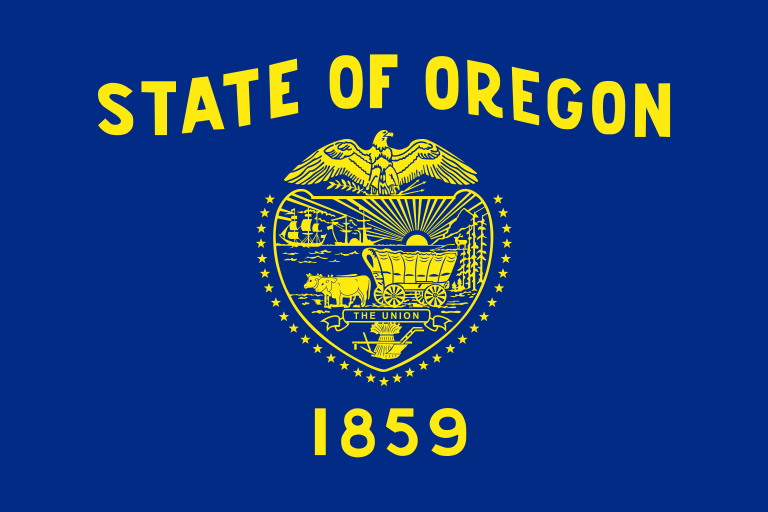
Oregon, a state in the Pacific Northwest, is part of the Western U.S. Its northern border with Washington is largely defined by the Columbia River, while the Snake River marks much of its eastern border with Idaho. The 42nd parallel forms its southern boundary with California and Nevada. The Pacific Ocean constitutes its western border.
8 hours ago : Heroic Intervention During Tragic Bend, Oregon Elementary School Shooting
A teacher confronted a school attacker at Silver Rail Elementary in Bend, Oregon, before an armed parent neutralized the suspect. The school remains closed as the community grapples with the aftermath of the deadly shooting incident.


1902: Oregon System introduced
In 1902, Oregon introduced direct legislation through initiatives and referendums, known as the Oregon System, allowing citizens to directly influence state laws.
1902: Ballot measure creates initiative and referendum
In 1902, Oregon overwhelmingly approved a ballot measure creating the initiative and referendum for citizens to introduce or approve proposed laws or amendments to the state constitution directly, making Oregon the first state to adopt such a system.
1902: People passed initiatives and referendums since 1902
Since 1902, the people of Oregon have passed 99 of the 288 initiatives and 25 of the 61 referendums on the ballot, though not all survived challenges in courts.
1904: Joaquin Miller's suggestion in Sunset magazine
In 1904, Joaquin Miller provided a suggestion regarding the origin of the name Oregon in Sunset magazine.
1904: Primary election adopted to select party candidates
In 1904, Oregon adopted the primary election to select party candidates.
1908: Oregon Constitution amended to include recall of public officials
In 1908, the Oregon Constitution was amended to include the recall of public officials.
1910: Congressional Apportionment Increases Oregon's Delegation
Following the census of 1910, congressional apportionment increased the size of Oregon's delegation in the House of Representatives.
1930: Gray wolves extirpated from Oregon
Around 1930, gray wolves were extirpated from Oregon but have since returned.
1930: Portland population boom
Between 1900 and 1930, Portland experienced a significant population boom, tripling in size.
February 10, 1933: Lowest recorded temperature in Seneca
On February 10, 1933, the lowest recorded temperature in Oregon was recorded at Seneca: −54 °F (−48 °C).
1933: Construction of Bonneville Dam begins
In 1933, construction began on the Bonneville Dam on the Columbia River, leading to industrial expansion in Oregon.
1940: Congressional Apportionment Increases Oregon's Delegation
Following the census of 1940, congressional apportionment increased the size of Oregon's delegation in the House of Representatives.
1944: George R. Stewart's "Ouaricon" theory
In 1944, George R. Stewart proposed that the name Oregon originated from an engraver's error on a French map, where the Wisconsin River was misprinted as "Ouaricon-sint", leading to the name "Ouaricon" being associated with a river flowing to the west.
May 5, 1945: Japanese balloon bomb explosion on Gearhart Mountain
On May 5, 1945, a Japanese balloon bomb exploded on Gearhart Mountain near Bly, resulting in the deaths of six civilians, marking the only casualties on American soil attributed to enemy balloon bombs during World War II.
1951: Self service gasoline ban
In 1951, self-service gasoline was banned in Oregon.
1970: Percentage of non-Hispanic Whites in Oregon
In 1970, the state's most populous ethnic group, non-Hispanic Whites, was at 95.8% of the total population.
1971: Oregon Beverage Container Act of 1971
In 1971, Oregon passed the Oregon Beverage Container Act of 1971, also known as the Bottle Bill, becoming the first law of its kind in the United States aimed at controlling litter.
1973: Oregon affected by the 1973 oil crisis
In 1973, Oregon and the Pacific Northwest were significantly affected by the 1973 oil crisis, leading to a substantial shortage.
1974: Intel Becomes a Top Employer in Oregon
Since 1974, Intel Corporation has been a top employer in Oregon, employing 22,000 people with most located at the Hillsboro campus.
1977: Portland Trail Blazers won the 1977 NBA Finals
The Portland Trail Blazers won the 1977 NBA Finals behind star Bill Walton.
1979: Enactment of the "Kicker Law"
In 1979, Oregon enacted the "kicker law", stipulating that when income tax collections exceed state economists' estimates by two percent or more, any excess must be returned to taxpayers.
1980: Congressional Apportionment Increases Oregon's Delegation
Following the 1980 census, congressional apportionment increased the size of Oregon's delegation in the House of Representatives.
1980: Mount St. Helens eruption
In 1980, the eruption of Mount St. Helens in Washington was visible from northern Oregon and affected some areas there.
1981: Oregon Legislative Assembly approved experimentation with postal voting
In 1981, the Oregon Legislative Assembly approved experimentation with postal voting.
1986: Democrats Elected as Oregon Governor
Since 1986, Oregon voters have elected Democratic governors in every election.
1988: Oregon Votes for Democratic Presidential Candidate
Oregonians have voted for the Democratic presidential candidate in every election since 1988.
1989: Timber harvest reduction begins
Between 1989 and 2011, the amount of timber harvested from federal lands in Oregon dropped about 90%.
1990: Passage of Measure 5 Impacts Higher Education Funding
Since the 1990 passage of Measure 5, which set limits on property tax levels, Oregon has struggled to fund higher education.
1992: Portland Trail Blazers reached the 1992 NBA Finals
The Portland Trail Blazers reached the 1992 NBA Finals with star Clyde Drexler in 1992.
1993: Oregon Voters Reject Sales Tax Proposal
In 1993, Oregon voters defeated Measure 1, a sales tax proposal, by a 75–25% margin, reaffirming the state's opposition to a sales tax.
1994: Oregon Health Plan adopted
In 1994, Oregon adopted the Oregon Health Plan, which made healthcare available to most of its citizens without private health insurance.
1994: Oregon legalizes physician-assisted suicide
In 1994, Oregon became the first U.S. state to legalize physician-assisted suicide through the Oregon Death with Dignity Act.
1998: Ballot measure mandated that all counties conduct elections by mail
In 1998, Oregon passed a ballot measure mandating that all counties conduct elections by mail.
2000: Ballot Measure 86 Converts the "Kicker" Law to the Oregon Constitution
In 2000, Ballot Measure 86 converted the "kicker" law from statute to the Oregon Constitution and changed some of its provisions.
2000: George W. Bush Carries Every County East of the Cascades
In 2000, George W. Bush carried every county east of the Cascade Mountains in Oregon.
2001: Recession and Dot-Com Bust Hit Oregon
In 2001, the recession and dot-com bust significantly impacted Oregon's technology sector, resulting in employee reductions and business closures.
January 2002: Weyerhaeuser Acquires Willamette Industries
In January 2002, Weyerhaeuser acquired Portland-based Willamette Industries, contributing to the decline of the timber industry in Oregon.
2002: Joey Harrington's "Orygun" stickers
In 2002, after being drafted by the Detroit Lions, Joey Harrington, a former Oregon Ducks quarterback, distributed "Orygun" stickers to the media to remind them of the correct pronunciation of Oregon.
2002: Oregon Voters Approve Minimum Wage Increase Ballot Measure
In the 2002 general election, Oregon voters approved a ballot measure to increase the state minimum wage automatically each year according to inflationary changes.
2004: Democrats Won Control of the State Senate
In 2004, Democrats won control of the State Senate.
2004: Open Source Development Labs Hires Linus Torvalds
In 2004, Open Source Development Labs made news by hiring Linus Torvalds, the developer of the Linux kernel.
2004: Measure 37 reflects a backlash against land-use laws
In 2004, Oregon's Measure 37 reflected a backlash against the state's land-use laws.
2004: Oregon Voters Pass Ballot Measures on Same-Sex Marriage and Land Use
In the 2004 general election, Oregon voters passed ballot measures banning same-sex marriage and restricting land use regulation.
2005: Oregon's Taxes per capita Ranked 41st out of 50
According to the U.S. Census Bureau, in 2005, Oregon ranked 41st out of 50 states in taxes per capita, with an average amount paid of $1,791.45.
2005: Oregon winery ranking
In 2005, Oregon ranked third among U.S. states with 303 wineries.
2005: Death with Dignity Act challenged unsuccessfully
In 2005, the Bush administration unsuccessfully challenged the Death with Dignity Act in a case heard by the U.S. Supreme Court.
2006: Democrats Won Control of the State House
In 2006, Democrats won control of the State House.
2006: Oregon State won college baseball championships
In 2006, Oregon State Beavers won college baseball championships.
2006: Oregon Voters Restrict Eminent Domain and Extend Prescription Drug Coverage
In the 2006 general election, Oregon voters restricted the use of eminent domain and extended the state's discount prescription drug coverage.
2007: Oregon State won college baseball championships and Oregon won NCAA men's cross country championships
In 2007, Oregon State Beavers won college baseball championships and the University of Oregon Ducks won NCAA men's cross country championships.
2007: Oregon Legislation Funds University System
In 2007, Oregon legislation funded the university system beyond the governor's requested budget, capping tuition increases at 3% per year.
2007: Measure 49 curtailed many of the provisions of 37
In 2007, Oregon's Measure 49 curtailed many of the provisions of Measure 37.
2008: Oregon won NCAA men's cross country championships
In 2008, the University of Oregon Ducks won NCAA men's cross country championships.
2008: Oregon Found to be Politically Polarized
In a 2008 analysis of the 2004 presidential election, a political analyst found that Oregon boasted both the most liberal Kerry voters and the most conservative Bush voters, making it the most politically polarized state in the country.
2008: Percentage of non-religious residents in Oregon
The 2008 American Religious Identification Survey placed Oregon as tied with Nevada in fifth place of U.S. states having the highest percentage of residents identifying themselves as "non-religious", at 24 percent.
2009: Oregon ranked as least religious state
According to a 2009 Gallup poll, Oregon was paired with Vermont as the two "least religious" states in the U.S.
2009: Foreign-born residents in Oregon
As of 2009, Oregon's population comprised 361,393 foreign-born residents, primarily from Latin America, Asia, and Europe.
2009: Oregonians identify as Christian
In the 2009 Gallup poll, 69% of Oregonians identified themselves as being Christian.
2009: Oregon Has Two Democratic U.S. Senators
Since 2009, Oregon has had two Democratic U.S. senators, Ron Wyden and Jeff Merkley.
2010: Oregon High School Graduation Rate
As measured from the 2010 U.S. census, approximately 90.5% of Oregon high school students graduate, improving on the national average of 88.3%.
2010: Genentech Opens Facility in Hillsboro; Facebook Datacenter Built near Prineville
In 2010, biotechnology giant Genentech opened a $400 million facility in Hillsboro to expand production, and Facebook built a large datacenter near Prineville.
2010: Largest Christian denominations in Oregon
In 2010, the largest Christian denominations in Oregon by number of adherents were the Roman Catholic Church, The Church of Jesus Christ of Latter-day Saints, and the Assemblies of God.
2010: Timbers repurposed the stadium into a soccer-specific stadium
In Fall 2010, The Portland Timbers repurposed the formerly multi-use stadium into a soccer-specific stadium, increasing the seating in the process.
2010: Oregon Initiative 71 Mandates Annual Legislative Meetings
Oregon Initiative 71, passed in 2010, mandates the legislature to begin meeting every year, for 160 days in odd-numbered years, and 35 days in even-numbered years.
2010: Oregon: Second Most Popular Destination
Oregon was the second-most popular moving destination in 2010.
2011: Minority children in Oregon
As of 2011, 38.7% of Oregon's children under one year of age belonged to minority groups, meaning they had at least one parent who was not a non-Hispanic White.
2011: Timber harvest reduction continues
Between 1989 and 2011, the amount of timber harvested from federal lands in Oregon dropped about 90%.
2011: Amazon Opens Datacenter Near Boardman
In 2011, Amazon opened a datacenter near Boardman, expanding its presence in Oregon.
2011: Oregon leads U.S. in Softwood Lumber Production
In 2011, Oregon led the U.S. in softwood lumber production with 4,134 million board feet produced, surpassing Washington, Georgia, and Mississippi.
2011: Portland Trail Blazers were the only major professional sports team in Oregon until 2011
Until 2011, the only major professional sports team in Oregon was the Portland Trail Blazers of the National Basketball Association.
2012: Barack Obama won the state by a margin of twelve percentage points
In 2012, Democratic incumbent Barack Obama won Oregon by a margin of twelve percentage points, with over 54% of the popular vote.
2012: Oregon: Second Most Popular Destination
Oregon was the second-most popular moving destination in 2012.
2013: Wallowa Valley moose herd
As of 2013, the moose herd in the Wallowa Valley numbered about 60.
2013: Portland Thorns FC won the inaugural 2013 season
In 2013, Portland Thorns FC won the league championships in the inaugural season of the National Women's Soccer League.
2013: Oregon food stamp usage
In August 2013, Oregon had the third largest amount of food stamp users in the nation (21% of the population).
2013: Oregon Public Schools Enrollment
In the 2013–2014 school year, Oregon had 567,000 students in public schools.
2013: Oregon: Top Moving Destination
Oregon was the nation's "Top Moving Destination" in 2013.
2013: Wine Production in Oregon
The wineries represented a growth of 12% over 2013
November 4, 2014: Oregon legalizes recreational marijuana
On November 4, 2014, Oregon approved a measure to legalize recreational use of marijuana, becoming the second state at the time to have legalized gay marriage, physician-assisted suicide, and recreational marijuana.
2014: Wineries opening in Oregon
In 2014, 71 wineries opened in Oregon, bringing the total to 676, representing a 12% growth over 2013.
2014: OSU Enrollment Largest in State
In fall 2014, Oregon State University had the state's largest enrollment.
2014: Oregon Public Schools Enrollment
In the 2013–2014 school year, Oregon had 567,000 students in public schools.
2014: Oregon: Top Moving Destination
Oregon was the nation's "Top Moving Destination" in 2014, with two families moving into the state for every one moving out (66.4% to 33.6%).
2015: Oregon's median household income ranking
As of 2015, Oregon ranks as the 17th highest in median household income at $60,834.
2015: Reed College Ranked Among Top Colleges
In 2015, Forbes ranked Reed College as the 52nd best college in the country.
2015: Gov. John Kitzhaber resigned and Secretary of State Kate Brown became governor
In 2015, Oregon's Governor John Kitzhaber resigned amid allegations of influence peddling, and Secretary of State Kate Brown became governor.
2016: Oregon's Hispanic or Latino population
According to the 2016 American Community Survey, 12.4% of Oregon's population was of Hispanic or Latino origin (of any race): Mexican (10.4%), Puerto Rican (0.3%), Cuban (0.1%), and other Hispanic or Latino origin (1.5%).
2016: Kate Brown won a special election to retain the position of governor
In 2016, Kate Brown won a special election to retain the position of governor of Oregon.
2016: Willamette Valley blueberry production
In 2016, the Willamette Valley region produced over 100 million pounds (45 kt) of blueberries.
2016: Largest School Districts in Oregon
In 2016, the largest school districts in Oregon were Portland Public Schools, Salem-Keizer School District, Beaverton School District, Hillsboro School District, and North Clackamas School District.
2016: Hillary Clinton won Oregon by 11 percentage points
In the 2016 election, Hillary Clinton won Oregon by 11 percentage points.
2017: Oregon's Biennial State Budget
In 2017, Oregon's biennial state budget was $2.6 billion, comprising General Funds, Federal Funds, Lottery Funds, and Other Funds.
2017: Portland Thorns FC won the league championships in 2017
In 2017, Portland Thorns FC won the league championships in the National Women's Soccer League.
2018: Health Insurance Market Share in Oregon
As of 2018, Cambia Health Solutions had the highest health insurance market share in Oregon at 21%, followed by Providence Health, with Kaiser Permanente leading in the Portland region.
2018: Amazon Opens Fulfillment Center in Troutdale
In 2018, Amazon opened a fulfillment center in Troutdale, adding to its facilities in Oregon.
2018: Kate Brown won a full four-year term
In 2018, Kate Brown won a full four-year term as governor of Oregon.
2018: Oregon State won college baseball championships
In 2018, Oregon State Beavers won college baseball championships.
2018: Oregon Implements Bicycle Tax
Since 2018, Oregon has had a $15 bicycle tax for each new bicycle over $200, making it the only state in the nation with a bicycle excise tax.
May 8, 2019: Educators Protest in Oregon
On May 8, 2019, educators across Oregon protested, demanding smaller class sizes, more support staff, and the restoration of art, music, and physical education classes, leading to the closure of about 600 schools.
2020: Oregon's population demographics
According to the 2020 census, 13.9% of Oregon's population was of Hispanic or Latino origin (of any race) and 71.7% non-Hispanic White, 2.0% African American, 1.5% Native American, 4.6% Asian, 1.5% Pacific Islander, and 10.5% two or more races.
2020: Oregon population and gender makeup
As of the 2020 census, the population of Oregon was 4,237,256, with a gender makeup of 49.5% male and 50.5% female.
2020: Congressional Apportionment Increases Oregon's Delegation
Following the 2020 census, Oregon gained a sixth congressional seat.
2020: Oregon Legalizes Psilocybin for Medicinal Use
In 2020, Oregon approved a ballot measure to create a legal means of administering psilocybin for medicinal use, making it the first state in the country to legalize the drug.
2020: Oregon cast seven votes through the 2020 presidential election
In 2020, Oregon cast seven votes in the U.S. Electoral College and Joe Biden won Oregon by 16 percentage points.
2020: Percentage of non-Hispanic Whites in Oregon
In 2020, the state's most populous ethnic group, non-Hispanic Whites, decreased to 71.7% of the total population, though it increased in absolute numbers.
2020: Oregon was ranked as the easiest state for citizens to vote in
In a 2020 study, Oregon was ranked as the easiest state for citizens to vote in.
2020: Oregon Decriminalizes Possession of Small Quantities of Street Drugs
In the 2020 general election, Oregon voters approved a ballot measure decriminalizing the possession of small quantities of street drugs, becoming the first state in the country to do so.
June 29, 2021: Highest recorded temperature at Pelton Dam
On June 29, 2021, Oregon's highest recorded temperature, 119 °F (48 °C), was tied at Pelton Dam.
2021: Salem-Keizer Volcanoes were not included in the 2021 Minor League Baseball reorganization
In 2021, the Salem-Keizer Volcanoes, a Class A Short Season Northwest League team, were not included in the 2021 Minor League Baseball reorganization.
June 30, 2022: Emerald Ash Borer Infestation Found
On June 30, 2022, an emerald ash borer infestation, the first for Western North America, was discovered in Forest Grove.
2022: Homeless population in Oregon
According to the U.S. Department of Housing and Urban Development's 2022 Annual Homeless Assessment Report, there were an estimated 17,959 homeless people in Oregon.
2022: Portland Thorns FC won the league championships in 2022
In 2022, Portland Thorns FC won the league championships in the National Women's Soccer League.
2022: Tina Kotek Elected as Governor
In 2022, Tina Kotek was elected as governor of Oregon over Republican Christine Drazan and Independent Betsy Johnson.
2022: Oregon Fills Sixth Congressional Seat
In the 2022 congressional elections, Oregon filled its newly gained sixth congressional seat.
August 2023: Self service gasoline allowed
In August 2023, self-service gasoline was allowed in Oregon.
2023: Oregon Representation in the U.S. House of Representatives
Since 2023, Oregon has been represented by four Democrats and two Republicans in the U.S. House of Representatives.
2024: Governor Kotek Signs Bill Reversing Drug Decriminalization
In 2024, Governor Kotek signed a bill reversing the decriminalization component of the 2020 ballot measure on street drugs while also expanding funding for drug treatment.
2024: Oregon cast eight votes in the 2024 election
In the 2024 election, Oregon cast eight votes in the Electoral College and Kamala Harris won Oregon by 14 percentage points.
May 2025: Oregon unemployment rate
Oregon's unemployment rate was 4.8% in May 2025, while the U.S. unemployment rate was 4.2 that month.
2025: GDP and personal income in Oregon
In 2025, the gross domestic product (GDP) of Oregon was $342.8 billion and the state's per capita personal income was $73,678.
2026: Portland Fire of the WBNA will begin play
In 2026, a fourth major professional team, the Portland Fire of the WBNA, will begin play in the state of Oregon.
2030: Oregon population projection
Projections from the U.S. Census Bureau show Oregon's population increasing to 4,833,918 by 2030.
2040: Oregon population projection
The state's own projections forecast a total population of 5,425,408 in 2040.
Mentioned in this timeline

Barack Obama the th U S President - was the...

Hillary Diane Rodham Clinton is a prominent American politician lawyer...

George W Bush the rd U S President - is...

Founded in by Mark Zuckerberg and his Harvard roommates Facebook...

India officially the Republic of India is a South Asian...

China officially the People's Republic of China PRC is located...
Trending

1 day ago Sonay Kartal Advances to Wuhan Open Semi-Finals

4 hours ago Abdul El-Sayed Addresses Sister-in-Law's Terror Watchlist Lawsuit Ahead of Obama Visit

4 hours ago Maja Chwali?ska Competes for Major Career Success in Wuhan WTA Final
4 hours ago Netflix Renews 3 Body Problem for Seasons 2 and 3 Following Major Success

4 hours ago Alejandro Davidovich Fokina Stuns Alexander Zverev to Reach Shanghai Masters Final

4 hours ago Kyler Gordon Activated from PUP List, Set for 2026 Season Debut
Popular

Ilhan Omar is a prominent American politician currently serving as...

Ken Paxton is an American politician and lawyer serving as...

Elon Musk is a visionary entrepreneur and engineer known for...

Michael Joseph Jackson the King of Pop was a highly...

Jameis Winston is an American football quarterback currently playing for...

Cristiano Ronaldo widely considered one of the greatest footballers captains...