


The public charge rule is a component of U.S. immigration policy used to determine if a non-citizen seeking entry or permanent residency is likely to become primarily dependent on the government for subsistence. Under current guidance, officials assess an individual's likelihood of relying on public assistance based on factors like age, health, income, assets, and education. If deemed a public charge, an individual may be denied a visa or green card. The policy aims to ensure that immigrants are self-sufficient and do not place an undue burden on public resources. Historically, the definition and application of this rule have shifted across different presidential administrations, leading to significant legal and political debate regarding its impact on immigrant communities and their access to essential social services. The current framework emphasizes a totality of circumstances approach, specifically focusing on long-term institutionalization or reliance on cash assistance for income maintenance, while generally excluding the use of most non-cash benefits like food stamps or housing assistance from disqualifying criteria.
1902: Isabel Gonzalez Denied Entry to the U.S.
In 1902, upon arriving in New York City, Isabel Gonzalez was deemed a likely public charge due to being pregnant, single, and a Puerto Rican immigrant, leading to her initial denial of entry into the United States despite family support.


1903: Passage of the Immigration Act of 1903
In 1903, the Immigration Act was enacted, introducing a provision that authorized the deportation of immigrants who became a public charge within their initial two-year period of residency in the United States.
1915: US Supreme Court Decision in Gegiow v. Uhl
In 1915, the US Supreme Court ruled in the case of Gegiow v. Uhl that the public charge restriction specifically targeted immigrants who were likely to become a burden on the public due to factors such as poverty, disease, insanity, or disability.
1952: Enactment of the Immigration and Nationality Act
In 1952, the Immigration and Nationality Act was enacted, establishing that any foreign national deemed likely to become a public charge is inadmissible to the United States and subject to potential deportation if they receive public benefits within their first five years in the country.
1965: Amendment of the Immigration and Nationality Act
In 1965, the Immigration and Nationality Act underwent amendments that refined the legal framework, maintaining the provision that immigrants considered likely to become public charges could be rendered inadmissible or deportable.
1992: High Rate of Visa Denials Under Public Charge Rule
In 1992, the public charge rule served as a significant barrier for immigration, accounting for approximately half of all visa denials for substantive reasons.
1996: Passage of the Illegal Immigration Reform and Immigrant Responsibility Act
In 1996, the Illegal Immigration Reform and Immigrant Responsibility Act was enacted, establishing stricter financial requirements for immigrant sponsors and mandating that they repay the government for any means-tested public benefits utilized by the sponsored immigrants.
May 1999: INS Issues Field Guidance on Public Charge
In May 1999, the Immigration and Nationalization Service (INS) released formal guidance that defined a public charge as an individual primarily dependent on the government for subsistence, specifically identifying the receipt of cash assistance or long-term institutionalization at government expense as qualifying criteria.
1999: Standardization of Public Charge Interpretation
Before 1999, consular officials and the Immigration and Naturalization Service frequently applied inconsistent standards and requirements regarding the public charge provision. By 1999, there was an effort to address these broad and varying interpretations of immigration law that had previously led to inconsistent outcomes for applicants.
1999: Establishment of the 1999 Interim Field Guidance
In 1999, the USCIS established the Interim Field Guidance rule to govern inadmissibility statutes, a framework that was reinstated following the repeal of the 2019 rule in March 2021.
1999: Administrative Modification of Public Charge Definition
In 1999, the administrative definition of the term public charge underwent a major change, altering the criteria for how immigrants are assessed regarding their potential reliance on government resources.
August 12, 2019: USCIS Announces Public Charge Rule
On August 12, 2019, U.S. Citizenship and Immigration Services (USCIS) officially introduced a new policy that restricts the ability of lower-income immigrants to obtain permanent residency status (Green Cards) if they are deemed likely to become a public charge.
October 15, 2019: Implementation of New Public Charge Rule
Starting October 15, 2019, the new public charge rule came into effect, enabling officials to deny permanent residency to immigrants who have utilized specific public benefits, such as Medicaid or SNAP, for more than twelve months within a three-year window.
2019: Implementation of the 2019 Public Charge Rule
In 2019, the U.S. government implemented a new public charge rule that established stricter criteria for immigration admissibility, which remained in effect until its repeal in 2021.
2019: Significant Administrative Revision to Public Charge Rule
The administrative definition and application of the public charge rule saw a major update in 2019, reflecting ongoing shifts in federal immigration policy concerning economic resources and visa eligibility.
January 2020: Supreme Court Rules on Public Charge Enforcement
In January 2020, the US Supreme Court issued a ruling allowing the Trump administration to move forward with the enforcement of the new public charge rules while legal challenges against the policy continued to wind through the federal court system.
February 24, 2020: Enforcement of Public Charge Rule Begins
On February 24, 2020, Citizenship and Immigration Services officially commenced the enforcement of the updated public charge rule following the prior Supreme Court authorization.
July 29, 2020: Southern District Court of New York Injunction
On July 29, 2020, the Southern District Court in New York issued an injunction to prevent the enforcement of the public charge rule throughout the duration of the COVID-19 pandemic.
November 2, 2020: Northern District Court of Illinois Ruling
On November 2, 2020, the Northern District Court in Illinois issued a ruling stating that the public charge rule was in violation of the Administrative Procedure Act.
March 2021: Repeal of the 2019 Public Charge Rule
In March 2021, the U.S. Citizenship and Immigration Service (USCIS) officially repealed the public charge rule established in 2019, reverting to the 1999 Interim Field Guidance standards.
Mentioned in this timeline
The United States of America is a federal republic primarily...

Medicaid is a joint federal and state government program providing...
Illinois is a Midwestern state in the United States bordered...
A supreme court the highest court in a legal jurisdiction...
New York City NYC the most populous city in the...
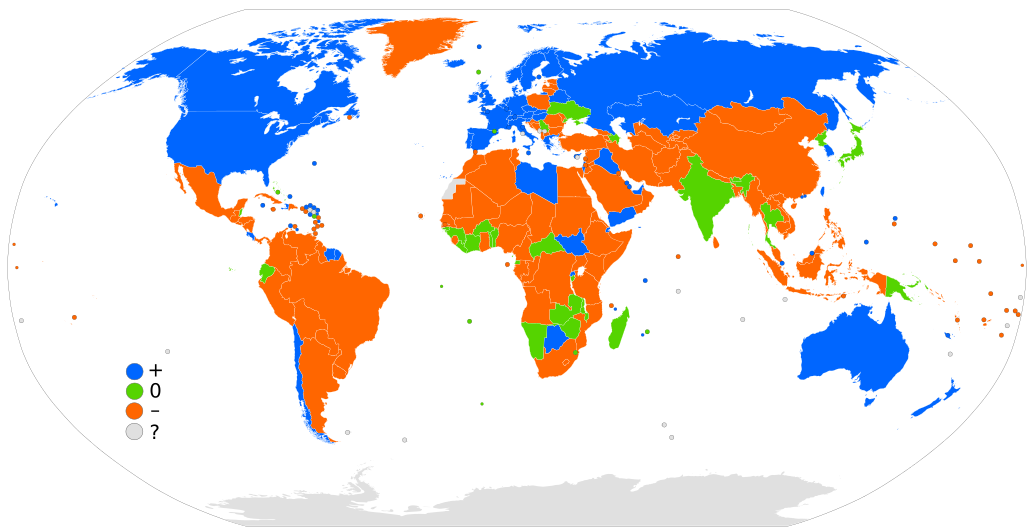
Immigration involves people moving to a new country where they...
Trending

3 hours ago Kyrie Irving and Cooper Flagg Sidelined Due to Mavericks Injury Concerns

3 hours ago Yandy Díaz and Jake Bauers Face Off in World Series Eight Years Post-Trade
3 hours ago Jonathan Aranda Becomes Integral Player During Tampa Bay Rays World Series Run

3 hours ago MLB Stars Willson and William Contreras Garner Attention Amid Silver Slugger Discussions

3 hours ago Tyler Herro Leads Offensive Effort Despite Miami Heat Loss to Chicago Bulls

3 hours ago Warriors Explore Trade Options for Center Kristaps Porzingis Amid Opening Week Uncertainty
Popular

Ilhan Omar is a prominent American politician currently serving as...

Ken Paxton is an American politician and lawyer serving as...

Elon Musk is a visionary entrepreneur and engineer known for...

Michael Joseph Jackson the King of Pop was a highly...

Elizabeth Holmes is an American entrepreneur and the founder of...

Kathy Hochul is an American politician and lawyer who has...