


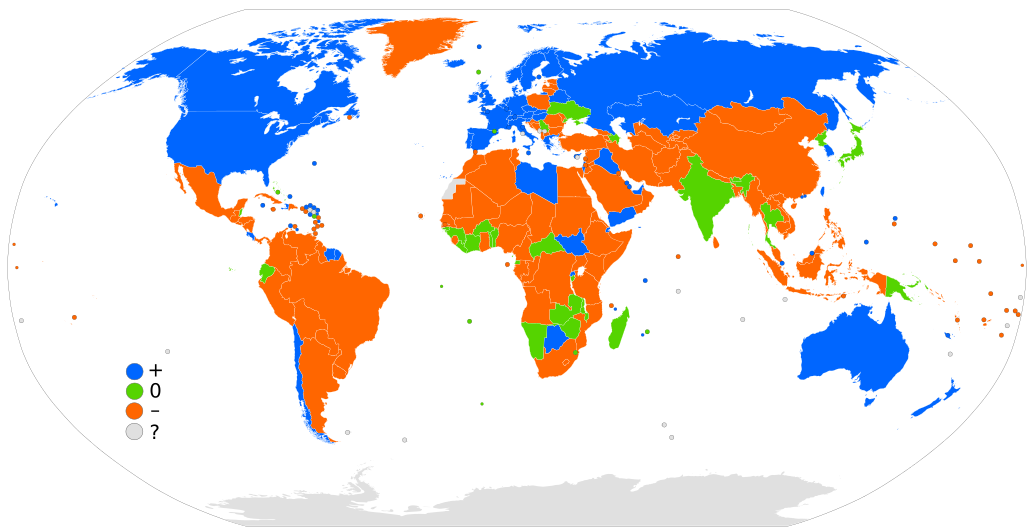
Immigration involves people moving to a new country, where they are not citizens or usual residents, to settle permanently. This excludes temporary visits like tourism or commuting, although overstaying a visa can lead to immigrant status. Seasonal labor is sometimes considered a form of immigration. Essentially, immigration is about long-term or permanent relocation across international borders.
1940: Immigration and High School Completion Study in the US: Start of immigration period
A 2016 study analyzed immigration between 1940 and 2010 in the United States and its impact on high school completion of natives.


1948: Universal Declaration of Human Rights (1948)
In 1948, the Universal Declaration of Human Rights recognized freedom of movement as a civil right, but it only applied to movement within national borders and the ability to return to one's home state.
1966: International Covenant on Civil and Political Rights (1966)
In 1966, The International Covenant on Civil and Political Rights recognized freedom of movement as a civil right, but this only applies to movement within national borders and the ability to return to one's home state.
1986: Research on Immigration and Social Capital: Start date
Research suggests that a vicious cycle of bigotry and isolation could reduce assimilation and increase bigotry towards immigrants in the long-term. One study examined the period between 1986 and 2004.
1990: Meta-analysis of correspondence tests on hiring discrimination
Between 1990 and 2015, 738 correspondence tests in 43 studies in OECD countries revealed widespread racial discrimination in hiring decisions in Europe and North America. A 2016 meta-analysis found that minority candidates needed to submit approximately 50% more applications to secure an interview compared to majority candidates.
1994: Accelerated Assimilation of Immigrants
A 2018 study found that immigrants arriving in the United States after 1994 assimilate more rapidly than immigrants who arrived in previous periods.
1995: Study on car dealer price quotes based on race and gender
In 1995, a study found that car dealers quoted significantly lower prices to white males compared to black or female test buyers using identical bargaining strategies.
2000: Increase in International Migrants
Since 2000, the number of international migrants worldwide has increased by 41%, reaching 244 million by 2015.
2003: Study on racial discrimination in US housing
A 2003 study found that agents interpret housing requests as customer preferences but are more likely to withhold a house in integrated suburban areas. Marketing efforts increase with asking price for white, but not black, customers. Blacks are more likely to see houses in integrated areas, and the houses agents show deviate more from initial requests when the customer is black, consistent with statistical discrimination.
2003: Family Reunification in US Immigration (2003)
As of 2003, family reunification accounted for approximately two-thirds of legal immigration to the US every year, indicating its significance in US immigration policy.
2004: Research on Immigration and Social Capital: End date
One study, examining the period between 1986 and 2004, found that larger increases in US states' Mexican population shares corresponded to larger decreases in social capital.
2005: French riots
The 2005 French riots are cited as an example of the value conflicts arising from immigration of Muslims in Western Europe, due to concerns about national security and terrorism linked to immigration.
2009: World Bank Estimates of Remittances in 2009
In 2009, the World Bank estimated that remittances totaled $420 billion, with $317 billion going to developing countries.
2010: European study on employers and immigration
A 2010 European study suggested that employers are more likely to favor immigration if immigrants compete with employees, but are more likely to oppose immigration if immigrants compete with employers.
2010: Immigration and High School Completion Study in the US: End of immigration period
A 2016 study analyzed immigration between 1940 and 2010 in the United States and its impact on high school completion of natives.
2010: Criticism of United Kingdom's immigrant detention policies
Since 2010, the United Kingdom's immigrant detention policies have faced criticism for inadequate protection of vulnerable groups.
2011: Study on lobbying and immigration
In 2011, a study found that businesses tend to lobby for increased immigration, while labor movements generally oppose it. Another 2011 study examining US representatives' voting on migration policy suggests that "representatives from more skilled labor abundant districts are more likely to support an open immigration policy towards the unskilled, whereas the opposite is true for representatives from more unskilled labor abundant districts."
2012: Gallup Survey on Migration Desires
A 2012 Gallup survey indicated that 640 million adults would migrate if given the opportunity, with 23% desiring to move to the United States and 7% to the United Kingdom.
2012: Study on jury composition and conviction rates
A 2012 study revealed that all-white juries convicted black defendants significantly (16 percentage points) more often than white defendants, and this gap was eliminated when the jury included at least one black member.
2013: Study on eBay sales of iPods based on race
A 2013 study found that eBay sellers of iPods received 21 percent more offers when a white hand held the iPod in the photo compared to a black hand.
2014: Meta-analysis of racial discrimination in the American housing market
A 2014 meta-analysis uncovered extensive racial discrimination in the American housing market, with minority applicants needing more inquiries to view properties and significant geographical steering of African-Americans.
2014: Meta-analysis of racial and ethnic discrimination in the housing market
In 2014, a meta-analysis revealed significant racial and ethnic discrimination in the housing markets of several European countries.
2014: Meta-analysis of racial discrimination in product markets
In 2014, a meta-analysis uncovered significant evidence of racial discrimination in product markets, revealing that minority applicants were quoted higher prices.
2015: Second-Generation Immigrants in France
A 2015 report by the National Institute of Demographic Studies finds that an overwhelming majority of second-generation immigrants of all origins in France feel French, despite persistent discrimination.
2015: Immigration and Institutional Quality Study
A 2015 study found some evidence that larger immigrant population shares yield positive impacts on institutional quality, indicating that increased immigration does not negatively impact economic freedom.
2015: International Migrant Numbers Reach 244 Million
As of 2015, the number of international migrants reached 244 million worldwide, a 41% increase since 2000. The United States hosted the largest number of international migrants, accounting for 19% of the world's total.
2015: Meta-analysis of correspondence tests on hiring discrimination
Between 1990 and 2015, 738 correspondence tests in 43 studies in OECD countries revealed widespread racial discrimination in hiring decisions in Europe and North America. A 2016 meta-analysis found that minority candidates needed to submit approximately 50% more applications to secure an interview compared to majority candidates.
2015: Age Distribution of International Migrants in 2015
In 2015, 37 million international migrants were below the age of 20, and 177 million were between 20 and 64. The median age varied by continent, with migrants in Africa being the youngest (29 years) and those in Oceania being the oldest (44 years).
2015: Argument on Counterproductive Fear-Based Policies
In 2015, Claire Adida, David Laitin and Marie-Anne Valfort argue that "fear-based policies that target groups of people according to their religion or region of origin are counter-productive.
2015: Study on faculty responsiveness to prospective students based on race
In 2015, a study using correspondence tests found that faculty were significantly more responsive to white males than to other student categories, especially in higher-paying disciplines and private institutions, when considering requests for mentoring.
2016: Paper on Cultural Differences and Economic Performance of Migrants
A 2016 paper challenges the view that cultural differences are necessarily an obstacle to long-run economic performance of migrants, noting that the negative effect of cultural distance diminishes over time.
2016: Immigration and High School Completion Study in the US
A 2016 study found that immigration between 1940 and 2010 in the United States increased the high school completion of natives. Specifically, a one percentage point increase in the share of immigrants aged 11-64 increased the probability that natives aged 11-17 complete 12 years of schooling by 0.3 percentage point.
2016: Meta-analysis of correspondence tests on hiring discrimination
In 2016, a meta-analysis of 738 correspondence tests across 43 studies in OECD countries (1990-2015) revealed widespread racial discrimination in hiring decisions in Europe and North America. Minority candidates needed to submit around 50% more applications to receive an interview compared to majority candidates.
2017: Study on Access to Citizenship and Economic Situation of Immigrant Women
A 2017 study found that faster access to citizenship improves the economic situation of immigrant women, especially their labor market attachment with higher employment rates, longer working hours and more stable jobs. Immigrants also invest more in host country-specific skills like language and vocational training.
2017: Study on British American Colonies and Immigration
A 2017 study in the British Journal of Political Science argued that British American colonies without slavery adopted better democratic institutions to attract migrant workers.
2017: Study on Ancestral Migration and Trust
A 2017 study in the Journal of Comparative Economics found that individuals whose ancestors migrated from countries with higher autocracy levels are less likely to trust others and to vote in presidential elections in the U.S.
2017: Studies on Naturalization in Switzerland
A 2017 study of Switzerland found that naturalization strongly improves long-term social integration of immigrants. A separate study of Switzerland found that naturalization improved the economic integration of immigrants, increasing annual earnings by approximately 5,000 U.S. dollars over 15 years, particularly for marginalized immigrants.
2018: NBER paper on teacher discrimination against children of immigrants
A 2018 National Bureau of Economic Research paper found that math teachers discriminate against the children of immigrants, but gave higher grades when informed about negative stereotypes.
2018: Study on reciprocity with immigrants in the Netherlands
A 2018 study discovered that native Dutch individuals were less likely to reciprocate in games played with immigrants than with other native Dutch individuals.
2018: Study on Immigration and Economic Freedom in the United States
A 2018 study failed to find evidence that immigration to the United States weakens economic freedom.
2018: Study on Chinese Nationals and Residency Permits
A 2018 study found that Chinese nationals in the United States who received permanent residency permits after the Tiananmen Square protests experienced significant employment and earnings gains compared to similar immigrant groups without the same rights.
2018: Studies on Immigrant Students' Effects on Native Students
A 2018 study found that immigrant students who have been in the country for some time have no effect on natives, but recent immigrants have a small negative effect on natives' language scores. Another 2018 study found that immigrant students in Italy were associated with small negative effects on math test scores, particularly for low-ability native students in classes with high immigrant concentration and linguistic distance.
2018: Immigration's Impact on Healthcare Waiting Times in the UK
A 2018 study found that immigration to the United Kingdom reduced waiting times for outpatient referrals and did not have significant effects on waiting times in accident and emergency departments (A&E) and elective care.
2018: Study casting doubts on ethnoracial homogeneity and public goods provision
A 2018 study in the American Political Science Review questioned findings that ethnoracial homogeneity led to greater public goods provision.
2018: Study on Immigrant Assimilation in the US
A 2018 study in the American Sociological Review found that within racial groups, most immigrants to the United States had fully assimilated within a span of 20 years, with more rapid assimilation for those arriving after 1994.
2018: Immigration and Political Engagement in Norway
A 2018 study in the British Journal of Political Science found that immigrants in Norway became more politically engaged the earlier that they were given voting rights.
2018: Migrant Health Study in The Lancet
A 2018 systemic review and meta-analysis in The Lancet found that migrants generally have better health than the general population.
2019: NBER Paper on Foreign-Born Students and US-Born Students
A 2019 NBER paper found little evidence that exposure to foreign-born students had an effect on US-born students.
2019: Review of Immigrant Assimilation
A 2019 review of existing research in the Annual Review of Sociology on immigrant assimilation in the United States, the United Kingdom, France, Germany, Sweden, Norway, Belgium, the Netherlands and Spain concluded "we find an overall pattern of intergenerational assimilation in terms of socioeconomic attainment, social relations, and cultural beliefs."
2019: Study on Reactions to Homogeneity Threats
A 2019 study found that humans are inclined to react negatively to threats to homogeneity in the short term, but these negative outcomes are compensated in the long term by the beneficial influence of intergroup contact.
2019: Study on Refugees and Economic Integration
A 2019 study found that refugees who resettled in areas with many conationals were more likely to be economically integrated.
2019: Language Training and Economic Assimilation in France
A 2019 study in the European Economic Review found that language training improved the economic assimilation of immigrants in France.
2020: Statistics on illegal immigrants in US higher education
As of 2020, illegal immigrants represent 2 percent (approximately 454,000 students) of all students enrolled in U.S. higher education. Fewer than half of illegal immigrants are eligible for the DACA program.
2020: Reforms of refugee policy in Denmark
In 2020, a paper examining refugee policy reforms in Denmark determined that language training improved refugees' economic and social integration. Conversely, benefit cuts had no impact, except for a temporary rise in property crimes.
2024: Working paper on pro-immigration research teams
A 2024 working paper by Borjas and Breznau found that pro-immigration research teams estimated more positive impacts of migration on the public support for welfare, while anti-immigration teams reported more negative estimates; the immigration researchers skewed heavily towards a pro-immigration stance.
2024: Eurobarometer 2024
In 2024, the Eurobarometer surveyed public support for immigration by country in the European Union.
Mentioned in this timeline
The United States of America is a federal republic primarily...

California is a U S state on the Pacific Coast...

The iPod a line of portable media players developed by...

Saudi Arabia officially the Kingdom of Saudi Arabia KSA is...

The apple is a widely cultivated edible fruit originating from...

Germany officially the Federal Republic of Germany is located in...
Trending

3 hours ago Joe Rogan Proposes Potential UFC Showdown Between Sean O'Malley and Rising Star Payton Talbott
3 hours ago Walmart Recalls 44,000 Cans of Fruit Cocktail Over Lead Contamination Fears
3 hours ago Joshua Van Scheduled to Face Manel Kape at UFC 336
3 hours ago Tiffany Hayes Vital for Golden State Valkyries WNBA Finals Comeback Hopes
3 hours ago Analysts Urge Indiana Football to Reconsider Josh Hoover Following Recent Struggles

4 hours ago Jeremy Sochan Selected As Number One Overall Pick In The 2026 NBA G League Draft
Popular

Ilhan Omar is a prominent American politician currently serving as...

Ken Paxton is an American politician and lawyer serving as...

Elon Musk is a visionary entrepreneur and engineer known for...

Michael Joseph Jackson the King of Pop was a highly...

Elizabeth Holmes is an American entrepreneur and the founder of...

Cristiano Ronaldo widely considered one of the greatest footballers captains...