


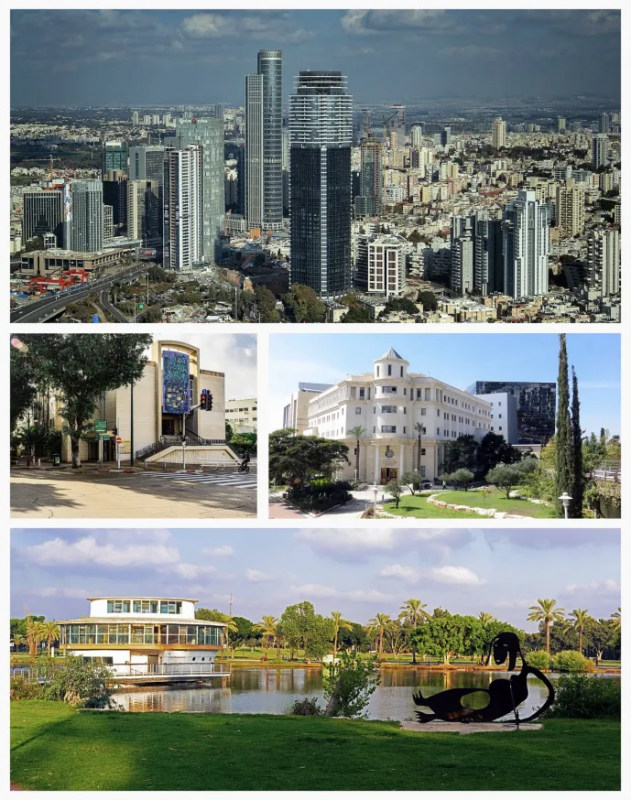
Ramat Gan is a city located in the Tel Aviv District of Israel, forming part of the Gush Dan metropolitan area. It lies east of Tel Aviv and is a notable hub for various industries. Key features of Ramat Gan include its Diamond Exchange District, a significant center for the diamond trade. The city also houses the Sheba Medical Center, one of Israel's largest hospitals. Furthermore, Ramat Gan is a prominent location for high-tech industries, contributing to Israel's technology sector.
1914: First land purchase
The first plots of land for Ramat Gan were purchased between 1914 and 1918.


1918: First land purchase
The first plots of land for Ramat Gan were purchased between 1914 and 1918.
1921: Establishment as a moshava
In 1921, Ramat Gan was established as a moshava, which is a communal farming settlement.
1921: Establishment by the Ir Ganim association
In 1921, Ramat Gan was established by the Ir Ganim association as a satellite town of Tel Aviv.
1923: Name change
In 1923, the name of the settlement was changed to Ramat Gan (lit: Garden Height).
1926: Local council status achieved
Ramat Gan achieved local council status in 1926, with 450 residents at the time.
1931: Census results
According to the 1931 census, Ramat Gan had 975 inhabitants, residing in 253 houses.
1933: Moshava operation ends
The settlement continued to operate as a moshava until 1933.
1946: Population Growth
By 1946, the population of Ramat Gan had grown to 12,000.
1950: Recognition as a city
In 1950, Ramat Gan was officially recognized as a city.
1955: Population Size
In 1955, Ramat Gan had a population of 55,000 residents.
1961: Municipal area expansion
In 1961, the municipal area of Ramat Gan expanded eastward, encompassing the area that includes the Sheba Medical Center in Tel Hashomer and Bar Ilan University.
1968: Diamond exchange opening
In 1968, the world's largest diamond exchange opened in Ramat Gan.
2000: Matriculation certificate rate
In 2000, 70.9% of twelfth-grade students in Ramat Gan received a matriculation certificate.
2001: Socioeconomic ranking
According to the Israel Central Bureau of Statistics, as of 2001, Ramat Gan's socioeconomic ranking stood at 8 out of 10.
2006: Employment statistics
As of 2006, 32,100 of the city's households had people who were not in the labour force, with 23,300 of these retired. 1,900 of the households had unemployed household members. 43,000 households were fully employed.
2006: Population and area size
As of 2006, Ramat Gan had 129,700 residents, situated in an area of 12,000 dunams (12 km).
2014: National football stadium status ends
In 2014, Ramat Gan Stadium ceased to be Israel's national football stadium.
2022: Population size
In 2022, Ramat Gan had a population of almost 200,000 residents.
June 2025: City targeted by Iran
In June 2025, during the Iran-Israel war, Ramat Gan was targeted by Iran. On June 14, a ballistic missile struck a residential building, killing a woman and displacing approximately 100 residents. On June 19, 22 people were injured due to a hit on the financial district.
Mentioned in this timeline
Iran formerly known as Persia is a sovereign state in...

Football commonly known as soccer in many regions is the...
Israel is a Middle Eastern nation located on the eastern...

War is defined as an armed conflict involving the armed...

Satellites often spacecraft are objects intentionally placed into orbit around...
Tel Aviv officially Tel Aviv-Yafo is the most populous city...
Trending

4 hours ago Taylor Fritz Overcomes Scary Fall to Secure Crucial Victory at the Lyon Open

6 hours ago Stefanos Tsitsipas Advances to Almaty Open Semifinals

5 hours ago Anna Wintour Faces Social Media Buzz Following Harry Styles Concert Appearance
5 hours ago Gina Hinojosa Campaigns Across Texas Ahead of 2026 Gubernatorial Race
6 hours ago Ms. Rachel Supports Toddler Following Alleged Discrimination at Darien Library Puppet Show
6 hours ago Curt Cignetti Reviews Ohio State Loss and Prepares Indiana for Upcoming Michigan Game
Popular

Ilhan Omar is a prominent American politician currently serving as...

Ken Paxton is an American politician and lawyer serving as...

Elon Musk is a visionary entrepreneur and engineer known for...
Michael Joseph Jackson the King of Pop was a highly...

Elizabeth Holmes is an American entrepreneur and the founder of...

Cristiano Ronaldo widely considered one of the greatest footballers captains...