Rise to Success: Career Highlights of Stephen Hawking


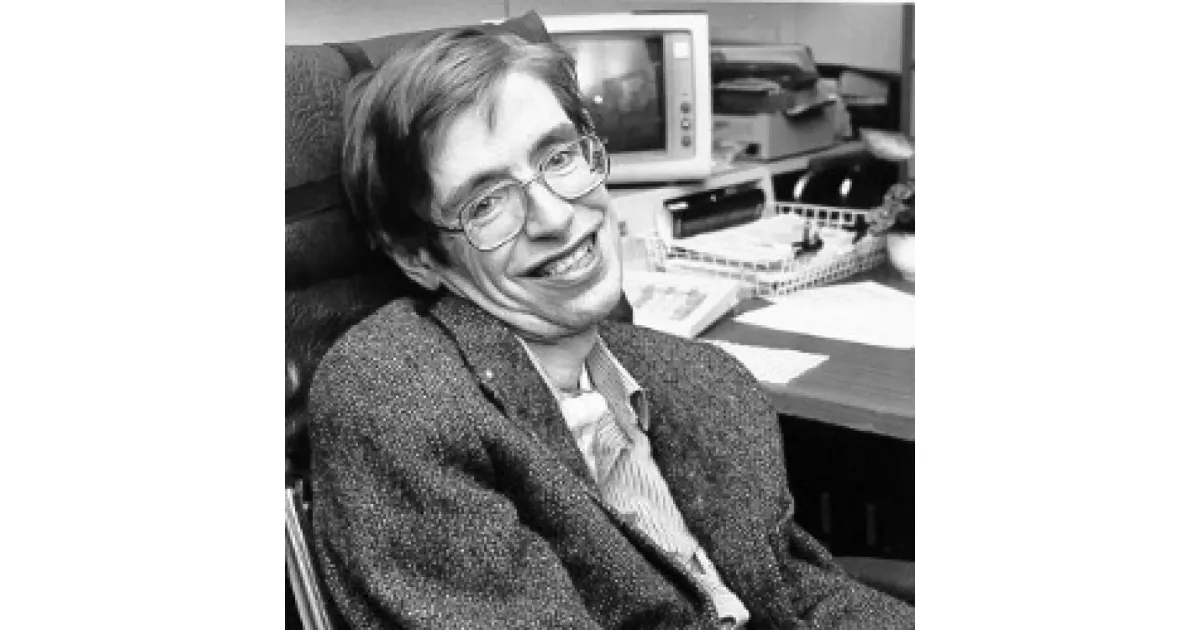
Discover the career path of Stephen Hawking, from the first major opportunity to industry-changing achievements.
Stephen Hawking was a highly influential English theoretical astrophysicist and cosmologist. He served as the Director of Research at the Centre for Theoretical Cosmology at the University of Cambridge and held the prestigious position of Lucasian Professor of Mathematics at Cambridge from 1979 to 2009. His work significantly contributed to our understanding of black holes, the Big Bang, and the unification of general relativity with quantum mechanics. Despite battling amyotrophic lateral sclerosis (ALS) for most of his adult life, Hawking made groundbreaking contributions to science and became a popular science icon through his books, making complex concepts accessible to a wide audience.
1958: Hawking builds a computer with friends
From 1958, Stephen Hawking, with the help of Dikran Tahta, and his friends built a computer from clock parts, an old telephone switchboard, and other recycled components.


1959: Hawking builds a record player
In 1959, Stephen Hawking built a record player from spare parts, showcasing his resourcefulness and interest in electronics.
October 1962: Hawking begins graduate work at Cambridge
In October 1962, after receiving a first-class BA degree in physics, Stephen Hawking began his graduate work at Trinity Hall, Cambridge.
1962: Hawking begins graduate work
In 1962, Stephen Hawking began his graduate work at Trinity Hall, Cambridge, focusing on applied mathematics and theoretical physics.
June 1964: Hawking challenges Hoyle's work
In June 1964, Stephen Hawking publicly challenged the work of Fred Hoyle and his student Jayant Narlikar at a lecture, marking the beginning of his reputation for intelligence and brashness.
1964: Higgs Boson Proposed
In 1964, the Higgs boson was proposed to exist as part of the Higgs field theory by Peter Higgs.
1965: Hawking writes thesis
In 1965, Stephen Hawking wrote his thesis focusing on the application of spacetime singularity theorems to the entire universe.
March 1966: Hawking receives PhD degree
In March 1966, Stephen Hawking received his PhD degree in applied mathematics and theoretical physics, specialising in general relativity and cosmology.
1966: Hawking obtains PhD
In 1966, Stephen Hawking obtained his PhD in applied mathematics and theoretical physics from Trinity Hall, Cambridge, specialising in general relativity and cosmology.
1968: Hawking's joint essay is runner-up
In 1968, Stephen Hawking's and Roger Penrose's joint essay was the runner-up in the Gravity Research Foundation competition.
1969: Hawking accepts Fellowship for Distinction in Science
In 1969, Stephen Hawking accepted a specially created Fellowship for Distinction in Science to remain at Caius College.
1970: Hawking publishes proof with Penrose
In 1970, Stephen Hawking and Roger Penrose published a proof that if the universe obeys the theory of general relativity, it must have begun as a singularity.
January 1971: Hawking wins Gravity Research Foundation Award
In January 1971, Stephen Hawking's essay titled "Black Holes" won the Gravity Research Foundation Award.
1972: Bekenstein's theory about black holes
In 1972 Jacob Bekenstein proposed the theory that black holes have an entropy proportional to the area of the event horizon, which would later be supported by Hawking's research.
1973: Hawking develops four laws of black hole mechanics
In 1973, Stephen Hawking and James M. Bardeen developed the four laws of black hole mechanics, drawing an analogy with thermodynamics.
1974: Hawking claims black holes emit radiation
In 1974, Stephen Hawking claimed that black holes emit radiation, which is known today as Hawking radiation, a groundbreaking discovery in theoretical physics.
1974: Appointment at Caltech and Wager on Cygnus X-1
In 1974, Stephen Hawking was appointed to the Sherman Fairchild Distinguished Visiting Professorship at the California Institute of Technology (Caltech). During this time, he made a scientific wager with Kip Thorne about whether the X-ray source Cygnus X-1 was a black hole, as an "insurance policy" against the proposition that black holes did not exist.
1974: Hawking elected Fellow of the Royal Society
In 1974, Stephen Hawking was elected a Fellow of the Royal Society (FRS), becoming one of the youngest scientists to receive this honor.
1974: Hawking takes position at Caltech
In 1974, upon Stephen Hawking's appointment to a year-long position at Caltech, Bernard Carr travelled with the Hawking family as the first of many students who helped with his care.
1975: Return to Cambridge and Awards
In 1975, Hawking returned to Cambridge as reader in gravitational physics. That same year, he was awarded both the Eddington Medal and the Pius XI Gold Medal for his work.
1975: Hawking returns to Cambridge
In 1975, Stephen Hawking returned to Cambridge and Don Page began working as his live-in graduate student assistant.
1977: Appointment as Professor
In 1977, Hawking was appointed a professor with a chair in gravitational physics at Cambridge University.
1979: Election as Lucasian Professor of Mathematics
In 1979, Hawking was elected Lucasian Professor of Mathematics at the University of Cambridge. He proposed N = 8 supergravity as the leading theory to solve outstanding physics problems. This promotion coincided with a health crisis and a transition to a more intuitive approach to physics.
1979: Hawking becomes Lucasian Professor
In 1979, Stephen Hawking was appointed as the Lucasian Professor of Mathematics at the University of Cambridge, a prestigious academic position.
October 1981: Conference in Moscow
Following a conference in Moscow in October 1981, Hawking helped organize a workshop on "The Very Early Universe" focusing on inflation theory.
1982: Decision to Write a Popular Book
In 1982, Hawking decided to write a popular book about the universe to finance his children's education and home expenses. He signed a contract with Bantam Books and received a large advance.
1982: Nuffield Workshop on the Very Early Universe
In the summer of 1982, Hawking and Gary Gibbons organised a three-week Nuffield Workshop in the summer of 1982 on "The Very Early Universe" at Cambridge University, a workshop that focused mainly on inflation theory. Hawking also began a new line of quantum-theory research into the origin of the universe.
1983: Publication of the Hartle-Hawking State
In 1983, Hawking and Jim Hartle published a model known as the Hartle-Hawking state, which proposed that prior to the Planck epoch, the universe had no boundary in spacetime, suggesting time did not exist before the Big Bang.
1984: Completion of First Draft of "A Brief History of Time"
In 1984, the first draft of Hawking's popular science book, "A Brief History of Time", was completed.
1986: Hawking receives computer program "Equalizer"
In 1986, Stephen Hawking received the "Equalizer" computer program from Walter Woltosz, CEO of Words Plus, which allowed him to select phrases, words, or letters from a scanned bank.
April 1988: Publication of "A Brief History of Time" in the US
In April 1988, Stephen Hawking's book "A Brief History of Time" was published in the US and quickly rose to the top of best-seller lists.
1990: Hawking Acknowledges Losing Bet
In 1990, Hawking acknowledged losing the 1974 bet he had made with Kip Thorne regarding the nature of Cygnus X-1. This was the first of several bets he would make with Thorne and others.
1991: Public scientific wager with Kip Thorne and John Preskill
In 1991, Hawking made a public scientific wager with Kip Thorne and John Preskill of Caltech, betting that Penrose's proposal of a "cosmic censorship conjecture" was correct.
1991: Premiere of "A Brief History of Time" Documentary
In 1991, the documentary "A Brief History of Time", directed by Errol Morris, premiered. It contained material from the book and interviews with Hawking and others.
1993: Co-edited book on Euclidean quantum gravity
In 1993, Hawking co-edited a book on Euclidean quantum gravity with Gary Gibbons and published a collected edition of his own articles on black holes and the Big Bang.
1993: Publication of "Black Holes and Baby Universes and Other Essays"
In 1993, Hawking's popular-level collection of essays, interviews, and talks titled "Black Holes and Baby Universes and Other Essays" was published.
1994: Lectures at Newton Institute
In 1994, Hawking and Penrose delivered a series of six lectures at Cambridge's Newton Institute.
1997: Concession in Wager and New Bet on Black Hole Information Paradox
In 1997, Hawking conceded the 1991 public scientific wager made with Kip Thorne and John Preskill regarding Penrose's cosmic censorship conjecture. The same year, a new bet was made between Thorne, Hawking, and Preskill concerning the black hole information paradox.
1997: Conceded 1997 bet with Preskill
In 1997, Hawking conceded the bet he made with Preskill. In 2004 lecture in Dublin, he conceded his 1997 bet with Preskill, but described his own, somewhat controversial solution to the information paradox problem, involving the possibility that black holes have more than one topology.
1997: Release of "Stephen Hawking's Universe" TV Series
In 1997, the six-part television series "Stephen Hawking's Universe" and a companion book were released, focusing entirely on science.
2001: Publication of "The Universe in a Nutshell"
In 2001, Hawking published "The Universe in a Nutshell", a popular science book.
2004: Conceded 1997 bet with Preskill
In a 2004 lecture in Dublin, Hawking conceded his 1997 bet with Preskill, but described his own, somewhat controversial solution to the information paradox problem, involving the possibility that black holes have more than one topology.
2005: Publication of "A Briefer History of Time"
In 2005, Hawking and Leonard Mlodinow published "A Briefer History of Time", an update to his earlier work intended for a wider audience.
2005: Hawking uses cheek muscles to control communication device
In 2005, Stephen Hawking began controlling his communication device with movements of his cheek muscles, allowing him to communicate at a rate of about one word per minute.
2005: Publication of Paper on Information Paradox
In the 2005 paper he published on the subject, he argued that the information paradox was explained by examining all the alternative histories of universes, with the information loss in those with black holes being cancelled out by those without such loss.
2006: Development of Top-Down Cosmology
From 2006 onwards, Hawking, along with Thomas Hertog and Jim Hartle, developed a theory of top-down cosmology.
2006: Hawking poses open question on the Internet
In 2006, Hawking posed the open question on the internet: "In a world that is in chaos politically, socially and environmentally, how can the human race sustain another 100 years?", to get people to think about it, and to be aware of the dangers we now face.
2007: Publication of "George's Secret Key to the Universe"
In 2007, Hawking and his daughter Lucy published "George's Secret Key to the Universe", a children's book designed to explain theoretical physics.
2009: Publication of "George's Secret Key to the Universe" sequels
In 2009, Hawking and his daughter Lucy published sequels of "George's Secret Key to the Universe".
2009: Retirement as Lucasian Professor
In 2009, Hawking retired as Lucasian Professor of Mathematics at the University of Cambridge, as required by university policy.
2009: Hawking Steps Down as Lucasian Professor
In 2009, Stephen Hawking stepped down from his position as the Lucasian Professor of Mathematics at the University of Cambridge, after holding the post since 1979.
2010: Hawking warns against contact with aliens
In 2010, Stephen Hawking warned against making contact with alien life forms, suggesting that they might pillage Earth for resources, comparing it to Columbus's arrival in America, which had a negative outcome for Native Americans.
2011: Publication of "George's Secret Key to the Universe" sequels
In 2011, Hawking and his daughter Lucy published sequels of "George's Secret Key to the Universe".
2011: Hawking: "philosophy is dead"
In 2011, at Google's Zeitgeist Conference, Stephen Hawking stated that "philosophy is dead", arguing philosophers have not kept up with modern science and that science is now the bearer of discovery. He expressed that science can answer philosophical problems and discussed the relationship between physics, morality, love, and faith.
July 2012: Discovery of the Higgs Boson
In July 2012, the Higgs boson was discovered at CERN following the construction of the Large Hadron Collider.
2014: Publication of "George's Secret Key to the Universe" sequels
In 2014, Hawking and his daughter Lucy published sequels of "George's Secret Key to the Universe".
July 2015: Launch of Breakthrough Initiatives
On 20 July 2015, Hawking helped launch Breakthrough Initiatives, an effort to search for extraterrestrial life.
August 2015: New Theory on Information Retrieval from Black Holes
In August 2015, Hawking said that not all information is lost when something enters a black hole and there might be a possibility to retrieve information from a black hole according to his theory.
2015: BBVA Foundation Frontiers of Knowledge Award
In 2015, Stephen Hawking and Viatcheslav Mukhanov received the BBVA Foundation Frontiers of Knowledge Award in Basic Sciences for their discovery that galaxies were formed from quantum fluctuations in the early Universe.
2015: Gravitational waves first observed
In 2015, gravitational waves, first theorized by Oliver Heaviside in 1893, were first observed, validating a key aspect of Hawking's second law of black hole mechanics.
2016: Publication of "George's Secret Key to the Universe" sequels
In 2016, Hawking and his daughter Lucy published sequels of "George's Secret Key to the Universe".
October 2017: Final Broadcast Interview
In his final broadcast interview, given October 2017, Hawking spoke of the scientific importance of GW170817, a black hole merger.
2017: Creation of "Stephen Hawking: Expedition New Earth"
In 2017, Hawking created "Stephen Hawking: Expedition New Earth", a documentary on space colonization, as an episode of Tomorrow's World.
2017: Establishment of the Professor Stephen Hawking Fellowship
In 2017, the Cambridge Union Society, in conjunction with Stephen Hawking, established the Professor Stephen Hawking Fellowship. The fellowship is awarded annually to an individual who has made an exceptional contribution to the STEM fields and social discourse, with a particular focus on impacts affecting the younger generations. Each fellow delivers a lecture on a topic of their choosing, known as the "Hawking Lecture".
2025: Hawking's law was validated
In 2025, analysis of black hole merger GW250114 validated Stephen Hawking's law.
Mentioned in this timeline
Neil deGrasse Tyson is a prominent American astrophysicist author and...
Google LLC is a multinational technology corporation specializing in a...
Jeffrey Epstein was an American financier and convicted sex offender...
California is a U S state on the Pacific Coast...
Ghislaine Maxwell is a British former socialite convicted in of...

Al Gore served as the th U S Vice President...
Trending
3 hours ago Jennifer Connelly and Paul Bettany Discuss Their Longstanding Marriage and Professional Projects
4 hours ago Demi Moore Stuns Fans With Ageless Makeup-Free Glowing Complexion Photo

4 hours ago Riot Games to Sunset League of Legends Classic Mode in January 2027

5 hours ago Justin Bieber Named White Boy of the Year at Anthony Edwards' Believe That Awards

5 hours ago AJ Dybantsa Exits Wizards Preseason Finale Due to Ankle Injury

5 hours ago Alexander Bublik Causes Stir After Racket Meltdown During Tennis Match
Popular

Ilhan Omar is a prominent American politician currently serving as...

Ken Paxton is an American politician and lawyer serving as...

Elon Musk is a visionary entrepreneur and engineer known for...

Michael Joseph Jackson the King of Pop was a highly...

Jameis Winston is an American football quarterback currently playing for...

Cristiano Ronaldo widely considered one of the greatest footballers captains...