Stephen Hawking's Success and Achievements in Timeline


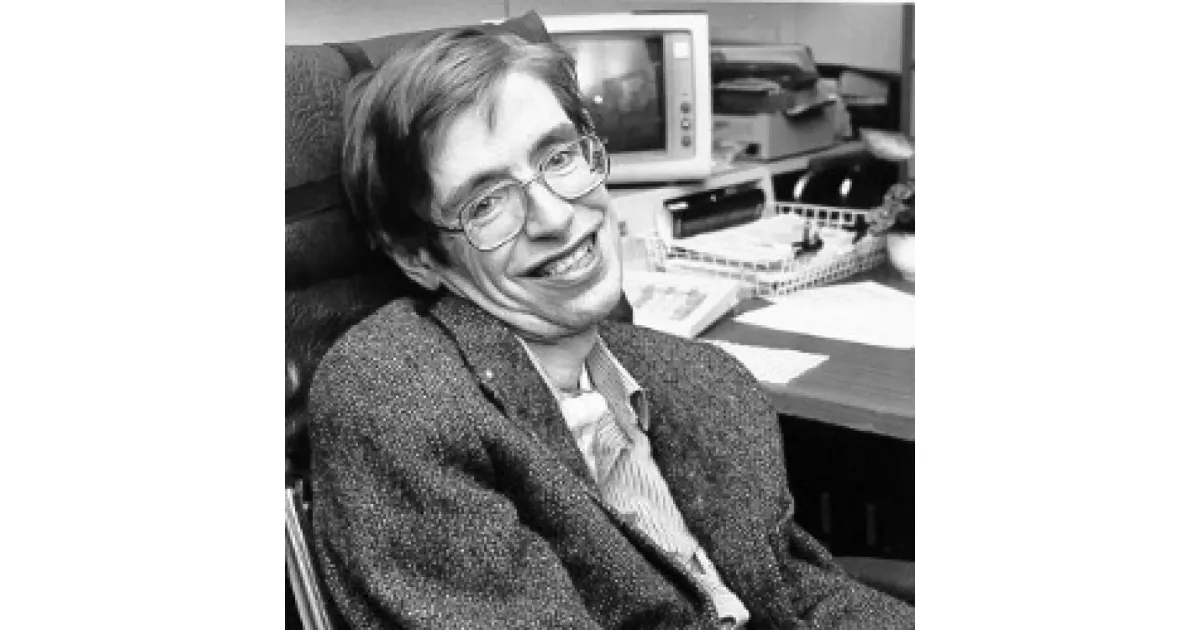
A closer look at the biggest achievements of Stephen Hawking. Awards, milestones, and records that define success.
Stephen Hawking was a highly influential English theoretical astrophysicist and cosmologist. He served as the Director of Research at the Centre for Theoretical Cosmology at the University of Cambridge and held the prestigious position of Lucasian Professor of Mathematics at Cambridge from 1979 to 2009. His work significantly contributed to our understanding of black holes, the Big Bang, and the unification of general relativity with quantum mechanics. Despite battling amyotrophic lateral sclerosis (ALS) for most of his adult life, Hawking made groundbreaking contributions to science and became a popular science icon through his books, making complex concepts accessible to a wide audience.
March 1959: Hawking awarded a scholarship
In March 1959, Stephen Hawking was awarded a scholarship after taking examinations, despite his headmaster's advice to wait until the next year.


1968: Hawking's joint essay is runner-up
In 1968, Stephen Hawking's and Roger Penrose's joint essay was the runner-up in the Gravity Research Foundation competition.
1969: Hawking accepts Fellowship for Distinction in Science
In 1969, Stephen Hawking accepted a specially created Fellowship for Distinction in Science to remain at Caius College.
January 1971: Hawking wins Gravity Research Foundation Award
In January 1971, Stephen Hawking's essay titled "Black Holes" won the Gravity Research Foundation Award.
1974: Hawking elected Fellow of the Royal Society
In 1974, Stephen Hawking was elected a Fellow of the Royal Society (FRS), becoming one of the youngest scientists to receive this honor.
1975: Return to Cambridge and Awards
In 1975, Hawking returned to Cambridge as reader in gravitational physics. That same year, he was awarded both the Eddington Medal and the Pius XI Gold Medal for his work.
1976: Academic Recognition
In 1976, Hawking received the Dannie Heineman Prize, the Maxwell Medal and Prize, and the Hughes Medal, furthering the academic recognition of his work.
1979: Hawking becomes Lucasian Professor
In 1979, Stephen Hawking was appointed as the Lucasian Professor of Mathematics at the University of Cambridge, a prestigious academic position.
1981: Awarded the American Franklin Medal
In 1981, Stephen Hawking was awarded the American Franklin Medal.
1984: Membership in American Academy of Arts and Sciences and American Philosophical Society
In 1984, Stephen Hawking became a member of the American Academy of Arts and Sciences and the American Philosophical Society.
1985: Awarded the Gold Medal of the Royal Astronomical Society
In 1985, Stephen Hawking received the Gold Medal of the Royal Astronomical Society.
1986: Appointed an Academician at the Pontifical Academy of Sciences
In 1986, Stephen Hawking was appointed an Academician at the Pontifical Academy of Sciences.
1987: Awarded the Paul Dirac Medal
In 1987, Stephen Hawking was awarded the Paul Dirac Medal.
April 1988: Publication of "A Brief History of Time" in the US
In April 1988, Stephen Hawking's book "A Brief History of Time" was published in the US and quickly rose to the top of best-seller lists.
1988: Awarded the Wolf Prize
In 1988, Stephen Hawking, jointly with Penrose, was awarded the Wolf Prize.
1989: Appointed a Member of the Order of the Companions of Honour
In the 1989 Birthday Honours, Stephen Hawking was appointed a Member of the Order of the Companions of Honour (CH).
1992: Membership in U.S. National Academy of Sciences and Honorary Membership
In 1992, Stephen Hawking became a member of the U.S. National Academy of Sciences and was awarded Honorary membership of the Manchester Literary and Philosophical Society.
1999: Awarded the Julius Edgar Lilienfeld Prize
In 1999, Stephen Hawking was awarded the Julius Edgar Lilienfeld Prize of the American Physical Society, adding to his role as a role model for disabled people and his participation in fundraising activities.
2002: Hawking ranked in BBC's 100 Greatest Britons
In 2002, Stephen Hawking was ranked number 25 in the BBC's poll of the 100 Greatest Britons, recognizing his significant impact and contributions.
2002: Included in BBC's List of 100 Greatest Britons
In 2002, following a UK-wide vote, the BBC included Stephen Hawking in their list of the 100 Greatest Britons.
2006: Awarded the Copley Medal from the Royal Society
In 2006, Stephen Hawking was awarded the Copley Medal from the Royal Society.
2008: Received the Fonseca Prize in Spain
In 2008, Stephen Hawking received the Fonseca Prize in Spain as part of his widespread travels that included trips to Chile, Easter Island, South Africa, and Canada.
2009: Awarded the Presidential Medal of Freedom
In 2009, Stephen Hawking received the Presidential Medal of Freedom, America's highest civilian honour.
2013: Higgs Wins Nobel Prize and Hawking Concedes Bet
In 2013, Peter Higgs won the Nobel Prize for Physics. Hawking conceded that he had lost his bet and said that Higgs should win the Nobel Prize for Physics.
2013: Awarded the Russian Special Fundamental Physics Prize
In 2013, Stephen Hawking was awarded the Russian Special Fundamental Physics Prize.
2015: BBVA Foundation Frontiers of Knowledge Award
In 2015, Stephen Hawking and Viatcheslav Mukhanov received the BBVA Foundation Frontiers of Knowledge Award in Basic Sciences for their discovery that galaxies were formed from quantum fluctuations in the early Universe.
2016: Pride of Britain Lifetime Achievement Award
In 2016, Stephen Hawking was awarded the Pride of Britain lifetime achievement award for his contribution to science and British culture. After receiving the award from Theresa May, Hawking jokingly requested that she not seek his help with Brexit.
2016: Stephen Hawking Medal for Science Communication Initiated
In 2016, the Stephen Hawking Medal for Science Communication was initiated as an annual award to honor members of the arts community for contributions that help build awareness of science. Recipients receive a medal bearing a portrait of Stephen Hawking by Alexei Leonov, and the other side represents an image of Leonov himself performing the first spacewalk along with an image of the "Red Special", the guitar of Brian May.
2016: Starmus III Festival and Awards
The 2016 Starmus III Festival paid tribute to Stephen Hawking, and the book of all Starmus III lectures, "Beyond the Horizon", was also dedicated to him. The first recipients of the Stephen Hawking Medals, which were awarded at the festival, were chosen by Hawking himself: composer Hans Zimmer, physicist Jim Al-Khalili, and the science documentary film Particle Fever (2013).
July 2017: Awarded Honorary Doctorate from Imperial College London
In July 2017, Stephen Hawking was awarded an Honorary Doctorate from Imperial College London.
2017: Establishment of the Professor Stephen Hawking Fellowship
In 2017, the Cambridge Union Society, in conjunction with Stephen Hawking, established the Professor Stephen Hawking Fellowship. The fellowship is awarded annually to an individual who has made an exceptional contribution to the STEM fields and social discourse, with a particular focus on impacts affecting the younger generations. Each fellow delivers a lecture on a topic of their choosing, known as the "Hawking Lecture".
Mentioned in this timeline
Neil deGrasse Tyson is a prominent American astrophysicist author and...
Google LLC is a multinational technology corporation specializing in a...
Jeffrey Epstein was an American financier and convicted sex offender...
California is a U S state on the Pacific Coast...
Ghislaine Maxwell is a British former socialite convicted in of...
Al Gore served as the th U S Vice President...
Trending
3 hours ago Jennifer Connelly and Paul Bettany Discuss Their Longstanding Marriage and Professional Projects
4 hours ago Demi Moore Stuns Fans With Ageless Makeup-Free Glowing Complexion Photo
4 hours ago Riot Games to Sunset League of Legends Classic Mode in January 2027

5 hours ago Justin Bieber Named White Boy of the Year at Anthony Edwards' Believe That Awards

5 hours ago AJ Dybantsa Exits Wizards Preseason Finale Due to Ankle Injury

5 hours ago Alexander Bublik Causes Stir After Racket Meltdown During Tennis Match
Popular

Ilhan Omar is a prominent American politician currently serving as...

Ken Paxton is an American politician and lawyer serving as...

Elon Musk is a visionary entrepreneur and engineer known for...

Michael Joseph Jackson the King of Pop was a highly...
Jameis Winston is an American football quarterback currently playing for...
Cristiano Ronaldo widely considered one of the greatest footballers captains...