


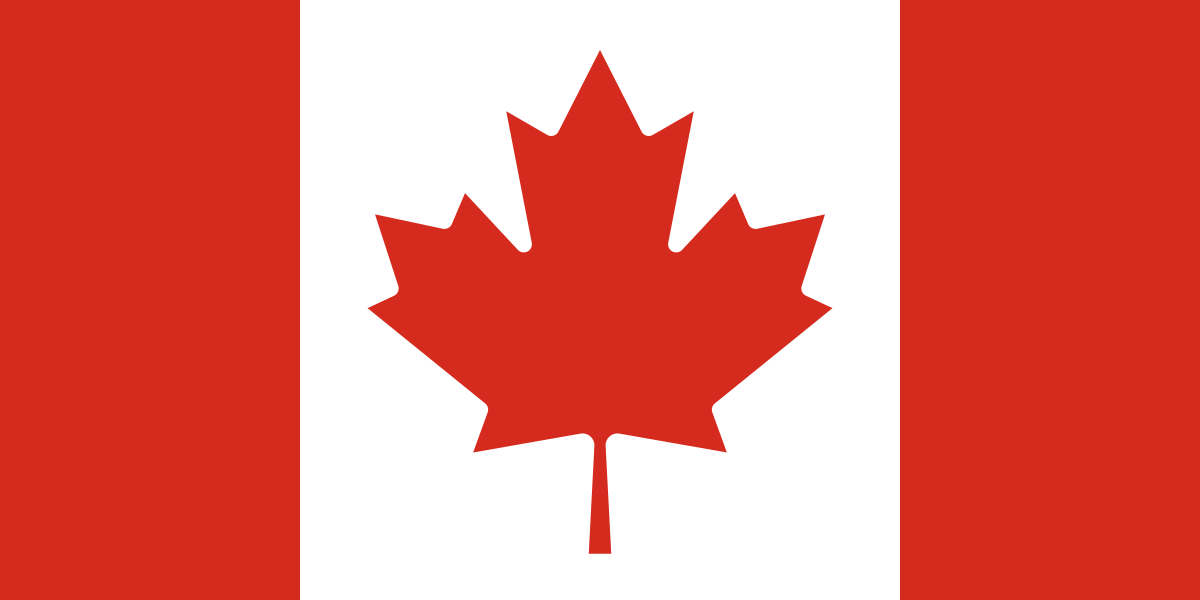
Canada is a North American country spanning from the Atlantic to the Pacific and Arctic Oceans, making it the second-largest globally. It shares the world's longest land border with the United States. Its geography and climate are diverse. Canada has a population exceeding 41 million, concentrated in urban areas. Ottawa is the capital, and the largest metropolitan areas include Toronto, Montreal, and Vancouver.
1 day ago : Canada Engages in Last-Minute Talks to Avoid Impending 50% US Tariffs
Canada is holding urgent negotiations with the US to prevent a massive 50% tariff on goods. With the deadline looming, officials are making a final attempt to convince the Trump administration to avoid severe trade consequences and economic instability.


1905: Alberta and Saskatchewan became provinces
In 1905, Alberta and Saskatchewan became provinces of Canada.
1914: Britain's declaration of war
In 1914, Britain's declaration of war automatically brought Canada into the First World War.
1917: Conscription Crisis of 1917
The Conscription Crisis of 1917 erupted over the proposal to augment the military with conscription, meeting opposition from French-speaking Quebecers.
1919: Canada joined the League of Nations
In 1919, Canada joined the League of Nations independently of Britain.
1921: Previous record of landed immigrant or permanent resident
The 2021 census indicated that 8.3 million people, or almost one-quarter (23.0 percent) of the population, reported themselves as being or having been a landed immigrant or permanent resident in Canada—above the 1921 census previous record of 22.3 percent.
1926: 1926 King–Byng affair
After the 1926 King–Byng affair raised concerns over the governor general's use of reserve powers, the Balfour Declaration that year put Canada on a legal path to full sovereignty equal to Britain's.
1931: Statute of Westminster
In 1931, the Statute of Westminster affirmed Canada's independence.
1934: Newfoundland relinquished responsible government
In 1934, due to the financial crisis of the Great Depression, the Dominion of Newfoundland relinquished responsible government and became a Crown colony.
September 10, 1939: Declaration of war with Germany
On September 10, 1939, Canada declared war with Germany, seven days after the United Kingdom, underscoring Canada's independence.
December 1939: Arrival of Canadian Army units in Britain
In December 1939, the first Canadian Army units arrived in Britain.
1942: Dieppe Raid
In 1942, Canadian troops played an important role in the failed Dieppe Raid.
1944: Battle of the Scheldt
In 1944, Canadian troops played an important role in the Battle of the Scheldt. Also in 1944, Canada faced another conscription crisis in Quebec.
1945: Founding member of the United Nations
In 1945, Canada was a founding member of the United Nations (UN).
1948: Canada ratified the Universal Declaration of Human Rights
In 1948, Canada ratified the Universal Declaration of Human Rights (UDHR).
1948: Rise in Canada's annual average temperature
Since 1948, Canada's annual average temperature over land has risen by 1.7 °C (3.1 °F).
1949: London Declaration of 1949
Following the London Declaration of 1949, Commonwealth countries agreed not to be referred to as dominions.
1949: Newfoundland joined Canada
In 1949, Newfoundlanders voted to join Canada as a province.
1951: Prime Minister Louis St. Laurent's announcement
In 1951, Prime Minister Louis St. Laurent announced that dominion was no longer an accurate term to use for Canada.
1958: North American Aerospace Defense Command formed
In 1958, Canada formed the North American Aerospace Defense Command together with the United States.
1961: Members of visible minority groups
In 1961, about 300,000 people, less than two percent of Canada's population, were members of visible minority groups.
1962: Launch of Alouette 1
In 1962, Canada launched its first satellite, Alouette 1.
1965: Adoption of the maple leaf flag
In 1965, Canada adopted the maple leaf flag, marking the emergence of a new Canadian identity.
1969: Implementation of official bilingualism
In 1969, Canada implemented official bilingualism (English and French).
1970: October Crisis
In 1970, the Front de libération du Québec (FLQ) ignited the October Crisis with bombings and kidnappings.
1971: Institution of official multiculturalism
In 1971, Canada instituted official multiculturalism.
1974: Quebec's Official Language Act
In 1974, Quebec's Official Language Act established French as the only official language of the province.
1976: Parti Québécois elected
In 1976, the sovereigntist Parti Québécois was elected in Quebec.
1980: O Canada adopted as official anthem
In 1980, "O Canada", originally composed in French in 1880, was adopted as Canada's official national anthem.
1980: Referendum on sovereignty-association
In 1980, the Parti Québécois organized an unsuccessful referendum on sovereignty-association.
1982: Constitution Act, 1982
In 1982, The Constitution Act requires that no more than five years pass between elections.
1982: Section 35 of the Constitution Act, 1982
In 1982, the role of Aboriginal law and the rights they support were reaffirmed by section 35 of the Constitution Act, 1982.
1984: Canada Health Act of 1984
In 1984, the Canada Health Act was enacted to guide the provincial and territorial systems of publicly funded healthcare, known as Medicare, ensuring universal access to healthcare services.
1985: Air India Flight 182 explosion
In 1985, Air India Flight 182 exploded, marking the largest mass murder in Canadian history.
1988: Canada – United States Free Trade Agreement
In 1988, the Canada – United States Free Trade Agreement (FTA) eliminated tariffs between the two countries.
1989: Founding member of APEC
In 1989, Canada was a founding member of the Asia-Pacific Economic Cooperation forum (APEC).
1989: École Polytechnique massacre
In 1989, the École Polytechnique massacre, a university shooting targeting female students, occurred.
1990: Increase in greenhouse gas emissions
Between 1990 and 2022, Canada's greenhouse gas emissions increased by 16.5 percent.
1990: Joined the Organization of American States
In 1990, Canada joined the Organization of American States (OAS).
1990: Meech Lake Accord failed
In 1990, attempts to accommodate Quebec nationalism constitutionally through the Meech Lake Accord failed.
1990: Oka Crisis
In 1990, the Oka Crisis occurred, marking the first of a number of violent confrontations between provincial governments and Indigenous groups. Canada also joined the Gulf War in 1990.
1994: North American Free Trade Agreement
In 1994, the North American Free Trade Agreement (NAFTA) expanded the free-trade zone to include Mexico.
1995: Second referendum
In 1995, a second referendum on sovereignty was rejected by a slim margin.
1997: Supreme Court ruling
In 1997, the Supreme Court ruled unilateral secession by a province would be unconstitutional.
1999: Nunavut became Canada's third territory
In 1999, Nunavut became Canada's third territory.
2001: Troops sent to Afghanistan
In 2001, Canada sent troops to Afghanistan.
2003: Reluctance to participate in the 2003 invasion of Iraq
Canada was reluctant to participate in the 2003 invasion of Iraq, an intervention not sanctioned by the United Nations.
2008: Formation of a reconciliation commission
In 2008, the Government of Canada formed a reconciliation commission to address cultural genocide and racial discrimination issues against Indigenous peoples.
2011: Visible minority population rise
Between 2011 and 2016, the visible minority population rose by 18.4 percent.
2015: Lake Superior National Marine Conservation Area established
Established in 2015, Lake Superior National Marine Conservation Area is the world's largest freshwater protected area.
2015: 2015 FIFA Women's World Cup, the 2015 Pan American Games and 2015 Parapan American Games
In 2015, Canada hosted the FIFA Women's World Cup, the Pan American Games, and the Parapan American Games.
2016: Visible minority population rise
Between 2011 and 2016, the visible minority population rose by 18.4 percent.
2016: Indigenous population growth
From 2016 to 2021, the Indigenous population representing 5 percent or 1.8 million people grew by 9.4 percent compared to the non-Indigenous population, which grew by 5.3 percent.
2016: Health of Canadians
In 2016, a report indicated that 88 percent of Canadians reported having good or very good health, one of the highest proportions among G7 countries.
2016: Canadian census figure
The 2021 Canadian census enumerated a total population of 36,991,981, an increase of around 5.2 percent over the 2016 figure.
2017: Richard Wagner appointed Chief Justice
In 2017, Richard Wagner was appointed the Chief Justice of Canada, leading the Supreme Court.
2018: Scott Islands Marine National Wildlife Area established
Established in 2018, Canada's largest national wildlife region, is the Scott Islands Marine National Wildlife Area.
2018: Trade Deficit
In 2018, Canada had a trade deficit in goods of $22 billion and a trade deficit in services of $25 billion.
January 27, 2020: Beginning of the COVID-19 pandemic in Canada
On January 27, 2020, the COVID-19 pandemic began in Canada, causing widespread social and economic disruption.
2020: Canada spent approximately $41.9 billion on domestic research and development
In 2020, Canada spent approximately $41.9 billion on domestic research and development.
2021: Religion in Canada
According to the 2021 census, Christianity is the largest religion in Canada, with Roman Catholics representing 29.9 percent of the population having the most adherents.
2021: Non-official language as their first language
As of the 2021 census, just over 7.8 million Canadians listed a non-official language as their first language.
2021: Defence spending around 1.3% to 1.4% of GDP
Between 2021 and 2024, Canada's defence spending was roughly 1.3% to 1.4% of its GDP.
2021: Canadian trade in goods and services
In 2021, Canadian trade in goods and services reached $2.016 trillion.
2021: Possible gravesites of Indigenous children found
In 2021, possible gravesites of Indigenous children were found near former Canadian residential schools.
2021: Commonwealth Fund's 2021 report
In 2021, the Commonwealth Fund's report ranked Canada's healthcare system second-to-last among 11 developed countries, citing weaknesses like higher infant mortality rates and long wait times.
2021: Largest self-reported ethnic or cultural origins
In 2021, the country's ten largest self-reported ethnic or cultural origins in 2021 were Canadian (accounting for 15.6 percent of the population), followed by English, Irish, Scottish, French, German, Chinese, Italian, Indian, and Ukrainian.
2021: Visible minority data
One out of every four Canadians or 26.5 percent of the population belonged to a non-White and non-Indigenous visible minority in 2021, the largest of which in 2021 were South Asian, Chinese, Black, Filipinos, Arabs, Latin Americans, Southeast Asians, West Asians, Koreans and Japanese.
2021: Ethnic or cultural origins
Respondents in the 2021 Canadian census self-reported over 450 "ethnic or cultural origins".
2021: Canadian census enumerated a total population
The 2021 Canadian census enumerated a total population of 36,991,981.
2021: Landed immigrant or permanent resident
The 2021 census indicated that 8.3 million people, or almost one-quarter (23.0 percent) of the population, reported themselves as being or having been a landed immigrant or permanent resident in Canada.
2022: Canada one of the most educated countries in the world
According to a 2022 report by the OECD, Canada ranks first worldwide with over 56% of adults having attained at least an undergraduate degree.
2022: Increase in greenhouse gas emissions
Between 1990 and 2022, Canada's greenhouse gas emissions increased by 16.5 percent.
2022: Refugee resettlement
Canada resettled more than 47,600 refugees in 2022.
2022: Canada's per-capita spending on health expenditures ranked 12th
In 2022, Canada's per-capita spending on health expenditures ranked 12th among OECD health-care systems.
2022: Supplementary estimates for research and development
In 2022, supplementary estimates for Canada's domestic research and development reached $43.2 billion.
2023: 15 Nobel laureates
As of 2023, Canada has produced 15 Nobel laureates in physics, chemistry, and medicine.
2023: Signatory to 15 free trade agreements
As of 2023, Canada is a signatory to 15 free trade agreements with 51 different countries.
2023: Canada's nominal GDP
As of 2023, Canada's mixed-market economy is highly developed, ranking as the world's ninth-largest by nominal GDP, at approximately US$2.221 trillion.
2023: Corruption Perceptions Index Ranking
In 2023, Canada ranked low in the Corruption Perceptions Index, holding the 14th position.
2023: Most commonly reported sport by Canadians
In 2023, swimming was the most commonly reported sport by over one-third (35 percent) of Canadians, followed closely by cycling (33 percent) and running (27 percent).
2023: Population surpassed 40,000,000
It is estimated that Canada's population surpassed 40,000,000 in 2023.
2024: Immigrants admitted
A record 483,390 immigrants were admitted in 2024.
2024: Defence spending around 1.3% to 1.4% of GDP
Between 2021 and 2024, Canada's defence spending was roughly 1.3% to 1.4% of its GDP.
2024: Global Competitiveness Report Ranking
Canada ranked high in the Global Competitiveness Report in 2024, securing the 19th position.
2024: Healthcare spending reached $372 billion
In 2024, the Canadian Institute for Health Information estimated that healthcare spending reached $372 billion, accounting for 12.4 percent of Canada's GDP.
February 1, 2025: Start of the trade war involving the United States
On February 1, 2025, a trade war involving the United States began when U.S. President Donald Trump imposed tariffs on goods entering the United States, alongside rhetoric suggesting the annexation of Canada.
2025: Canadian election
In 2025, five parties had representatives elected to Parliament.
2025: Unemployment Rate
The unemployment rate in Canada in 2025 was 6.8 percent.
March 2026: Achieved NATO target of spending 2% of GDP on defence
In March 2026, Canada achieved the NATO target of spending 2% of its GDP on defence for the 2026 fiscal year.
April 2026: Liberals transitioned into a majority government
In April 2026, the Liberals transitioned from a minority government into a majority government due to defections from other parties.
Mentioned in this timeline
India officially the Republic of India is a South Asian...
Germany officially the Federal Republic of Germany is located in...
Iraq officially the Republic of Iraq is a country in...

FIFA or the F d ration Internationale de Football Association...
Mexico officially the United Mexican States is a North American...

War is defined as an armed conflict involving the armed...
Trending

4 hours ago Alvin Kamara Experiences Knee Injury During Saints Practice

4 hours ago Former U.S. President Bill Clinton Celebrates His 80th Birthday
4 hours ago Understanding Custodial Accounts and Financial Education for Children
4 hours ago Institutional Investors Reduce Pfizer Stock Holdings Amid Recent Market Activity

5 hours ago Isla Fisher, Anna Faris, and Leslie Mann Spotted Together in New York City

5 hours ago Madelyn Cline Showcases Bold Two-Tone Fashion and Plunging Neckline Styles
Popular

Mario Armando Lavandeira Jr better known as Perez Hilton is...

Michael Joseph Jackson the King of Pop was a highly...
Buc-ee's is an American chain of large country stores gas...

Candace Owens is an American conservative political commentator author and...

Rosie O'Donnell is an American comedian actress and talk show...

George Soros is a Hungarian-American investor and philanthropist with a...