


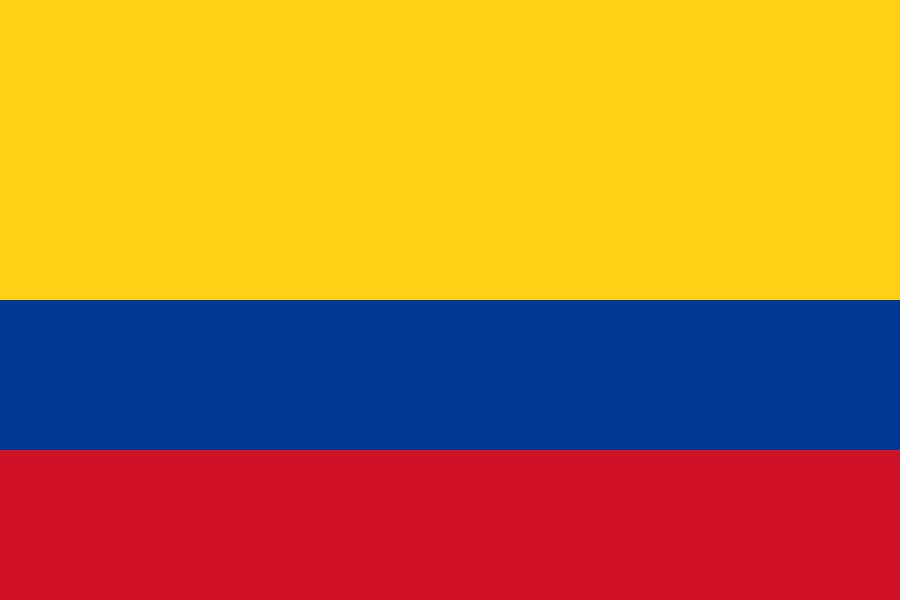
Colombia is a country in South America with insular regions in North America, bordered by the Caribbean Sea and Pacific Ocean, and neighboring Venezuela, Brazil, Peru, Ecuador, and Panama. It is divided into 32 departments, with Bogotá as its capital and largest city. Its population is around 52 million and it covers 1,141,748 square kilometers. Its culture reflects a blend of European, Middle Eastern, African, and Indigenous influences. Spanish is the official language, but other languages are also recognized regionally.
1902: Defeat of the Liberal Party in the Thousand Days' War
In 1902, the Liberal Party, which was supported by Venezuela, Ecuador, Nicaragua, and Guatemala and had rebelled against the Nationalist government, was ultimately defeated by nationalist forces.


1903: Secession of Panama
In 1903, the Department of Panama seceded from Colombia due to the United States' influence, particularly regarding the construction and control of the Panama Canal.
1921: US payment to Colombia and recognition of Panama
In 1921, the United States paid Colombia $25,000,000 as redress for President Theodore Roosevelt's role in the creation of Panama, and Colombia recognized Panama under the terms of the Thomson–Urrutia Treaty.
June 1934: League of Nations awards disputed territory to Colombia
In June 1934, the League of Nations awarded the disputed territory between Colombia and Peru to Colombia, following a peace deal brokered by the League.
1938: Urban population at 31% of the total
In 1938, the urban population in Colombia was 31% of the total population.
1939: Seven books of poetry were published under the name Stone and Sky
Between 1939 and 1940 seven books of poetry were published under the name Stone and Sky in the city of Bogotá that significantly influenced the country; they were edited by the poet Jorge Rojas.
1940: Seven books of poetry were published under the name Stone and Sky
Between 1939 and 1940 seven books of poetry were published under the name Stone and Sky in the city of Bogotá that significantly influenced the country; they were edited by the poet Jorge Rojas.
1947: Colombia was world amateur champion
In 1947, Colombia was world amateur champion in baseball.
April 1948: Assassination of Jorge Eliécer Gaitán and El Bogotazo
In April 1948, specifically on April 9th, the assassination of Liberal presidential candidate Jorge Eliécer Gaitán ignited riots in Bogotá known as El Bogotazo, which then spread throughout the country, resulting in at least 180,000 deaths.
1965: Colombia was world amateur champion
In 1965, Colombia was world amateur champion in baseball.
1970: Start of Steady Economic Growth
From 1970, Colombia's market economy grew steadily with an average GDP increase of over 4% per year until 1998.
1973: Urban population at nearly 60% of the total
In 1973, the urban population in Colombia increased to nearly 60% of the total population.
1974: Lowest registered homicide rate
Colombia registered a homicide rate in 1974.
1982: Organización Nacional Indígena de Colombia (ONIC) founded
In 1982, the Organización Nacional Indígena de Colombia (ONIC) was founded at the first National Indigenous Congress.
1989: Demobilization of Guerrilla Organizations
In 1989 and continuing through 1994, several guerrilla organizations decided to demobilize following peace negotiations.
1989: Indigenous and Tribal Peoples Convention
In 1989, the Indigenous and Tribal Peoples Convention took place.
July 1991: Promulgation of a new Constitution
On July 4, 1991, a new Constitution was promulgated in Colombia, leading to changes that are viewed as positive by Colombian society.
1991: Colombia signed and ratified the Indigenous and Tribal Peoples Convention, 1989
In 1991, Colombia signed and ratified the Indigenous and Tribal Peoples Convention, 1989, which is the current international law concerning indigenous peoples.
1991: The Colombian constitution guarantees freedom of religion
In 1991, the Colombian constitution guaranteed freedom of religion.
1991: Implementation of adversarial system
Since 1991, Colombia operates a system of civil law, which since 1991 has been applied through an adversarial system.
1991: Constitution of 1991
The government of Colombia takes place within the framework of a presidential participatory democratic republic as established in the Constitution of 1991.
1993: Healthcare coverage at 21%
Prior to 1993, healthcare coverage in Colombia was at 21%.
1994: Demobilization of Guerrilla Organizations
In 1994 and beginning in 1989, several guerrilla organizations decided to demobilize after peace negotiations.
1997: Édgar Rentería was champion of the World Series
In 1997, Édgar Rentería was champion of the World Series.
1998: End of steady Economic Growth
Until 1998, Colombia's market economy grew steadily with an average GDP increase of over 4% per year from 1970.
1999: Recession
In 1999, Colombia suffered a recession, which was the first full year of negative growth since the Great Depression.
2000: Improvement in security, stability, and rule of law
Since 2000, Colombia has experienced improvement in security, stability, and rule of law, as well as economic growth and development.
2001: Champion of the 2001 Copa América
In 2001, Colombia won the Copa América, setting a record by being undefeated, conceding no goals, and winning each match.
2002: Álvaro Uribe's Presidency Begins
In 2002, Álvaro Uribe began his presidency, adopting the democratic security policy.
2003: The film industry was growing with support from the Film Act passed in 2003
In 2003, the film industry in Colombia experienced growth due to the support from the Film Act.
2004: Constitutional Amendment on Presidential Term Limits
In 2004, a constitutional amendment changed the one-term limit for presidents to a two-term limit, which was later repealed in 2015.
2005: Piloto public library
Up until 2005, the Piloto public library has Latin America's largest archive of negatives, containing 1.7 million antique photographs covering Colombia.
2006: Produced 15 tons of gold per year
In 2006, Colombia produced 15 tons of gold
2006: The Federal Research Division estimated the 86% of the population that did not consider themselves part of one of the ethnic groups indicated by the 2006 census
The Federal Research Division estimated that the 86% of the population that did not consider themselves part of one of the ethnic groups indicated by the 2006 census.
2007: Produced 15 tons of gold per year
In 2007, Colombia produced 15 tons of gold.
2007: Foreign tourist visits at 0.6 million
In 2007, Colombia saw approximately 0.6 million foreign tourist visits.
2007: Growth reaching 7%
In 2007, Colombia's growth reached 7%, one of the highest in Latin America.
February 2008: Demonstrations against FARC and other outlawed groups
In February 2008, millions of Colombians demonstrated against FARC and other outlawed groups.
2009: Uribe's approval rating peaked at 76%
In 2009, a poll showed that Álvaro Uribe's approval rating peaked at 76%.
June 2010: Juan Manuel Santos wins presidential election
On 20 June 2010, Juan Manuel Santos won the presidential election with 69% of the vote.
2010: End of Álvaro Uribe's Presidency
In 2010, Álvaro Uribe's presidency ended, having served two terms and constitutionally barred from seeking re-election.
2010: Édgar Rentería was champion of the World Series
In 2010, Édgar Rentería was champion of the World Series.
2011: "Borders for Prosperity" plan launched
In 2011, President Juan Manuel Santos launched the "Borders for Prosperity" plan to fight poverty and combat violence along Colombia's borders.
2012: World's largest populations of internally displaced persons (IDPs)
As of 2012, Colombia had the world's largest populations of internally displaced persons (IDPs), estimated to be up to 4.9 million people.
2012: Record of 66.1 tons of gold extracted
In 2012, Colombia extracted a record of 66.1 tons of gold.
2012: Healthcare coverage at 96%
In 2012, healthcare coverage in Colombia reached 96% after healthcare reforms.
June 2014: Santos wins re-election
On 15 June 2014, Santos won re-election with nearly 51% of the vote.
2014: Urban population at 76% of the total
By 2014, the urban population in Colombia stood at 76% of the total population.
2014: Recognized in the Global Green Economy Index (GGEI)
In 2014, Colombia's commitment to renewable energy was recognized in the Global Green Economy Index (GGEI), ranking among the top 10 nations globally in terms of greening efficiency sectors.
2015: 72 cities now have populations of 100,000 or more
As of 2015, Colombia had 72 cities with populations of 100,000 or more.
2015: Repeal of constitutional amendment on presidential term limits
In 2015, Colombia's Congress approved the repeal of a 2004 constitutional amendment that changed the one-term limit for presidents to a two-term limit.
2015: Public spending on education was 4.49% of GDP
In 2015, public spending on education in Colombia was 4.49% of the gross domestic product.
2015: Life expectancy was 74.8 years and adult literacy rate was 94.58%
In 2015, the life expectancy in Colombia was 74.8 years, and the adult literacy rate was 94.58%.
November 2016: Revised peace deal signed with FARC
In November 2016, the Colombian government and the FARC signed a revised peace deal that was approved by the Colombian congress.
2016: 21 Colombian health care institutions among the top 44 in Latin America
A 2016 study conducted by América Economía magazine ranked 21 Colombian health care institutions among the top 44 in Latin America.
2016: Government aimed to build 7,000 km of roads
Between 2016 and 2020, the Colombian government aimed to build 7,000 km of roads to reduce travel times and transport costs.
2016: Military expenditure
In 2016, 3.4% of Colombia's GDP went towards military expenditure, placing it 24th in the world.
2016: Homicide rate of 24.4 per 100,000
In 2016, Colombia registered a homicide rate of 24.4 per 100,000, the lowest since 1974. This was also the year the government signed a peace agreement with the FARC.
2016: Annual inflation at 5.75% YoY
In 2016, Colombia's annual inflation was 5.75% year-over-year.
2016: Estimated population growth rate of 0.9%
In 2016, Colombia's population growth rate was estimated to be 0.9%.
2016: Infant mortality was 13.1 per thousand
In 2016, infant mortality in Colombia was 13.1 per thousand.
2016: Tourism contribution to GDP
In 2016, the contribution of tourism to Colombia's GDP was US$5,880.3 billion (2.0% of total GDP), and the tourism sector generated 556,135 jobs (2.5% of total employment).
2017: The country had around 2,100 km of duplicated highways
At the end of 2017, Colombia had around 2,100 km of duplicated highways.
2017: 52.2 tons of gold were extracted
In 2017, Colombia extracted 52.2 tons of gold.
2017: Annual inflation closed at 4.09% YoY and average national unemployment rate was 9.4%
In 2017, annual inflation in Colombia closed at 4.09% year-over-year. The average national unemployment rate was 9.4%, with informality being a significant issue in the labor market.
2017: Foreign tourist visits predicted to have risen to 4 million
In 2017, foreign tourist visits to Colombia were predicted to have risen to 4 million, a significant increase from 0.6 million in 2007.
2017: Government declared a cancer research and treatment center as a Project of National Strategic Interest
In 2017, the Colombian government declared a cancer research and treatment center as a Project of National Strategic Interest.
2017: 26.9% of the population were living below the poverty line
In 2017, the National Administrative Department of Statistics (DANE) reported that 26.9% of Colombia's population was living below the poverty line, with 7.4% in extreme poverty. The multidimensional poverty rate was 17.0 percent.
June 2018: Iván Duque wins the presidential election
In June 2018, Iván Duque, the candidate of the right-wing Democratic Center party, won the presidential election.
August 2018: Iván Duque began his four-year term as president
In 2018, specifically on August 7th, Iván Duque's four-year term as Colombia's president began.
August 2018: Iván Duque sworn in as President
On August 7, 2018, Iván Duque was sworn in as the new President of Colombia.
2018: Forest Landscape Integrity Index Score
In 2018, Colombia had a Forest Landscape Integrity Index mean score of 8.26/10, ranking it 25th globally out of 172 countries.
2018: Colombia signed the UN treaty on the Prohibition of Nuclear Weapons
In 2018, Colombia signed the UN treaty on the Prohibition of Nuclear Weapons.
2018: 5th largest coal exporter in the world
In 2018, Colombia was the 5th largest coal exporter in the world.
2018: 2018 census reported that the non-ethnic population constituted 87.6% of the national population
The 2018 census reported that the "non-ethnic population", consisting of whites and mestizos, constituted 87.6% of the national population of Colombia.
February 2019: Venezuela cuts off diplomatic relations with Colombia
In February 2019, Venezuelan president Nicolás Maduro cut off diplomatic relations with Colombia after Colombian President Ivan Duque had helped Venezuelan opposition politicians deliver humanitarian aid to their country.
August 2019: Colombia offered citizenship to more than 24,000 children of Venezuelan refugees
In August 2019, Colombia offered citizenship to more than 24,000 children of Venezuelan refugees who were born in Colombia.
2019: 20th largest petroleum producer in the world
In 2019, Colombia was the 20th largest petroleum producer in the world, producing 791 thousand barrels per day.
January 2020: Colombia rejects Venezuela's proposal to restore diplomatic relations
In January 2020, Colombia rejected Maduro's proposal that the two countries restore diplomatic relations.
November 2020: Discovery of Pictographs at Serranía de la Lindosa
In November 2020, a site including eight miles (13 km) of pictographs under study at Serranía de la Lindosa was revealed, suggested to be approximately 12,500 years old, depicting extinct fauna from the earliest known human occupation of the area.
2020: Government aimed to build 7,000 km of roads
Between 2016 and 2020, the Colombian government aimed to build 7,000 km of roads to reduce travel times and transport costs.
2020: Estimated population of 50 million
In 2020, Colombia's estimated population was 50 million, making it the third-most populous country in Latin America.
2020: More than 40% of the country's exports were based on coal and petroleum
In 2020, more than 40% of Colombia's exports were based on coal and petroleum. Additionally, the country was the 19th largest oil exporter in the world.
2020: Murder rate decreased to 22.6
In 2020, the murder rate further decreased to 22.6.
April 2021: Protests start due to proposed tax bill
On 28 April 2021, protests started when the government proposed a tax bill that would greatly expand the range of the 19 percent value-added tax.
2021: Colombia had 204,389 km of roads
In 2021, Colombia had 204,389 km of roads, of which 32,280 km were paved.
June 2022: Gustavo Petro wins presidential election
The 19 June 2022 election run-off vote ended in a win for former guerrilla, Gustavo Petro, taking 50.47% of the vote.
August 2022: Petro sworn in as Colombia's first leftist president
On 7 August 2022, Gustavo Petro was sworn in, becoming the country's first leftist president.
2022: 26 Colombian hospitals were among the 61 best in Latin America
In 2022, 26 Colombian hospitals were among the 61 best in Latin America.
2022: Colombia elected its first leftist leader
In 2022, Colombia elected Gustavo Petro, who became its first leftist leader, and Francia Marquez, who was the first black person elected as vice president.
2023: Study estimates that 50.3% of the population are Mestizo
A 2023 study by Latinobarómetro estimates that 50.3% of Colombia's population are Mestizo.
2023: Two Colombian hospitals were among the top 75 of the world
Also in 2023, two Colombian hospitals were among the top 75 of the world.
2025: Ranked 71st in the Global Innovation Index
In 2025, Colombia was ranked 71st in the Global Innovation Index.
2050: Projected population of 55.3 million
By 2050, Colombia's population is projected to reach 55.3 million.
Mentioned in this timeline
Venezuela officially the Bolivarian Republic of Venezuela is a country...
Inflation in economics signifies a rise in the average price...

The World Series is Major League Baseball's championship series held...
France officially the French Republic is primarily in Western Europe...
Argentina is a country located in the southern cone of...

War is defined as an armed conflict involving the armed...
Trending

4 hours ago Stefanos Tsitsipas Draws Attention at the 2026 US Open Tennis Tournament
5 hours ago Brayan Rocchio Hits Clutch Grand Slam for Cleveland Guardians Against Tigers
5 hours ago Wimbledon Champion Linda Nosková Competes at 2026 US Open and Meets WWE Star

5 hours ago Stephen A. Smith Discusses Molly Qerim's First Take Role and Media Critiques
5 hours ago Olympique Lyonnais Defeats Auxerre to Secure Provisional Lead in Ligue 1

5 hours ago Ann Li Shows Strong Performance as Relocation Pays Off at 2026 US Open
Popular

Dolly Parton is a celebrated American singer-songwriter actress philanthropist and...

Michael Joseph Jackson the King of Pop was a highly...
Bernie Sanders is a prominent American politician and the senior...
John F Kennedy JFK was the th U S President...
Joe Biden served as the th President of the United...

Mark Zuckerberg is an American businessman and programmer best known...