


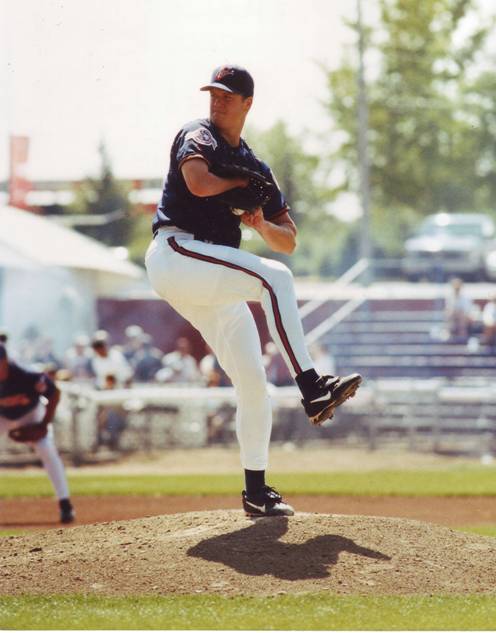
Jim Abbott is a former professional baseball player who defied immense odds by competing at the highest level of Major League Baseball despite being born without a right hand. A standout pitcher, he starred at the University of Michigan before winning an Olympic gold medal in 1988. Abbott made a seamless transition to the MLB without playing a single game in the minor leagues, enjoying a ten-year career with teams including the California Angels and the New York Yankees. His most notable achievement came in 1993 when he threw a no-hitter against the Cleveland Indians. Beyond his statistical accomplishments, Abbott became an iconic symbol of perseverance and determination. He mastered a unique technique of transitioning his glove from his right arm to his left hand between pitches, allowing him to field effectively. Since retiring, he has remained a respected motivational speaker, inspiring people globally by demonstrating that physical limitations do not define one's potential for success.
September 19, 1967: Birth of Jim Abbott
On September 19, 1967, James Anthony Abbott was born, marking the beginning of the life of the future professional baseball pitcher who would become known for competing at the highest level despite being born without a right hand.


1985: Enrollment at the University of Michigan
In 1985, Jim Abbott began his collegiate journey by enrolling at the University of Michigan, where he commenced a three-year career playing baseball for the Michigan Wolverines.
1987: Sullivan Award and Pan American Games Participation
In 1987, Abbott achieved significant recognition by becoming the first baseball player to win the James E. Sullivan Award for top amateur athlete in the U.S. and served as the U.S. flag-bearer at the 1987 Pan American Games.
1987: James E. Sullivan Award Win
In 1987, while playing for the University of Michigan, Jim Abbott was honored with the James E. Sullivan Award, recognizing him as the top amateur athlete in the United States.
1988: 1988 Olympic Gold and MLB Draft Selection
During 1988, Abbott achieved a significant triumph by winning a gold medal in the demonstration event at the Summer Olympics and was selected in the first round of the 1988 MLB draft.
1988: Olympic Success and Big Ten Honors
During 1988, Abbott concluded his time at the University of Michigan, was named the Big Ten Athlete of the Year, and pitched the final game for the United States baseball team in the 1988 Summer Olympics to earn an unofficial gold medal.
1988: Selected in the 1988 MLB Draft
In 1988, Jim Abbott achieved a major career milestone when he was selected in the first round as the eighth overall pick by the California Angels during the Major League Baseball draft.
1989: Rookie Season with the California Angels
During the 1989 season, Jim Abbott bypassed the Minor Leagues to join the California Angels' starting rotation. Throughout 1989, he maintained a 12–12 win-loss record with a 3.92 ERA and earned a fifth-place finish in the American League Rookie of the Year Award voting.
1989: Start of MLB Career
In 1989, Jim Abbott officially began his professional career in Major League Baseball, joining the California Angels as a pitcher and starting his decade-long journey in the major leagues.
1991: Abbott hits a triple in spring training
During a 1991 spring training game, Jim Abbott successfully hit a triple off of pitcher Rick Reuschel, showcasing his capability to hit despite typically playing in the American League where designated hitters were used.
1991: 1991 MLB Season Performance
During the 1991 season, Jim Abbott achieved a record of 18–11 for the California Angels, recorded the fourth-lowest ERA in the American League at 2.89, and ultimately placed third in the voting for the AL Cy Young Award.
1992: 1992 MLB Season and Award Win
In 1992, Jim Abbott maintained a strong performance with a 2.77 ERA while finishing the season with a 7–15 record for the Angels; additionally, he was honored with the Tony Conigliaro Award that same year.
September 4, 1993: Jim Abbott Pitches a No-Hitter
On September 4, 1993, while playing for the New York Yankees, Jim Abbott achieved a career highlight by throwing a no-hitter against the Cleveland Indians.
1993: Jim Abbott Throws a No-Hitter
In 1993, while playing as a pitcher for the New York Yankees, Jim Abbott achieved a historic career milestone by throwing a no-hitter against the Cleveland Indians.
1994: 1994 MLB Players Strike
During the 1994 season, Jim Abbott's New York Yankees were leading the AL East; however, on August 12, 1994, a major players strike resulted in the cancellation of the remainder of the season and the postseason.
April 1995: Abbott Signs with White Sox
After becoming a free agent following the conclusion of the 1994 season, Jim Abbott signed a contract to play for the Chicago White Sox in April 1995.
July 27, 1995: Trade to the Angels
On July 27, 1995, Jim Abbott was traded along with Tim Fortugno from the Chicago White Sox to the California Angels in exchange for McKay Christensen, Andrew Lorraine, Bill Simas, and John Snyder.
1996: 1996 Season with the Angels
In 1996, Jim Abbott re-signed with the California Angels, but he faced significant performance challenges throughout the season, finishing with a 2–18 record and a 7.48 ERA.
1997: Release from the Angels and Retirement
Prior to Opening Day in 1997, the Angels released Jim Abbott from his contract, leading him to announce his retirement from professional baseball.
1998: Return to the Chicago White Sox
In 1998, Jim Abbott rejoined the Chicago White Sox organization, where he demonstrated a perfect performance by starting five games and securing a win in each of those five appearances.
1999: Retirement from Professional Baseball
In 1999, Jim Abbott officially retired from his professional baseball career, finishing with a cumulative record of 87 wins, 108 losses, and a 4.25 ERA.
1999: Abbott joins Milwaukee Brewers
In 1999, after joining the Milwaukee Brewers in the National League, Jim Abbott recorded two hits in 21 at-bats, both of which were against pitcher Jon Lieber.
1999: Conclusion of MLB Career
The professional baseball career of Jim Abbott concluded in 1999, closing out an impressive tenure that spanned across multiple teams including the California Angels, New York Yankees, Chicago White Sox, and Milwaukee Brewers.
2005: National Baseball Hall of Fame Ballot Eligibility
In 2005, Jim Abbott became eligible for the National Baseball Hall of Fame ballot, but he received only 13 votes, representing 2.5% of the total, which resulted in his removal from the ballot.
2007: Induction into College Baseball Hall of Fame
In 2007, Jim Abbott was honored with an election into the College Baseball Hall of Fame, recognizing his outstanding athletic performance during his tenure at the University of Michigan.
April 18, 2009: Retirement of Jersey #31
On April 18, 2009, the University of Michigan officially retired Jim Abbott's number 31 jersey during a home game held against Michigan State University.
April 2012: Publication of Imperfect: An Improbable Life
In April 2012, Jim Abbott's autobiography titled Imperfect: An Improbable Life, which he co-authored with Tim Brown, was officially released by the publisher Ballantine Books.

2025: Southpaw wins Peabody Award
In 2025, the ESPN documentary titled Southpaw—The Life and Legacy of Jim Abbott received a prestigious Peabody Award for its comprehensive and human-centric examination of Jim Abbott's significance to both the sport of baseball and the broader public.
Mentioned in this timeline
The United States of America is a federal republic primarily...
California is a U S state on the Pacific Coast...
Denton True Cy Young was a Major League Baseball pitcher...

Michigan is a state in the Great Lakes region of...

Chicago situated on Lake Michigan's western shore is the most...

Cleveland is a major city in Ohio United States situated...
Trending

4 hours ago Skeet Ulrich Discusses Scream Franchise Future Following Melissa Barrera’s Departure

4 hours ago Stephanie Vaquer Defends Women's World Title At WWE Money in the Bank Event
4 hours ago Dameon Pierce Emerges as Potential Replacement Amidst Philadelphia Eagles Running Back Injury Crisis
4 hours ago Kamil Majchrzak Faces Yannick Hanfmann at the 2026 ATP Shanghai Masters Tournament

6 hours ago Coco Gauff Faces Elise Mertens in WTA China Open Round of 16 Match

6 hours ago Tennis Prediction Markets for Upcoming October 2026 Matches
Popular

Ken Paxton is an American politician and lawyer serving as...

Elon Musk is a visionary entrepreneur and engineer known for...

Cristiano Ronaldo widely considered one of the greatest footballers captains...

Shakira Isabel Mebarak Ripoll the Queen of Latin Music is...

Jameis Winston is an American football quarterback currently playing for...

Bernie Sanders is a prominent American politician and the senior...