


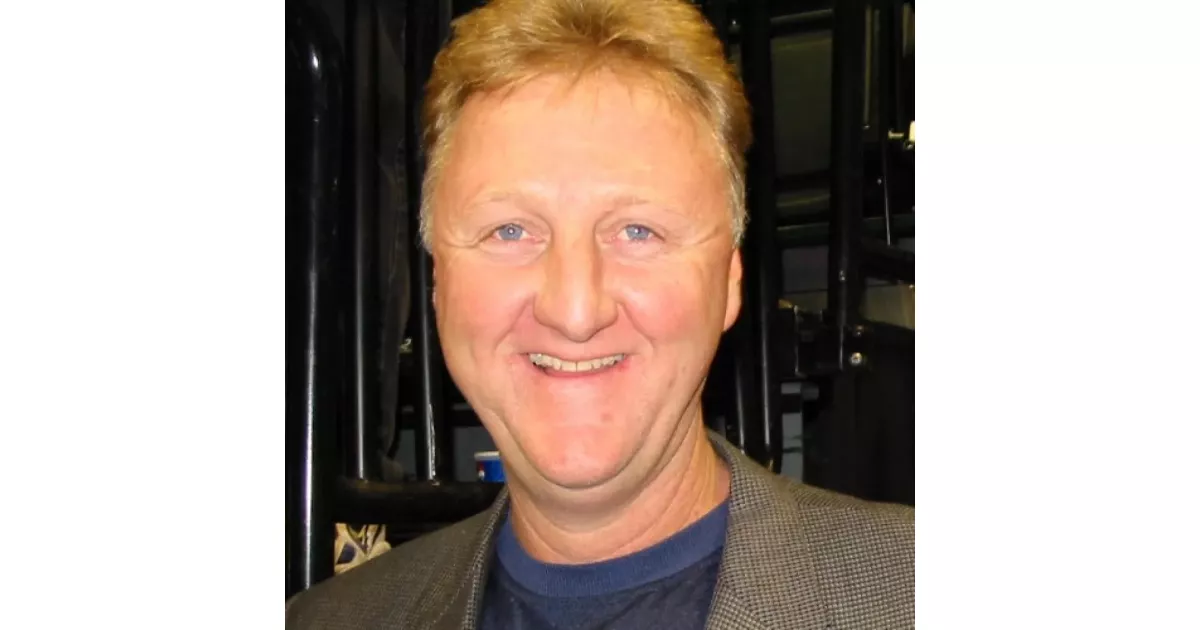
Larry Bird, nicknamed "the Hick from French Lick" and "Larry Legend," is considered one of basketball's all-time greats. He excelled as a player, coach, and executive in the NBA. Bird achieved the unique distinction of being the only person in NBA history to win Rookie of the Year, Most Valuable Player, Finals MVP, All-Star MVP, Coach of the Year, and Executive of the Year.
4 hours ago : Maxx Crosby Goes Viral Wearing Larry Bird Celtics Jersey Before Raiders Game
Raiders defensive end Maxx Crosby creates a buzz during NFL Week 5 by arriving at the stadium wearing a vintage Larry Bird Boston Celtics jersey, capturing significant social media attention.


1926: Birth of Claude Joseph "Joe" Bird
In 1926, Claude Joseph "Joe" Bird, Larry Bird's father, was born.
1930: Birth of Georgia Marie (Kerns)
In 1930, Georgia Marie (née Kerns), Larry Bird's mother, was born.
December 7, 1956: Larry Bird's Birth
On December 7, 1956, Larry Joe Bird was born. He would become an American former professional basketball player, coach, and executive in the National Basketball Association (NBA).
1974: Graduation from Springs Valley High School
In 1974, Larry Bird graduated from Springs Valley High School, averaging 31 points, 21 rebounds, and 4.0 assists as a senior and becoming the school's all-time scoring leader.
1974: Scholarship to Indiana Hoosiers
In 1974, Larry Bird received a scholarship to play college basketball for the Indiana Hoosiers under head coach Bob Knight but dropped out after less than a month.
February 1975: Father's Suicide
In February 1975, Larry Bird's father, Joe, committed suicide after his parents divorced when Larry was in high school.
1975: Death of Claude Joseph "Joe" Bird
In 1975, Claude Joseph "Joe" Bird, Larry Bird's father, passed away.
1975: Enrolled at Indiana State University
In 1975, Larry Bird enrolled at Indiana State University in Terre Haute after working municipal jobs for a year.
1977: Birth of Daughter Corrie
In 1977, following an attempted reconciliation, Larry Bird and Janet Condra had a daughter, Corrie.
1978: Drafted by the Boston Celtics
In 1978, Larry Bird was selected by the Boston Celtics as the sixth overall pick in the NBA draft after his second year at Indiana State, but he elected to stay in college for the 1978–79 season.
November 14, 1979: First Career Triple-Double
On November 14, 1979, Larry Bird recorded his first career triple-double with 23 points, 19 rebounds and 10 assists in a 115–111 victory over the Detroit Pistons.
1979: Entered the NBA
In 1979, Larry Bird entered the NBA for the 1979–80 season, where he made an immediate impact on the Celtics.
1979: Graduated from Indiana State University
In 1979, Larry Bird graduated from Indiana State with a Bachelor of Science degree in physical education. During his college career, he averaged 30.3 points, 13.3 rebounds, and 4.6 assists per game.
1979: Signed with the Boston Celtics
In 1979, after protracted negotiations, Larry Bird signed a five-year, $3.25 million contract with the Boston Celtics, making him the highest-paid rookie in sports history. Shortly afterwards, NBA draft eligibility rules were changed to prevent teams from drafting players before they were ready to sign, a rule known as the Bird Collegiate Rule.
1980: Celtics Draft Kevin McHale
Before the 1980-81 NBA season, the Celtics drafted forward Kevin McHale and acquired center Robert Parish from the Golden State Warriors. The front-court of Bird, McHale, and Parish is regarded as one of the greatest front-courts in NBA history.
1981: NBA championship in 1981
In 1981, Larry Bird and the Celtics won the NBA championship.
1982: All-Star Game MVP Award
At the 1982 All-Star Game, Larry Bird scored 19 points en route to winning the All-Star Game MVP Award.
1982: Regular Season MVP runner-up
In 1982, Larry Bird was the runner-up for the regular season MVP award.
1983: Signed a Seven-Year Extension
In 1983, Larry Bird signed a seven-year, $12.6 million extension before the NBA's salary cap came into effect.
1983: Regular Season MVP runner-up
In 1983, Larry Bird was the runner-up for the regular season MVP award.
1983: Named MVP of the 1983-84 Season
Larry Bird was named MVP of the 1983–84 season with averages of 24.2 points, 10.1 rebounds, 6.6 assists, and 1.8 steals per game.
December 9, 1984: 48 Points vs. Atlanta Hawks
On December 9, 1984, Larry Bird recorded 48 points to go along with 14 rebounds and 5 assists in a 128–127 victory over the Atlanta Hawks.
1984: NBA championship in 1984
In 1984, Larry Bird and the Celtics won the NBA championship.
1984: NBA Most Valuable Player Award
In 1984, Larry Bird won the NBA Most Valuable Player Award for the first time.
1984: "Soft Cap" and the "Larry Bird Rule"
In 1984, the NBA modified from a "hard" salary cap to a "soft cap", meaning the cap could be exceeded in order for a team to re-sign its own free agents. This came to be erroneously known as the "Larry Bird Rule"
November 27, 1985: 47-point performance against Pistons
On November 27, 1985, Larry Bird scored 47 points, grabbed 12 rebounds, dished out two assists, and secured two steals in a 132–124 victory over the Detroit Pistons.
1985: Acquisition of Bill Walton
Before the start of the 1985-86 season, the Celtics acquired Bill Walton, an All-Star center with a history of injury.
1985: Back Injury While Shoveling Rock
During the 1985 offseason, Larry Bird injured his back shoveling crushed rock to create a driveway at his mother's house, leading to back problems for the rest of his career.
1985: Celtics Ranked as One of the Greatest Teams
In 1985, the Celtics team was often considered one of the greatest basketball teams of all time according to Peter May of the Boston Globe and Bill Simmons of Grantland.
1985: Rivalry with Magic Johnson Continues
In 1985, the Celtics, led by Larry Bird, faced the Lakers, led by Magic Johnson, in the NBA Finals, continuing their storied rivalry, with Magic ultimately winning.
March 10, 1986: 50-point game against Mavericks
On March 10, 1986, Larry Bird had an outstanding performance with 50 points, 11 rebounds, and five assists in a close 116–115 loss to the Dallas Mavericks.
1986: NBA championship in 1986
In 1986, Larry Bird and the Celtics won the NBA championship.
1986: Second NBA Most Valuable Player Award
In 1986, Larry Bird won the NBA Most Valuable Player Award for the third consecutive time.
1986: Won the Three-Point Shootout
In 1986, Larry Bird won the inaugural Three-Point Shootout during the NBA All-Star Weekend.
1986: Jordan sets NBA playoff record
In 1986, after Game 2 of the Celtics' first-round series against the Bulls when Michael Jordan scored an NBA playoff-record 63 points in a 135-131 Celtics win, Larry Bird famously called Jordan 'God disguised as Michael Jordan.'
1987: Trash-talking incident with Dennis Rodman
During the 1987 Eastern Conference finals, Larry Bird engaged in intense trash-talking with Dennis Rodman, a player known for his defensive abilities, and belittled Rodman's skills.
1987: Classic Celtics-Lakers Game
During the 1987-88 season, a regular-season game between the Celtics and Lakers proved to be a classic, with Magic Johnson hitting a game-winning shot at the buzzer for a 115-114 Lakers victory at Boston Garden. The historical rift between the teams and the presence of Bird and Magic transformed the NBA.
1987: Magic Johnson's Lakers Defeat Larry Bird's Celtics
In 1987, Magic Johnson secured another victory against Larry Bird as the Lakers triumphed over the Celtics in the NBA Finals.
1987: Finals Appearance and Loss to Lakers
In 1987, the Celtics, led by Larry Bird, reached the NBA Finals but lost to the Lakers in six games. In Game 5 of the Eastern Conference Finals against the Pistons, Bird made a crucial steal and pass to Dennis Johnson for a game-winning layup.
1988: Continued High Performance Despite Setbacks
Despite bone spur surgery, Larry Bird returned to the Celtics in 1989 and maintained his status as a premier player, averaging over 20 points, nine rebounds, and seven assists in his final three seasons, leading the Celtics to playoff appearances.
1988: Regular Season MVP runner-up
In 1988, Larry Bird was the runner-up for the regular season MVP award.
1988: Highest-Scoring Season and Semifinals Victory
The 1987-88 season was the highest-scoring season of Larry Bird's career. In 1988, during Game 7 of the Eastern Conference Semifinals against the Atlanta Hawks, Bird scored 20 points in the fourth quarter to lead the Celtics to a series-clinching victory.
1989: Marriage to Dinah Mattingly and Autobiography Release
In 1989, Larry Bird married Dinah Mattingly and released his autobiography "Drive: The Story of My Life", co-written with Bob Ryan.
1989: Season cut short by bone spurs
Larry Bird's 1988-89 season was cut short after six games when, in 1989, he had bone spurs surgically removed from both of his heels.
1990: Injury troubles begin
After a strong start to the 1990-91 season, Larry Bird missed 22 games due to a compressed nerve root in his back.
1991: Back surgery
Larry Bird had off-season surgery in 1991 to remove a disc from his back, but continued back problems caused him to miss 37 games during the 1991-92 season.
August 18, 1992: Retirement from the NBA
On August 18, 1992, Larry Bird announced his retirement from the NBA, and the Celtics promptly retired his jersey number 33 in his honor.
1992: Continued back problems
During the 1992 Eastern Conference Semifinals against the Cleveland Cavaliers, Larry Bird missed four of the seven games due to recurring back problems.
1992: Playing in the Olympics
During the summer of 1992, Larry Bird joined Magic Johnson, Michael Jordan, and other NBA stars to play for the United States men's national basketball team in the Olympics in Barcelona, Spain, marking the first time NBA players competed for the U.S. The team was co-captained by Bird and Johnson.
1992: Special assistant role
From 1992 until 1997, Larry Bird was employed by the Celtics as a special assistant in the team's front office.
1992: Member of the "Dream Team"
In 1992, Larry Bird was a member of the gold medal-winning U.S. Olympic basketball team, known as the "Dream Team".
1992: Jordan Defers to Bird and Magic
In 1992, Michael Jordan deferred to Larry Bird and Magic Johnson for co-captaincy of the United States men's Olympic basketball team.
February 4, 1993: Johnson's appearance at Bird's retirement ceremony
On February 4, 1993, Magic Johnson attended Larry Bird's retirement ceremony and emotionally described Bird as a "friend forever,"
1996: Death of Georgia Marie (Kerns)
In 1996, Georgia Marie (née Kerns), Larry Bird's mother, passed away.
1996: Named to NBA's 50 Greatest Players in NBA History
In 1996, Larry Bird was voted onto the NBA's 50 Greatest Players in NBA History list.
1996: Selection to NBA's 50th Anniversary All-Time Team
In 1996, Larry Bird was voted onto the NBA's 50th Anniversary All-Time Team list.
1997: Special assistant role
From 1992 until 1997, Larry Bird was employed by the Celtics as a special assistant in the team's front office.
1997: Head Coach of the Indiana Pacers
In 1997, Larry Bird accepted the position of head coach for the Indiana Pacers, committing to a three-year tenure. Despite lacking prior coaching experience, he led the Pacers to a franchise-best 58–24 record during the 1997–98 season.
1998: Inducted into the Naismith Memorial Basketball Hall of Fame
In 1998, Larry Bird was inducted into the Naismith Memorial Basketball Hall of Fame as an individual player.
1999: Central Division Title
In 1999, Larry Bird led the Indiana Pacers to a Central Division title.
1999: Ranking on Greatest Athletes Lists
In 1999, Larry Bird ranked No. 30 on ESPN SportsCentury's list of 50 Greatest Athletes of the 20th century and No. 24 on the Associated Press's list of the 100 Greatest Athletes of the 20th century.
2000: NBA Finals Berth and Resignation
In 2000, Larry Bird coached the Indiana Pacers to the NBA Finals, where they were defeated by the Los Angeles Lakers. Following the season, fulfilling his initial commitment, Bird resigned from his head coaching position.
2000: Led Pacers to NBA Finals Berth
In 2000, Larry Bird led the Pacers to a berth in the NBA Finals as their head coach.
2003: Hired as President of Basketball Operations
In 2003, Larry Bird was hired as the Indiana Pacers' president of basketball operations, replacing Isiah Thomas with Rick Carlisle as head coach.
2003: President of Basketball Operations for Pacers
In 2003, Larry Bird was named president of basketball operations for the Indiana Pacers.
2006: Roster Overhaul
From 2006 onwards, as president of basketball operations, Larry Bird began overhauling the Indiana Pacers' roster by trading away veteran players and making strategic draft picks.
2010: Hall of Fame Induction as Part of Dream Team
In 2010, Larry Bird was inducted into the Hall of Fame again as a member of the "Dream Team".
2010: Second Hall of Fame Induction
In 2010, Larry Bird was inducted into the Naismith Memorial Basketball Hall of Fame as a member of the "Dream Team".
2011: Lifetime achievement award
In 2011, Larry Bird was honored with a lifetime achievement award at The Sports Museum's 10th annual The Tradition event. The Missouri Valley Conference Men's Basketball Player of the Year trophy is named in Bird's honor.
2011: NBA Executive of the Year
In 2011, Larry Bird was named NBA Executive of the Year after the Indiana Pacers secured the No. 3 seed in the East.
2012: NBA Executive of the Year
In 2012, Larry Bird was named NBA Executive of the Year.
2013: Bronze Statue and Larry Bird Day
In 2013, Indiana State University unveiled a bronze statue of Larry Bird on campus. Additionally, November 9th was proclaimed as Larry Bird Day in the state of Indiana.
2013: Return to the Pacers
In 2013, Larry Bird returned to the Indiana Pacers as president of basketball operations.
2013: Returned as President of Basketball Operations
In 2013, Larry Bird returned to the Pacers as president of basketball operations.
2016: "Sometimes my job really sucks."
In 2016, Larry Bird stated, "Sometimes my job really sucks."
2016: Rated Greatest NBA Small Forward of All Time
In 2016, Larry Bird was rated the greatest NBA small forward of all time by Fox Sports.
2017: Stepped down as president of basketball operations
In 2017, Larry Bird remained with the Indiana Pacers as an advisor.
2017: Stepping Down as President
In 2017, Larry Bird stepped down as president of basketball operations for the Indiana Pacers, transitioning to an advisory role within the team.
2019: NBA Lifetime Achievement Award
At the 2019 NBA Awards, Larry Bird received the NBA Lifetime Achievement Award (shared with Magic Johnson).
2020: Historical recognition of Larry Bird
As of 2020, Larry Bird's record of winning three consecutive regular season MVP awards was matched only by Bill Russell and Wilt Chamberlain. Also in 2020, Bird was placed at the power forward position on an NBA all-time starting five roster.
2020: NBA all-time starting five roster
In 2020, Larry Bird was placed at the power forward position on an NBA all-time starting five roster.
October 2021: NBA's 75th Anniversary All-Time Team
In October 2021, as part of the NBA's 75th Anniversary, Larry Bird was honored as one of the 75 greatest players of all time, by being named to the NBA's 75th Anniversary All-Time Team.
2021: Named to NBA's 75th Anniversary Team
In 2021, Larry Bird was named to the NBA's 75th Anniversary Team list.
July 2022: Stepped Back from Pacers Active Role
In July 2022, Larry Bird "stepped back from maintaining an active role with the Indiana Pacers," continuing in an advisory capacity.
July 2022: Consultant for the Pacers
In July 2022, after nearly a year's break, Larry Bird returned to the Pacers organization in the role of consultant.
2022: Naming of Eastern Conference Finals MVP Trophy
Since 2022, the NBA will award the MVPs for the conference finals; the Eastern Conference Finals MVP trophy is named in Larry Bird's honor.
June 2023: Re-hired as a Consultant
In June 2023, the Indiana Pacers re-hired Larry Bird to serve as a consultant.
May 2024: Opening of the Larry Bird Museum
In May 2024, the Larry Bird Museum was opened in Terre Haute, Indiana, containing memorabilia from his career along with interactive exhibits and interviews.
2025: Consultant for the Pacers
As of 2025, Larry Bird holds his position as a consultant for the Indiana Pacers.
Mentioned in this timeline
Basketball is a team sport played on a rectangular court...
The United States of America is a federal republic primarily...
Dennis Rodman nicknamed the Worm is a retired American professional...
Earvin Magic Johnson Jr is a celebrated American businessman and...
A star is a self-gravitating luminous plasma spheroid exemplified by...
Dallas Texas is the ninth-most populous city in the U...
Trending
3 hours ago Maxwell Hairston Benched for Bills Despite Coaching Expectations
3 hours ago KOSPI Plunges as Korean Chip Stocks Decline Amid Rising Competition and Industry Concerns

3 hours ago Brian Austin Green and Taylor Sheridan's Early Acting Roles Revealed
3 hours ago Steven Kwan Faces Growing MLB Trade Rumors Amid Offseason Speculation
3 hours ago Sherrod Brown Faces Intense Spending and Changing Voter Dynamics in Ohio Senate Race
3 hours ago Chelsea Green Discusses Wrestling Imposter Syndrome and Fears of Losing WWE Women's Title
Popular

Ken Paxton is an American politician and lawyer serving as...
Jameis Winston is an American football quarterback currently playing for...
Michael Joseph Jackson the King of Pop was a highly...
Cristiano Ronaldo widely considered one of the greatest footballers captains...
Elon Musk is a visionary entrepreneur and engineer known for...
Marco Rubio is a prominent American politician serving as the...