History of NASCAR rules and regulations in Timeline


NASCAR's rules cover vehicle specifications, safety regulations, and competition procedures. Cars must adhere to strict guidelines regarding dimensions, weight, and engine components to maintain parity. Safety is paramount, with mandated features like roll cages, fire suppression systems, and driver safety equipment. Competition rules address qualifying, race starts, restarts, pit stops, and penalties for rule infractions. NASCAR also implements inspection processes to ensure compliance and fair play. Penalties can range from fines and point deductions to suspensions.
1972: Viceroy Rule Originates
The Viceroy Rule is named after the 1972 USAC Championship Car season, where title sponsor Marlboro renounced its branding when Viceroy entered the sport to sponsor entries.


1985: Retirement of No. 61 in Whelen Modified Tour
In 1985, number 61 was retired in the Whelen Modified Tour, in memory of nine-time series champion Richie Evans, who was killed at Martinsville Speedway practicing for the final race of the season.
1989: Richard Petty's Qualifying Troubles
In 1989, Richard Petty's failure to qualify in four races led to a drop in viewership ratings, prompting NASCAR to later introduce the past champion's provisional rule.
1989: Pit Road Closure Rule Implemented
In 1989, following the Motorcraft Quality Parts 500, NASCAR implemented a rule where the pit lane is immediately closed when a caution comes out. This is indicated by a flashing red light at the entrance to pit road, and entering pit road when it is closed results in a penalty.
1991: Busch Series Combination Races
During the 1991 Busch Series season, there were selected races in the Northeast where both the Busch Grand National and Busch Grand National North Series raced in combination races. Teams with the same number would have their qualifying time determine who got to use the number.
1991: Introduction of the Past Champion's Provisional
In 1991, NASCAR introduced the past champion's provisional (or "Petty rule") to allow a former Cup champion to claim a final starting position if they couldn't qualify by speed.
1992: Professional and Amateur Sports Protection Act of 1992
In 1992, the Professional and Amateur Sports Protection Act was enacted, preceding the later Supreme Court ruling that would allow states to authorize legal wagering.
1994: Camel Sponsorship with Travis Carter Enterprises
Between 1994 and 1997, Travis Carter Enterprises' No. 23 car, driven mostly by Jimmy Spencer, was sponsored by Camel, a brand owned by R. J. Reynolds Tobacco Company.
1997: Camel Sponsorship with Travis Carter Enterprises
Between 1994 and 1997, Travis Carter Enterprises' No. 23 car, driven mostly by Jimmy Spencer, was sponsored by Camel, a brand owned by R. J. Reynolds Tobacco Company.
1997: Darrell Waltrip Misses UAW-GM Quality 500
In 1997, Darrell Waltrip failed to make the UAW-GM Quality 500 lineup due to Terry Labonte being a more recent champion and higher in points, highlighting a flaw in the past champion's provisional rule.
1998: Waltrip's Use of Provisional Leads to Rule Changes
In 1998, Darrell Waltrip used the past champion's provisional to enter 20 of 33 races, which led NASCAR to set a limit of eight total provisionals for past champions starting in 1999.
1998: Switch to Winston Sponsorship
In 1998, Travis Carter Enterprises switched its primary sponsorship to Winston due to the one-brand rule imposed by the Tobacco Master Settlement Agreement.
1999: Limit Set for Past Champions Provisional
In 1999, NASCAR set the limit for past champions to a total of eight provisionals per season, after Darrell Waltrip exceeded the intended use of the rule in 1998. As a result, Waltrip missed seven races after exhausting his provisionals.
2001: No. 3 Unofficially Retired
From 2001 to 2013, the number 3, previously used by Dale Earnhardt, was unofficially retired, with Richard Childress paying a licensing fee to keep the number out of circulation.
2001: Head and Neck Restraint Required
Since late 2001, NASCAR has required all drivers to use a head and neck restraint device.
2002: Robert Yates Racing Switches Number
After the 2002 season, Robert Yates Racing switched from number 28 to 38 after sponsor Texaco-Havoline ceased their sponsorship.
2003: Dale Earnhardt Jr. Involved in Track Limits Controversy at the 2003 Aaron's 499
At the 2003 Aaron's 499, Dale Earnhardt Jr. was involved in a track limits controversy.
2003: Nextel Replaces Winston as Cup Series Sponsor
Following the 2003 season, R. J. Reynolds declined to renew their Winston sponsorship of the Cup Series. Winston was replaced by Nextel.
2003: Helmets Required for Pit Crew Members
Since 2003, NASCAR has required helmets for pit crew members, as well as firesuits for both drivers and pit crew members. Drivers are also required to use carbon fiber seats and headrests.
2004: Past Champion's Provisionals Limited
In 2004, NASCAR limited past Cup champions to a maximum of 10 past champion's provisionals per season.
2004: Nextel Sponsorship and Patch Requirements
In 2004, after Nextel became the Cup Series sponsor, Robby Gordon was required to wear a full-color Nextel patch on his driving suit, unlike the subdued patch he wore when sponsored by Cingular.
2004: Limited Alcohol Sponsorships
Until 2004, only beer sponsorships were permitted by alcoholic beverage manufacturers in NASCAR. Hard liquors were not allowed.
2005: Reversal of Ban on Hard Liquor Sponsorships
In 2005, NASCAR reversed its ban on hard liquor sponsorships, requiring manufacturers to include responsible drinking messages on sponsored cars. Beer advertisers were not required to do the same.
2005: HANS Device Becomes Only Approved Device
Since 2005, the HANS device (Head and Neck Support Device) has been the only approved head and neck restraint device in NASCAR.
2007: NASCAR vs. AT&T Mobility Lawsuit
Between 2007 and 2008, NASCAR and AT&T Mobility (successor to Cingular) engaged in lawsuits, with NASCAR aiming to exclude rival telecommunications companies from the top series. In a separate incident, Robby Gordon retained Motorola sponsorship by adding logos referencing "Digital Audio Players".
2007: Further Reduction in Provisionals
In 2007, NASCAR reduced the number of past champion's provisionals to six per season. Dale Jarrett's move to Michael Waltrip Racing, a fledging team, resulted in him using all of his provisionals early in the season. As a result he failed to qualify in 12 races.
2008: Controversy at the 2008 AMP Energy 500
At the 2008 AMP Energy 500, Regan Smith was stripped of the win after a last-lap pass attempt that went below the yellow line, sparking controversy.
2008: Nationwide Series Windshield Sponsor
In 2008, the Nationwide Series (now Xfinity Series) began featuring the series title sponsor on the windshield, a practice later adopted by the Truck Series. This allowed drivers running for points in the Xfinity Series to carry their names on the front windshields of their cars.
June 2010: FDA Regulations Impact Tobacco Sponsorship
In June 2010, the Food and Drug Administration (FDA) passed new regulations preventing sponsorship for cigarettes or smokeless tobacco products in sporting events. This affected Ron Hornaday Jr.'s No. 33 Truck (Longhorn Moist Snuff sponsorship) and Baker Curb Racing's No. 27 Nationwide Series car (Red Man sponsorship).
2010: Penske's Cup Series Scheme without Verizon Branding
In 2010, Team Penske ran a similar scheme in the Cup Series without Verizon branding.
2013: Past Champion's Provisional Rule Revised Again
In 2013, NASCAR revised the past champion's provisional rule again, allowing past champions only one provisional every six races, requiring them to requalify in the following races to earn another.
2013: NASCAR Cup Series Livery Changes with Gen 6 Car
In 2013, coinciding with the introduction of the Generation 6 model car, NASCAR Cup Series livery layouts were changed. The driver's last name was prominently featured on the windshield header, and manufacturer logos were placed on the corners. Sponsor logos were restricted from headlights and taillights, and a new sponsor logo location was added to the rear of the roof.
2013: Return of Car No. 3
In 2013, the number 3 car made a comeback with Richard Childress paying licensing fees.
October 2014: Terry Labonte's Split-Scheme Car at Talladega
In October 2014, at Talladega, Terry Labonte's Go Fas Racing team presented his No. 32 car with two different color schemes as a tribute. NASCAR initially allowed the scheme for qualifying but required both sides to match for the race, emphasizing safety rules.
2014: Chase for the Championship Layout Created
In 2014, a new layout was created for NASCAR Chase for the Championship participants, including yellow roof numbers, front splitters, and fascias, along with a yellow windshield header displaying the driver's name in black. A new Chase logo replaced the NASCAR Cup Series logo, and a decal was added to signify each win.
August 2015: Driver's Meeting Experiment
In August 2015, NASCAR experimented with moving the driver's meeting to one hour before the race due to the brevity of the meetings.
2015: Ban on Private Testing
In 2015, NASCAR banned all private testing after the annual 4-day pre-season test at Daytona International Speedway. After the Daytona test, each organization was allowed four 2-day tests at different racetracks, with rookie drivers allocated an additional test.
2015: Xfinity and Camping World Truck Series Livery Changes
In 2015, the liveries of the Xfinity and Camping World Truck Series were updated to feature the driver's last name on the upper rear window.
2016: Open Tests at Various Speedways
Beginning in 2016, each NASCAR team was eligible to participate in five open tests at Indianapolis Motor Speedway, Watkins Glen International, Chicagoland Speedway, and Homestead-Miami Speedway.
2016: Split-Side Schemes Allowed With Permission
By 2016, NASCAR seemingly removed the rule requiring the same color pattern on both sides of the car, or allowed teams to race with split-side schemes with permission, as seen with John Hunter Nemechek's No. 8 truck at the American Ethanol E15 225 and RDV Compétition cars at the NASCAR Whelen Euro Series.
2016: Past Champion's Provisional Discontinued in Cup Series
In 2016, as part of the new Charter system and qualifying system, the past champion's provisional was discontinued in the Cup Series, but remained in effect in the Xfinity and Truck Series.
2017: Combination Race Points System Changed
For 2017, drivers in NASCAR's combination races (ARCA Menards Series East and West) receive points in their series based on their actual finish in the race among all competitors. Drivers running for a championship in both series are awarded points in both, provided they have the appropriate license.
2017: Monster Energy Logo on Front Windshield
From 2017 to 2019, during the Monster Energy Cup Series era, the Monster Energy logo was placed on the front windshield, shifting the driver's name to the rear windshield.
2017: Possible Start Time Adjustments
Starting in 2017, NASCAR reserved the right to move up the start of a race by one hour to avoid inclement weather, such as heavy rain and lightning on road courses.
2017: Penalty System Changes
Starting in 2017, NASCAR started issuing more penalties during a race weekend with the introduction of L1 and L2 penalties instead of waiting until Wednesday.
May 2018: Supreme Court Ruling on Sports Betting
In May 2018, the Supreme Court of the United States struck down the Professional and Amateur Sports Protection Act of 1992, allowing US states to authorize legal wagering.
2018: Mountain Dew Victory Lane at Kansas
In 2018, Chase Elliott took his Mountain Dew No. 9 car to victory lane at Kansas, exploiting a loophole in the NASCAR rule book by displaying the Monster Energy logo only on the left side of the car.
2018: New Roster System Created
In 2018, NASCAR created a new roster system that would standardize the number of at-track team members, splitting rosters into Organizational, Road Crew, and Pit Crew categories.
2018: Gas Man Restriction
With the 2018 NASCAR rule changes, the gas man is now not allowed to make any adjustments to the car when refueling it.
January 28, 2019: NASCAR Unveils Sports Betting Policy
On January 28, 2019, NASCAR unveiled its new Sports Betting Policy, prohibiting gambling on NASCAR and disclosing confidential information, with potential fines and suspensions for offenders.
May 2019: Return to Single-Car Qualifying
In May 2019, at the Dover spring race, NASCAR returned to single-car qualifying at ovals in all three national series, ending a five-year span of using a knockout system.
2019: End of Monster Energy Cup Series Era
The Monster Energy Cup Series era ended in 2019. During this time, the Monster Energy logo was featured on the front windshield, with the driver's name moved to the rear.
2020: Metric Qualifying Introduced
Following the postponement of races due to the global pandemic in 2020, NASCAR implemented a new "metric qualifying" format beginning at the Daytona Road Course race to set the starting order.
2020: Kaz Grala Drives Car No. 3
In 2020, Kaz Grala became the first driver not part of the Earnhardt or Childress family to drive a No. 3 car when Austin Dillon missed the Go Bowling 235 due to a positive COVID-19 test.
2020: Cup Series Logo Replaces Monster Energy
In 2020, after Monster Energy's sponsorship concluded, the Monster Energy logo on the front windshield was replaced with the Cup Series logo.
2020: Driver's Meeting Changes Due to Pandemic
In restarting the 2020 season at Darlington, NASCAR changed the official driver's meeting to a conference call for all competitors, typically held on Thursday evening.
2020: Controversy Surrounding Finish of the 2020 YellaWood 500
The finish of the 2020 YellaWood 500 led to considerable criticism and controversies surrounding track limits, with calls for the repeal of the "yellow line rule."
2021: Metric Qualifying Used as Fallback
Starting in 2021, NASCAR began to use the metric qualifying formula as a fallback in case qualifying cannot be held, as was used in the Bristol dirt race when qualifying was cancelled as a result of inclement weather.
2021: Bristol Dirt Race Format
The 2021 NASCAR Cup Series and Truck Series dirt races at Bristol Motor Speedway will use a format similar to selected dirt track races, such as the Bryan Clauson Classic at Indianapolis or the Lucas Oil Chili Bowl Midget Nationals using heat races and random draws.
2022: Practice and Qualifying Group Determination Based on Pandemic Formula
In 2022, NASCAR added practice and qualifying group determination to be based on the pandemic formula.
2022: Safety Car Rules Changed for Road Courses
In 2022, NASCAR changed its safety car rules for road course races, deciding not to call a safety car situation if rain is potentially an issue. This allows teams to change tires and install windshield wipers, and teams can switch to rain tires at any time if they wish.
2022: Past Champion's Provisional Revised in Xfinity Series
In 2022, NASCAR revised the past champion's provisional in the Xfinity Series, limiting its use to former champions in that series within the past ten years who declare for points in the Xfinity Series. If not needed, the provisional goes to the highest-placed race winner.
2022: L3 Penalties added for Next Gen Cars
In 2022, a third level, L3, of penalties was added for Cup Series' Next Gen cars.
2022: Track Limits Marked by White Line at Atlanta Motor Speedway
In 2022, at the Atlanta Motor Speedway, the track limits were marked by a white line separating the apron from the racing surface.
2022: Next Gen Car and Number Placement
In 2022, with the introduction of the Next Gen model car for the Cup Series, the door number was moved forward, and the driver's name on the windshield was shifted to the right to accommodate a cooling duct due to driver heat complaints.
2022: Expanded Video Evidence Rule
Starting in 2022, following a controversial finish in October 2021 at Talladega, NASCAR expanded the video evidence rule to determine finishing order when a safety car is called and the race cannot be restarted.
2022: Practice Session Reduced to 20 Minutes
Starting in 2022, the NASCAR Cup Series for most races offered teams a 20 minute practice session, reduced from 25 minutes following the pandemic.
2022: Two-Round Qualifying System Introduced
Starting with the 2022 season, NASCAR implemented a two-round qualifying system for all ovals, dividing teams into groups based on previous race performance, with practice sessions except for certain races.
2023: "Choose Rule" Expanded to All Races
As of 2023, the "choose rule" for restarts is used for all races after being introduced for plate races and road courses earlier in the year.
2023: Safety Car Rules Changed for Selected Ovals
In 2023, NASCAR announced that safety cars will be called on selected flat and short ovals - Loudon, Phoenix, Martinsville, North Wilkesboro, and Richmond - for rain tire changes.
2024: Time Limit Procedure Change
In 2024, NASCAR implemented a new procedure for races reaching the time limit, specifying that if the limit is reached with less than three laps remaining, the race will conclude two laps after the leader crosses the finish line or after an ensuing safety car. This procedure was first used at the 2024 Grant Park 165 in Chicago.
2024: Practice Session at 20 Minutes
In 2024, the NASCAR Cup Series for most races continued to offer teams a 20 minute practice session.
March 2025: Provisional Rules Changed
In March 2025, NASCAR altered the provisional rules, stipulating that if there are more than 40 entries, the race field will expand to 41, and the requesting team must use the provisional regardless of qualifying position. NASCAR also reserves the right to deem races ineligible for the provisional.
May 27, 2025: International Provisionals Added to Xfinity Series in Mexico City
On May 27, 2025, NASCAR announced that the starting field for the NASCAR Xfinity Series event at Autódromo Hermanos Rodríguez in Mexico City, Mexico, will be expanded to 40 entries with the introduction of International Provisionals. IP drivers do not receive benefits of finishing positions.
July 21, 2025: Open Exemption Provisional Update
On July 21, 2025, NASCAR updated the OEP to give NASCAR the authority to cap the field at 40 cars. The revision also established owner points as the qualifying metric for non-chartered teams, replacing single-lap speed, when more than 40 cars attempt to enter.
2025: Open Exemption Provisional Added to Cup Series
In 2025, NASCAR added the Open Exemption Provisional to the Cup Series, guaranteeing a starting position for world-class drivers in a Cup race under specific conditions.
2025: Rain Tires to be Used at Bristol
Starting in 2025, rain tires will be used at Bristol.
2025: Practice Session Expanded to 25 Minutes
Starting in 2025, the NASCAR Cup Series for most races will offer teams a 25 minute practice session, expanded from 20 minutes.
2026: Engine and Transmission Rules
In 2026, engine and transmission changes are prohibited during a race weekend. All race engines must be sealed and reused during the season in all national series, with engine usage based on circuit size. Cup Series teams are restricted to 18 engines in a season.
Mentioned in this timeline
Coca-Cola is a globally recognized cola soft drink produced by...
The United States of America is a federal republic primarily...

Verizon Communications is a leading American telecommunications company headquartered in...

Xfinity a brand of Comcast Corporation provides cable television internet...
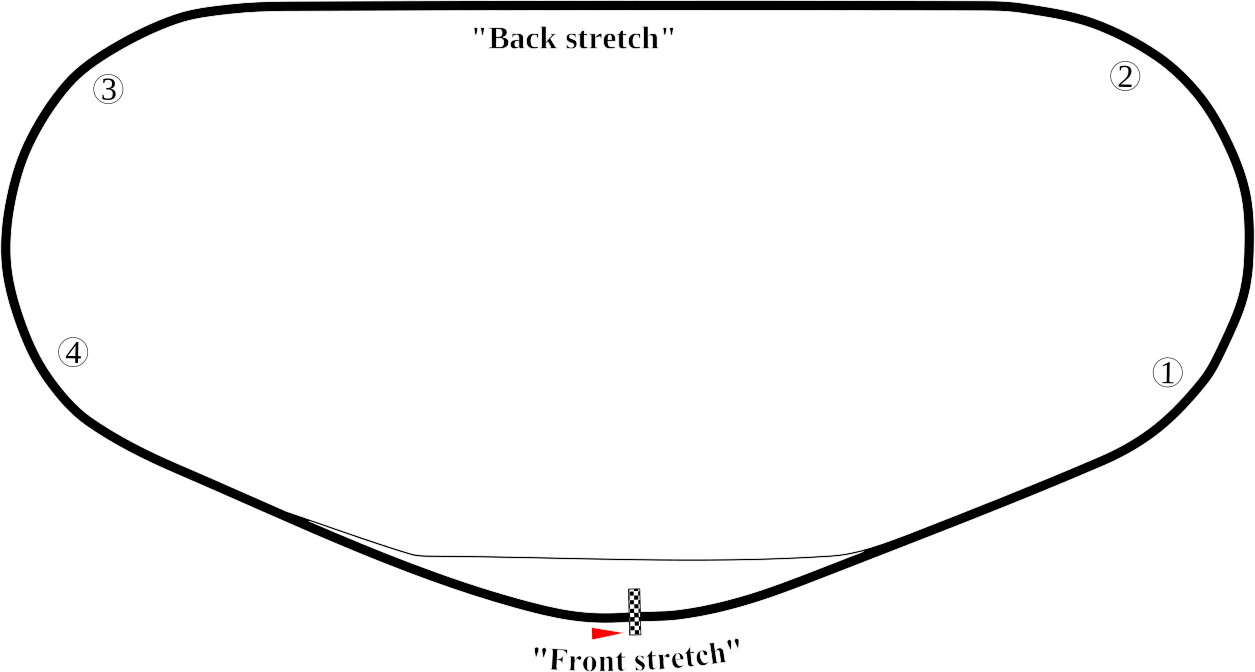
Daytona International Speedway located in Daytona Beach Florida is a...

A star is a self-gravitating luminous plasma spheroid exemplified by...
Trending
3 hours ago Detroit Pistons Fall to Wizards in Hard-Fought Preseason Basketball Matchup
3 hours ago Rashod Bateman Cleared for Week 5 Action After Shoulder Recovery
7 days ago Seahawks Place Running Back Jadarian Price on Injured Reserve
4 hours ago Deebo Samuel Fantasy Football Value and Start Sit Advice for NFL Week 5
4 hours ago Denver Women's Tennis Teams Compete in ITA Mountain Regional Championships
5 hours ago Jameson Williams Critiques His Early Season Performance With Detroit Lions
Popular
Ken Paxton is an American politician and lawyer serving as...

Jameis Winston is an American football quarterback currently playing for...

Cristiano Ronaldo widely considered one of the greatest footballers captains...
Michael Joseph Jackson the King of Pop was a highly...

Elon Musk is a visionary entrepreneur and engineer known for...

Shakira Isabel Mebarak Ripoll the Queen of Latin Music is...