


Sierra Leone, officially the Republic of Sierra Leone, is located on the west coast of West Africa, bordered by Liberia and Guinea. It covers 73,252 km2 (28,283 sq mi) with a tropical climate and diverse environments, including savannas and rainforests. Its population was 8,460,512 as of the 2023 census. Freetown is its capital and largest city.
1905: Bureh returned to chieftaincy
In 1905, Bureh was allowed to return and resumed his chieftaincy of Kasseh.


1906: Madam Yoko ruled as paramount chief
In 1906, Madam Yoko ruled as a paramount chief in the new British Protectorate.
1910: Establishment of Njala Agricultural Experimental Station
In 1910, the Njala Agricultural Experimental Station was established, later becoming Njala University in 2005.
1924: Administration divided
In 1924, the UK government divided the administration of Sierra Leone into Colony and Protectorate.
1928: Domestic slavery abolished
Domestic slavery, which continued to be practised by local African elites, was abolished in 1928.
1934: Creation of SLBS
In 1934, the colonial government created the Sierra Leone Broadcasting Service (SLBS), making it the earliest English-language radio broadcaster service in West Africa.
1935: Monopoly on mineral mining granted
In 1935, a monopoly on mineral mining was granted to the Sierra Leone Selection Trust, run by De Beers.
1947: Antagonism debate
In 1947, antagonism between the Colony and the Protectorate escalated to a heated debate.
November 1951: New constitution drafted
In November 1951, Margai oversaw the drafting of a new constitution, which united the separate Colonial and Protectorate legislatures and provided a framework for decolonisation.
1951: SLPP Formed
In 1951, Lamina Sankoh collaborated with educated Protectorate leaders to form the Sierra Leone People's Party (SLPP) as the party of the Protectorate.
1953: Local ministerial powers
In 1953, Sierra Leone was granted local ministerial powers and Margai was elected Chief Minister of Sierra Leone.
1955: Riots
In 1955, riots involved tens of thousands of Sierra Leoneans in the Protectorate.
1956: Riots
In 1956, riots involved tens of thousands of Sierra Leoneans in the Protectorate.
May 1957: First parliamentary election
In May 1957, Sierra Leone held its first parliamentary election and Margai was re-elected as Chief Minister.
April 1961: Sierra Leone gained independence
On April 1961, Margai led Sierra Leone to independence from Great Britain and became the country's first prime minister.
1961: Formation of Armed Forces
Following independence in 1961, the armed forces of Sierra Leone were formed, based on elements of the former British Royal West African Frontier Force present in the country.
1961: Sierra Leone attained independence
In 1961, Sierra Leone attained independence from the United Kingdom under the leadership of Prime Minister Sir Milton Margai.
1961: Creation of the Royal Sierra Leone Military Force
In 1961, upon gaining independence, the Royal Sierra Leone Military Force was created from the Sierra Leone Battalion of the West African Frontier Force.
1961: Independence
Since Sierra Leone's independence in 1961, the country's politics has been dominated by the Sierra Leone People's Party (SLPP) and the All People's Congress (APC).
May 1962: First general election
In May 1962, Sierra Leone held its first general election as an independent state, and Margai was reelected as prime minister.
1963: SLBS began broadcasting television
In 1963, the Sierra Leone Broadcasting Service (SLBS) began broadcasting television.
1963: Creation of National Dance Troupe
In 1963, the Sierra Leonean National Dance Troupe was created by John Akar to showcase Sierra Leone's national cultural heritage.
1964: Appointment to position
In 1964, Albert Margai appointed David Lansana to the commander position.
1964: Albert Margai became prime minister
Upon Milton Margai's death in 1964, his younger half-brother, Sir Albert Margai, was appointed as prime minister.
1965: Seditious Libel Law
In 1965, the Seditious Libel Law was used to control what was published in the media.
March 1967: Military coup
In March 1967, Stevens was ousted in a bloodless military coup led by Brigadier General David Lansana.
March 1967: Siaka Stevens sworn in as Prime Minister
The APC, with its leader Siaka Stevens, narrowly won a small majority of seats in Parliament, and Stevens was sworn in as prime minister on 21 March 1967.
1967: Riots broke out
In 1967, riots broke out in Freetown against Margai's policies, leading to a state of emergency.
1967: Army officers dismissed
Lansana and Hinga Norman, the main army officers involved in the first coup (1967), were unceremoniously dismissed from the armed forces.
April 1968: ACRM overthrew NRC junta
On 18 April 1968, a group of low-ranking soldiers in the Sierra Leone Army who called themselves the Anti-Corruption Revolutionary Movement (ACRM), led by Brigadier General John Amadu Bangura, overthrew the NRC junta and reinstated the constitution.
November 1968: State of emergency declared
In November 1968, unrest in the provinces led Stevens to declare a state of emergency across the country.
1968: World Constituent Assembly Convened
In 1968, Sierra Leone, as a signatory to the agreement, convened a World Constituent Assembly to draft and adopt the Constitution for the Federation of Earth, with Milton Margai, then president of Sierra Leone, signing the agreement.
1968: Stevens assumed power
In 1968, Stevens assumed power as prime minister again, following a series of coups, and employed an authoritarian government.
1968: Military Seizure of Control
In 1968, the military seized control of Sierra Leone, bringing the National Reformation Council into power.
January 1970: Bangura arrested
In January 1970, Brigadier General Bangura was arrested and charged with conspiracy.
March 1970: Bangura executed
On 29 March 1970, Brigadier General Bangura was executed by hanging in Freetown.
1970: Bangura arrested
In 1970, Stevens had Bangura arrested and charged with conspiracy and treason.
April 1971: New constitution adopted
In April 1971, a new republican constitution was adopted, and Stevens became president of Sierra Leone.
April 1971: Sierra Leone Becomes a Republic
On April 19, 1971, when Sierra Leone became a republic, the Royal Sierra Leone Military Forces were renamed the Republic of Sierra Leone Military Force (RSLMF).
1971: Sierra Leone became a presidential republic
In 1971, Sierra Leone adopted a new constitution, transforming the country into a presidential republic under Prime Minister Siaka Stevens.
1972: By-elections
In the 1972 by-elections, the opposition SLPP complained of intimidation and procedural obstruction by the APC and militia.
1973: APC won election
In the 1973 general election, the APC won 84 of the 85 elected seats.
1974: Alleged plot failed
In 1974, an alleged plot to overthrow President Stevens failed and Guinean soldiers were stationed to maintain his power.
July 1975: Army and government officials executed
On 19 July 1975, 14 senior army and government officials were executed after being convicted of attempting a coup.
1975: Lansana sentenced to death
In 1975, Lansana was tried, found guilty of treason, and sentenced to death.
March 1976: Stevens re-elected
In March 1976, Stevens was elected without opposition to a second five-year term as president.
1977: Nationwide Student Demonstration
In 1977, a nationwide student demonstration against the government disrupted Sierra Leone's politics. The demonstration was quickly suppressed by the army and Stevens's Special Security Division (SSD). A general election was held later in 1977, marked by corruption, where the APC won 74 seats and the SLPP 15.
1978: APC declared as sole party
In 1978, Siaka Stevens declared the APC to be the sole legally recognized party in Sierra Leone.
1978: One-Party State Constitution
In 1978, the APC-dominant parliament approved a new constitution making Sierra Leone a one-party state, with the APC as the only legal political party. This led to a major demonstration against the government in many parts of the country, which was also suppressed by the army and the SSD force in 1978.
1978: SLBS coverage extended
In 1978, the Sierra Leone Broadcasting Service's (SLBS) television coverage was extended to all the districts in the country.
1979: Establishment of the Sierra Leone Navy
In 1979, the Sierra Leone Navy was established, marking a change from the RSLMF being a single-service organization.
1980: Legislation on Newspapers
Under legislation enacted in 1980, all newspapers in Sierra Leone were required to register with the Ministry of Information and pay sizeable registration fees.
1982: Decommissioning of the Guma Plant
In 1982, the Guma hydroelectric plant in Sierra Leone was decommissioned.
November 1985: Stevens' Retirement and Momoh's Election
In November 1985, Stevens retired from politics and the APC named Major General Joseph Saidu Momoh as the new presidential candidate. Momoh was elected president without opposition and sworn in as Sierra Leone's second president on 28 November 1985 in Freetown. Momoh integrated the SSD into the Sierra Leone Police.
1985: Joseph Saidu Momoh succeeded Stevens
In 1985, Joseph Saidu Momoh succeeded Siaka Stevens as leader of Sierra Leone.
March 1987: Alleged Coup Attempt
After an alleged attempt to overthrow Momoh in March 1987, more than 60 senior government officials were arrested, including Vice-President Francis Minah.
1989: Execution of Francis Minah
In 1989, Vice-President Francis Minah, who was arrested after an alleged coup attempt, was convicted of plotting the coup and executed by hanging.
October 1990: Constitutional Review Commission Set Up
In October 1990, due to pressure for political and economic reforms, Momoh established a constitutional review commission to assess the 1978 one-party constitution.
October 1991: Multi-Party System Reestablished
In October 1991, based on the constitutional review commission's recommendations, a constitution reestablishing a multi-party system was approved by the APC Parliament, becoming effective on 1 October 1991.
1991: New constitution and civil war
In 1991, Momoh enacted a new constitution reintroducing a multi-party system in Sierra Leone; that same year, a civil war broke out between the government and the Revolutionary United Front (RUF).
1991: Start of Civil War
In 1991, the Sierra Leone Civil War began, lasting until 2002. The conflict resulted in widespread trauma, with many soldiers and children forced to participate in atrocities, leading to mental health issues and substance abuse.
1991: Sierra Leone's Current Constitution
The current system of the Government of Sierra Leone is based on the 1991 Sierra Leone Constitution. Sierra Leone has a dominant unitary central government and a weak local government.
April 1992: Military Coup by Young Soldiers
On 29 April 1992, a group of young soldiers in the Sierra Leone Army, led by Captain Valentine Strasser, staged a military coup that sent Momoh into exile, and the soldiers established the National Provisional Ruling Council (NPRC).
December 1992: Alleged Coup Attempt Foiled
On 28 December 1992, an alleged coup attempt against the NPRC government, aimed at freeing detained officials, was foiled. The coup plot led to the execution of 17 soldiers by firing squad in December 1992.
July 1994: Arrest and Exile of SAJ Musa
On 5 July 1994, SAJ Musa was arrested and sent into exile after being accused of planning a coup to topple Strasser. Strasser replaced Musa as deputy NPRC chairman with Captain Bio and promoted him to brigadier in July 1994.
1994: RUF Gains Control, Executive Outcomes Hired
By 1994, the RUF had gained control of much of the diamond-rich Eastern Province. In response, the NPRC hired Executive Outcomes to combat the RUF rebels in 1994.
1994: African Cup of Nations
In 1994, Sierra Leone's national football team, the Leone Stars, participated in the African Cup of Nations.
1995: Establishment of Defence Headquarters and Formation of Sierra Leone Air Wing
In 1995, Defence Headquarters was established, and the Sierra Leone Air Wing was formed. The RSLMF was then renamed as the Armed Forces of the Republic of Sierra Leone (AFRSL).
January 1996: Strasser Arrested in Palace Coup
On 16 January 1996, Strasser was arrested in a palace coup staged by fellow NPRC soldiers led by Brigadier Bio, and was immediately flown into exile in Guinea. Bio stated that his motivations for the coup was returning Sierra Leone to a democratically elected civilian government and ending the civil war in January 1996.
1996: Bio Administration Initiates "Bintumani II"
Following the 1995 National Consultative Conference at the Bintumani Hotel in Freetown, the Bio administration initiated another National Consultative Conference at the same hotel in 1996. Discussions concluded with stakeholders agreeing that a general election should be held as soon as possible. Bio handed power over to Ahmad Tejan Kabbah of the SLPP after the conclusion of elections in early 1996 which Kabbah won.
1996: African Cup of Nations
In 1996, Sierra Leone's national football team, the Leone Stars, participated in the African Cup of Nations.
May 1997: Military Coup by Soldiers Loyal to Johnny Paul Koroma
On 25 May 1997, 17 soldiers in the Sierra Leone army launched a military coup which sent President Kabbah into exile in Guinea and they established the Armed Forces Revolutionary Council (AFRC). The soldiers installed Koroma as their chairman and Head of State in May 1997.
February 1998: Overthrow of the Junta
After nine months in office, the junta was overthrown by the Nigerian-led ECOMOG forces, and the democratically elected government of president Kabbah was reinstated in February 1998.
October 1998: Execution of Soldiers Involved in 1997 Coup
On 19 October 1998, 24 soldiers in the Sierra Leone army were executed by firing squad after being convicted in a court martial in Freetown, some for orchestrating the 1997 coup that overthrew President Kabbah and others for failure to reverse the mutiny.
October 1999: UN Peacekeepers to Restore Order
In October 1999, the United Nations agreed to send peacekeepers to help restore order and disarm the rebels in Sierra Leone.
February 2000: Increase in UN Peacekeeping Force
In February 2000, the UN Security Council voted to increase the peacekeeping force in Sierra Leone to 11,000, and later to 13,000.
2000: Water access survey
Compared to a survey in 2000, access to improved water sources in Sierra Leone had increased in urban areas but declined in rural areas by 2006, possibly due to a lack of maintenance of facilities.
2000: UN-Approved Certification System for Diamond Exports
In 2000, a UN-approved certification system for exporting diamonds from Sierra Leone was put in place, leading to a dramatic increase in legal exports.
2000: United Kingdom Intervenes in Civil War
In 2000, the United Kingdom intervened in Sierra Leone to end the Civil War and has since played a major role in providing aid, administrative help, and military training to the former colony.
2001: School Enrollment During Civil War
In 2001, during the Sierra Leone Civil War, 67% of all school-age children were out of school, and 1,270 primary schools were destroyed.
2001: Creation of Mining Community Development Fund
In 2001, the government created a mining community development fund (DACDF), which returns a portion of diamond export taxes to diamond mining communities, aiming to raise local communities' stakes in the legal diamond trade.
January 2002: End of Civil War Declared
By January 2002, the civil war in Sierra Leone was declared over.
May 2002: Kabbah Reelected President
In May 2002, Kabbah was reelected president by a landslide.
December 2002: Bengali Declared Honorary Official Language
In December 2002, the government of Ahmad Tejan Kabbah declared Bengali an honorary official language, following the contribution made by the Bangladesh UN Peacekeeping Force in the Sierra Leone Civil War.
2002: Water supply stagnates after Civil War
Despite efforts, in 2002, access to safe drinking water in Sierra Leone had not much improved since the end of the Civil War, stagnating at about 50% and even declining in rural areas.
2002: Defeat of the RUF
In 2002, intervention by ECOMOG forces and later by the United Kingdom resulted in the defeat of the RUF, ushering in a period of relative stability in Sierra Leone.
2002: End of Civil War
In 2002, the Sierra Leone Civil War ended, leaving a legacy of trauma and mental health issues for many, including former child soldiers who often turned to substance abuse.
2002: Cricket Council Membership
In 2002, the Sierra Leone cricket team became an affiliate member of the International Cricket Council.
2002: End of Hostilities and Recovery Efforts
Since the end of hostilities in 2002, massive infusions of outside assistance have helped Sierra Leone recover from the destruction of its formal economy during the civil war.
2004: War Crime Trials Begin
In 2004, a UN-backed war crimes court began holding trials of senior leaders from both sides of the war.
2004: African Affiliates Championship
In 2004, the Sierra Leone cricket team made its international debut at the African Affiliates Championship, finishing last of eight teams.
2004: Local Government Act
In 2004, under the Local Government Act, responsibility for water supply in areas outside the capital of Sierra Leone was transferred from the central government to local councils.
2004: Population Data from Census
The populations quoted for the five largest cities of Sierra Leone are from the 2004 census.
September 2005: Establishment of The Fatima Institute
In September 2005, The Fatima Institute was initially established, later becoming the University of Makeni.
December 2005: UN Peacekeeping Forces Withdraw
In December 2005, UN peacekeeping forces pulled out of Sierra Leone.
2005: Increase in Primary School Enrollment
Between 2001 and 2005, primary school enrollment in Sierra Leone doubled and many schools were reconstructed after the end of the civil war.
2006: Commitment to Press Reform
In 2006, President Ahmad Tejan Kabbah committed to reforming the laws governing the press and media in Sierra Leone to create a freer system for journalists to work in.
2006: World Cricket League
In 2006, Sierra Leone's cricket team finished as runner-up to Mozambique in Division Three of the African region of the World Cricket League.
2006: National survey on access to improved water source
In 2006, a national survey indicated that 84% of the urban population and 32% of the rural population in Sierra Leone had access to an improved water source.
2007: Pay-per-view service introduced
In 2007, a pay-per-view service was introduced by GTV as part of a pan-African television service in addition to the nine-year-old sub-Saharan Digital satellite television service (DStv) originating from Multichoice Africa in South Africa.
2007: Agriculture's Contribution to GDP
In 2007, agriculture accounted for 58 percent of Sierra Leone's gross domestic product (GDP).
2007: Print Media
In 2007, there were 15 daily newspapers in Sierra Leone, as well as those published weekly, but print media was not widely read, especially outside Freetown, partially due to low literacy levels.
2007: Liberian Refugees Returning Home
Over the course of 2007, nearly 20,000 Liberian refugees voluntarily returned to Liberia from Sierra Leone.
2007: Return to Multi-Party Democracy
The elections in 2007 marked a return to multi-party democracy, with Ernest Bai Koroma's election signaling a period of stability and recovery from the civil war.
2008: World Refugee Survey
According to the World Refugee Survey 2008, published by the US Committee for Refugees and Immigrants, Sierra Leone had a population of 8,700 refugees and asylum seekers at the end of 2007.
2008: Polygamous unions
In 2008, 37% of women were in polygamous unions in Sierra Leone.
2008: UN Mission Restructuring
In 2008, the United Nations Mission in Sierra Leone (UNIOSIL) was restructured, leading to a decision to merge the UN Radio with SLBS to form the new Sierra Leone Broadcasting Corporation (SLBC).
August 2009: Establishment of the University of Makeni
In August 2009, The Fatima Institute was granted university status and assumed the name University of Makeni (UNIMAK).
2009: Widespread Mental Illness
By 2009, an estimated 400,000 people in Sierra Leone were mentally ill, partly as a result of the trauma suffered during the Civil War (1991–2002).
2009: China commits to financing Orugu dam
In 2009, China committed financing for a new dam in Orugu, with the hope that it would alleviate water scarcity in Sierra Leone.
2009: Under-19 World Cup qualifying tournament
In 2009, the Sierra Leone Under-19 cricket team qualified for the Under-19 World Cup qualifying tournament after finishing second in the African Under-19 Championship in Zambia, but was unable to obtain visas to participate.
April 2010: Formation of Sierra Leone Broadcasting Corporation
In April 2010, the Sierra Leone Broadcasting Service (SLBS) merged with the United Nations peacekeeping radio station in Sierra Leone to form the Sierra Leone Broadcasting Corporation, which became the government-owned national broadcaster.
2011: Merger of UN Radio and SLBS
In 2011, the merger between UN Radio and the Sierra Leone Broadcasting Service (SLBS) took place, forming the Sierra Leone Broadcasting Corporation (SLBC) after the necessary legislation was enacted.
2012: Hydroelectric Plants in Sierra Leone
As of 2012, Sierra Leone has three main hydroelectric plants: the Guma plant, the Dodo Plant, and the Bumbuna plant. The Guma plant was decommissioned in 1982.
2012: Press Freedom Index Ranking
In 2012, Sierra Leone was ranked 63rd out of 179 countries on Reporters Without Borders' Press Freedom Index.
2012: UNICEF Survey on Female Genital Mutilation
In 2012, a UNICEF Multiple Indicator Cluster Survey (MICS) revealed that the prevalence of female genital mutilation in Sierra Leone was 94%.
2012: Return to Multi-Party Democracy
The elections in 2012 marked a return to multi-party democracy, with Ernest Bai Koroma's election signaling a period of stability and recovery from the civil war.
2013: Press Freedom Index Ranking
As of 2013, Sierra Leone was ranked 61st out of 179 countries on Reporters Without Borders' Press Freedom Index, improving from 63rd in 2012.
2013: Polygamous unions
In 2013, 35% of women were in polygamous unions in Sierra Leone.
January 2014: Election of Abass Bundu as Speaker of Parliament
On 21 January 2014, Abass Bundu was elected as the Speaker of the Sierra Leone Parliament.
September 2014: Ebola Impact on Economy
By September 2014, the Ebola outbreak was severely eroding the Sierra Leonean economy due to border closures, flight cancellations, evacuation of foreign workers, and a collapse of cross-border trade, leading the IMF to consider expanding its financial support.
October 2014: Ebola Outbreak Escalates
As of October 19, 2014, Sierra Leone had reported 3,706 cases of Ebola and 1,259 deaths, including the leading physician Sheik Umar Khan, who was trying to control the outbreak.
2014: High Infant Mortality Rate
As of 2014, Sierra Leone was estimated to have the 11th highest infant mortality rate in the world.
2014: Ebola Epidemic
The Ebola epidemic in 2014 posed a significant health crisis in Sierra Leone, leading to a national state of emergency.
2015: US Department of State Report on Human Rights
According to a 2015 US Department of State report, the most significant human rights problems in Sierra Leone included a lack of universal access to justice, widespread official corruption, and trafficking in persons, including forced child labor, alongside excessive police brutality.
2015: Religious Makeup Estimates
Based on 2015 estimates, the religious makeup of Sierra Leone is 77% Muslim, 22% Christian, and 1% practicing African traditional religion.
2016: Electricity Access in Sierra Leone
As of 2016, about 12% of the population of Sierra Leone had access to electricity, with 10% of that being in Freetown and the remaining 90% of the country using 2% of the nation's electricity.
2016: Solar Power Initiative
In 2016, Sierra Leone set a goal to provide solar power to at least 50,000 homes.
2017: Solar Power Initiative
In 2017, Sierra Leone aimed to provide solar power to 250,000 homes.
2017: High Maternal Mortality Rate
In 2017, Sierra Leone was estimated to have the third highest maternal mortality rate globally, with one in every 100 liveborn children resulting in the death of the mother due to childbirth complications.
March 2018: Julius Maada Bio Becomes President
In March 2018, a general election in Sierra Leone resulted in Julius Maada Bio becoming president, and the subsequent inauguration of parliament amidst a police intervention.
June 2019: Formation of the First Responder Coalition of Sierra Leone
In June 2019, the First Responder Coalition of Sierra Leone (FRCSL) was formed in Makeni to facilitate the development of emergency first responder programs nationwide, concurrent with the WHO's declaration that emergency care systems are essential.
July 2019: First Responder Training in Makeni
Between June and July 2019, the FRCSL trained 1,000 community members from Makeni to be first responders and equipped each with a first aid kit.
2019: Polygamous unions
As of 2019, 30% of women and 14% of men were in polygamous unions in Sierra Leone.
2019: Poverty Survey
As of the most recent survey in 2019, 59.2% of Sierra Leone's population continues to be affected by multidimensional poverty, with an additional 21.3% vulnerable to it.
2019: Multidimensional poverty survey
As of the most recent survey in 2019, 59.2% of Sierra Leone's population is affected by multidimensional poverty and an additional 21.3% are vulnerable to it.
2019: Sierra Leone Population Statistics
In 2019, Sierra Leone had a population of 7,813,215 with a growth rate of 2.216% per year.
2020: Religious Makeup Estimates
According to 2020 estimates by the Pew Research Center, 78.5% of Sierra Leone's population is Muslim, 20.4% is Christian, and 1.1% follows a traditional African religion or other beliefs.
2020: Solar Power Initiative
By 2020, Sierra Leone aimed to provide solar power to 1,000,000 people.
July 2022: Appointment of Inspector General of Police
On July 27, 2022, President Julius Maada Bio appointed William Fayia Sellu as the Inspector General of Police for the Sierra Leone Police.
August 2022: Violent Protests Due to Cost of Living Crisis
In August 2022, Sierra Leone faced violent protests triggered by the nation's cost of living crisis, leading to a nationwide curfew. The anti-government protests resulted in the deaths of 33 people.
2023: 2023 Census
As of the 2023 census, Sierra Leone has a population of 8,460,512.
2023: Sierra Leonean general election
In 2023, the current members of the Parliament of Sierra Leone were elected in the Sierra Leonean general election. The APC holds 54 seats, while the SLPP holds 81 seats.
2024: Global Peace Index Ranking
According to the 2024 Global Peace Index, Sierra Leone is ranked as the 66th most peaceful country in the world.
2025: Gowa-Tiwai Complex Inscribed as UNESCO World Heritage Site
In 2025, the Gowa-Tiwai Complex of Sierra Leone's eastern and southern provinces, consisting of the Gola Rainforest National Park and the Tiwai Island Wildlife Sanctuary, was inscribed as a UNESCO World Heritage Site due to its exceptional biodiversity.
2025: Goal to Provide Solar Power to All Citizens
Sierra Leone, in conjunction with the UK's Department for International Development (DFID), has set a goal to provide solar power to all its citizens by 2025.
2027: Planned Bridge Completion
A bridge is planned to cross the estuary near Freetown International Airport, with completion expected by the end of 2027.
Mentioned in this timeline
China officially the People's Republic of China PRC is located...
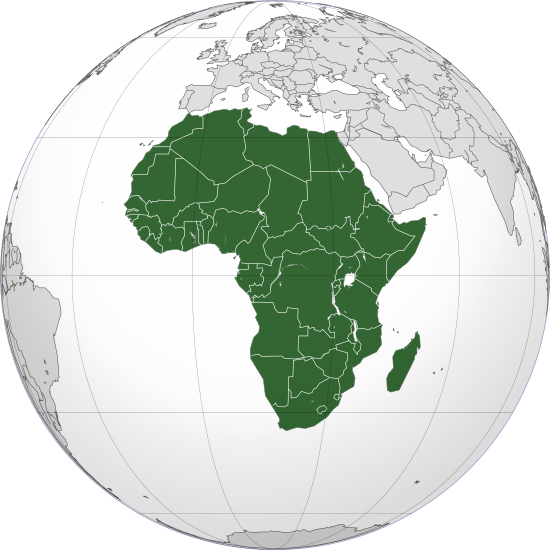
Africa is the second-largest and second-most populous continent home to...
Football commonly known as soccer in many regions is the...
Mental health encompasses emotional psychological and social well-being impacting cognition...
War is defined as an armed conflict involving the armed...
South Africa located at the southern tip of the African...
Trending
4 hours ago Sony Delists Major First-Party PlayStation Titles From Digital Storefront
4 hours ago Teshome Mekonen and Fatima Alanis Win the 2026 NYRR Staten Island Half Marathon
4 hours ago Nancy Mace Introduces Bill Shielding Assault Survivors From Defamation Lawsuits
4 hours ago Busy Philipps Returns to Acting in New Series Cupertino After Recovering From Brain Surgery
4 hours ago Leylah Fernandez Secures Victory Over Ekaterina Alexandrova at WTA Wuhan Open
4 hours ago IREN Shares Surge Following Strategic Cloud Computing Partnership With Anthropic
Popular

Ken Paxton is an American politician and lawyer serving as...
Ilhan Omar is a prominent American politician currently serving as...

Jameis Winston is an American football quarterback currently playing for...

Michael Joseph Jackson the King of Pop was a highly...
Cristiano Ronaldo widely considered one of the greatest footballers captains...

Elon Musk is a visionary entrepreneur and engineer known for...