


Brussels, officially the Brussels-Capital Region, is a region of Belgium consisting of 19 municipalities, including the City of Brussels, which serves as the capital of Belgium. Situated in the central part of the country, it's part of both the French and Flemish Communities but remains distinct from the Flemish Region (Flanders), where it exists as an enclave, and the Walloon Region (Wallonia), located a short distance to the south.
1900: Cantillon Brewery Founded
In 1900, the Cantillon Brewery, a lambic brewery, was founded in Brussels.


1900: Construction of Hôtel Solvay
In 1900, the Hôtel Solvay was built by Victor Horta in Art Nouveau style.
1901: Construction of the Horta Museum
In 1901, the Horta Museum was built by Victor Horta in Art Nouveau style.
1910: Brussels International Exposition of 1910
In 1910, Brussels hosted the Brussels International Exposition.
1910: Increase of monolingual French-speakers
In 1910, family transmission of the historic Brabantian dialect declined, leading to an increase of monolingual French-speakers in Brussels.
1911: Construction of the Stoclet Palace
In 1911, the Stoclet Palace, by the Viennese architect Josef Hoffmann, was built.
1912: Introduction of Pralines
In 1912, pralines were first introduced by Jean Neuhaus II, a Belgian chocolatier of Swiss origin, in the Royal Saint-Hubert Galleries.
November 1918: Street battles in Brussels
In November 1918, Brussels was embroiled in street battles between revolutionary and imperialist soldiers amidst the German Revolution. Explosives left by retreating German troops damaged infrastructure and around 2,300 houses.
1921: Merger into the City of Brussels
In 1921, Laeken, Haren and Neder-Over-Heembeek were merged into the City of Brussels.
1927: Construction of Résidence Palace
In 1927, the Résidence Palace (now part of the Europa building) was constructed in Art Deco style.
1928: Construction of the Centre for Fine Arts
In 1928, the Centre for Fine Arts was constructed in Art Deco style.
1932: Construction of the Church of St. John the Baptist
In 1932, the Church of St. John the Baptist in Molenbeek was constructed in Art Deco style.
1934: Construction of the Villa Empain
In 1934, the Villa Empain was constructed in Art Deco style.
1935: Brussels International Exposition of 1935
In 1935, Brussels hosted the Brussels International Exposition.
1935: Construction of the Church of St. Augustine
In 1935, the Church of St. Augustine in Forest was constructed in Art Deco style.
September 1943: Deadly Bombing in Ixelles
On 7 September 1943, a deadly bombing took place in Ixelles, carried out by the American airforce, killing 282 civilians after accidentally striking an area while trying to aim at SABCA facilities.
September 1944: Liberation of Brussels
On 3 September 1944, Brussels was liberated by the British Guards Armoured Division.
March 1948: Treaty of Brussels
On 17 March 1948, the Treaty of Brussels was signed between Belgium, France, Luxembourg, the Netherlands and the United Kingdom.
1949: NATO Summits
Since 1949, a number of NATO Summits have been held in Brussels.
1952: Completion of the North-South connection
In 1952, the construction of the North–South connection, linking the main railway stations in the city, was completed.
1957: Hosting European Institutions
In 1957, Brussels, along with Luxembourg and Strasbourg, began to host European institutions, becoming the center of activities for the Commission and Council.
1958: 1958 Brussels World's Fair (Expo 58)
In 1958, Brussels hosted the Brussels World's Fair (Expo 58).
1958: Atomium built for the World's Fair (Expo 58)
In 1958, the Atomium was originally built for the World's Fair (Expo 58) on the Heysel Plateau.
1960: Foundation of Eurocontrol
In 1960, the European Organisation for the Safety of Air Navigation (Eurocontrol) was founded.
1964: Municipalities mergers
In 1964, municipalities mergers occurred in Belgium, except the ones now located in the Brussels-Capital Region.
1968: Premetro Tramways
Underground lines known as the premetro have been serviced by tramways since 1968.
1969: Launch of the first premetro service
In 1969, the first premetro (underground tram) service was launched in Brussels.
1970: Municipalities mergers
In 1970, municipalities mergers occurred in Belgium, except the ones now located in the Brussels-Capital Region.
1970: University Split
In 1970, the Free University of Brussels split into the French-speaking Université libre de Bruxelles (ULB) and the Dutch-speaking Vrije Universiteit Brussel (VUB).
November 1971: Election of the council
On 21 November 1971, the only election of the Brussels Agglomeration council took place.
1971: Establishment of the Brussels Agglomeration
In 1971, the Brussels Agglomeration, an administrative division, was established.
1973: UCLouvain Medical Faculties at Woluwe
In 1973, the French-speaking Catholic University of Louvain (UCLouvain) established its medical faculties at UCLouvain Bruxelles Woluwe.
1975: Municipalities mergers
In 1975, municipalities mergers occurred in Belgium, except the ones now located in the Brussels-Capital Region.
1976: Opening of the first Metro line
In 1976, the first Metro line was opened in Brussels.
1976: Brussels Metro Inauguration
The Brussels Metro system was inaugurated in 1976, marking the beginning of rapid transit in the city.
1981: Climate measurement starting year
1981 is the starting year for measurements used to determine the average climate of Brussels, up to 2010.
1985: European Cup Final
In 1985, the King Baudouin Stadium hosted the European Cup Final, which saw 39 deaths due to hooliganism and structural collapse.
June 1989: Formation of the Brussels-Capital Region
On 18 June 1989, the Brussels-Capital Region was formed, following a constitutional reform.
1989: Creation of the Brussels-Capital Region
In 1989, the Brussels-Capital Region was created, becoming officially bilingual in French and Dutch.
1991: Belgian census
At the last Belgian census in 1991, 63.7% of inhabitants in Brussels-Capital Region answered that they were Belgian citizens, born as such in Belgium.
1991: Reform of naturalisation process
Many immigrants were naturalised following the great 1991 reform of the naturalisation process.
1995: Reorganisation of the Province of Brabant
In 1995, upon the reorganisation and split of the Province of Brabant, the Brussels Region ceased to belong to any province.
1998: Grand-Place designated UNESCO World Heritage Site
In 1998, the Grand-Place in Brussels was designated as a UNESCO World Heritage Site.
2000: European Capital of Culture
In 2000, Brussels was named European Capital of Culture alongside eight other European cities.
2000: Dutch Language Percentage
In 2000, Dutch was spoken "well to perfectly" by 33% of the population.
2000: Major Town Houses of the Architect Victor Horta listed as UNESCO World Heritage Site
In 2000, The Major Town Houses of the Architect Victor Horta—Hôtel Tassel (1893), Hôtel van Eetvelde (1898), Hôtel Solvay (1900) and the Horta Museum (1901)—have been listed as a UNESCO World Heritage Site
2000: Inaugural Zinneke Parade
In May 2000, the first Zinneke Parade, a colourful, multicultural parade through the city, was held.
2001: Language diversity in Brussels
In 2001 residents spoke a total of 72 languages, compared to the 104 languages spoken by residents in 2023 and 2024.
2001: Launch of Winter Wonders in Brussels
In December 2001, the "Winter Wonders" were launched in Brussels, animating the heart of the city with winter activities.
2002: European Council fixed seat
Between 2002 and 2004, the European Council also fixed its seat in Brussels.
2003: Car-Sharing Service Introduction
In 2003, Brussels introduced a car-sharing service operated by Cambio, in partnership with STIB/MIVB and Taxi Stop.
2004: European Council fixed seat
Between 2002 and 2004, the European Council also fixed its seat in Brussels.
2004: Election changes
Until 2004, some Dutch-speaking members of the Brussels Parliament were also members of the Flemish Parliament. Afterwards, people voting for a Flemish party had to vote separately for Flemish Parliament members.
2005: Muslim background in Brussels
It was estimated that, in 2005, people of Muslim background living in the Brussels Region numbered 256,220 and accounted for 25.5% of the city's population, a much higher concentration than those of the other regions of Belgium.
2006: Public Bicycle-Sharing Program Introduction
In 2006, a public bicycle-sharing program was introduced in Brussels, later taken over by Villo!.
April 2007: Noctis Night Bus Service Launched
In April 2007, STIB/MIVB launched Noctis, a night bus network operating on Friday and Saturday nights.
2007: MoBIB Smart Card Introduced
In 2007, STIB/MIVB introduced MoBIB, an electronic smart card, replacing paper tickets for public transportation.
2008: Collecto Shared Taxi System
Since 2008, the night-time public transport service has been supplemented by Collecto, a shared taxi system.
June 2009: Stoclet Palace designated a World Heritage Site by UNESCO
In June 2009, the Stoclet Palace, by the Viennese architect Josef Hoffmann, was designated a World Heritage Site by UNESCO.
2009: Lobbying consultancies in Brussels
In 2009, there were an estimated 286 lobbying consultancies known to work in Brussels.
2010: Climate measurement ending year
2010 is the ending year for measurements used to determine the average climate of Brussels, starting from 1981.
2010: Construction of new NATO headquarters
In 2010, construction began on a new €750 million headquarters building for NATO.
2012: Traffic Congestion Ranking
In 2012, Brussels was identified as having the most congested traffic in Europe and North America, according to INRIX.
2012: Zen Car Electric Car-Sharing Scheme Launched
In 2012, the Zen Car electric car-sharing scheme was launched in the university and European areas of Brussels.
2012: Division of Brussels-Halle-Vilvoorde (BHV)
In mid-2012, the Brussels-Halle-Vilvoorde (BHV) arrondissement was divided, separating the Flemish part from the Brussels Region.
December 2013: Unemployment Rate
As of December 2013, the unemployment rate among Brussels residents was 20.4%.
2013: Brussels Agreement
In 2013, Brussels was the site of the Brussels Agreement.
2013: Language diversity in Brussels
In 2013, research indicated that approximately 17% of families in Brussels spoke none of the official languages at home, while in a further 23% a foreign language was used alongside French, showcasing the increasing linguistic diversity of the city.
2014: Abolishment of the Governor office
In 2014, the office of the Governor was formally abolished.
June 2015: Car-Free Boulevards
Since June 2015, a number of central boulevards inside the Pentagon in Brussels have become car-free.
September 2015: Office of the High official
In September 2015, the office of the "High official of the Arrondissement of Brussels-Capital" replaced the Governor.
2015: Religious studies ruling by Belgian Constitutional Court
In 2015, the Belgian Constitutional Court ruled that religious studies could no longer be required in the primary and secondary educational systems.
March 2016: Brussels bombings
On 22 March 2016, coordinated nail bombings were detonated by ISIL at Brussels Airport and Maalbeek/Maelbeek metro station, resulting in 32 victims, three suicide bombers killed, and 330 people injured.
2016: Religious demographics of Brussels
According to a 2016 survey, approximately 40% of residents of Brussels declared themselves Catholics, 30% were non-religious, 23% were Muslim, 3% were Protestants and 4% were of another religion.
2016: GDP per Capita
In 2016, Brussels had the highest GDP per capita of any NUTS 1 region in the EU, at approximately $80,000.
October 2017: Opening of Docks Bruxsel
In October 2017, Docks Bruxsel shopping center opened.
2017: Brussels Tram System Status
As of 2017, the Brussels tram system consists of 17 tram lines, with a total route length of 139 km.
2017: Metro Network Status
As of 2017, the Metro network within the Brussels region has a total of 69 metro and premetro stations.
2017: Sonian Forest UNESCO Inscription
As of 2017, the Sonian Forest, located in the southern part of Brussels, was inscribed as a UNESCO World Heritage Site.
2017: Completion of new NATO headquarters
In 2017, the new €750 million headquarters building for NATO was completed.
September 2018: University Name Change
From September 2018, Saint-Louis University, Brussels started using the name UCLouvain, in conjunction with the Catholic University of Louvain, due to a merger between the two universities.
2019: Saint Verhaegen listed as intangible cultural heritage
Since 2019, Saint Verhaegen, a folkloric student procession, has also been listed as intangible cultural heritage of the Brussels-Capital Region.
2019: Ommegang recognized by UNESCO
Since 2019, the Ommegang, a medieval pageant, has been recognised as a Masterpiece of the Oral and Intangible Heritage of Humanity by UNESCO.
2020: Population of foreign origin
According to Statbel, in 2020, 74.3% of the population of the Brussels-Capital Region was of foreign origin.
2020: Financial Centre Ranking
In 2020, Brussels was ranked as the 34th most important financial centre in the world, according to the Global Financial Centres Index.
2020: Zen Car Ceases Operations
In 2020, the Zen Car electric car-sharing scheme ceased operating in the city of Brussels.
June 2021: NATO Summit
In June 2021, a NATO Summit took place in Brussels.
July 2021: Noctis Service Returns
Noctis services returned on 2 July 2021 after a disruption of over a year due to the COVID-19 pandemic in Belgium.
2023: Racing White Daring Molenbeek back in Belgian Pro League
In 2023, Racing White Daring Molenbeek (RWDM) returned to playing in the Belgian Pro League.
2023: Language diversity in Brussels
Surveys from 2023 to 2024 suggest that 29% of the population speaks only languages other than French and Dutch in the home, while residents speak a total of 104 languages, up from 72 in 2001.
2024: Language diversity in Brussels
Surveys from 2023 to 2024 suggest that 29% of the population speaks only languages other than French and Dutch in the home, while residents speak a total of 104 languages, up from 72 in 2001.
Mentioned in this timeline
Morocco a North African country in the Maghreb region boasts...
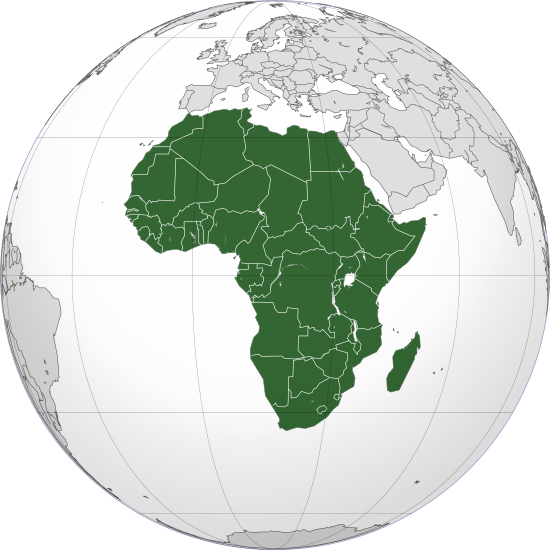
Africa is the second-largest and second-most populous continent home to...
Football commonly known as soccer in many regions is the...
France officially the French Republic is primarily in Western Europe...
A car also known as an automobile is a wheeled...
Turkey officially the Republic of T rkiye is a transcontinental...
Trending
1 month ago Cruz Azul Faces Santos Laguna in Upcoming Liga MX Matchday Clash

4 hours ago Jake Matthews Questionable for Falcons Upcoming Game Against Ravens
4 hours ago Brewers Shortstop Cooper Pratt's Performance Trends During National League Division Series
4 hours ago Andrew Vaughn Replaces Christian Yelich in Brewers Starting Lineup for NLCS Game 1

4 hours ago Mookie Betts and Dodgers Players Encounter Alleged Hauntings at Milwaukee's Pfister Hotel

4 hours ago Jamie Lee Curtis Stars in NBC Newlyweds and Halloween Game Update
Popular

Ken Paxton is an American politician and lawyer serving as...

Jameis Winston is an American football quarterback currently playing for...

Cristiano Ronaldo widely considered one of the greatest footballers captains...

Michael Joseph Jackson the King of Pop was a highly...

Elon Musk is a visionary entrepreneur and engineer known for...

Shakira Isabel Mebarak Ripoll the Queen of Latin Music is...