


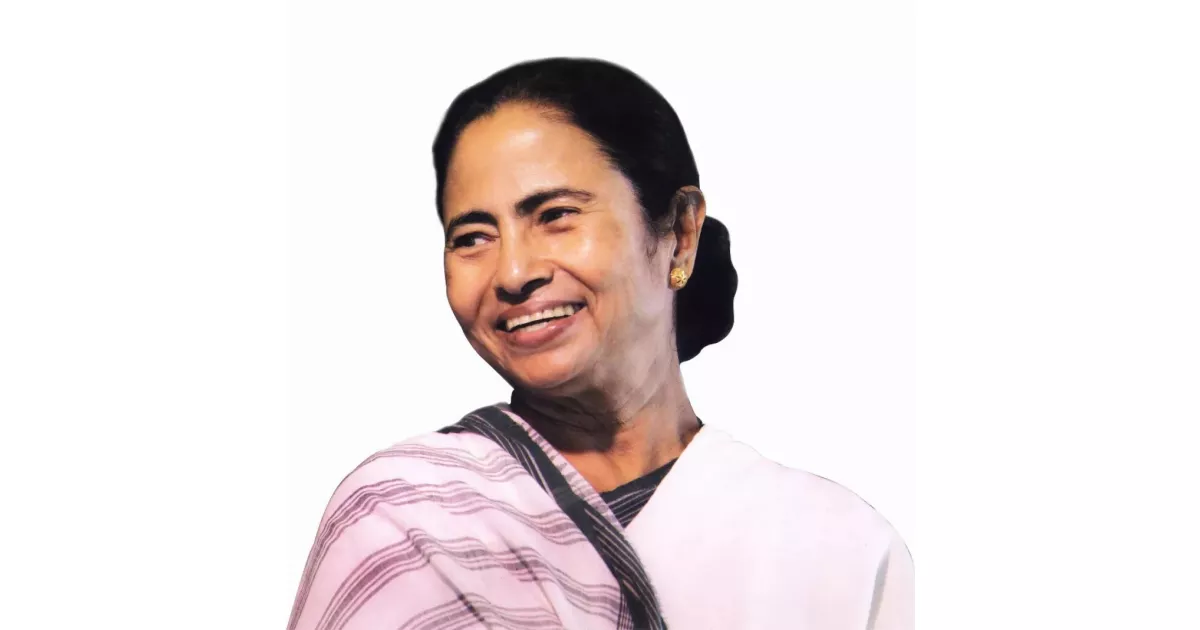
Mamata Banerjee is an Indian politician and lawyer, currently serving as the Chief Minister of West Bengal since 2011, the first woman to hold the position. She is the founder and president of the All India Trinamool Congress. Previously, she served as a Union Cabinet Minister and is the current leader of the house in West Bengal's Legislative Assembly. She is a prominent figure in Indian politics.
January 1955: Mamata Banerjee's Birth
In January 1955, Mamata Banerjee was born. She is an Indian politician and lawyer and is the current chief minister of West Bengal.


1962: First ruling party to win without an ally
In 2016, All India Trinamool Congress became the first ruling party to win without an ally since 1962 in West Bengal.
1967: Prafulla Chandra Sen Lost Election
In 1967, Prafulla Chandra Sen lost an election from his own constituency. Mamata Banerjee was compared to him after losing her seat.
1970: Completed Higher Secondary Education
In 1970, Mamata Banerjee completed her higher secondary board examination from Deshbandhu Sishu Sikshalay.
1975: Protest during the Emergency
In 1975, Mamata Banerjee gained attention by dancing on the car of socialist activist Jayaprakash Narayan as a protest during the Emergency.
1976: General Secretary of Mahila Congress
From 1976 to 1980, Mamata Banerjee served as the general secretary of Mahila Congress (Indira), West Bengal.
1980: Continued as General Secretary of Mahila Congress
In 1980, Mamata Banerjee was the general secretary of Mahila Congress (Indira), West Bengal.
1984: Congress Victory
In 1984, Congress won 16 seats, which was considered their best show in opposition until the 2009 elections.
1984: Elected as Parliamentarian
In the 1984 general election, Mamata Banerjee became one of India's youngest parliamentarians, defeating Somnath Chatterjee to win the Jadavpur parliamentary Constituency in West Bengal. She also became the general secretary of the Indian Youth Congress in 1984.
1989: Lost Parliamentary Seat
In the 1989 general elections, Mamata Banerjee lost her seat to Malini Bhattacharya of the Communist Party of India (Marxist) amidst an anti-Congress wave.
1991: Appointed Union Minister of State
In 1991, Mamata Banerjee was appointed the Union Minister of State for Human Resources Development, Youth Affairs and Sports, and Women and Child Development by Prime Minister P. V. Narasimha Rao.
1991: Re-elected in General Elections
In the 1991 general elections, Mamata Banerjee was re-elected, securing the Calcutta South constituency.
December 1992: Incident at Writers' Building
In December 1992, Mamata Banerjee took a physically challenged girl Dipali Basak, who was allegedly raped by CPI(M) cadre Souvagya Basak, to Writers' Building to the then Chief Minister Jyoti Basu but was harassed by the police before being arrested and put on detention. She vowed to enter the building again only as chief minister.
July 1993: Protest march to Writers' Building
On 21 July 1993, the State Youth Congress, led by Mamata Banerjee, organized a protest march to Writers' Building in Kolkata against the Left Front government. The protest, demanding voter ID cards as the only required document for voting, resulted in the death of thirteen people shot by police.
1993: Discharged of portfolios
In 1993, Mamata Banerjee was discharged of her portfolios.
1994: Ongoing Jammu-Baramulla line project
Since 1994, the Anantnag-Qadigund segment of the Jammu–Baramulla line was in the making.
April 1996: Alleged Congress (I) was behaving as a stooge of the CPI-M
In April 1996, Mamata Banerjee alleged that Congress (I) was behaving as a stooge of the CPI-M in West Bengal, advocating for a "clean Congress".
1996: Retained Kolkata South Seat
In the 1996 general elections, Mamata Banerjee retained the Kolkata South seat.
1997: Left Congress (I) Party
In 1997, Mamata Banerjee left the Congress (I) Party in West Bengal due to differences with Somendra Nath Mitra. She became a founding member of the All India Trinamool Congress.
December 1998: Incident in Lok Sabha
On 11 December 1998, Mamata Banerjee held a Samajwadi Party MP, Daroga Prasad Saroj, by the collar and dragged him out of the Lok Sabha to prevent him from protesting against the Women's Reservation Bill.
1998: Founded All India Trinamool Congress
In 1998, Mamata Banerjee founded the All India Trinamool Congress (AITC) after separating from the Indian National Congress (I).
1998: Retained Kolkata South Seat
In the 1998 general elections, Mamata Banerjee retained the Kolkata South seat.
1999: Joined NDA Government as Railways Minister
In 1999, Mamata Banerjee joined the BJP-led National Democratic Alliance (NDA) government and became Railways Minister.
1999: Retained Kolkata South Seat
In the 1999 general elections, Mamata Banerjee retained the Kolkata South seat.
2000: Resignation and Withdrawal
In 2000, Mamata Banerjee and Ajit Kumar Panja resigned to protest the hike in petroleum prices, and then withdrew their resignations without providing any reasons.
2000: Focused on developing tourism
In 2000, Mamata Banerjee focused on developing tourism, enabling the Darjeeling Himalayan Railway section to obtain two additional locomotives and proposing the Indian Railway Catering and Tourism Corporation Limited.
2000: Presented First Railway Budget
In 2000, Mamata Banerjee presented her first Railway Budget as Railways Minister, fulfilling promises to West Bengal. She introduced new trains such as the New Delhi-Sealdah Rajdhani Express, Howrah-Purulia Rupasi Bangla Express, Sealdah-New Jalpaiguri Padatik Express, Shalimar-Adra Aranyak Express, Sealdah-Ajmer Ananya Superfast Express, and Sealdah-Amritsar Akal Takht Superfast Express. She also increased the frequency of the Pune-Howrah Azad Hind Express.
2001: Became President of AITC
In 2001, Mamata Banerjee became the second president of the All India Trinamool Congress (AITC).
2001: Introduced new trains
In 2001, Mamata Banerjee introduced 19 new trains for the 2000-2001 fiscal year, focusing on India's role in the Trans-Asian Railway and rail links between Bangladesh and Nepal.
2001: Walked out of NDA cabinet
In early 2001, Mamata Banerjee walked out of the NDA cabinet and allied with the Congress Party for West Bengal's 2001 elections, to protest the corruption charges levelled by Tehelka's exposure of Operation West End against senior ministers of the government.
September 2003: Returned to NDA government
In September 2003, Mamata Banerjee returned to the NDA government as a cabinet minister without any portfolio, along with her party colleague Sudip Banerjee.
January 2004: Took Charge as Minister of Coal and Mines
On 9 January 2004, Mamata Banerjee took charge as Minister of Coal and Mines.
May 2004: Held Coal and Mines Portfolios
Mamata Banerjee held the Coal and Mines portfolios until 22 May 2004.
2004: Retained Kolkata South Seat
In the 2004 general elections, Mamata Banerjee retained the Kolkata South seat.
2004: Alliance Lost Election
In the Indian general election of 2004, Mamata Banerjee's party aligned with the Bharatiya Janata Party. However, the alliance lost the election, and she was the only Trinamool Congress member to be elected from a parliamentary seat from West Bengal.
October 2005: Protest Against Land Acquisition
On 20 October 2005, Mamata Banerjee protested against forceful land acquisition and atrocities against local farmers in the name of industrial development by the Buddhadeb Bhattacharjee government in West Bengal, opposing the Salim Group's investment.
2005: Party Lost Control of Kolkata Municipal Corporation
In 2005, Mamata Banerjee suffered setbacks when her party lost control of the Kolkata Municipal Corporation, and the sitting mayor Subrata Mukherjee defected from her party.
August 2006: Resignation Papers Hurled in Lok Sabha
On 4 August 2006, Mamata Banerjee hurled her resignation papers at the deputy speaker Charanjit Singh Atwal in Lok Sabha after her adjournment motion on illegal infiltration by Bangladeshis in West Bengal was rejected.
November 2006: Stopped from Rally in Singur
In November 2006, Mamata Banerjee was forcibly stopped on her way to Singur for a rally against a proposed Tata Motors car project. She protested at the West Bengal assembly, leading to a strike.
December 2006: Began Hunger Strike in Kolkata
On 4 December 2006, Mamata Banerjee began a 26-day hunger strike in Kolkata protesting the forcible acquisition of farmland by the government. She broke her fast at midnight on 29 December after receiving a letter from Prime Minister Manmohan Singh.
2007: Nandigram Violence
In 2007, armed police stormed Nandigram to suppress protests against the government's land acquisition plans for a Special Economic Zone, resulting in the deaths of at least 14 villagers and injuries to 70 more. Allegedly, CPI(M) cadres molested and raped 300 women and girls during the Nandigram invasions.
2009: Alliance with UPA and Railway Minister
In 2009, Mamata Banerjee allied with the United Progressive Alliance (UPA) for the parliamentary elections, securing 26 seats. She then joined the central cabinet as the railway minister for her second tenure.
2009: Second Term as Railway Minister
In 2009, Mamata Banerjee became the railway minister for the second time, focusing again on West Bengal.
2009: Strong Performance in Parliamentary Election
In 2009, Trinamool Congress had a strong performance in the parliamentary election, winning 19 seats. Allies in Congress and SUCI also won, marking the best performance by any opposition party in West Bengal since the Left's regime.
2009: Retained Kolkata South Seat
In the 2009 general elections, Mamata Banerjee retained the Kolkata South seat.
2010: TMC Wins Municipal Elections
In 2010, Trinamool Congress (TMC) won the Kolkata Municipal Corporation by a margin of 62 seats and also secured Bidhan Nagar Corporation by a seven-seat margin.
May 2011: Became Chief Minister of West Bengal
In May 2011, Mamata Banerjee became the chief minister of West Bengal, the first woman to hold the office.
May 2011: Swearing-in as Chief Minister and Land Return to Farmers
On May 20, 2011, Mamata Banerjee was sworn in as the first female chief minister of West Bengal, and one of her first decisions was to return 400 acres of land to Singur farmers.
2011: Landslide victory in West Bengal
In 2011, Mamata Banerjee and the AITC alliance secured a landslide victory in West Bengal, defeating the 34-year-old Communist Party of India (Marxist)-led Left Front government.
2011: Elected to West Bengal Legislative Assembly
In 2011, Mamata Banerjee served as a member of the West Bengal Legislative Assembly from Bhabanipur.
2011: Victory and Chief Minister Position
In 2011, Mamata Banerjee's party achieved a sweeping majority, leading her to assume the position of chief minister of West Bengal, effectively ending the 34-year rule of the Left Front.
2011: Political Activism and Victory
In 2011, Mamata Banerjee's political activism, including writing letters to the Prime Minister and Home Minister to stop the violence in Nandigram, contributed to her landslide victory in the elections.
2011: Victory in West Bengal Assembly Election
In 2011, the All India Trinamool Congress, along with SUCI and the INC, won the West Bengal legislative assembly election against the Left Alliance by securing 227 seats, marking the end of the 34-year-long Left Front government.
February 2012: Praise from Bill Gates for Polio-Free Year
In February 2012, Bill Gates, of the Bill & Melinda Gates Foundation, sent a letter to the West Bengal government praising Mamata Banerjee and her administration for achieving a full year without any reported cases of polio.
June 2012: Presidential Election Support
In June 2012, Mamata Banerjee launched a Facebook page to gather support for A.P.J Abdul Kalam, her party's initial choice for the presidential elections. After Kalam's refusal, she supported Pranab Mukherjee for the post.
September 2012: Named one of the 50 most influential people in finance
In September 2012, Bloomberg Markets magazine listed Mamata Banerjee among the 50 most influential people in the world of finance.
October 2012: Controversial statement on increasing rape incidence
On October 17, 2012, Mamata Banerjee attributed the increasing incidence of rape in the country to "more free interaction between men and women", which sparked criticism in the national media.
2014: Inquiry into 1993 protest
In 2014, an inquiry into the 1993 protest march to Writers' Building, led by Mamata Banerjee, described the police response as "unprovoked and unconstitutional", comparing it to the Jallianwala Bagh massacre.
April 2015: Nadia declared Open Defecation Free district
On April 30, 2015, UNICEF India congratulated the government for making Nadia the first Open Defecation Free district in the country.
2016: All India Trinamool Congress landslide victory
In 2016, All India Trinamool Congress won a landslide two-thirds majority under Mamata Banerjee, winning 211 seats out of total 293. She has been elected as Chief Minister West Bengal for the second term.
2016: Land Acquisition Declared Illegal
In 2016, the Supreme Court declared that the acquisition of 997 acres of land by West Bengal's Left Front government for the Tata Motors plant in Singur was illegal.
2017: Kanyashree Prakalpa Ranked Best by United Nations
In 2017, Kanyashree Prakalpa, a scheme launched by Mamata Banerjee's government, was ranked the best by the United Nations among 552 social sector schemes from across 62 countries.
January 2018: Honorary D.Litt from Calcutta University
In January 2018, Mamata Banerjee received an Honorary D.Litt in Literature from Calcutta University.
2018: Skoch Chief Minister of the Year Award
In 2018, Mamata Banerjee was conferred the Skoch Chief Minister of the Year Award.
April 2019: Public Austerity and Personal Connection with Narendra Modi
In April 2019, it was revealed that Mamata Banerjee maintains a publicly austere lifestyle. Prime Minister Narendra Modi also claimed that Banerjee sends him selected kurtas and sweets every year, despite their political differences.
September 2019: Protest Rally Against NRC
On September 12, 2019, Mamata Banerjee led a protest rally in Kolkata against the National Register of Citizens (NRC) in Assam, claiming it was a 'game plan' to 'divide and rule' Indians.
December 2019: Rally Against NRC and CAA
On December 26, 2019, Chief Minister Mamata Banerjee led a massive rally against NRC and the Citizenship Amendment Act (CAA) from Kolkata's Raja Bazar to Mullick Bazar, criticizing the Modi government.
January 2020: Anti-CAA Protests in Kolkata
In January 2020, Park Circus ground became a major venue for anti-CAA protests in Kolkata, with various personalities, politicians, and social activists joining. P. Chidambaram, Kabir Suman, Umar Khalid, and Yogendra Yadav expressed their support at the venue.
May 2021: AITC Victory and Third Term as Chief Minister
In May 2021, AITC won the assembly elections with a landslide majority, leading to Mamata Banerjee's election as Chief Minister of West Bengal for the third term. She took oath as Chief Minister on May 5, 2021.
September 2021: Included in TIME's 100 Most Influential People
On 15 September 2021, TIME magazine published its annual list of 'The 100 Most Influential People of 2021', which included Mamata Banerjee.
November 2021: Surpassed predecessor as third-longest-serving Chief Minister
On November 30, 2021, Mamata Banerjee surpassed her immediate predecessor Buddhadeb Bhattacharjee to become the third-longest-serving Chief Minister of West Bengal.
2021: Contested and Lost Nandigram Assembly Seat
In 2021, Mamata Banerjee contested the Nandigram assembly seat and lost to Suvendu Adhikari of BJP, although her party won a majority of seats. She challenged the result in Calcutta High Court.
2022: Paschimbanga Akademy Award for Kabita Bitan
In 2022, Mamata Banerjee was given the Paschimbanga Akademy Award for 'Kabita Bitan', a collection of 946 poems written by her.
February 2023: Honorary D.Litt from St. Xavier's University
On 6 February 2023, Mamata Banerjee received an Honorary D.Litt in Literature from St. Xavier's University.
2023: Saradha Scam Allegations
Mamata Banerjee's tenure was marred by the Saradha Scam, involving financial embezzlement and scrutiny of her paintings being sold to firms involved. In 2023, one of her paintings was revealed to have been sold to Sudipto Sen for a large sum. During her tenure she challenged the federal system of India when she ordered the arrest of CBI officials, who arrived in Kolkata to investigate the Saradha Group financial scandal.
February 2024: Sandeshkhali Allegations and Arrest
In February 2024, women in Sandeshkhali village alleged sexual assault and rape by local Trinamool Congress leaders. Mamata Bannerjee was accused of protecting the accused. Sheikh Shahjahan was arrested on February 29, 2024, by the West Bengal police.
August 2025: Launch of Shramashree Scheme
On August 18, 2025, Chief Minister Mamata Banerjee launched the Shramashree scheme, a rehabilitation initiative aimed at Bengali-speaking migrant workers returning to West Bengal following alleged harassment in certain other states. The scheme provides financial aid, food security, health insurance, and educational support.
September 2025: Potential second-female-longest-serving Chief Minister
If Mamata Banerjee remains in office till 22 September 2025, she would also be become the second-female-longest-serving Chief Minister after Sheila Dikshit, superseding J. Jayalalithaa.
October 2025: Potential second-longest-serving Chief Minister
If Mamata Banerjee remains in office at least till 26 October 2025, she would become the second-longest-serving Chief Minister after Jyoti Basu, superseding Bidhan Chandra Roy
November 2025: Enrollment in Shramashree Scheme
Enrollment for the Shramashree scheme will be encouraged through state outreach camps (Duare Sarkar and Amader Para Amader Samadhan-APAS) until early November 2025.
January 2026: ED Raids and Allegations of Obstruction
In January 2026, the Enforcement Directorate (ED) conducted searches at I-PAC offices in Kolkata as part of a money-laundering probe. Chief Minister Mamata Banerjee visited the premises during the operation. The ED accused Banerjee and her party of removing documents and electronic devices, leading to allegations of obstruction of investigation and ongoing litigation.
Mentioned in this timeline

Bill Gates an American businessman and philanthropist revolutionized personal computing...

Founded in by Mark Zuckerberg and his Harvard roommates Facebook...
Poliomyelitis or polio is an infectious disease caused by the...
India officially the Republic of India is a South Asian...

A car also known as an automobile is a wheeled...

Money functions as a fundamental social and economic tool serving...
Trending
5 hours ago No. 8 BYU Faces No. 2 Notre Dame in Highly Anticipated Top Ten College Football Showdown
5 hours ago Protests and Tensions Erupt Across Major French Cities Including Paris
5 hours ago West Indies Champions Defeat Australia to Secure Spot in World Championship of Legends Final
6 hours ago Arnold Schwarzenegger Childhood Home Transformed Into Dedicated Museum in Austria

1 day ago Iga ?wi?tek Competes at Wuhan Open Tournament
1 day ago Austin Faces Major Temperature Drop Following Hot and Humid Week
Popular
Ilhan Omar is a prominent American politician currently serving as...
Ken Paxton is an American politician and lawyer serving as...
Elon Musk is a visionary entrepreneur and engineer known for...

Michael Joseph Jackson the King of Pop was a highly...

Jameis Winston is an American football quarterback currently playing for...

Cristiano Ronaldo widely considered one of the greatest footballers captains...