History of Uganda in Timeline


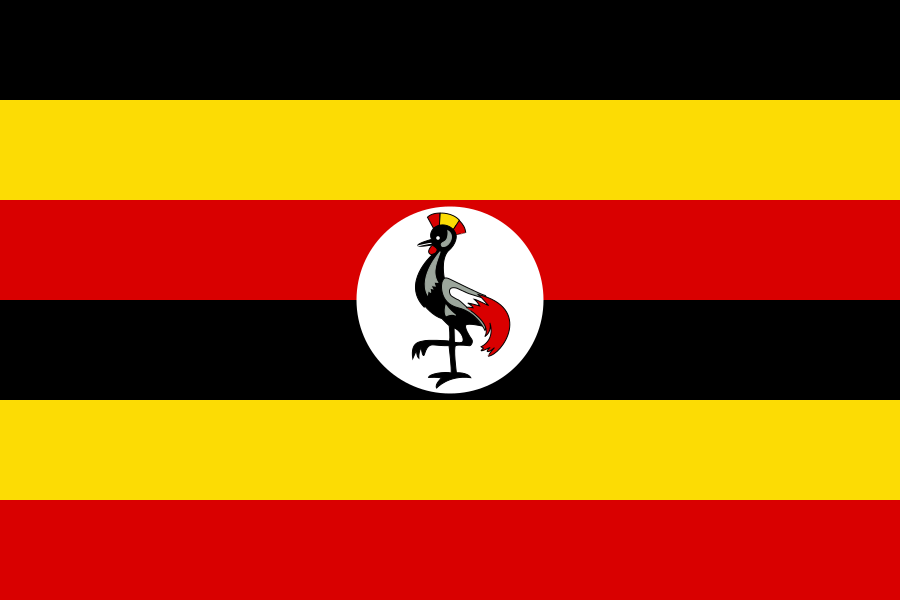
Uganda, officially the Republic of Uganda, is a landlocked country in East Africa bordered by Kenya, South Sudan, the Democratic Republic of the Congo, Rwanda, and Tanzania. A significant portion of Lake Victoria is within its southern borders. Located in the African Great Lakes region and within the Nile basin, Uganda has a varied equatorial climate. As of 2024, its population is estimated at 45.9 million, with Kampala being its capital and largest city, housing 1.8 million people.
2 days ago : Ugandan Military Chief Vows Support for Israel Against Iran, Creating Social Media Buzz.
Uganda's military chief pledged support for Israel against Iran, triggering a viral social media reaction. The commander offered military assistance, stating Uganda would side with Israel in a potential conflict.


1900: Sleeping Sickness Epidemic
From 1900 to 1920, a sleeping sickness epidemic in the southern part of Uganda, along the north shores of Lake Victoria, killed more than 250,000 people.
1900: Treaty with Toro
In 1900, a treaty was signed with the kingdom of Toro as part of the expansion of the Uganda Protectorate.
1901: Treaty with Ankole
In 1901, a treaty was signed with the kingdom of Ankole as part of the expansion of the Uganda Protectorate.
1920: Sleeping Sickness Epidemic
From 1900 to 1920, a sleeping sickness epidemic in the southern part of Uganda, along the north shores of Lake Victoria, killed more than 250,000 people.
1933: Treaty with Bunyoro
In 1933, a treaty was signed with the kingdom of Bunyoro, further expanding the Uganda Protectorate.
October 1962: Uganda Gains Independence
On 9 October 1962, Uganda gained independence from the UK with Queen Elizabeth II as head of state and Queen of Uganda.
1962: End of the Protectorate of Uganda
In 1962, the Protectorate of Uganda, which had been under British rule since 1894, came to an end.
1962: First Post-Independence Election
In 1962, the first post-independence election was won by an alliance between the Uganda People's Congress (UPC) and Kabaka Yekka (KY). Milton Obote became executive prime minister, and Edward Muteesa II held the ceremonial position of president.
October 1963: Uganda Becomes a Republic
In October 1963, Uganda became a republic but maintained its membership in the Commonwealth of Nations.
1964: UPC Delegates Conference in Gulu
In 1964, at the UPC delegates conference in Gulu, Obote began losing control of his party during the battle for the Secretary-General position between Grace Ibingira and John Kakonge.
1964: Government Response to Demands from Buganda Kingdom
In 1964, the government responded to demands from parts of the Buganda Kingdom, leading to a referendum on the "lost counties" that angered the Kabaka and ended the alliance between KY and UPC.
1964: UPC Peak
The UPC reached a peak at the end of 1964 when the leader of the DP in parliament crossed the floor with five other MPs.
February 1966: Obote Assumes Special Powers
In February 1966, Obote arrested Ibingira and other ministers, assumed special powers.
March 1966: Obote Dismisses Kabaka
In March 1966, Obote dismissed the Kabaka by announcing that the offices of President and vice-president would cease to exist.
April 1966: Army Recruitment in Moroto
In April 1966, Obote passed out eight hundred new army recruits at Moroto, with seventy per cent from the Northern Region.
May 1966: Attack on Kabaka's Palace
In May 1966, Obote ordered Idi Amin to attack the Kabaka's palace after the Kabaka requested foreign help and the Buganda parliament demanded that the Uganda government leave Buganda. The Kabaka escaped to exile in London.
1966: UPC Internal Problems
By 1966, the UPC was tearing itself apart due to ethnic, religious, regional, and personal interests, intensified by newcomers from DP and KY.
1966: Obote Suspends Constitution
In 1966, Obote suspended the constitution and removed the ceremonial president and vice-president following a power struggle with King Muteesa.
1966: UPC Fragmentation
In 1966, UPC fragmentation continued, challenging incumbent council leaders at the local level.
1966: Mengo Crisis
In 1966, the Mengo Crisis occurred, marking a conflict with the Buganda kingdom and the country's shift from a parliamentary to a presidential system.
1966: Ochieng's Allegations
In early 1966, Daudi Ochieng accused Obote, Onama, and Neykon of illegally plundering ivory and gold from the Congo, leading to a motion to censure Amin and investigate Obote.
1967: Uganda Declared a Republic
In 1967, a new constitution proclaimed Uganda a republic and abolished the traditional kingdoms, with Obote declared as the president.
1967: Looming National Elections
With national elections looming in 1967, the UPC faced the real possibility of losing power due to the lack of KY support and growing factionalism.
1968: Summer Olympics
From 1968 to 1980, the Uganda national boxing team won four medals at the Summer Olympics.
January 1971: Idi Amin Seizes Power
On 25 January 1971, Idi Amin seized control of Uganda after deposing Obote in a military coup.
1971: Idi Amin's Military Coup
In 1971, Idi Amin led a military coup, initiating a brutal regime marked by mass killings and economic decline.
1972: John Akii-Bua wins Olympic gold
At the 1972 Summer Olympics in Munich, John Akii-Bua won the 400m hurdles race with a world record time of 47.82 seconds, earning the first Olympic gold medal for Uganda.
1972: Expulsion of Ugandan-Asians
In 1972, Idi Amin required the expulsion of Ugandan-Asians (mostly of Indian origin), reducing the population to as low as 7,000.
1972: Simba SC Achievement
In 1972, Simba SC achieved the feat of reaching the final of the African Cup of Champions Clubs.
1974: World Amateur Boxing Championships
In 1974, the Uganda national boxing team won two medals at the World Amateur Boxing Championships.
1975: Cricket World Cup qualification
In 1975, Uganda was part of the East Africa team that qualified for the Cricket World Cup.
June 1976: Entebbe Hostage Crisis
In June 1976, Palestinian terrorists hijacked an Air France flight and forced it to land at Entebbe airport, leading to a hostage crisis.
1978: African Cup of Nations
In 1978, Uganda's best finish in the African Cup of Nations was second.
1980: Summer Olympics
From 1968 to 1980, the Uganda national boxing team won four medals at the Summer Olympics.
January 1986: Museveni Becomes President
In January 1986, Yoweri Museveni became president after his forces toppled the previous regime.
1986: NRM Takes Power
In 1986, Yoweri Museveni's National Resistance Movement (NRM) took power after a six-year guerrilla war.
1986: Agriculture accounted for 56% of the economy
In 1986, agriculture, with coffee as its main export, accounted for 56 per cent of the Ugandan economy.
1986: Museveni begins ruling Uganda
Museveni has ruled Uganda since 1986.
1990: Economic growth
Between 1990 and 2015, Uganda's real gross domestic product (GDP) grew at an average of 6.7% annually, and real GDP per capita grew at 3.3% per annum.
1991: African Cup of Champions Clubs
In 1991, SC Villa reached the final of the African Cup of Champions Clubs.
1992: Poverty Incidence
In 1992, 56 per cent of Uganda's population was living in poverty.
1993: Pope John Paul II visits Uganda
In 1993, Pope John Paul II visited Uganda during his six-day pastoral trip to urge Ugandans to seek reconciliation.
1996: Davis Kamoga wins bronze
In 1996, 400 metres runner Davis Kamoga earned the bronze medal at the Summer Olympics in Atlanta.
1996: Uganda Securities Exchange established
The Uganda Securities Exchange was established in 1996, and the government has used it for privatization, listing all government treasury issues on the exchange.
1997: Davis Kamoga wins silver
In 1997, 400 metres runner Davis Kamoga earned the silver medal at the World Championships.
1997: Universal primary education (UPE) introduced
In 1997, Uganda introduced universal primary education (UPE), leading to significant gains in access to primary education.
1997: Free primary school
In 1997, the Ugandan government declared that primary school would be free for all children.
1998: Ugandan water supply and sanitation sector reforms
Sector reforms in Uganda occurred in the period 1998–2003, including the commercialisation and modernisation of the National Water and Sewerage Corporation.
1998: Invasion of the Democratic Republic of the Congo
Since 1998, Museveni's presidency has been marred by invading and occupying the Democratic Republic of the Congo during the Second Congo War.
1999: Number of children attending primary school
By 1999, six million children were attending primary school in Uganda.
2000: Economic growth in Uganda
Between 2000 and 2003, Uganda experienced an average annual economic growth of 2.5%, but poverty levels increased by 3.8% during that time.
2000: Contraceptive method use
From 2000 to 2011, the percentage of sexually active unmarried women using a modern contraceptive method in Uganda barely changed.
2001: PEAP estimates
According to PEAP estimates, from 2001 to 2015, about US$1.4 billion was needed to increase water supply coverage up to 95 per cent.
2001: Elimination of user fees at state health facilities
In 2001, Uganda eliminated user fees at state health facilities, which resulted in an 80 per cent increase in visits, with over half of this increase coming from the poorest 20 per cent of the population.
2001: Unbundling of energy market segments
Since 2001, Uganda has unbundled its energy market segments, including generation, transmission, and supply.
2002: Religious Affiliation Census
According to the 2002 census, the remainder of the population in Uganda followed traditional religions (1%).
2002: Religious Adherents
In 2002, the Catholic Church in Uganda had the largest number of adherents (41.6%).
2002: Uganda Census
In 2002, the census in Uganda recorded a literacy rate of 66.8%, with 76.8% for males and 57.7% for females.
2002: Population Census Increase
With respect to the census in 2002, Uganda's population increased by 21.7 million people in those 22 years.
2003: Increased poverty levels in Uganda
Between 2000 and 2003, Uganda experienced an average annual economic growth of 2.5%, but poverty levels increased by 3.8% during that time.
2003: Ugandan water supply and sanitation sector reforms
Sector reforms in Uganda occurred in the period 1998–2003, including the commercialisation and modernisation of the National Water and Sewerage Corporation.
2004: Poverty Eradication Action Plan
In 2004, the water and sanitation sector was recognized as a key area under Uganda's Poverty Eradication Action Plan (PEAP), the main strategy paper to fight poverty.
May 2005: British government withholds aid
In May 2005, the British government decided to withhold part of its aid to Uganda due to attacks on political freedom.
July 2005: Constitutional referendum cancels ban on multi-party politics
In July 2005, a constitutional referendum cancelled the nineteen-year ban on multi-party politics in Uganda.
2005: Public spending on education
From 2002 to 2005, public spending on education in Uganda was at 5.2% of the GDP.
2005: Female headed households
In 2005, 26% of Ugandan households were headed by women only, up from previous years as a result of death of men from AIDS.
2005: Dorcus Inzikuru wins 3000 m steeplechase
In 2005, Dorcus Inzikuru won the 3000 m steeplechase at the World Championships.
2005: Swahili approved as second national language
In 2005, Swahili was approved as the country's second official national language.
2005: Parliament abolishes presidential term limits
In 2005, the Ugandan Parliament abolished presidential term limits, allegedly after Museveni paid US$2,000 to each member of parliament who supported the measure.
2005: Release of Feelings Struggle
In 2005, the first publicly recognized film produced solely by Ugandans, 'Feelings Struggle', directed and written by Hajji Ashraf Ssemwogerere, was released, marking a significant year for Ugandan cinema.
February 2006: Condemnation following Besigye's arrest
Before the February 2006 elections, the arrest of opposition leader Kizza Besigye and the siege of the High Court led to international condemnation.
February 2006: Presidential elections held
In February 2006, presidential elections were held in Uganda, with Museveni running against several candidates, including Kizza Besigye.
2006: Uganda water supply coverage
According to a 2006 published report, a comprehensive expenditure framework had been introduced to coordinate financial support by external donors, the national government, and nongovernmental organizations.
2006: Ugandan water supply and sanitation sector progress
According to a 2006 published report, the Ugandan water supply and sanitation sector had made substantial progress in urban areas since the mid-1990s.
2006: Dorcus Inzikuru wins 3000 m steeplechase
In 2006, Dorcus Inzikuru won the 3000 m steeplechase at the Commonwealth Games.
2006: Non-Governmental Organisations (Amendment) Act passed
In 2006, the Non-Governmental Organisations (Amendment) Act was passed, stifling the productivity of NGOs through erecting barriers to entry, activity, funding and assembly within the sector.
2006: Uganda Demographic Health Survey (UDHS)
The 2006 Uganda Demographic Health Survey (UDHS) indicated that roughly 6,000 women die each year from pregnancy-related complications.
2007: Services sector surpasses agriculture
By 2007, the services sector had surpassed agriculture in Uganda, accounting for 52 per cent of GDP.
2007: Universal secondary education (USE) introduced
In 2007, Uganda became the first country in sub-Saharan Africa to introduce universal secondary education (USE).
2007: Newspaper publishes list of allegedly gay men
In 2007, a newspaper, the Red Pepper, published a list of allegedly gay men, leading to harassment of those listed.
2007: Pension sector reform
In 2007, pension sector reform was the center of attention as a means of increasing formal domestic savings in Uganda.
2007: Violations of refugee rights reported
In 2007, the US Committee for Refugees and Immigrants reported several violations of refugee rights in Uganda, including forcible deportations.
2008: Research Funding
Between 2008 and 2010, research funding in Uganda climbed from 0.33% to 0.48% of GDP.
2008: HIV infection rates
By the end of 2008, HIV infection rates in Uganda had fallen to 6.4% of the population, down from 30% in the 1980s.
February 2009: UN official accuses LRA of "appalling brutality"
In February 2009, a UN official accused the Lord's Resistance Army (LRA) of "appalling brutality" in the Democratic Republic of Congo.
September 2009: Museveni refuses king permission to visit Buganda Kingdom
In September 2009, Museveni refused Kabaka Muwenda Mutebi permission to visit some areas of Buganda Kingdom, resulting in riots and over 40 deaths.
October 2009: Anti-Homosexuality Bill considered by parliament
In October 2009, the Ugandan parliament considered an Anti-Homosexuality Bill which would have broadened the criminalisation of homosexuality, including the death penalty in certain cases.
2009: Poverty Reduction
By 2009, Uganda had reduced the countrywide poverty incidence to 24.5 per cent of the population from 56 per cent in 1992.
2009: National Science, Technology and Innovation Policy
The National Science, Technology and Innovation Policy dates from 2009, aiming to strengthen national capability to generate, transfer and apply scientific knowledge.
October 2010: Rolling Stone publishes article
On 9 October 2010, the Ugandan newspaper Rolling Stone published a front-page article titled "100 Pictures of Uganda's Top Homos Leak" with names, addresses, and photographs of 100 homosexuals alongside a banner reading "Hang Them."
2010: East African Common Market Protocol guaranteed
According to the East African Common Market Protocol of 2010, the free trade and free movement of people is guaranteed, including the right to reside in another member country for employment.
2010: Increase in number of researchers
Between 2008 and 2010, the number of researchers in Uganda doubled (in head counts) from 1,387 to 2,823.
2010: Lack of access to improved water source
In 2010, 38 per cent of the Ugandan population still had no access to an improved water source.
2010: Unsafe abortion and maternal deaths
In 2010, the Ugandan Ministry of Health estimated that unsafe abortion accounted for 8% of the country's maternal deaths.
January 2011: David Kato was murdered
On 27 January 2011, gay rights activist David Kato was murdered.
February 2011: Museveni declared winner of the 2011 elections
On 20 February 2011, the Uganda Electoral Commission declared Museveni the winning candidate of the 2011 elections held on 18 February 2011, with 68% of the votes. The opposition condemned the results as fraudulent.
April 2011: "Walk to Work" demonstrations
In April 2011, 9 people were killed during the "Walk to Work" demonstrations.
July 2011: Little League World Series qualification
In July 2011, Kampala, Uganda qualified for the 2011 Little League World Series in Williamsport, Pennsylvania for the first time, beating Saudi Arabian baseball team Dharan LL, although visa complications prevented them from attending the series.
2011: Museveni Elected President
In 2011, Museveni was elected president.
2011: Access to improved sanitation
In 2011, government figures indicated that access to improved sanitation in Uganda was 70 per cent in rural areas and 81 per cent in urban areas.
2011: Contraceptive usage statistics
In 2011, only ≈26% of married women in Uganda used contraceptives, with usage differing substantially between poor (≈15%) and wealthy women (≈40%).
July 2012: Ebola outbreak in Kibaale District
In July 2012, there was an Ebola outbreak in the Kibaale District of Uganda.
August 2012: Anonymous hacks Ugandan government websites over anti-gay bills
Since August 2012, the hacktivist group Anonymous has threatened Ugandan officials and hacked official government websites in protest of anti-gay bills.
September 2012: Allegations of Torture registered
In September 2012, according to a US State Department report, the African Center for Treatment and Rehabilitation for Torture Victims registered 170 allegations of torture against police and 214 against the UPDF.
October 2012: End of Ebola outbreak declared
On 4 October 2012, the Ministry of Health officially declared the end of the Ebola outbreak in Uganda, after at least 16 people had died.
2012: Corruption problem in Uganda
According to the United States Department of State's 2012 Human Rights Report on Uganda, corruption was a severe problem.
2012: Increase in lower secondary enrolment
Between 2007 and 2012, Uganda saw an increase in lower secondary enrolment of nearly 25% due to the introduction of universal secondary education.
2012: Embezzlement of donor funds
In 2012, $12.6 million of donor funds were embezzled from the Office of the Prime Minister, leading to the suspension of aid by several countries.
2012: Poverty in Uganda
In 2012, 37.8 per cent of the population lived on less than $1.25 a day.
2012: Little League World Series attendance
In 2012, Little League teams from Uganda qualified for and attended the Little League World Series.
2012: Stephen Kiprotich wins Olympic marathon
In 2012, Stephen Kiprotich won the marathon at the Summer Olympics in London.
2012: Infant mortality rate
In 2012, Uganda's infant mortality rate was approximately 61 deaths per 1,000 children.
2012: Petroleum Bill passed
In 2012, the Petroleum Bill was passed by parliament. Global Witness reported that Uganda now has "oil reserves that have the potential to double the government's revenue within six to ten years, worth an estimated US $2.4 billion per year."
2012: Uganda listed on Heavily Indebted Poor Countries list
In 2012, the World Bank listed Uganda on the Heavily Indebted Poor Countries list.
2012: Tourism Financial Year
In the financial year of 2012–13, tourism in Uganda contributed 4.9 trillion Ugandan shillings to the GDP.
2012: Pilot studies by Future Health Systems
Pilot studies in 2012 by Future Health Systems have shown that the maternal mortality rate in Uganda could be significantly reduced by implementing a voucher scheme for health services and transport to clinics.
April 2013: Launch of Uganda Vision 2040
In April 2013, Uganda Vision 2040 was launched to transform Ugandan society from a peasant to a modern and prosperous country within 30 years.
August 2013: Tourism Contribution to GDP
As of August 2013, tourism in Uganda contributed 4.9 trillion Ugandan shillings (US$1.88 billion or €1.4 billion) to Uganda's GDP in the financial year 2012–13.
August 2013: Outbreak of Congo Crimean Hemorrhagic Fever
On 16 August 2013, the Health Ministry announced that three people had died in northern Uganda from a suspected outbreak of Congo Crimean Hemorrhagic Fever.
December 2013: Anti-Homosexuality Bill passed
On 20 December 2013, the Anti-Homosexuality Bill was passed.
2013: UNICEF report on FGM
According to a 2013 UNICEF report, only 1 per cent of women in Uganda have undergone female genital mutilation (FGM), with the practice being illegal in the country.
2013: Government failed to investigate killings
According to the Humans Rights Watch 2013 World Report on Uganda, the government has failed to investigate the killings associated with both the September 2009 riots and the April 2011 "Walk to Work" demonstrations.
2013: Use of the Public Order Management Act
In 2013, Freedom of the press has been continually infringed upon through the use of intimidation and the Public Order Management Act.
2013: Stephen Kiprotich wins World Championships marathon
In 2013, Stephen Kiprotich won the marathon at the World Championships.
February 2014: Museveni signs Anti-Homosexuality Bill
On 24 February 2014, President Museveni signed the Anti-Homosexuality Bill into law. On 28 February 2014, the World Bank postponed a US$90 million loan, while the United States said it was reviewing ties with Uganda.
June 2014: Protests in parliament over corruption
In June 2014, protests occurred in Uganda's parliament against high salaries and corruption, including the smuggling of two piglets into the parliament.
August 2014: Anti-Homosexuality Bill ruled invalid
On 1 August 2014, the Constitutional Court of Uganda ruled the Anti-Homosexuality Bill invalid. On 13 August 2014, the Ugandan attorney general dropped plans to appeal.
2014: Religious Affiliation Census
According to the 2014 census, the remainder of the population in Uganda followed traditional religions (0.1 per cent), other religions (1.4 per cent), or had no religious affiliation (0.2 per cent).
2014: Uganda shelters displaced people
By 2014, Uganda was sheltering roughly 400,000 displaced people due to regional conflicts, including the Rwandan genocide, Sudanese civil war, and Congolese wars.
2014: UCC Regulations for Ugandan Television
In 2014, the Uganda Communications Commission (UCC) began preparing regulations mandating that Ugandan television broadcast 70% Ugandan content, with 40% of that being independent productions.
2015: PEAP estimates
According to PEAP estimates, from 2001 to 2015, about US$1.4 billion was needed to increase water supply coverage up to 95 per cent.
2015: Economic growth
Between 1990 and 2015, Uganda's real gross domestic product (GDP) grew at an average of 6.7% annually, and real GDP per capita grew at 3.3% per annum.
2015: Stephen Kiprotich finishes second in Tokyo Marathon
In 2015, Stephen Kiprotich finished second at the Tokyo Marathon.
2015: Uganda's export income
In 2015, Uganda's economy generated export income from coffee, oil re-exports, base metals, fish, maize, cement, tobacco, tea, sugar, hides and skins, cocoa beans, beans, simsim, and flowers.
2015: FIBA Africa Championship Debut
In 2015, Uganda's national basketball team, nicknamed "The Silverbacks", made its debut at the FIBA Africa Championship.
2015: The World Bank's Governance Indicators rank Uganda poorly
In 2015, the World Bank's Worldwide Governance Indicators ranked Uganda in the worst 12 percentile of all countries.
September 2016: Uganda-Tanzania sign deal to build crude oil pipeline
On September 13, 2016, Uganda and Tanzania signed an agreement to construct the 1,445 km Uganda–Tanzania Crude Oil Pipeline (UTCOP), also known as the East African Crude Oil Pipeline (EACOP).
November 2016: Inflation Rate
In November 2016, the Ugandan Bureau of Statistics announced inflation was 4.6 per cent.
2016: Remittances to Uganda
According to the World Bank, in 2016 Uganda received an estimated US$1.099 billion in remittances from abroad, second only to Kenya in the East African Community.
2016: Museveni Elected President
In 2016, Museveni was elected president.
2016: Transparency International rates Uganda's public sector
In 2016, Transparency International rated Uganda's public sector as one of the most corrupt in the world, ranking it 151st out of 176.
2017: Airport Traffic at Entebbe International Airport
In 2017, the airport traffic at Entebbe International Airport was 1.53 million passengers, 8% more than the previous year.
2017: Drop in Inflation
On June 29, 2018, Uganda's statistics agency reported a drop in inflation to 3.4% in the financial year ending 2017/18, compared to 5.7% in the previous financial year.
June 2018: Drop in Inflation
On June 29, 2018, Uganda's statistics agency reported a drop in inflation to 3.4% in the financial year ending 2017/18, compared to 5.7% in the previous financial year.
2018: Telecommunications subscribers in Uganda
As of 2018, Uganda had over 24 million telecommunications subscribers in a population of 48 million, with over 95% of internet connections made using mobile phones.
2018: Asuman Basalirwa became a member of parliament
In 2018, Asuman Basalirwa became a member of parliament from the opposition representing Bugiri Municipality on a Justice Forum party ticket.
2018: Religious Adherents
In 2018, the category of Evangelical/Pentecostal/Born-Again Christians in Uganda showed the most growth, rising to 11.1%.
2019: Adoption of LGBT rights progresses slowly
As of 2019, adoption of LGBT rights on the African continent was slow but progressing with South Africa being the only country where same sex marriages are recognised.
2019: Halimah Nakaayi wins 800 meters race
In 2019, Halimah Nakaayi won the 800 meters race at the World Championships.
2019: Uganda's Forest Landscape Integrity Index score
In 2019, Uganda had a Forest Landscape Integrity Index mean score of 4.36/10, ranking it 128th globally out of 172 countries.
2019: Global Innovation Index Ranking
In 2019, Uganda was ranked 102nd in the Global Innovation Index.
2019: Life expectancy at birth
In 2019, life expectancy at birth in Uganda was estimated to be 63.4 years.
2020: Olympics
As of 2020, Uganda at the Olympics has won a total of two gold, three silver, and two bronze medals, four of which were in boxing and three in athletics.
2020: NCHE listed private accredited universities
As of 2020, the NCHE website listed 46 private accredited universities, including Makerere University, Mbarara University of science and technology, Kyambogo University, Gulu University, Uganda Christian University, and Kampala international University.
January 2021: Museveni re-elected in presidential elections
In January 2021, Museveni won the presidential elections with 58% of the vote, while Bobi Wine had 35%. The opposition challenged the results due to allegations of fraud.
August 2021: Refugee population
According to the UNHCR, as of August 2021, Uganda hosts over 1.4 million refugees, mostly from South Sudan and the Democratic Republic of the Congo.
2021: Museveni Elected President
In 2021, Museveni was elected president.
2022: Uganda divided into regions and districts
As of 2022, Uganda is divided into four Regions of Uganda and 136 districts, with rural areas subdivided into sub-counties, parishes, and villages, and municipal and town councils designated in urban areas.
March 2023: Anti-homosexuality bill tabled in Parliament
In March 2023, Asuman Basalirwa introduced a bill in the Ugandan parliament aiming to punish gay sex and its promotion, claiming it offends Ugandan laws and threatens family sanctity. The parliament speaker, Annet Anita Among, directed the bill to a committee for review and vowed to pass the bill into law to protect Ugandan culture, despite concerns from western countries and donors about morality.
March 2023: Parliament approves anti-homosexuality bill
In March 2023, the Ugandan parliament approved a bill that initially proposed a 20-year prison sentence for identifying as homosexual and the death penalty for "aggravated homosexuality". The bill was later revised, decriminalizing identifying as homosexual.
March 2023: International condemnation of anti-homosexuality bill
In March 2023, the United States, United Kingdom, Canada, Germany, and the European Union strongly condemned Uganda's anti-homosexuality bill, emphasizing that human rights are universal and no one should be attacked or imprisoned for their identity.
2023: Influx of refugees from Sudan
From 2023, over 90,000 refugees fleeing the civil war in Sudan have entered Uganda.
May 2024: New Inspector General of Police
On 18 May 2024, Abbas Byakagaba replaced Geoffrey Tumusiime as the Inspector General of Police (IGP) of the Uganda Police Force.
2024: Population
As of 2024, Uganda's population was measured at 45.9 million.
2024: ICC T20 World Cup Qualification
In 2024, the Uganda national cricket team qualified for the ICC T20 World Cup.
August 2025: Uganda agrees to take in asylum seekers deported from the US
In August 2025, Uganda agreed with the US to take in asylum seekers deported from the US, migrants were to be of African origin and had to have no criminal record.
2025: Global Innovation Index Ranking
In 2025, Uganda was ranked 124th in the Global Innovation Index.
2040: Uganda Vision 2040
Uganda Vision 2040 aims to transform Ugandan society from a peasant to a modern and prosperous country by 2040.
Mentioned in this timeline
Basketball is a team sport played on a rectangular court...
Elizabeth II reigned as Queen of the United Kingdom and...
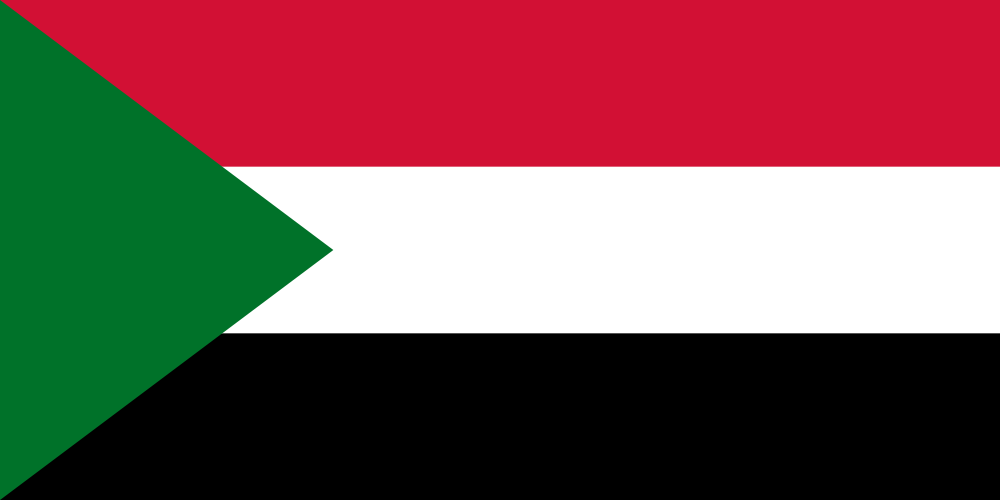
Sudan officially the Republic of the Sudan is a country...
Germany officially the Federal Republic of Germany is a nation...
The Catholic Church the largest Christian church globally with over...
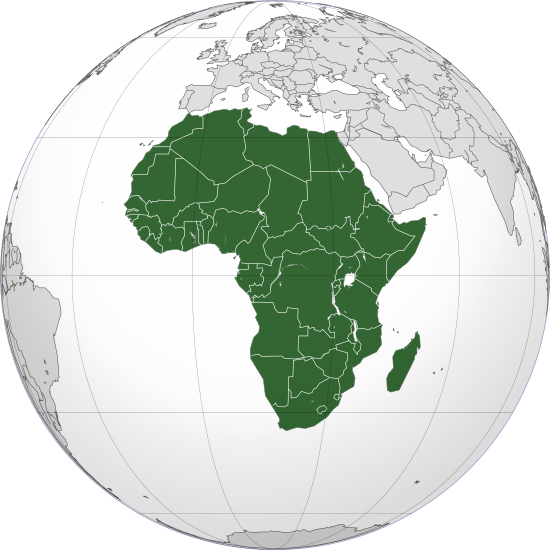
Africa is the second-largest and second-most populous continent home to...
Trending
35 minutes ago Trump Considers Seizing Iranian Oil and Kharg Island; Pentagon Prepares Ground Ops.
36 minutes ago John Hannah Returns: 'The Mummy 4' Reunites Fraser, Weisz, and Hannah!
36 minutes ago Florida AG Challenges NFL's Rooney Rule: Legal Consequences Possible
36 minutes ago AI Facial Recognition Leads to Wrongful Arrest and Imprisonment of Tennessee Woman
36 minutes ago Rising Gas Prices Fueling Increased Interest in Electric Car Ownership and Green Tech.
37 minutes ago FBI Investigates Flight Diversion to Detroit After Passenger Disturbance on American Airlines.
Popular
Sir David Attenborough is a highly influential British broadcaster biologist...
William Franklin Graham III commonly known as Franklin Graham is...
XXXTentacion born Jahseh Dwayne Ricardo Onfroy was a controversial yet...
Chuck Schumer is the senior U S Senator from New...
Cristiano Ronaldo known as CR is a Portuguese professional footballer...
Kelsey Grammer is a highly acclaimed American actor best known...