History of Wisconsin Elections Commission in Timeline


The Wisconsin Elections Commission is a bipartisan regulatory agency in Wisconsin responsible for administering and enforcing the state's election laws. Established in 2015 and operational since June 30, 2016, it was created by the Wisconsin Legislature alongside the Wisconsin Ethics Commission to handle campaign finance, ethics, and lobbying regulations. These two commissions replaced the former Wisconsin Government Accountability Board (GAB). The Elections Commission plays a vital role in ensuring fair and legal election processes within the state.
December 16, 2015: Wisconsin Act 118 Signed Into Law
On December 16, 2015, Governor Scott Walker signed 2015 Wisconsin Act 118 into law, which created the Wisconsin Elections Commission and the Wisconsin Ethics Commission.


June 30, 2016: Wisconsin Elections Commission Begins Operation
On June 30, 2016, the Wisconsin Elections Commission formally began operation, replacing the Wisconsin Government Accountability Board. This marked a significant change in the administration and enforcement of election laws in the state.
November 25, 2016: Commission Receives Petition for Recount
On November 25, 2016, the Wisconsin Elections Commission received a petition from Green Party presidential nominee Jill Stein requesting a hand recount of the votes from the 2016 presidential election in the state.
March 2, 2018: Meagan Wolfe Appointed Interim Administrator
On March 2, 2018, Meagan Wolfe was appointed as the interim administrator of the Wisconsin Elections Commission. She was later unanimously confirmed by the Wisconsin Senate.
May 15, 2019: Meagan Wolfe Confirmed as Administrator
On May 15, 2019, Meagan Wolfe was unanimously confirmed by the Wisconsin Senate as the administrator of the Wisconsin Elections Commission for a term ending June 30, 2023.
December 17, 2019: Circuit Court Orders Voter Roll Purge
On December 17, 2019, presiding circuit court judge Paul V. Malloy ordered the Wisconsin Elections Commission to remove registrations of voters suspected of moving. This order was part of a lawsuit filed by the Wisconsin Institute for Law and Liberty (WILL).
January 2, 2020: WILL Seeks Contempt Charges Against Elections Commission
On January 2, 2020, the Wisconsin Institute for Law and Liberty (WILL) asked the circuit court to hold the Elections Commission in contempt and fine it up to $12,000 daily for not complying with the order to remove voters from the rolls.
January 12, 2020: Democrats on Elections Commission Held in Contempt
On January 12, 2020, Judge Malloy found the three Democrats on the Elections Commission in contempt of court, ordering them each to pay a fine of $250 daily until they complied with his order regarding the voter roll purge.
April 2020: Controversy Over Spring Election Administration
In April 2020, controversies surrounded the administration of the Spring election, specifically concerning the expansion of vote-by-mail opportunities in response to the COVID-19 pandemic. Allegations of fraud related to absentee ballots were raised.
November 2020: Controversies Surrounding the Presidential Election
In November 2020, controversies surrounded the presidential election, with former President Donald Trump and his allies stoking fears of election fraud and seeking to blame the Wisconsin Elections Commission after his election loss.
January 6, 2021: Attempt to Challenge Wisconsin's Electoral Votes
On January 6, 2021, Trump's allies sought extralegal options to challenge Wisconsin's legitimate electoral votes during the counting and certification of electoral votes in Congress, including the designation of a fraudulent slate of presidential electors. Robert Spindell, a Wisconsin Elections Commission commissioner, was one of the fraudulent electors.
January 20, 2021: Controversies Continue After Presidential Inauguration
Even after the inauguration of the new president on January 20, 2021, controversies related to the 2020 election continued, with calls from state Republicans for changes to election law and proposals to dissolve and replace the Wisconsin Elections Commission.
May 2021: Prehn's Term Expired
In May 2021, the term of Frederick Prehn, a member of the state Board of Natural Resources expired, leading to the State ex rel. Kaul v. Prehn case, which had implications for the WEC administrator's term.
May 2023: Joseph Czarnezki Appointed
In May 2023, Joseph Czarnezki had been serving on the commission in an acting capacity since the mid-term resignation of Julie Glancey.
June 2023: Wolfe's Term Expiration and Renomination Controversy
In June 2023, as Meagan Wolfe's term as administrator was set to expire, Republicans sought to remove her. However, Democrats short-circuited this plan by abstaining from the renomination vote.
June 27, 2023: Commission Vote on Wolfe Reappointment Deadlocks
On June 27, 2023, a commission vote to reappoint Meagan Wolfe deadlocked, likely resulting in her continuing to serve as acting administrator, as Democrats on the commission abstained, preventing the nomination from going to the State Senate.
June 30, 2023: Meagan Wolfe's Term Expires
On June 30, 2023, Meagan Wolfe's term as administrator was set to expire. A deadlocked vote on her reappointment means she likely continues as acting administrator.
October 2023: Former Justices Speak Out Against Impeachment
In early October 2023, two conservative former Wisconsin Supreme Court justices spoke out against using impeachment for partisan political purposes, leading Republicans to appear to back away from impeachment threats against Meagan Wolfe.
December 23, 2023: Wisconsin Supreme Court Rules Legislative Maps Unconstitutional
On December 23, 2023, the Wisconsin Supreme Court issued its opinion in Clarke v. Wisconsin Elections Commission, holding that the state legislative maps violated the Constitution of Wisconsin.
January 10, 2024: Judge Rules on Wolfe's Status
On January 10, 2024, Dane County circuit judge Ann Peacock ruled that Meagan Wolfe was lawfully holding over as administrator, that the vote on her renomination was invalid, and that the state Senate vote to reject her "renomination" had no legal weight.
Mentioned in this timeline

Donald John Trump is an American politician media personality and...

Impeachment is a formal process where a legislative body brings...
A supreme court the highest court in a legal jurisdiction...
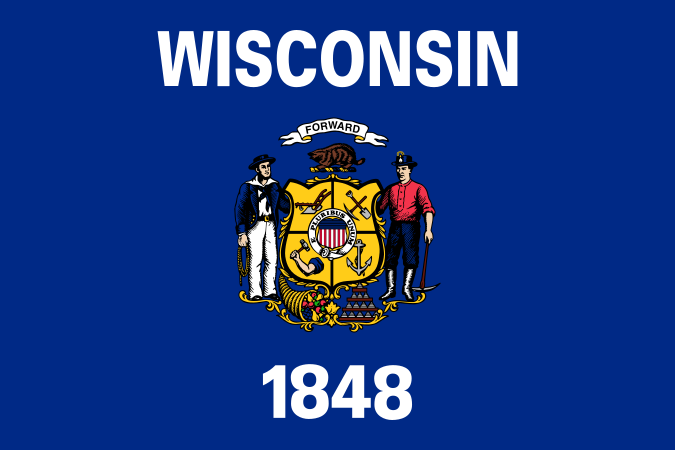
Wisconsin located in the Upper Midwest and Great Lakes regions...
A constitution serves as the foundational legal document for any...
An election is a structured decision-making process where a population...
Trending

5 hours ago Aryna Sabalenka Dominates Renata Zarazua in Beijing Open Opener
4 hours ago Crystal Lake Prequel Series and NYCC Experience Announced

4 hours ago Carlos Alcaraz Overcomes Challenges with Tactical Adjustments at the Japan Open
4 hours ago Macklemore Announces Sold Out Free Palestine Concert Tour

4 hours ago Colin Jost and Pete Davidson Host Comedy Show on Staten Island Ferry

4 hours ago Alex Rodriguez Shares Bold MLB Playoff and World Series Predictions
Popular

Jameis Winston is an American football quarterback currently playing for...

Ken Paxton is an American politician and lawyer serving as...

Shakira Isabel Mebarak Ripoll the Queen of Latin Music is...

Elon Musk is a visionary entrepreneur and engineer known for...

Sylvester Stallone is an iconic American actor screenwriter and filmmaker...

Bernie Sanders is a prominent American politician and the senior...