


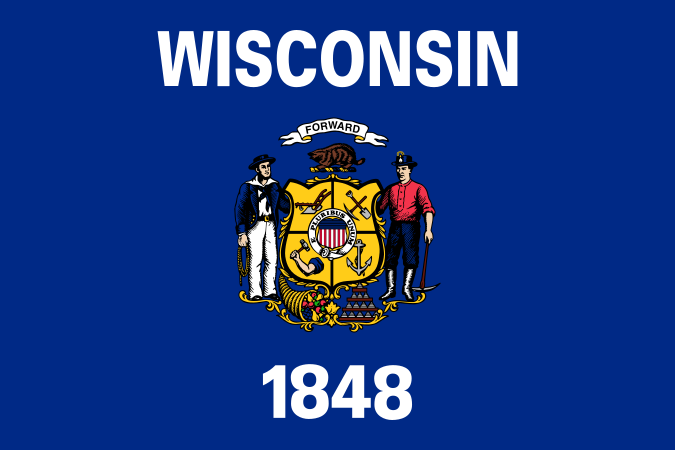
Wisconsin, located in the Upper Midwest and Great Lakes regions, borders Minnesota, Iowa, Illinois, Lake Michigan, Michigan, and Lake Superior. With around 6 million residents and an area of approximately 65,500 square miles, it ranks as the 20th-largest state by population and 23rd by area. The state comprises 72 counties. Milwaukee is its most populous city, while Madison serves as the capital and second-most populous city. Other notable urban centers include Green Bay and the Fox Cities.
1900: Immigrant Wave
Between 1850 and 1900, immigrants were mostly Germans, Scandinavians (the largest group being Norwegian), Irish, and Poles.


1901: Robert M. La Follette as Governor
In 1901, Robert M. La Follette began his service as governor of Wisconsin, holding the position until 1906.
1901: Brewers' first season
In 1901, the first team called the Brewers played only one season before becoming the St. Louis Browns.
1903: Milwaukee Mile opens
In 1903, the Milwaukee Mile, an oval track, opened and became the oldest operating motorsports venue in the world.
1906: Robert M. La Follette as U.S. Senator
In 1906, Robert M. La Follette began his service as U.S. Senator, a role he held until 1925.
1909: Marquette University becomes coeducational
In 1909, Marquette University became the world's first coeducational Catholic university.
1910: Wisconsin Ranks 8th in Product Value
By 1910, Wisconsin ranked 8th among U.S. states in total product value, driven by manufacturing industries in cities like Milwaukee.
1910: Emil Seidel elected mayor of Milwaukee
In 1910, Emil Seidel was elected mayor of Milwaukee, becoming the first socialist mayor of a large city in the United States.
1914: Progressive Reforms
By 1914, Progressive Republicans in Wisconsin had established the nation's first comprehensive statewide primary election system, workplace injury compensation law, and state income tax.
1921: Packers join the NFL
In 1921, The Green Bay Packers became part of the NFL.
1925: End of La Follette's Senate Term
In 1925, Robert M. La Follette's term as U.S. Senator concluded after serving since 1906.
1926: United States Numbered Highways Designated
In 1926, the designation of fourteen United States Numbered Highways in Wisconsin began, and continued until the mid-1930s.
1927: Races held at oldest operating velodrome
Since 1927, races have been held every year at Wisconsin's oldest operating velodrome in Kenosha.
1932: Unemployment Compensation Program
In 1932, UW economics professors John R. Commons and Harold Groves helped Wisconsin create the United States' first unemployment compensation program.
1934: Wisconsin v. Michigan Border Dispute
In 1934, the first of two cases, Wisconsin v. Michigan, was filed to settle a border dispute.
1935: Social Security Act
In 1935, Wisconsin Idea scholars at the University of Wisconsin generated the plan that became the New Deal's Social Security Act.
1935: Wisconsin v. Michigan Border Dispute
In 1935, the second of two cases, Wisconsin v. Michigan, was filed to settle a border dispute.
July 13, 1936: Highest Temperature Recorded
On July 13, 1936, the highest temperature ever recorded in Wisconsin was in the Wisconsin Dells, reaching 114 °F (46 °C).
1938: Philip La Follette's Reelection Loss
In 1938, Philip La Follette lost reelection as governor to Julius P. Heil, facing scandal and accusations of authoritarianism, and subsequently left politics to serve in World War II.
1940: African Americans in Milwaukee
African Americans came to Milwaukee, especially from 1940 on.
1940: Wisconsin becomes "America's Dairyland"
In 1940, Wisconsin's prominence in the dairy industry led to the state being officially known as "America's Dairyland", which was made the official state slogan.
1940: "America's Dairyland" on license plates
Since 1940, Wisconsin's license plates have read "America's Dairyland", reflecting the state's prominence in dairy farming.
1945: Balance between Republicans and Democrats
Since 1945, Wisconsin has maintained a close balance between Republicans and Democrats.
1946: La Follette Jr. Lost Senate Election
In 1946, Robert La Follette Jr. rejoined the Republican Party of Wisconsin to run in the Senate election but narrowly lost to Joseph McCarthy in the Republican primary.
1949: Chinese Communist Revolution
After the Chinese Communist Revolution of 1949, public opinion in Wisconsin began to continue move toward support for the protection of democracy and capitalism against Communist expansion.
1953: Braves move to Milwaukee
In 1953, the now-Atlanta Braves franchise moved from Boston to Milwaukee.
1956: Interstate Highway System Construction
In 1956, the first part of Wisconsin's Interstate Highway system was constructed, consisting of five primary routes and three auxiliary routes.
1957: Braves win World Series
In 1957, the Milwaukee Braves won the World Series.
1957: Badger Named State Animal
In 1957, the badger was officially named Wisconsin's state animal, solidifying its symbolic representation of the state's heritage.
1965: Braves leave Milwaukee
August 1970: Sterling Hall Bombing
In August 1970, during radical protests against the Vietnam War at UW-Madison, an attack by anarchists culminated in the Sterling Hall bombing.
1982: Democrats win all statewide offices
In 2018, Democrats won all constitutional statewide offices on the ballot, the first time this happened in Wisconsin since 1982.
1984: Last time Wisconsin voted for Republican
Since 1984, it's the first time Wisconsin voted for a Republican presidential nominee.
1992: Blue Wall Presidential Elections
Wisconsin was part of the blue wall, a group of states the Democratic Party won in each presidential election from 1992 to 2012.
1996: Lowest Temperature Recorded
In 1996, specifically on February 2 and 4, the lowest temperature ever recorded in Wisconsin was in Couderay, reaching −55 °F (−48 °C).
2001: Brewers play in American Family Field
Since 2001, the Milwaukee Brewers have played in American Family Field in Milwaukee.
2003: DUI offenses lowered
In 2003, DUI offenses in Wisconsin were lowered to a BAC of 0.08 due to federal government pressure.
2004: PGA Championship at Whistling Straits
In 2004, the PGA Championship was held at Whistling Straits golf club in Sheboygan.
January 1, 2008: Wisconsin estate tax decoupled
Until January 1, 2008, Wisconsin's estate tax was decoupled from the federal estate tax laws, imposing its own estate tax on certain large estates.
2008: Deer Population Projection
In 2008, the Wisconsin Department of Natural Resources projected the pre-hunt deer population to be between 1.5 and 1.7 million.
2009: Minimum Wage
Since 2009, Wisconsin's minimum wage has been $7.25, the same as the federal rate.
2009: FBI Crime Statistics
Statewide FBI Crime statistics for 2009 include 144 murders/non-negligent manslaughter; 1,108 rapes; 4,850 robberies; 8,431 aggravated assaults; and 147,486 property crimes.
2010: PGA Championship at Whistling Straits
In 2010, the PGA Championship was held at Whistling Straits golf club in Sheboygan.
2010: Population Increase Since 2010 Census
Since the 2010 United States census, the population of Wisconsin increased by 2.4%.
2011: Cities With Population 50,000+
As of 2011, there were 12 cities in Wisconsin with a population of 50,000 or more, accounting for 73% of the state's employment.
2011: Wisconsin Act 10
In 2011, Governor Scott Walker proposed and enacted 2011 Wisconsin Act 10, which made significant changes to collective bargaining, compensation, retirement, health insurance, and sick leave for public sector employees, leading to major protests.
2011: Democratic backsliding
Some have argued the state has experienced democratic backsliding since 2011.
2012: Walker Recall Election and Ryan Nomination
In 2012, Scott Walker survived a recall election, becoming the first U.S. governor to do so, and Paul Ryan became the first Wisconsinite on a major party ticket as Mitt Romney's running mate in the 2012 United States presidential election.
2012: Paul Ryan on ticket
Wisconsin Congressman Paul Ryan was the Republican vice-presidential nominee in the 2012 election, alongside Mitt Romney.
2012: Blue Wall Presidential Elections
Wisconsin was part of the blue wall, a group of states the Democratic Party won in each presidential election from 1992 to 2012.
2013: Kringle becomes state pastry
In 2013, Kringle, a sweet flaky pastry, was made the official state pastry of Wisconsin.
2014: Republicans hold statewide offices
Following the 2014 general elections, the governor, lieutenant governor, attorney general, and treasurer were all Republicans, while the secretary of state was a Democrat.
March 30, 2015: WIAC claims 107th NCAA Championship
As of March 30, 2015, the Wisconsin Intercollegiate Athletic Conference had claimed 107 NCAA national championships in 15 different sports.
2015: Renewable energy goal met
By the end of 2015, Wisconsin met its mandate that ten percent of its electrical energy come from renewable sources.
2015: Paul Ryan Elected Speaker of the House
In 2015, Congressman Paul Ryan was elected Speaker of the House.
2015: Manufacturing jobs and employment decline
In 2015, Wisconsin had approximately 500,000 manufacturing jobs, similar to 1970. However, manufacturing declined to 14% of total employment.
2015: Interstate Highway Expansion
In 2015, Wisconsin's Interstate Highway system expanded with the addition of I-41.
2015: PGA Championship at Whistling Straits
In 2015, the PGA Championship was held at Whistling Straits golf club in Sheboygan.
July 1, 2016: Mexican consulate opens in Milwaukee
On July 1, 2016, a Mexican consulate opened in Milwaukee.
2016: Trump wins Wisconsin
In 2016, Trump won Wisconsin by a similarly narrow margin of 0.77%, the first time the state voted for a Republican presidential nominee since 1984.
2018: Democrats win all statewide offices
In 2018, Democrats won all constitutional statewide offices on the ballot, the first time this happened in Wisconsin since 1982.
2018: The Hop Streetcar System Begins Service
In 2018, The Hop, a modern streetcar system in Milwaukee, began service. The initial line runs from Milwaukee Intermodal Station to Burns Commons.
January 7, 2019: Tony Evers assumes office
On January 7, 2019, Tony Evers assumed office as the Governor of Wisconsin.
July 1, 2019: Population Estimate
On July 1, 2019, the United States Census Bureau estimated the population of Wisconsin was 5,822,434.
2020: Congressional reapportionment
Following the 2020 census reapportionment, Wisconsin has eight seats in the U.S. House of Representatives.
2020: Biden wins Wisconsin
In 2020, Democrat Joe Biden won Wisconsin by a narrow margin of 0.63%.
2020: Wisconsin's Gross Domestic Product
In 2020, Wisconsin's gross domestic product was $348 billion.
2020: Ryder Cup at Whistling Straits
In 2020, the Ryder Cup golf competition between USA and Europe was held at Whistling Straits in Sheboygan.
2020: Wisconsin ranked for voting ease
In a 2020 study, Wisconsin was ranked as the 25th easiest state for citizens to vote in.
2020: Religion Denominations
Per the Association of Religion Data Archives' 2020 study, Catholicism was the single-largest denomination with 1,237,342 adherents, followed by the Evangelical Lutheran Church in America with 316,245 members and the Wisconsin Evangelical Lutheran Synod with 209,788 adherents.
2021: Marine Sanctuary Established
In 2021, the Wisconsin Shipwreck Coast National Marine Sanctuary was established in Lake Michigan.
2021: Tourism generates billions
In 2021, tourism in Wisconsin generated $20.9 billion in total economic impact, becoming the state's third-largest sector.
2022: Homeless Population Estimate
According to HUD's 2022 Annual Homeless Assessment Report, there were an estimated 4,775 homeless people in Wisconsin.
2022: Religion Survey
According to Public Religion Research Institute's 2022 American Values Survey, those identifying with a religion or spiritual tradition were approximately 75% of the state's population.
2022: Largest European Ancestry Groups
In 2022, the five largest European ancestry groups in Wisconsin were German, Irish, Polish, English, and Norwegian.
2022: Per Capita Personal Income
In 2022, the per capita personal income in Wisconsin was $61,475, and $66,596 when adjusted by regional price parity.
2023: Gross State Product
In 2023, Wisconsin's gross state product was $413.966 billion.
2023: Legislative gerrymander overturned
In 2023, the Wisconsin Supreme Court overturned the legislative gerrymander in the ruling of Clarke v. Wisconsin Elections Commission.
2023: UW Campus Closures
Since 2023, five University of Wisconsin branch campuses have closed, one has gone entirely online, and one has stopped using several of its buildings, raising concerns about the Wisconsin Idea's future.
2024: Road America hosts racing events
As of 2024, Road America hosts races in the IndyCar Series, IMSA SportsCar Championship, and other racing series.
2024: Unemployment Rate
In 2024, Wisconsin's seasonally adjusted unemployment rate has hovered at 3.0%.
2024: Fortune 500 Corporations
In 2024, eight corporations based in Wisconsin are listed on the Fortune 500 including Northwestern Mutual, Fiserv, ManpowerGroup, Rockwell Automation, WEC Energy Group, Kohl's, American Family Insurance, and Oshkosh Corporation.
2024: Trump wins Wisconsin
In the 2024 presidential election, Republican Donald Trump won Wisconsin by 0.87%.
Mentioned in this timeline
Donald John Trump is an American politician media personality and...
Barack Obama the th U S President - was the...
Joe Biden served as the th President of the United...
Mitt Romney is an American businessman and former politician He...
India officially the Republic of India is a South Asian...

China officially the People's Republic of China PRC is located...
Trending
1 day ago Cason Wallace and Jaylin Williams Exit Game Against Clippers Due to Injuries
3 hours ago Makai Lemon Faces Crucial Opportunity With Philadelphia Eagles Amidst Team Injury Struggles
3 hours ago Cata Coll Wins Prestigious Yashin Trophy for Best Goalkeeper
3 hours ago Dallas Goedert Cleared to Compete in Upcoming Eagles Matchup Against Dallas Cowboys
4 hours ago The Impact and Controversy Surrounding the Doxing of Jane Doe

4 hours ago David Raya Reveals Future Ambition to Play in La Liga Amid Arsenal Stint
Popular

Ilhan Omar is a prominent American politician currently serving as...

Ken Paxton is an American politician and lawyer serving as...

Elon Musk is a visionary entrepreneur and engineer known for...
William Franklin Graham III known as Franklin Graham is an...
Greg Abbott is the current and th Governor of Texas...
Barack Obama the th U S President - was the...