


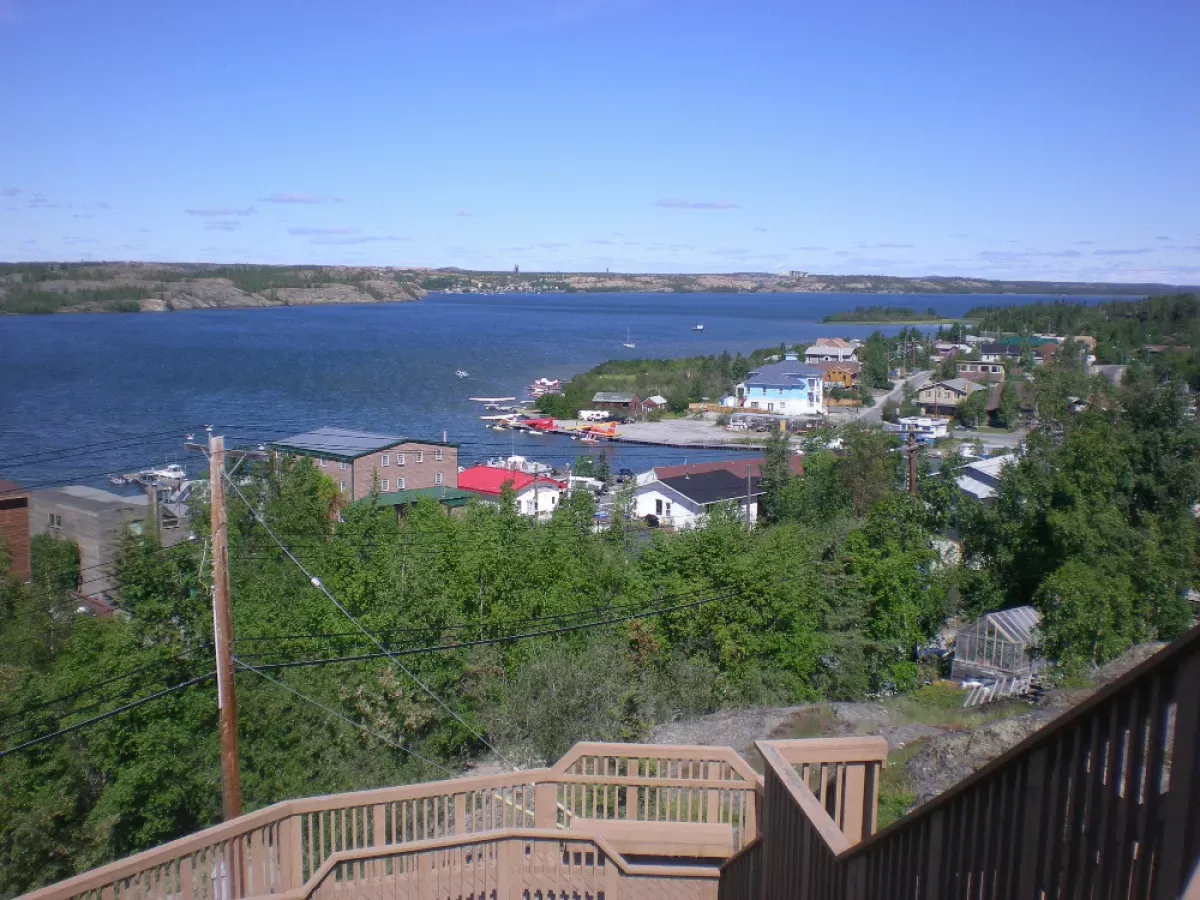
"Yellowknife is the capital city of Canada's Northwest Territories, boasting the largest population in the territory. Situated on the northern banks of Great Slave Lake, it lies approximately 400 kilometers south of the Arctic Circle. The city is strategically positioned on the western edge of Yellowknife Bay, near the mouth of the Yellowknife River."
1933: Prospectors Find Gold
Prospectors Herb Dixon and Johnny Baker found gold samples at Quyta Lake and Homer Lake in 1933 while surveying for mineral deposits.


1934: Gold Discovery and Burwash Mine
Gold was discovered on the east side of Yellowknife Bay in 1934, leading to the development of the short-lived Burwash Mine.
1934: Founding of Yellowknife
The Yellowknife settlement was founded in 1934 after the discovery of gold in the area.
1935: Gold Discovery and Staking Rush
Government geologists discovered gold on the west side of Yellowknife Bay in the fall of 1935, sparking a staking rush.
1936: Commercial Activity Begins
Commercial activity in the waterfront area of Yellowknife began in 1936.
1936: First Settlement and Businesses
The discovery and development of the Con Mine led to the first settlement of Yellowknife in 1936-1937 and the establishment of early businesses like Corona Inn and Weaver & Devore Trading.
1937: Winslow C. Ranney's Prospecting
Prospector and trapper Winslow C. Ranney staked claims in the area between David Lake and Rater Lake from 1935 to 1937.
September 1938: Con Mine Begins Production
Con Mine, a significant gold deposit, started production on September 5, 1938, leading to a boom in Yellowknife's economy.
1939: Northern Affairs Department Control
Between 1939 and 1953, Yellowknife was under the control of the Northern Affairs department of the Canadian government.
1940: Population Growth
Yellowknife's population grew rapidly, reaching 1,000 by 1940.
1942: Five Gold Mines Operating
By 1942, five gold mines were operational in the Yellowknife region.
1944: Gold Production Halted and Exploration
Gold production was put on hold in 1944 due to World War II, but an exploration program at the Giant Mine property suggested a significant gold deposit.
1945: Post-War Staking Rush and Town Expansion
The discovery at Giant Mine resulted in a large staking rush after the war, leading to the expansion of the Yellowknife townsite in 1945-1946.
1946: Establishment of New Townsite
The new townsite of Yellowknife was established during 1945-1946.
January 1947: Record Low Temperature
The lowest temperature ever recorded in Yellowknife was -51.2 degrees Celsius on January 31, 1947.
1947: Yellowknife Telephone Company Established
Yellowknife's telephone services were first established in 1947 by the Yellowknife Telephone Company, an independent entity primarily owned by local investors.
1950: Discovery Mine Operation
The Discovery Mine, with its own townsite, was in operation from 1950 to 1969, located 81 km to the north-northeast of Yellowknife.
1953: Yellowknife Becomes a Municipality
Yellowknife became a municipality in 1953, with its own council and town hall.
1963: Yellowknife Telephone Company Sold to CNT
At the end of 1963, the Yellowknife Telephone Company was sold to Canadian National Telecommunications, which later became Northwestel.
September 1967: Yellowknife Becomes NWT Capital
Yellowknife officially became the capital of the Northwest Territories in September 1967, leading to a third boom in the city.
1967: Yellowknife Becomes Capital
Yellowknife was named the capital of the Northwest Territories in 1967.
1967: Over-the-Air Television Transmission Begins
Yellowknife's first television services began in 1967 with the introduction of over-the-air transmission.
1969: Closure of Discovery Mine
The Discovery Mine ceased operations in 1969.
September 1972: Mackenzie Media Cable Television System Launched
The Mackenzie Media cable television system began operating in Yellowknife on September 1, 1972, supplementing the existing over-the-air television transmission that started in 1967. The cable system was later sold to Northwestel in late 1995.
1978: Houseboat Community Established
In 1978, a community of houseboats emerged on Jolliffe Island in Yellowknife Bay, marking the beginning of an off-grid lifestyle for its residents.
1978: Kosmos 954 Satellite Crash
The Soviet satellite Kosmos 954, powered by a nuclear reactor, crashed near Yellowknife in 1978. While there were no known casualties, a small amount of radioactive material was released.
1991: Diamond Mining Rush
A new mining rush and building boom began in Yellowknife with the discovery of diamonds 300 km north of the city in 1991.
1992: Giant Mine Bombing
A bombing at the Giant Mine during a labor dispute in 1992 resulted in nine fatalities, making it one of the deadliest mass murders in Canada.
1995: Mackenzie Media Sold to Northwestel
The Mackenzie Media cable television system, launched in 1972, was sold to Northwestel in late 1995.
1998: Ekati Diamond Mine Opens
The Ekati Diamond Mine, owned and operated by BHP Billiton, commenced operations in 1998.
April 1999: Nunavut Separates from NWT
When Nunavut separated from the Northwest Territories on April 1, 1999, Yellowknife's purview as capital was reduced, and it lost its status as the Canadian capital with the smallest population.
1999: Government Workforce Downsizing
Yellowknife's economy experienced a downturn in 1999 due to the closure of gold mines and a reduction in the government workforce.
2001: 2001 Religious Demographics of Yellowknife
According to the 2001 Census, nearly 73% of Yellowknife residents identified as Christian, while 24% indicated no religious affiliation. The largest Christian denominations were Roman Catholic, Anglican, and the United Church.
2003: Diavik Diamond Mine Begins Production
The Diavik Diamond Mine started its production in 2003, contributing to Yellowknife's economic recovery.
2004: Diamond Production Boosts Economy
In 2004, the combined production from the Ekati and Diavik diamond mines reached 12,618,000 carats, valued at over CA$2.1 billion, boosting Canada's ranking in global diamond production.
2004: Tourism Revenue in the Northwest Territories
In 2004-2005, the Northwest Territories, with Yellowknife as its main entry point for visitors, generated CA$100.5 million in revenue from tourism.
2004: Last Gold Mine Closes
The last of Yellowknife's gold mines closed in 2004, shifting the city's focus to government and services for the diamond industry.
2004: Closure of the Last Gold Mine
The year 2004 marked a turning point for Yellowknife's economy with the closure of its last gold mine due to declining gold prices and rising operating costs.
2005: Tourism Revenue in the Northwest Territories
In 2004-2005, the Northwest Territories, with Yellowknife as its main entry point for visitors, generated CA$100.5 million in revenue from tourism.
2005: Property Tax Mill Rates Set
In 2005, the property tax mill rates in Yellowknife were set at 13.84 for residential properties and 19.87 for commercial properties.
2005: Snap Lake Diamond Mine Receives Approval and Funding, De Beers Applies for Gahcho Kue Permit
The Snap Lake Diamond Mine, owned by De Beers, received final approval and funding in 2005. In the same year, De Beers also applied for a permit to open the Gahcho Kue Diamond Mine Project.
2007: Ice Road Truckers Features Yellowknife Drivers
During the 2007 ice road season, several truck drivers based in Yellowknife were featured on the History Channel TV series Ice Road Truckers.
2007: Yellowknife Airport Records 70,699 Aircraft Movements
In 2007, Yellowknife Airport, the busiest airport in northern Canada, recorded 70,699 aircraft movements.
2007: Snap Lake Diamond Mine Begins Production
The Snap Lake Diamond Mine, owned by De Beers, went into production in 2007.
2007: Baseline Year for Population Growth
The year 2007 serves as the baseline for calculating the average annual population growth rate of 0.6% reported by the Government of the Northwest Territories in 2017.
2008: Ice Wireless Enters Yellowknife Market
In 2008, Ice Wireless, a northern-based company, entered the Yellowknife market, offering digital cellular products and services.
2011: Recent Immigrants in Yellowknife (2011-2016)
Between 2011 and 2016, Yellowknife welcomed 695 new immigrants. The majority of these recent immigrants came from Asia (70.5%), followed by Africa (15.1%), and then the Americas and Europe (7.2% combined).
2011: Launch of Edge Magazine in Yellowknife
Edge Magazine, focusing on arts, events, people, culture, and the economy of Yellowknife, was established in 2011.
August 2012: NASA Renames Mars Landing Site "Yellowknife"
On August 10, 2012, NASA announced that the landing site of the Curiosity rover, part of the Mars Science Laboratory mission, would be named "Yellowknife" in honor of the city's significance in geological research, particularly related to some of the oldest known rocks in North America.
November 2012: Deh Cho Bridge Opens
The Deh Cho Bridge, which officially opened in November 2012, provided Yellowknife with its first permanent road connection to the rest of Canada's highway network.
August 2013: Canadian North Relocates Headquarters
Canadian North, a regional airline headquartered in Yellowknife, relocated its headquarters and 20 employees to Calgary at the end of August 2013 after its lease expired.
2013: BHP Billiton Sells Ekati Diamond Mine
BHP Billiton sold the Ekati Diamond Mine to Dominion Diamond Corporation in 2013.
2014: Climate Rankings
In 2014, Environment Canada identified Yellowknife as having the coldest winter, longest snow cover, sunniest spring, and sunniest summer among Canadian cities.
2014: 2014 Births and Deaths in Yellowknife
There were 299 births and 62 deaths recorded in Yellowknife in 2014.
2015: 2015 Yellowknife Income and Expenditures
In 2015, the average individual income in Yellowknife was CA$73,500, while the average family income was CA$160,394. The average household expenditure in 2015 was CA$125,783.
September 2016: Gahcho Kue Diamond Mine Opens
The Gahcho Kue Diamond Mine, owned by De Beers, was officially opened in September 2016 and commenced commercial production in March 2017.
2016: Recent Immigrants in Yellowknife (2011-2016)
By 2016, recent immigrants (those who arrived between 2011 and 2016) accounted for 3.7% of Yellowknife's population. The Philippines was the largest source of recent immigrants, with the Philippines, India, the United Kingdom, and Vietnam being the top origin countries.
2016: 2016 Crime Statistics for Yellowknife
In 2016, Yellowknife recorded a crime rate of 46.7 per 1,000 people for violent crimes and 167.2 per 1,000 people for property crimes.
2016: 2016 Yellowknife Household and Income Statistics
In 2016, the average household size in Yellowknife was 2.7. The unemployment rate was 5.9% in 2016, with different rates for males and females.
2016: Population of Yellowknife at 19,569
The 2016 Census of Population reported that Yellowknife had a population of 19,569, which later grew to 20,340 according to the 2021 census.
2016: Census Data for Yellowknife
The 2016 Census recorded a population of 19,569 people and 7,130 households in Yellowknife, with a population density of 185.5/km (480/sq mi) and 22.7% of residents identifying as Indigenous.
2016: 2016 Yellowknife Census Data
The 2016 census in Yellowknife showed that the average age of the population was slightly younger than the average age for the rest of the NWT. It also provided detailed information on the age distribution of residents in 2016.
March 2017: Gahcho Kue Diamond Mine Begins Production
The Gahcho Kue Diamond Mine, owned by De Beers, officially began commercial production in March 2017.
2017: Government Report on Yellowknife's Population
In 2017, the Government of the Northwest Territories reported a population of 20,834 for Yellowknife, indicating an average annual growth rate of 0.6% since 2007.
October 2018: Rebecca Alty Elected Mayor
Rebecca Alty was elected as the mayor of Yellowknife in October 2018, succeeding Mark Heyck.
2018: 2018 Minimum Wage in Yellowknife
As of 2018, the minimum wage in Yellowknife, NWT, was CA$13.46.
August 2021: Record High Temperature
Yellowknife experienced its highest ever recorded temperature on August 2, 2021, reaching 32.6 degrees Celsius.
2021: Population of Yellowknife Reaches 20,340
According to the 2021 Census of Population conducted by Statistics Canada, Yellowknife had a population of 20,340, representing a 3.9% increase from its 2016 population of 19,569.
2021: 2021 Yellowknife Immigrant Population
According to the 2021 census, immigrants made up 16.4% of Yellowknife's total population. The Philippines, India, and the United Kingdom were the top countries of origin for immigrants.
2021: 2021 Religious Groups in Yellowknife
The 2021 census collected information on the religious composition of Yellowknife, providing insights into the religious demographics of the city.
2021: 2021 Yellowknife Ethnic Composition
The 2021 census revealed that Yellowknife had a slight European majority (55.8% of the total population). The Indigenous population represented 24.2%, while visible minorities accounted for 20.0% of the population.
August 16, 2023: Wildfire Evacuation
The territorial government began evacuating Yellowknife on August 16, 2023, as wildfires approached the city, raising concerns about the accessibility of Highway 3.
August 19, 2023: Evacuation Nears Completion
By August 19, 2023, 87% of Yellowknife's population had been evacuated, leaving only 2,600 people remaining, including 1,000 essential workers. NWT Premier Caroline Cochrane evacuated to Alberta.
Mentioned in this timeline

NASA the National Aeronautics and Space Administration is the U...

India officially the Republic of India is a South Asian...
Africa is the second-largest and second-most populous continent home to...
Canada is a North American country spanning from the Atlantic...

War is defined as an armed conflict involving the armed...

An airline is a company that provides air transport services...
Trending

4 hours ago Trump Faces Scrutiny Over Proposed Russian Diesel Deal Amid Peace Overtures
4 hours ago Oil Prices Fall as Trump Waives Russia Sanctions to Increase Global Fuel Supply
5 hours ago Alex Eala Aims for Recovery at the Ningbo Open Tennis Tournament

5 hours ago Stephen A. Smith Details Shocking Dinner with Donald Trump and Bill Maher

4 hours ago Lisa Rinna Supports Daughter Amelia Gray at the 2026 Victoria's Secret Fashion Show
5 hours ago Ashlyn Krueger Faces Janice Tjen at the WTA Kinoshita Group Japan Open
Popular

Ilhan Omar is a prominent American politician currently serving as...

Ken Paxton is an American politician and lawyer serving as...

Elon Musk is a visionary entrepreneur and engineer known for...

Michael Joseph Jackson the King of Pop was a highly...

Cristiano Ronaldo widely considered one of the greatest footballers captains...

Greta Thunberg is a Swedish climate activist who gained international...