History of Arkansas in Timeline


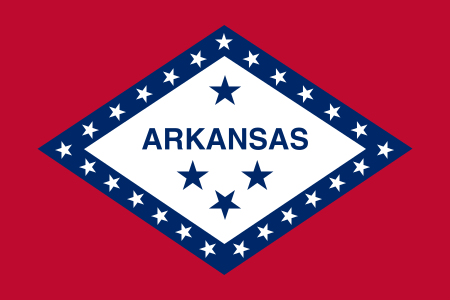
Arkansas is a state in the Southern United States, bordered by six other states. Its name originates from the Osage language, referencing the Quapaw people. The state features diverse geography, including the Ozark and Ouachita Mountains, the Arkansas Timberlands, and the Mississippi River lowlands.
5 hours ago : Arkansas State Police sees 29% drop in high-speed pursuits due to law changes.
Arkansas State Police reported a 29% drop in high-speed pursuits. This reduction resulted from law changes and a messaging campaign. The ASP director shared data with lawmakers about the positive impact of new policies on public safety.


1900: Democratic Party Expands White Primary Use
In 1900, the Democratic Party expanded the use of the white primary in Arkansas county and state elections, which further denied black people participation in the political process.
February 13, 1905: Record Low Temperature in Arkansas
On February 13, 1905, Arkansas recorded its record low temperature of −29 °F (−34 °C) at Gravette.
1905: Immigration to Arkansas Begins
Between 1905 and 1911, Arkansas began to receive a small immigration of German, Slovak, and Scots-Irish from Europe, increasing the diversity in the state.
1911: Immigration to Arkansas Concludes
Between 1905 and 1911, Arkansas received a small immigration of German, Slovak, and Scots-Irish from Europe, increasing diversity.
1915: Arkansas Game and Fish Commission created
In 1915, the state created the Arkansas Game and Fish Commission to regulate hunting.
September 30, 1919: Elaine Massacre Begins
On September 30, 1919, the Elaine massacre began after a confrontation between white men and black sharecroppers organizing a farmers' union, leading to a large-scale attack on black people in Phillips County and surrounding areas.
1924: State highway system designated
In 1924, Arkansas first designated a state highway system.
1927: The Great Mississippi Flood of 1927
In 1927, the Great Mississippi Flood occurred, impacting areas along the Ouachita Rivers and other rivers in Arkansas.
August 10, 1936: Record High Temperature in Arkansas
On August 10, 1936, Arkansas recorded its record high temperature of 120 °F (49 °C) at Ozark.
September 1942: Rohwer Camp Opens
In September 1942, the Rohwer Camp in Desha County, Arkansas, opened as an internment camp for Japanese Americans forcibly removed from the West Coast.
October 1942: Jerome War Relocation Center Opens
In October 1942, the Jerome War Relocation Center in Drew County, Arkansas, opened as an internment camp for Japanese Americans.
June 1944: Jerome War Relocation Center Closes
In June 1944, the Jerome War Relocation Center in Drew County, Arkansas, closed after operating as an internment camp for Japanese Americans since October 1942.
November 1945: Rohwer Camp Closes
In November 1945, the Rohwer Camp in Desha County, Arkansas, closed after operating as an internment camp for Japanese Americans since September 1942.
1950: Population Losses in 1950 Census
Arkansas recorded population losses in the 1950 census due to factors like farm mechanization and lack of non-farming industry.
1954: Supreme Court Rules Segregation Unconstitutional
In 1954, the Supreme Court ruled segregation in public schools unconstitutional in Brown v. Board of Education, leading to integration efforts in Arkansas.
September 25, 1957: Federal Troops Escort Little Rock Nine
On September 25, 1957, President Dwight D. Eisenhower sent federal troops to escort and protect the Little Rock Nine as they integrated Central High School in Little Rock, Arkansas.
1959: Little Rock High Schools Fully Integrated
By the fall of 1959, the high schools in Little Rock, Arkansas, were completely integrated following the events of the Little Rock Nine in 1957.
1960: Population Losses in 1960 Census
Arkansas recorded population losses in the 1960 census due to factors like farm mechanization and lack of non-farming industry.
1962: Walmart founded
In 1962, Sam Walton founded the mega-retailer Walmart, which is now headquartered in Bentonville.
1964: Passage of Civil Rights Act of 1964
The Civil Rights Act of 1964 was passed to enforce constitutional rights.
1965: Passage of Voting Rights Act of 1965
The Voting Rights Act of 1965 was passed to enforce constitutional rights.
1980: Arkansas Population Exceeds Two Million
By the 1980 census, Arkansas's population had exceeded two million, marking the start of a period of positive growth rates.
1980: Titan II ICBM Explosion
In 1980, Launch Complex 374–7 in Damascus, Arkansas, was the site of an explosion of a Titan II Intercontinental Ballistic Missile (ICBM).
1986: Gubernatorial term length
In 1986, a referendum lengthened the Arkansas gubernatorial term to four years, effective with that year's election.
1988: Bill Clinton's Speech
In 1988, Arkansas governor Bill Clinton delivered a long speech at the Democratic National Convention endorsing Michael Dukakis, which brought national attention to the state.
1992: Arkansas State University FBS Team
In 1992, Arkansas State University became the second NCAA Division I Football Bowl Subdivision (FBS) team in the state.
1992: Clinton wins the Presidential Election
In 1992, Bill Clinton won the presidential election with 43.0% of the vote, presenting himself as a "New Democrat."
2000: Center of Population of Arkansas in 2000
In 2000, the center of population of Arkansas was located in Perry County, near Nogal.
2004: Ban on Same-Sex Marriage
In 2004, Arkansas voters passed a ban on same-sex marriage with 75% voting yes, although that ban has been inactive since the Supreme Court protected same-sex marriage in Obergefell v. Hodges.
2006: Languages Spoken at Home in Arkansas in 2006-2008
According to the 2006–2008 American Community Survey, 93.8% of Arkansas's population (over the age of five) spoke only English at home.
2006: Arkansas Clean Indoor Air Act
In 2006, the Arkansas Clean Indoor Air Act, a statewide smoking ban excluding bars and some restaurants, went into effect.
2007: Resolution on the Possessive Form of Arkansas
In 2007, the Arkansas state legislature passed a non-binding resolution declaring the possessive form of the state's name to be Arkansas's.
2008: Languages Spoken at Home in Arkansas in 2006-2008
According to the 2006–2008 American Community Survey, 93.8% of Arkansas's population (over the age of five) spoke only English at home.
2010: United States Forest Service Survey
A 2010 United States Forest Service survey determined that 18,720,000 acres (7,580,000 ha) of Arkansas's land is forestland, or 56% of the state's total area.
2010: Ancestries of Arkansas Residents in 2010
A 2010 survey of the principal ancestries of Arkansas's residents revealed the following: 15.5% African American, 12.3% Irish, 11.5% German, 11.0% American, 10.1% English, 4.7% Mexican, 2.1% French, 1.7% Scottish, 1.7% Dutch, 1.6% Italian, and 1.4% Scots-Irish.
2010: Republican strength expands
After 2010, Republican strength in Arkansas expanded further to the Northeast and Southwest and into the Little Rock suburbs.
2010: Newspaper Ownership
As of 2010, many local newspapers in Arkansas were owned by various media companies, including WEHCO Media, Lancaster Management, Paxton Media Group, Rust Communications, Stephens Media, and GateHouse Media.
2010: Arkansas Cities Above 50,000 in Population (2010 Census)
Based on the 2010 census, Arkansas had eight cities with populations above 50,000. They include Little Rock, Fort Smith, Fayetteville, Springdale, Jonesboro, North Little Rock, Conway, and Rogers.
2010: Republicans capture House seats
In 2010, Republicans captured three of Arkansas's four seats in the U.S. House of Representatives.
2010: Largest Religious Denominations in Arkansas in 2010
In 2010, the largest religious denominations in Arkansas by number of adherents were the Southern Baptist Convention, the United Methodist Church, non-denominational Evangelical Protestants, the Catholic Church, and the Church of Jesus Christ of Latter-day Saints.
2010: United States Census in 2010
The 2010 United States census was conducted.
2011: Corporal Punishment
According to government data for the 2011-12 school year, 20,083 public school students in Arkansas were paddled at least one time.
2011: Racial and Ethnic Composition of Arkansas in 2011
In 2011, Arkansas was 80.1% white (74.2% non-Hispanic white), 15.6% Black or African American, 0.9% American Indian and Alaska Native, 1.3% Asian, and 1.8% from two or more races. Hispanics or Latinos of any race made up 6.6% of the population.
2011: Arkansas business rankings
Since 2011, Arkansas gained 12 spots in the best state for business rankings.
2012: Republican Majority in the Arkansas State House of Representatives
After the 2012 elections, the Republican Party's majority status in the Arkansas State House of Representatives was established, marking the party's first majority since 1874.
2012: Health Statistics
As of 2012, Arkansas had a high incidence of premature death, infant mortality, cardiovascular deaths, and occupational fatalities compared to the rest of the United States and was tied for 43rd with New York in percentage of adults who regularly exercise.
2012: Republicans win all House seats
In 2012, Republicans won election to all four House seats in Arkansas.
2012: Crystal Bridges Museum Visits
In 2012, its first year, the Crystal Bridges Museum of American Art in Bentonville was visited by 604,000 people.
2012: GOP Victories
In 2012, the GOP held a 51-seat majority in the state House and 21 seats (of 35) in the state Senate following victories.
2012: Republican majority in the Senate and House
In the 2012 elections, Arkansas voters elected a 21–14 Republican majority in the Senate, and Republicans gained a 51–49 majority in the House of Representatives, establishing a Republican dominance in both bodies of legislature.
2013: General Assembly Controlled by Republican Party
Before 2013, the General Assembly of Arkansas had not been controlled by the Republican Party since Reconstruction.
2013: Creation of More Districts
In 2013, more districts were created for the State District Court in Arkansas.
2013: Little Rock Metropolitan Area Population in 2013
In 2013, the Little Rock–North Little Rock–Conway metropolitan area was the largest in the state of Arkansas, with a population of 724,385.
2013: Percentage of Uninsured Residents
In 2013, the percentage of uninsured residents in Arkansas was 22.5%.
August 2014: Uninsured Residents Decrease
In August 2014, the percentage of uninsured residents in Arkansas dropped from 22.5% in 2013 to 12.4% after the Affordable Care Act passed.
2014: Most affordable state
As of 2014, Arkansas was the most affordable state to live in.
2014: Tom Cotton Defeats Mark Pryor
In 2014, Tom Cotton defeated Mark Pryor for U.S. Senate, resulting in the entire congressional delegation being in GOP hands for the first time since Reconstruction.
2014: Religious Affiliations in Arkansas in 2014
In 2014, the Pew Research Center determined that 79% of the population was Christian, dominated by evangelicals in the Southern Baptist and independent Baptist churches. Of the unaffiliated population, 2% were atheist.
2014: Entire delegation in GOP hands
When Mark Pryor was defeated in 2014, the entire Arkansas congressional delegation was in GOP hands for the first time since Reconstruction.
2015: Top Countries of Origin for Arkansas Immigrants in 2015
According to the American Immigration Council, in 2015, the top countries of origin for Arkansas' immigrants were Mexico, El Salvador, India, Vietnam, and Guatemala.
2017: Creation of More Districts
In 2017, more districts were created for the State District Court in Arkansas.
July 1, 2019: Estimated Population of Arkansas on July 1, 2019
On July 1, 2019, the United States Census Bureau estimated the population of Arkansas to be 3,017,804, a 3.49% increase since the 2010 census.
2019: Racial and Ethnic Composition of Arkansas in 2019
Per the 2019 census estimates, Arkansas was 72.0% non-Hispanic white, 15.4% Black or African American, 0.5% American Indian and Alaska Native, 1.5% Asian, 0.4% Native Hawaiian or other Pacific Islander, 0.1% some other race, 2.4% two or more races, and 7.7% Hispanic or Latin American of any race.
2020: Religious Affiliations in Arkansas in 2020
By 2020, the Public Religion Research Institute determined 71% of the population in Arkansas was Christian, with evangelicals, mainline Protestants, and historically black or African American churches being dominant.
2020: Arkansas Resident Population in 2020
In 2020, the U.S. census recorded Arkansas having a resident population of 3,011,524.
2020: Arkansas Population at the 2020 Census
In 2020, the state of Arkansas had a population of just over three million according to the census.
2021: UCA joins Atlantic Sun Conference
In 2021, the University of Central Arkansas (UCA) joined the Atlantic Sun Conference.
2022: Homeless Population in Arkansas in 2022
According to HUD's 2022 Annual Homeless Assessment Report, there were an estimated 2,459 homeless people in Arkansas.
2022: Little Rock joins Ohio Valley Conference
In 2022, the University of Arkansas at Little Rock joined the Ohio Valley Conference.
January 10, 2023: Sarah Huckabee Sanders Inauguration
On January 10, 2023, Sarah Huckabee Sanders was inaugurated as the governor of Arkansas.
2023: UCA played in UAC
From 2023–2025, UCA, which played in the football-only version of the UAC.
2023: Arkansas's GDP
In 2023, Arkansas's gross domestic product (GDP) was $176.24 billion, and the per capita personal income was $54,347, ranking 46th in the nation.
May 2025: Unemployment Rate
In May 2025, the unemployment rate in Arkansas was 3.7%.
2025: UCA played in UAC
From 2023–2025, UCA, which played in the football-only version of the UAC.
July 2026: Little Rock Moves to the United Athletic Conference
In July 2026, Little Rock will move to the United Athletic Conference, which is transitioning from a football-only league to an all-sports conference via a rebranding of the Western Athletic Conference.
Mentioned in this timeline

Bill Clinton the nd U S President - served as...
The United States of America is a federal republic located...
The Affordable Care Act ACA also known as Obamacare is...

CNBC is an American business news channel owned by NBCUniversal...

Tom Cotton is an American politician and Army veteran currently...

India officially the Republic of India is a South Asian...
Trending

11 minutes ago Yoon Suk Yeol, South Korean ex-president, receives life sentence for insurrection and martial law.

2 hours ago Maya Hawke and Christian Lee Hutson celebrated wedding with Stranger Things cast present.
2 hours ago Wizz Air Launches New Larnaka-Barcelona Flights, Boosting Tourism for Cyprus and Spain.

2 hours ago Jon Ossoff criticizes Trump, speech goes viral, fueling 2028 'Front Runner' speculation.
4 hours ago ANTM's controversies are revealed in a new Netflix documentary, with Tyra Banks facing criticism.

4 hours ago EU monitors Albania's legal changes: Concerns raised over Rama's SPAK amendment.
Popular

Jesse Jackson is an American civil rights activist politician and...
Randall Adam Fine is an American politician a Republican who...

Pam Bondi is an American attorney lobbyist and politician currently...

Barack Obama the th U S President - was the...

Martin Luther King Jr was a pivotal leader in the...

Ken Paxton is an American politician and lawyer serving as...