


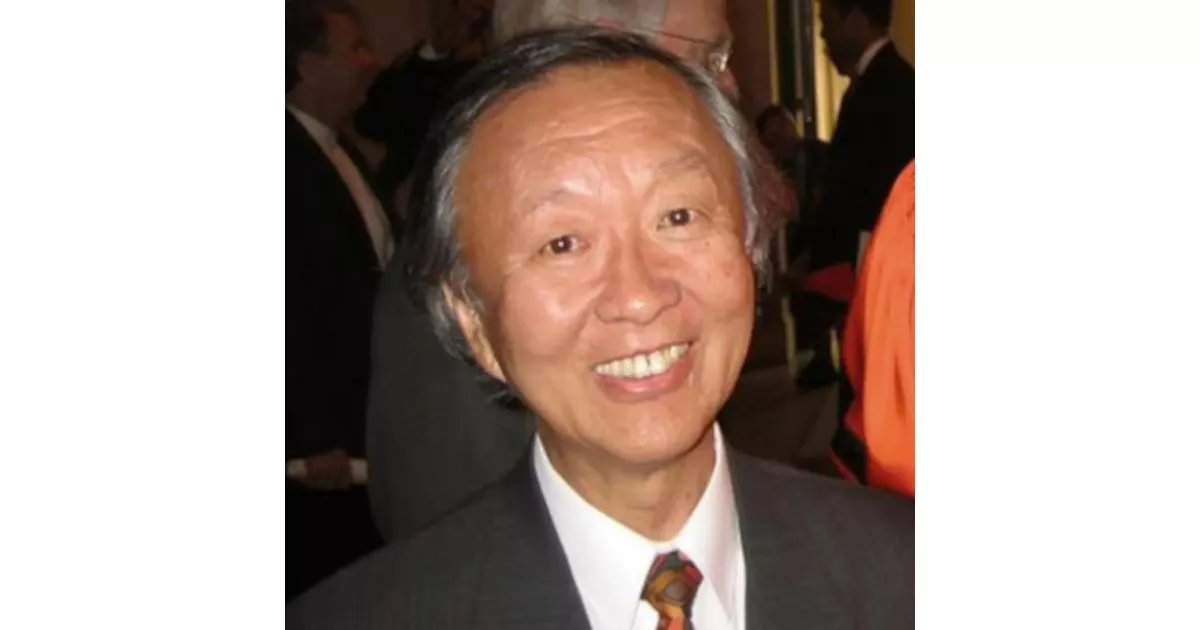
Sir Charles Kao Kuen, a Chinese physicist, revolutionized telecommunications through his groundbreaking work on fiber optics. During the 1960s, Kao developed innovative techniques for transmitting digital data using lasers and glass fibers. His pioneering research laid the foundation for the development of the internet, transforming how we communicate and access information globally.
1925: Kao Chun-Hsiang Earns Law Degree
Charles K. Kao's father, Kao Chun-Hsiang, graduated with a Juris Doctor degree from the University of Michigan Law School in 1925.


November 4, 1933: Birth of Charles K. Kao
Charles K. Kao was born on November 4, 1933 in Shanghai, China.
1933: Early Life and Education in Shanghai
Charles K. Kao was born in Shanghai in 1933 and received his early education in Chinese classics, English, and French at the Shanghai World School.
1949: Relocation to Hong Kong
Following the Communist revolution, Charles K. Kao's family settled in Hong Kong in 1949.
1949: Kao Family Settles in Hong Kong
In 1949, Charles K. Kao's family moved to Hong Kong.
1953: Graduation and Move to London
Charles K. Kao graduated from St. Joseph's College in Hong Kong and moved to London to study electrical engineering in 1953.
1953: Move to London and Engineering Studies
In 1953, Charles K. Kao moved to London to further his education in electrical engineering, first attending Woolwich Polytechnic (now the University of Greenwich).
1959: Marriage to Gwen May-Wan Wong
Charles K. Kao married Gwen May-Wan Wong in London in 1959.
1963: Joining the Optical Communications Research Team
In 1963, Charles K. Kao joined the optical communications research team at Standard Telecommunication Laboratories (STL), focusing on fiber attenuation and the properties of various glass materials.
December 1964: Leading the Electro-Optics Research Group
In December 1964, Charles K. Kao became the head of the electro-optics research group at STL, taking over the optical communication program.
1964: Identification of Critical Specification for Long-Range Communication Devices
Around 1964, Charles K. Kao played a crucial role in identifying a critical and theoretical specification for long-range communication devices, establishing the 10 or 20 dB of light loss per kilometer standard.
1964: Collaboration with George Hockham
Charles K. Kao began collaborating with George Hockham in 1964 to investigate the potential of glass fibers for optical communication.
1965: PhD in Electrical Engineering
Charles K. Kao earned his PhD in electrical engineering from the University of London in 1965, while simultaneously working at Standard Telecommunication Laboratories (STL) in Harlow, England.
1965: Continued Research with George Hockham
Charles K. Kao's collaboration with George Hockham continued into 1965, leading to significant advancements in the field of fiber optics.
1965: Breakthrough in Optical Fiber Attenuation
In 1965, Charles K. Kao and George Hockham established that the fundamental limit for glass light attenuation was below 20 dB/km, a critical value for effective optical communication.
January 1966: Presentation on Fiber Optics for Communication
Charles K. Kao presented his research on using glass fibers for optical communication at the IEE in London in January 1966.
1966: Seeking Support for Fiber Optics Research
In 1966, Charles K. Kao traveled to the United States and Japan seeking support for further research and development in fiber optics.
1966: Groundwork for Fiber Optics
While working at Standard Telecommunication Laboratories in Harlow, Charles K. Kao laid the groundwork for fiber optics in communication in 1966.
1969: Measurement of Intrinsic Loss in Fused Silica
In 1969, Charles K. Kao and M. W. Jones achieved a significant breakthrough by measuring the intrinsic loss of bulk-fused silica at 4 dB/km, demonstrating the potential for ultra-transparent glass in fiber optics.
1970: Founding of CUHK's Department of Electronics
In 1970, Charles K. Kao joined the Chinese University of Hong Kong (CUHK) to establish the Department of Electronics, which would later evolve into the Department of Electronic Engineering.
1972: Early Studies on Environmental Effects of Land Reclamation
Charles K. Kao was among the pioneers in examining the environmental impact of land reclamation in Hong Kong, presenting one of his initial studies on the subject at the Association of Commonwealth Universities (ACU) conference in Edinburgh in 1972.
1974: Return to ITT Corporation
Charles K. Kao returned to ITT Corporation in 1974, initially serving as Chief Scientist and subsequently as Director of Engineering in Roanoke, Virginia.
1980: Gold Medal from American Armed Forces Communications and Electronics Association
In 1980, Charles K. Kao was honored with the Gold Medal by the American Armed Forces Communications and Electronics Association in recognition of his significant contributions to the application of optical fiber technology in military communications.
1982: ITT's First Executive Scientist
Charles K. Kao achieved a significant milestone in 1982 by becoming the first ITT Executive Scientist, primarily stationed at the Advanced Technology Center in Connecticut.
1983: Vision for Submarine Communications Cables
In 1983, Charles K. Kao predicted the widespread use of fiber optic cables for submarine communications, a vision that became a reality a few years later.
1985: Research at SEL Research Center in West Germany
In 1985, Charles K. Kao dedicated a year to research at the SEL Research Center in West Germany.
1986: Corporate Director of Research at ITT
Charles K. Kao assumed the role of Corporate Director of Research at ITT in 1986.
1987: Vice-Chancellor of CUHK
Charles K. Kao served as the vice-chancellor of the Chinese University of Hong Kong (CUHK) from 1987 to 1996.
1991: Independent Non-Executive Director at Varitronix International Limited
Starting in 1991, Charles K. Kao held the position of Independent Non-Executive Director and served as a member of the Audit Committee at Varitronix International Limited in Hong Kong.
1993: President of ASAIHL
From 1993 to 1994, Charles K. Kao served as the President of the Association of Southeast Asian Institutions of Higher Learning (ASAIHL).
1994: End of Term as President of ASAIHL
Charles K. Kao concluded his term as the President of the Association of Southeast Asian Institutions of Higher Learning (ASAIHL) in 1994.
1996: Retirement from CUHK and Establishment of Charles Kao Fund
Following his retirement from CUHK in 1996, Charles K. Kao generously donated to Yale University, leading to the establishment of the Charles Kao Fund Research Grants. This fund was created to support Yale's academic pursuits, research endeavors, and creative initiatives focused on Asia.
1997: Visiting Professor at Imperial College London
Charles K. Kao took on the role of a visiting professor at the Imperial College London Department of Electrical and Electronic Engineering from 1997 to 2002.
April 20, 2000: Appointment to Hong Kong's Council of Advisors on Innovation and Technology
Charles K. Kao was appointed as a Member of the Council of Advisors on Innovation and Technology of Hong Kong on April 20, 2000.
July 15, 2000: Retirement from Hong Kong's Energy Advisory Committee
Charles K. Kao retired from his position as chairman and member of the Energy Advisory Committee (EAC) of Hong Kong on July 15, 2000, after serving for two years.
2002: Conclusion of Visiting Professorship at Imperial College London
Charles K. Kao concluded his tenure as a visiting professor at the Imperial College London Department of Electrical and Electronic Engineering in 2002.
2002: Keynote Speaker at IEEE GLOBECOM
Charles K. Kao delivered a keynote address at the IEEE GLOBECOM conference in Taipei, Taiwan, in 2002.
2003: Chair Professor at National Taiwan University
Charles K. Kao was honored with the title of Chair Professor by special appointment at the Electronics Institute of the College of Electrical Engineering and Computer Science, National Taiwan University, in 2003.
2004: Alzheimer's Disease Diagnosis
Charles K. Kao began experiencing symptoms of Alzheimer's disease in early 2004, leading to difficulties with speech. However, he retained his ability to recognize people and places. This condition also affected his father.
December 2008: Stepping Down from ISF Board
In December 2008, Charles K. Kao stepped down from the board of the Independent Schools Foundation (ISF).
2008: Relocation to Mountain View, California
In 2008, Charles K. Kao made the decision to move from Hong Kong to Mountain View, California. This relocation brought him closer to his children and grandchild, providing a supportive environment as he navigated the challenges of Alzheimer's disease.
January 30, 2009: End of Tenure at Next Media
Charles K. Kao's tenure as an independent non-executive director and member of the audit committee of Next Media ended on January 30, 2009.
October 6, 2009: Nobel Prize in Physics
On October 6, 2009, Charles K. Kao was awarded the Nobel Prize in Physics in recognition of his groundbreaking contributions to the study of light transmission in optical fibers and his pivotal role in the development of fiber optic communication.
2010: Knighted by Queen Elizabeth II
Charles K. Kao was knighted by Queen Elizabeth II in 2010 for his contributions to fiber optic communications.
2010: Establishment of the Charles K. Kao Foundation for Alzheimer's Disease
Charles and Gwen Kao established the Charles K. Kao Foundation for Alzheimer's Disease in 2010 to increase public understanding of the condition and provide assistance to those affected by it.
2010: Open Letter Affirming Hong Kong Belonging
In 2010, Charles K. Kao and his wife issued an open letter to clarify his national identity, stating that while Kao's international travels led him to feel a sense of belonging to the world, he considers himself a "Hong Kong belonger" due to his deep ties to the city, including his education, teaching career, role as Vice-Chancellor of CUHK, and retirement there.
2016: Deterioration of Health
Charles K. Kao's health deteriorated in 2016 as he lost the ability to maintain his balance due to the progression of Alzheimer's disease. He made the decision to decline life support or CPR in the event of further health decline.
2017: Advancements in Fiber Optic Loss Reduction
By 2017, significant advancements in fiber optic technology had reduced losses to as low as 0.1419 dB/km at the 1.56 μm wavelength.
September 2018: Passing of Charles K. Kao
Charles K. Kao passed away at the Bradbury Hospice in Hong Kong in September 2018, at the age of 84.
September 23, 2018: Death of Charles K. Kao
Charles K. Kao passed away on September 23, 2018.
Mentioned in this timeline
Elizabeth II reigned as Queen of the United Kingdom and...
California is a U S state on the Pacific Coast...
Submarine is a coming-of-age comedy-drama directed by Richard Ayoade based...
Hong Kong is a densely populated special administrative region of...
Germany officially the Federal Republic of Germany is located in...
China officially the People's Republic of China PRC is located...
Trending
4 hours ago Kim Kardashian and Lewis Hamilton Share Romantic Moments in Paris
5 hours ago Police Arrest Men Emerging From New York City Sewers Near Hotel
5 hours ago Amanda Bynes Faces Social Media Criticism Over New Handmade Purse Designs
6 hours ago Breaking Bad Featured in New York Times List of 100 Best 21st Century TV Shows

6 hours ago Law Roach Reveals Zendaya Secretly Married Tom Holland

7 hours ago Alix Earle Launches New Reale Actives Go Calm Serum Amidst Iconic SI Swimsuit Success
Popular

Jameis Winston is an American football quarterback currently playing for...

Shakira Isabel Mebarak Ripoll the Queen of Latin Music is...

Michael Joseph Jackson the King of Pop was a highly...

Ken Paxton is an American politician and lawyer serving as...
Lane Kiffin is an American football coach with a notable...
Cristiano Ronaldo widely considered one of the greatest footballers captains...