


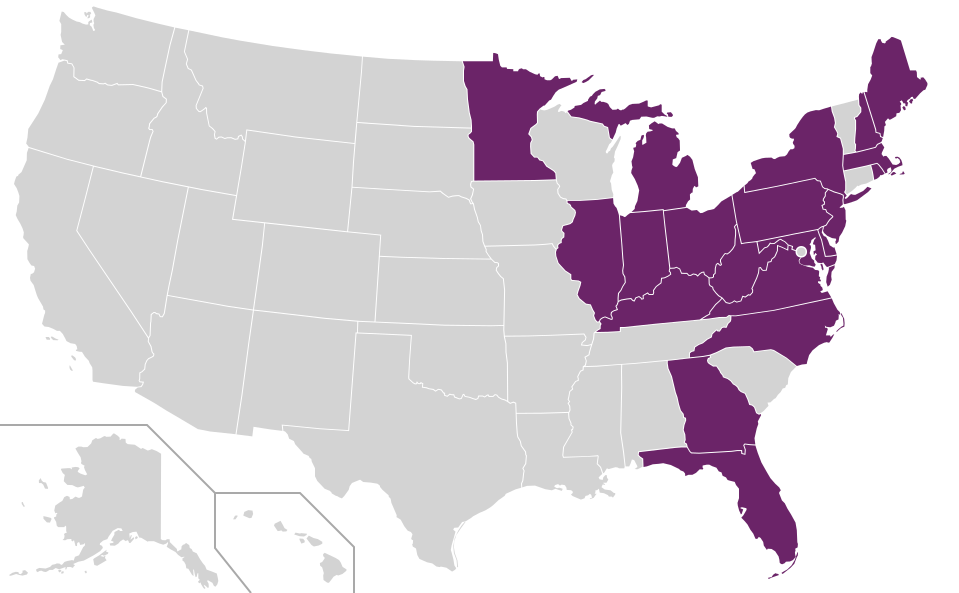
E-ZPass is an electronic toll collection system employed across numerous toll roads, bridges, and tunnels in the Eastern, Midwestern, and Southeastern regions of the United States. It is managed by the E-ZPass Interagency Group (IAG), which comprises member agencies from various states. This system utilizes a unified technology, enabling travelers to use a single transponder for seamless toll payments throughout the entire E-ZPass network. This promotes efficiency and convenience for drivers across multiple states.
1987: E-ZPass creation
In 1987, the E-ZPass system was created, leading to the integration of various independent systems using the same technology, such as I-PASS in Illinois and NC Quick Pass in North Carolina. Negotiations are ongoing for nationwide interoperability in the United States.


1991: Creation of the Interagency Committee
In 1991, the Interagency Committee was created to develop E-ZPass, involving seven independent toll agencies. The E-ZPass trademark belongs to the Port Authority of New York and New Jersey.
1992: Plans to test two technologies for E-ZPass
In 1992, the seven agencies started making plans to test two possible technologies for E-ZPass, to be installed along the Garden State Parkway and New York State Thruway.
August 3, 1993: First deployment of E-ZPass on the Thruway
On August 3, 1993, E-ZPass was first deployed on the Thruway at the Spring Valley toll plaza.
1995: TBTA begins E-ZPass implementation
In 1995, the Triborough Bridge and Tunnel Authority (TBTA) began its E-ZPass implementation.
August 1996: E-ZPass popularity grows among motorists
By August 1996, E-ZPass was popular among motorists who frequently used TBTA crossings, with nearly 2,000 motorists per day signing up for it.
December 1996: E-ZPass implemented at all Thruway's fixed-toll barriers
By December 1996, E-ZPass was implemented at all of the New York State Thruway's fixed-toll barriers.
December 17, 1996: First E-ZPass system implemented
On December 17, 1996, the first E-ZPass system was implemented at all toll collection facilities of the Triborough Bridge and Tunnel Authority, which included 7 bridges and 2 tunnels.
January 1997: TBTA completes E-ZPass implementation
By January 1997, the Triborough Bridge and Tunnel Authority completed its E-ZPass implementation at all nine of its toll facilities.
July 1997: E-ZPass implemented at the George Washington Bridge
In July 1997, the Port Authority of New York and New Jersey implemented E-ZPass at the George Washington Bridge.
October 1997: E-ZPass implemented at Holland and Lincoln Tunnels
In October 1997, the Port Authority of New York and New Jersey implemented E-ZPass at the Holland Tunnel and Lincoln Tunnel.
March 1998: E-ZPass installed at all Thruway's mainline exits
By March 1998, E-ZPass was installed at all of the New York State Thruway's mainline exits.
October 6, 1998: U.S. patent issued for automated toll collection system
On October 6, 1998, a U.S. patent for an automated toll collection system was issued to Fred Slavin and Randy J. Schafer.
1998: Pennsylvania Turnpike planned to adopt E-ZPass
In 1998, the Pennsylvania Turnpike planned to adopt E-ZPass.
December 2, 2000: E-ZPass debuts on the Pennsylvania Turnpike
On December 2, 2000, E-ZPass debuted on the Pennsylvania Turnpike between Harrisburg West and the Delaware River Bridge.
December 15, 2001: E-ZPass usable on the entire Pennsylvania Turnpike
By December 15, 2001, E-ZPass could be used on the entire length of the mainline Pennsylvania Turnpike.
July 15, 2002: New Jersey implements monthly E-ZPass account fee
On July 15, 2002, New Jersey implemented a monthly account fee of one dollar on E-ZPass accounts due to financial losses, which is still in effect for both individual and business accounts.
December 14, 2002: Commercial vehicles allowed to use E-ZPass on the Pennsylvania Turnpike
On December 14, 2002, commercial vehicles were allowed to use the E-ZPass system on the Pennsylvania Turnpike.
July 1, 2005: TBTA Imposes Monthly Account Fee
On July 1, 2005, the Triborough Bridge and Tunnel Authority (TBTA) in New York City imposed a monthly account fee to cover administrative costs.
2005: Toll payment location changes at Peace Bridge
In 2005, following upgrades to the border crossings, drivers crossing the Peace Bridge between Fort Erie, Ontario, and Buffalo, New York, began paying a toll on the Canadian side of the Peace Bridge after clearing Canadian customs, making it the first E-ZPass toll gantry outside of the United States.
June 1, 2006: TBTA Repeals Monthly Account Fee
On June 1, 2006, the TBTA repealed the monthly account fee following consideration of New York State Assembly Bill A06859A in 2005 and 2006 and Senate Bill S6331 in 2006, which sought to ban the fee. New Jerseyans sought New York accounts at an E-ZPass New York Service Center.
2006: Entire Pennsylvania Turnpike system taking E-ZPass
By 2006, the entire Pennsylvania Turnpike system was taking E-ZPass.
2006: Kentucky toll road system ended
The Kentucky Transportation Cabinet had a toll road system predating the E-ZPass system which was ended in 2006.
July 17, 2007: DRBA Announces New E-ZPass Fees
On July 17, 2007, the Delaware River and Bay Authority (DRBA) announced that, beginning January 1, 2008, all DRBA E-ZPass account holders would be charged an account management fee of $1.50 per month, and the transponder cost would be passed on to E-ZPass customers for each new transponder.
August 2007: Privacy concerns regarding E-ZPass data usage
As of August 2007, civil liberties and privacy rights advocates have expressed concern about how the position data gathered through E-ZPass is used. Several states had provided electronic toll information in response to court orders in civil cases.
2007: E-ZPass Plus Offered at NY State Fair Parking
In 2007, the New York State Fair offered E-ZPass Plus as a payment option at two of its parking lots for the first time. Motorists' E-ZPass accounts were charged the same $5 parking fee that cash customers were charged. The system, administered by the New York State Thruway Authority (NYSTA), used mobile, self-contained E-ZPass units.
January 1, 2008: DRBA Implements New E-ZPass Fees
Beginning January 1, 2008, the DRBA charged all DRBA E-ZPass account holders an account management fee of $1.50 per month, and the transponder cost was passed on to E-ZPass customers for each new transponder as announced on July 17, 2007.
December 16, 2008: Rhode Island joins E-ZPass network
On December 16, 2008, Rhode Island joined the E-ZPass network by activating E-ZPass lanes in the state's only toll booth, at the Claiborne Pell Newport Bridge.
July 1, 2009: Maryland Transportation Authority begins charging monthly E-ZPass fee
On July 1, 2009, the Maryland Transportation Authority began charging a fee of $1.50 a month to E-ZPass account holders.
October 2009: Ohio Turnpike upgrades toll plazas for E-ZPass
In October 2009, the Ohio Turnpike Commission upgraded its toll plazas for the Ohio Turnpike (I-76, I-80, I-90) to include E-ZPass functionality.
2009: Alliance for Toll Interoperability explores high-speed cameras
In 2009, the Alliance for Toll Interoperability stated that it was exploring the option of using high-speed cameras to take photographs of the cars passing through non-E-ZPass lanes in other states.
2012: E-ZPass Flex transponder introduced
In late 2012, the I-495 HOT (high occupancy toll) lanes in Virginia introduced the E-ZPass Flex transponder, which allows drivers to switch between HOV and toll-paying modes.
2012: MAP-21 passed
Under MAP-21, passed in 2012, all ETC facilities in the United States were supposed to have some form of interoperability by October 1, 2016.
April 2013: Kapsch makes E-ZPass protocol royalty-free
In April 2013, Kapsch, who purchased Mark IV Industries, made the E-ZPass protocol available royalty-free in perpetuity to all interested parties and granted the right to sublicense the protocol.
2013: Restrictions on cash/check replenishment for E-ZPass accounts
As of 2013, subscribers who replenish their E-ZPass accounts with cash or check cannot participate in certain programs and this service is only available to customers of specific DOTs and authorities in Delaware, New Hampshire, Maryland, New Jersey, New York, and Pennsylvania.
2013: Wendy's Drive-Thru E-ZPass Testing
In late 2013, Wendy's started testing a system called drive-thru at five Staten Island locations that is E-ZPass compatible.
August 11, 2014: E-ZPass accepted at Lewiston-Queenston, Rainbow and Whirlpool Rapids Bridges
On August 11, 2014, E-ZPass began to be accepted at the Lewiston–Queenston Bridge, Rainbow Bridge, and Whirlpool Rapids Bridge.
July 1, 2015: Maryland Eliminates E-ZPass Monthly Fee
On July 1, 2015, a plan put forth by Governor Larry Hogan eliminated Maryland's E-ZPass monthly fee (except for accounts without a Maryland address, unless using Maryland toll facilities at least three times in the previous statement period) and decreased some toll rates, especially for Maryland-issued E-ZPass tags.
July 1, 2015: Changes to Maryland's monthly E-ZPass fee
As of July 1, 2015, Maryland's monthly E-ZPass fee only applies to non-residents and is waived if three Maryland E-ZPass tolls were incurred during the previous month.
October 1, 2016: Deadline for ETC interoperability not met
The October 1, 2016 deadline for all ETC facilities in the United States to have some form of interoperability, as mandated by MAP-21, was not met.
2016: E-ZPass usage on Port Authority crossings
Throughout 2016, according to the Port Authority of New York and New Jersey, 83.4% of vehicles used E-ZPass for toll payment when crossing its six bridges and tunnels.
November 9, 2017: Central Florida Expressway Authority announces joining E-ZPass
On November 9, 2017, the Central Florida Expressway Authority (CFX) announced that it was joining the E-ZPass group.
2017: TBTA revenue from tolls
In 2017, the Triborough Bridge and Tunnel Authority, which maintains all toll bridges and tunnels that begin and end in New York City, had revenue of $1.9 billion, making it the largest tolling agency by revenue in the United States.
September 1, 2018: CFX begins accepting E-ZPass
On September 1, 2018, the Central Florida Expressway Authority (CFX) began accepting E-ZPass along its toll roads.
September 2018: ETC interoperability still not accomplished
As of September 2018, interoperability among all ETC facilities in the United States, as mandated by MAP-21, had yet to be accomplished.
2018: E-ZPass Limited in Florida
From 2018, E-ZPass was only available on the Central Florida Expressway Authority's 125-mile toll road network.
2018: E-ZPass Drive-Thru and Gas Station Payment Pilot Project Announced
In 2018, a one-year pilot project with the startup Verdeva was announced to test drive-thru and gas station payments via separate accounts set up with the E-ZPass system.
May 2019: Delaware Memorial Bridge Discount Expansion
As of May 2019, all New Jersey and Delaware DoT issued E-ZPass passenger vehicle accounts receive a 25 cent discount at the Delaware Memorial Bridge facility, reversing the previous restriction of discount plans to only New Jersey tags.
June 27, 2019: E-ZPass accepted at Thousand Islands Bridge
On June 27, 2019, E-ZPass began to be accepted at the Thousand Islands Bridge on both the US side and Canada side.
2020: E-ZPass usage on Pennsylvania Turnpike
As of 2020, about 86% of vehicles used E-ZPass for toll payments along the Pennsylvania Turnpike.
2020: Pennsylvania Turnpike implements all-electronic tolling for non-E-ZPass users
In 2020, the Pennsylvania Turnpike Commission implemented an all-electronic tolling system for non-E-ZPass users due to the on-going COVID-19 pandemic.
April 2021: Verrazzano-Narrows Bridge HOV support with E-ZPass Flex ends
Until April 2021, the Verrazzano-Narrows Bridge in New York supported E-ZPass Flex in HOV mode, with a reduced toll for HOV 3+. The MTA only offers discounted tolls to holders of New York transponders.
May 28, 2021: Florida Turnpike Enterprise to accept E-ZPass
On May 28, 2021, the Florida Turnpike Enterprise announced that its SunPass facilities would begin accepting E-ZPass. In addition, E-ZPass facilities began accepting SunPass Pro transponders.

December 2021: PayByCar Launches E-ZPass Pilot at Alltown Gas Stations
In December 2021, PayByCar launched a pilot program to accept E-ZPass (or its own RFID stickers) at 27 Alltown gas stations in the Boston area.
2021: Limited issuance of E-ZPass Flex devices
As of 2021, E-ZPass Flex devices are currently issued only by Virginia, Maryland, Minnesota, and North Carolina.
2021: E-ZPass Accepted Statewide in Florida
Since 2021, the entire state of Florida has accepted E-ZPass.
2022: States with E-ZPass account expiration for inactivity
As of 2022, some states have a policy of expiring E-ZPass accounts due to inactivity.
2022: Georgia Toll Roads Progress Towards E-ZPass Compatibility
By 2022, Georgia toll roads were in the process of becoming compatible with E-ZPass.
2024: E-ZPass Interagency Group Includes 20 States
As of 2024, the E-ZPass Interagency Group includes agencies in 20 states, as listed on its website.
January 5, 2025: Congestion Pricing Begins in New York City
On January 5, 2025, congestion pricing began in New York City, with electronic tolls collected from most motor vehicular traffic using the central business district area of Manhattan south of 60th Street. Vehicles without E-ZPass toll transponders are charged around 50 percent more. The zone is operated by MTA Bridges and Tunnels.
Mentioned in this timeline
The United States of America is a federal republic primarily...
North Carolina is a diverse U S state situated on...
Florida the southernmost state in the contiguous United States is...
Pennsylvania is a U S state located in the Mid-Atlantic...

George Washington a pivotal Founding Father served as the first...
Virginia a state in the Southeastern and Mid-Atlantic regions of...
Trending

4 hours ago Jennifer Connelly and Paul Bettany Discuss Their Longstanding Marriage and Professional Projects

4 hours ago Demi Moore Stuns Fans With Ageless Makeup-Free Glowing Complexion Photo

4 hours ago Riot Games to Sunset League of Legends Classic Mode in January 2027

5 hours ago Justin Bieber Named White Boy of the Year at Anthony Edwards' Believe That Awards

5 hours ago AJ Dybantsa Exits Wizards Preseason Finale Due to Ankle Injury

6 hours ago Alexander Bublik Causes Stir After Racket Meltdown During Tennis Match
Popular

Ilhan Omar is a prominent American politician currently serving as...

Ken Paxton is an American politician and lawyer serving as...

Elon Musk is a visionary entrepreneur and engineer known for...

Michael Joseph Jackson the King of Pop was a highly...

Jameis Winston is an American football quarterback currently playing for...

Cristiano Ronaldo widely considered one of the greatest footballers captains...