


The International Motor Sports Association (IMSA) is a North American sports car racing sanctioning body headquartered in Daytona Beach, Florida, operating under the ACCUS arm of the FIA. Founded in 1969 by John and Peggy Bishop with assistance from Bill France Sr. of NASCAR, IMSA sanctions the WeatherTech SportsCar Championship, which was created in 2014 through the merger of Grand-Am Road Racing and the American Le Mans Series. IMSA is currently a subsidiary of NASCAR Holdings.
1958: SCCA Internal Changes
In 1958, the SCCA (Sports Car Club of America) underwent internal changes, including the creation of a new executive director position to which regional executives reported. Hugo Rush took on this position.


1962: SCCA Manages World Championship Rounds
By 1962, the SCCA was managing major World Championship for Makes rounds, including events at Daytona, Sebring, Bridgehampton, and Watkins Glen. They were also involved in the US Grand Prix.
June 23, 1969: IMSA Articles of Incorporation Filed
On June 23, 1969, the articles of incorporation for the International Motor Sports Association (IMSA) were filed in Connecticut. Bill France Sr. financed the majority of the organization and owned 75% of the stock, while John Bishop owned the remaining 25%.
October 1969: First IMSA Race at Pocono Raceway
In October 1969, IMSA's first organized race, a Formula Vee and Formula Ford event, took place at Pocono Raceway with an attendance of 328 spectators.
1969: Inaugural IMSA Sedan race at Talladega
In 1969, the inaugural IMSA Sedan race was held at the Talladega Superspeedway Road Course, possibly designated as the International Sedan Series. Details are limited due to it being the only race that year.
1969: Inaugural Race at Talladega Superspeedway Road Course
In 1969, the initial race was held at Talladega Superspeedway Road Course. Gaston Andrey won overall in an Alfa Romeo Giulia Super sedan.
1970: Establishment of FIA "J appendix" Foundations
At the end of the 1970 season, Bishop helped to establish the foundations of the FIA (Fédération Internationale de l'Automobile) "J appendix" for World Championship for Makes sports cars. He also advertised a new championship for Group 2 and Group 4 cars with equity between competitors.
1970: Emphasis on Compact Sedans and Two Classes
From 1970, the series emphasized compact sedans like the AMC Gremlin and Opel Manta, with two classes: Class A for under two liters and under 1.6 liters with overhead cam, and Class B for over 1.6 L with overhead cam and over two liters up to the AMC Gremlin's 232 cubic inches.
1970: First Year of the Series with Two Races
In 1970, the Series' first year consisted of two races. The inaugural race was at Summit Point Motorsports Park, won by Rasey Feezell in an Alfa Romeo Giulia TI Super sedan. The second race was at Montgomery Speedway, won by Red Farmer in a Datsun 510. Feezell quit after an incident with local cars.
1970: Rules and Name Change for the Series
Over the winter of 1969-70, rules were officially established for the series, initially intended as the International 100 Series for sedans up to 1600 cc. However, prior to the 1970 season, the rules were revised to include larger engines, leading to a name change to the International Sedan Series.
1971: Introduction of International Endurance Racing
In 1971, the Grand Touring (GT) season marked the introduction of international endurance racing to North America.
1971: Start of the IMSA RS Series as the Baby Grand Series
In 1971, the IMSA RS Series (for radial sedan) began as the Baby Grand Series, initially sponsored by B.F. Goodrich as the Goodrich Radial Challenge.
1971: Series revamped to become the Radial Sedan Series
In 1971, the series was revamped and became the Radial Sedan Series, requiring DOT radial tires. New rules divided cars over 1.6 L into two classes, Class A for Sedans under 2 L (except for overhead cam engines limited to 1.6 L) and Class B for larger engines up to the AMC Gremlin's 232 c.i.
1972: Camel Cigarettes Sponsorship
In 1972, Camel Cigarettes became the new sponsor of the GT series, and the sedan series was renamed the B.F. Goodrich Radial Challenge.
1973: 12 Hours of Sebring Joins IMSA GT Championship
In 1973, the 12 Hours of Sebring was added to the IMSA GT Championship's schedule, and the organization gained recognition from the ACCUS and the FIA.
1973: Emphasis on Compact Sedans and Two Classes
Through 1973, the series emphasized compact sedans like the AMC Gremlin and Opel Manta, with two classes: Class A for under two liters and under 1.6 liters with overhead cam, and Class B for over 1.6 L with overhead cam and over two liters up to the AMC Gremlin's 232 cubic inches.
1974: Cancellation of 24 Hours of Daytona
IMSA was scheduled to sanction the 1974 24 Hours of Daytona, but the race was cancelled because of the oil crisis.
1974: One Class for all cars
In 1974, all cars were placed in one class, with free carburetion for under 1.6 liters. Limited preparation was permitted. Rules required retention of headlights, seats, upholstery, window cranks, stock brakes, original springs, and radial tires. Only the exhaust systems and shock absorbers were free.
1975: Formation of All American Grand Touring (AAGT)
In 1975, a new series called All American Grand Touring (AAGT) was formed to provide equal opportunity to foreign cars, as European cars began to dominate.
1975: Goodrich dropped sponsorship
Midway through 1975, B.F. Goodrich dropped sponsorship of the IMSA RS Series.
1976: Goodrich dropped sponsorship
Midway through 1976, B.F. Goodrich dropped sponsorship of the IMSA RS Series.
1977: Start of the American Challenge Series
In 1977, the American Challenge (AAC), a category for US-built cars, began. It was always run as a support race to the premier GT series.
1977: Turbocharged Cars Permitted
In 1977, turbocharged cars were permitted in the All American Grand Touring (AAGT) series.
April 4, 1981: Meeting at Road Atlanta to Sanction the Renault Cup
On April 4, 1981, a meeting was held at Road Atlanta between John Bishop (IMSA), B Clar (Renault), and Coleman (drivers). Renault offered a support program, guaranteeing 25 entrants for the first race. Bishop agreed to sanction the series.
1981: Formation of Grand Touring Prototype (GTP) Category
In 1981, a pair of Jean Rondeau-built Inaltera cars were invited to compete as "special prototypes". These cars became the foundation of the newly formed Grand Touring Prototype (GTP) category, which had separate rules similar to Group C.
April 4, 1982: Inaugural Renault Cup Race at Road Atlanta
On April 4, 1982, the inaugural Renault Cup race was held at Road Atlanta, with 51 Le Cars starting the race.
1982: Inauguration of the Renault Cup
In 1982, the Renault Cup, a one-make racing series, was inaugurated. It featured an East Coast series from 1982 to 1985. The East Coast series started with the Renault Le Car.
1983: West Coast Series Inaugurated with Renault Alliance
In 1983, the West Coast Series of the Renault Cup was inaugurated, running the Renault Alliance.
1984: Parker Johnstone's Debut Season
In 1984, Parker Johnstone took runner-up spot on his debut season in the series.
1984: Final Season of IMSA RS Series
In 1984, the IMSA RS Series held its final season before being replaced by the IMSA Showroom Stock class the following year. During this time, the series was dominated mostly by Mazda's rotary-powered RX-2 and RX-3, prompting IMSA to specify heavier weights than piston-engined cars and prohibit modifications to the rotors and more importantly to intake and exhaust ports.
1985: Major Rules Reformat and Sponsor Retention
In 1985, IMSA underwent a major rules reformat while retaining its sponsor, with the series being restricted to current models available for retail sale in US dealerships. The series had similar rules and race formats to the RS series, being an endurance series.
1985: East Coast Series Runs Renault Encore and End of Renault Cup
In 1985, the East Coast Series of the Renault Cup ran the Renault Encore, and the Renault Cup series ended.
1987: Champion Steps Down, Firestone Becomes Sponsor
At the end of the 1987 season, Champion stepped down as sponsor and was replaced by Firestone Tire and Rubber Company, renaming the series to IMSA Firestone Firehawk Endurance Championship.
1987: FISA President Attempt to Settle Dispute
In 1987, FISA president Jean-Marie Balestre attempted to settle the dispute by announcing that turbochargers and fuel restrictions would be phased out by 1989 (excepting naturally aspirated engines below 3.5 liters).
1987: John Bishop's Heart Bypass Surgery
In 1987, John Bishop underwent heart bypass surgery and began to rethink his priorities, realizing that the Camel GT series was becoming oriented toward factory-backed teams.
1988: Retaining Sponsor Until 1988
The IMSA RS Series retained its sponsor until 1988.
January 1989: Sale of IMSA to Cone and Parker
In January 1989, the Bishops sold IMSA to Mike Cone and Jeff Parker, owners of the IMSA Grand Prix of St. Petersburg. John Bishop stepped down as president, replaced by Mark Raffauf.
1989: End of the American Challenge Series
In 1989, the American Challenge Series ended.
1989: Turbochargers and fuel restrictions phased out
In 1989, turbochargers and fuel restrictions were to be phased out (excepting naturally aspirated engines below 3.5 liters).
1991: Start of the Bridgestone Supercar Championship
In 1991, IMSA also hosted the Bridgestone Supercar Championship, sponsored by Bridgestone, which was for higher-end sports cars. All cars had to run on road-going Bridgestone Potenza RE71 tires which were trimmed to semi-racing depth.
1991: Failed Attempt to Settle Dispute
In 1991, another attempt to settle the dispute failed. Chassis ballast penalties for turbocharged cars rendered them uncompetitive, except at Le Mans.
1991: Consulier GTP Debut and Controversy
In 1991, the Consulier GTP debuted at Lime Rock and won despite a weight of 2,100 lb (950 kg) and 195 hp (145 kW), outpacing heavier, more powerful cars driven by experienced drivers. IMSA added a 300 lb (140 kg) weight penalty to the GTP due to its weight advantage and barred it from the series at the end of the season despite the car taking a runner up spot. This caused controversy due to the car's composite build and lack of resemblance to road cars.
1991: Total Prize Purses Amount to $1 Million
In 1991, total prize purses, year-end point funds, and manufacturer contingency awards amounted up to $1 million in the Firestone Firehawk Endurance Championship. All cars were required to use Firehawk SZ, Firehawk SV, or Firehawk GTX tires. Bosch and Kendall Oil were also associate sponsors.
1992: GTO Category Renamed to GTS and Reallocation to Former American Challenge Cars
In 1992, the premier GTO category was renamed to GTS due to sponsor reasons, and the title was reallocated to the former American Challenge cars, which were then run alongside GTS cars.
1992: Total prize fund for the season
In 1992, the total prize fund for the Bridgestone Supercar Championship season was $555,555.
1995: End of the Bridgestone Supercar Championship
The Bridgestone Supercar Championship was run between 1991 and ended in 1995.
1996: Slater Sells IMSA to Muller and Evans; Name Change to PSCR
In 1996, Charles Slater sold IMSA to Roberto Muller and Andy Evans. Evans changed the name to Professional Sports Car Racing (PSCR).
1998: Series Known as Speedvision Cup
By 1998, the series was known as Speedvision Cup, named for the former motosports-oriented television network.
1998: Sportscar Racing Split
During the sportscar racing "split" from 1998, a rival series from Canada, the Motorola Cup, was sanctioned by the SCCA.
1998: Revival of United States Road Racing Championship (USRRC)
In 1998, the United States Road Racing Championship was revived as an alternative to Professional Sports Car Racing. John Bishop, Bill France Jr., Rob Dyson, Roger Penske, Skip Barber, and Ralph Sanchez were involved in the revival.
1999: Women's Global GT Series Formation
In 1999, Lyn St. James formed the Women's Global GT Series as a support race to ALMS, featuring race-modified Panoz Esperante cars. The series was invitational, selecting forty-one drivers from four hundred applicants, including experienced racers like Giovanna Amati, Divina Galica, Shawna Robinson, and Tamara Vidali, alongside amateur drivers from various professions.
1999: Cancellation of USRRC Season
In 1999, the USRRC season was cancelled halfway through its schedule due to a lack of competitors.
2001: Panoz Acquires PSCR, Renames it IMSA
In 2001, Don Panoz bought Professional Sports Car Racing from Andy Evans, and he renamed the sanctioning organization back to the International Motor Sports Association (IMSA).
2001: Grand-Am Takes Over Motorola Cup
In 2001, Grand-Am took over the Motorola Cup, which eventually led to the modern Continental Tire Sports Car Challenge.
2005: Inauguration of the Porsche GT3 Cup Challenge USA by Yokohama
In 2005, the Porsche GT3 Cup Challenge USA by Yokohama, a one-make series dedicated to the Porsche 911 GT3, was inaugurated. The series is similar in concept to the Porsche Carrera Cup.
June 2008: IMSA Sanctions Atlantic Championship
In June 2008, IMSA began sanctioning the Atlantic Championship for two seasons.
2009: Porsche GT3 Cup Challenge USA allowed in the American Le Mans Series
In 2009, entries from the Porsche GT3 Cup Challenge USA by Yokohama were allowed in the American Le Mans Series, specifically in the GTC Class.
2010: Continental Tire Becomes Title Sponsor
In 2010, Continental Tire became the title sponsor for the Continental Tire Sports Car Challenge, remaining so until 2018.
August 2011: Ed Bennett becomes President and CEO of Grand-Am Road Racing
In August 2011, Ed Bennett became President and CEO of Grand-Am Road Racing.
2011: Creation of Ultra 94 Porsche Cup Challenge Canada by Yokohama
In 2011, IMSA created the Ultra 94 Porsche Cup Challenge Canada by Yokohama, which supported major Canadian motorsports events such as the Formula One Canadian Grand Prix, the Honda Indy Toronto, the Grand Prix of Mosport, and the Grand Prix de Trois-Rivières.
2012: Atlantic Championship Under SCCA Pro Racing Sanction
In 2012, the Atlantic Championship came under SCCA Pro Racing sanction.
December 2013: Ed Bennett's Tenure as President and CEO of Grand-Am Road Racing Ends
In December 2013, Ed Bennett's tenure as President and CEO of Grand-Am Road Racing came to an end.
2013: Sportscar Racing Split
During the sportscar racing "split" until 2013, a rival series from Canada, the Motorola Cup, was sanctioned by the SCCA.
2013: Debut of Lamborghini Super Trofeo in North America
In 2013, the Lamborghini Super Trofeo, a one-make series dedicated to the Lamborghini Huracán LP 620-2 Super Trofeo EVO2, debuted in North America under IMSA sanction.
2013: Announcement of Tudor United SportsCar Championship
In 2013, the unified series was announced as the Tudor United SportsCar Championship (now IMSA SportsCar Championship). IMSA managed and sanctioned the new series as a wholly owned subsidiary of NASCAR.
January 2014: Ed Bennett Continues as CEO of Modern Era IMSA
Since January 2014, Ed Bennett has continued as CEO of the modern era IMSA.
2014: WeatherTech SportsCar Championship Sanctioning
Beginning in 2014, IMSA became the sanctioning body of the WeatherTech SportsCar Championship, a premier series created by the merger of Grand-Am Road Racing and the American Le Mans Series.
2014: Michelin Pilot Challenge Becomes Support Series
In 2014, the Continental Tire Sports Car Challenge became the support series for the United SportsCar Championship series upon the merger of the Rolex Series and the American Le Mans Series, branded as the IMSA Continental Tire SportsCar Challenge.
2014: Creation of WeatherTech SportsCar Championship
In 2014, the WeatherTech SportsCar Championship was created through the merger of Grand-Am Road Racing and the American Le Mans Series. It debuted under the name Tudor United SportsCar Championship on January 25–26, 2014, at Daytona International Speedway.
2014: Mazda Prototype Lites support series for American Le Mans Series
Prior to 2014, the Mazda Prototype Lites presented by Cooper Tires Championship was the support series for the American Le Mans Series.
2016: Title Sponsorship Change to WeatherTech
For the 2016 season, the title sponsorship of the WeatherTech SportsCar Championship changed from Tudor to WeatherTech.
2017: IMSA Prototype Challenge presented by Mazda
In 2017, the series became the IMSA Prototype Challenge presented by Mazda, featuring LMP3 cars and L1 cars re-branded as MPC (Mazda Prototype Challenge).
2018: End of Continental Tire Sponsorship
The Continental Tire sponsorship of the Continental Tire SportsCar Challenge ended in 2018.
September 19, 2019: Scott Atherton Announces Retirement
On September 19, 2019, Scott Atherton announced his retirement from his position as the President of the International Motor Sports Association at the end of 2019.
2019: Michelin Becomes Supplier and Title Sponsor
In 2019, Michelin replaced Continental Tire as the supplier and title sponsor, renaming the series the IMSA Michelin Pilot Challenge.
2021: Historic Alignment of Technical Regulations
At the 2021 Daytona 24 Hours, IMSA and the ACO announced the historic alignment of the technical regulations for sportscar racing, which brought about the convergence of all sportscar regulations between the FIA, IMSA and the ACO.
2021: Sanctioning agreement with IMSA
In 2021, a sanctioning agreement between an unnamed series and IMSA began.
2021: Porsche GT3 Cup Challenge USA becomes Porsche Carrera Cup North America
In 2021, the Porsche GT3 Cup Challenge USA series was rebranded and became the Porsche Carrera Cup North America.
2021: Porsche Carrera Cup North America Replaces Ultra 94 Porsche Cup Challenge Canada
In 2021, the Ultra 94 Porsche Cup Challenge Canada was replaced by the Porsche Carrera Cup North America.
January 2022: IMSA Ownership of HSR
In January 2022, HSR was acquired by IMSA.
January 2022: IMSA Buys Historic Sportscar Racing
In January 2022, IMSA bought Historic Sportscar Racing, whose events include the Classic 24 Hours of Daytona, the Classic 12 Hours of Sebring and the Rolex Monterey Motorsports Reunion.
July 27, 2023: Announcement of the Mustang Challenge series
On July 27, 2023, Ford and IMSA announced the creation of the Mustang Challenge, a spec-racing series for the 7th Generation Mustang. IMSA will sanction the championship, with organization handled by Ford through the Ford Performance Racing School.
October 24, 2023: Formation of the IMSA HSR Prototype Challenge
On October 24, 2023, IMSA and HSR announced the formation of the IMSA HSR Prototype Challenge, a new prototype-only series for LMP3 Gen 1 and Gen 2 cars. A minimum 20-car grid is required for standalone races. The series calendar will follow HSR's events, including the Classic 24 Hour at Daytona and the Classic 12 Hour at Sebring.
2023: IMSA VP Racing SportsCar Challenge Replaces Prototype Challenge
In 2023, the IMSA VP Racing SportsCar Challenge replaced the IMSA Prototype Challenge, featuring LMP3 and GT4 cars in their respective classes with shorter race distances.
2023: Introduction of the IMSA VP Racing SportsCar Challenge
In 2023, the IMSA VP Racing SportsCar Challenge was introduced as a development series featuring LMP3 and GT4 cars, replacing the IMSA Prototype Challenge series. Races are typically held in support of the IMSA WeatherTech SportsCar Championship and consist of two 45-minute sprint races without pit stops or driver changes. The series features multi-class racing with prototypes and GT cars competing simultaneously, and drivers must hold a Silver or Bronze FIA categorization.
Mentioned in this timeline
The United States of America is a federal republic primarily...
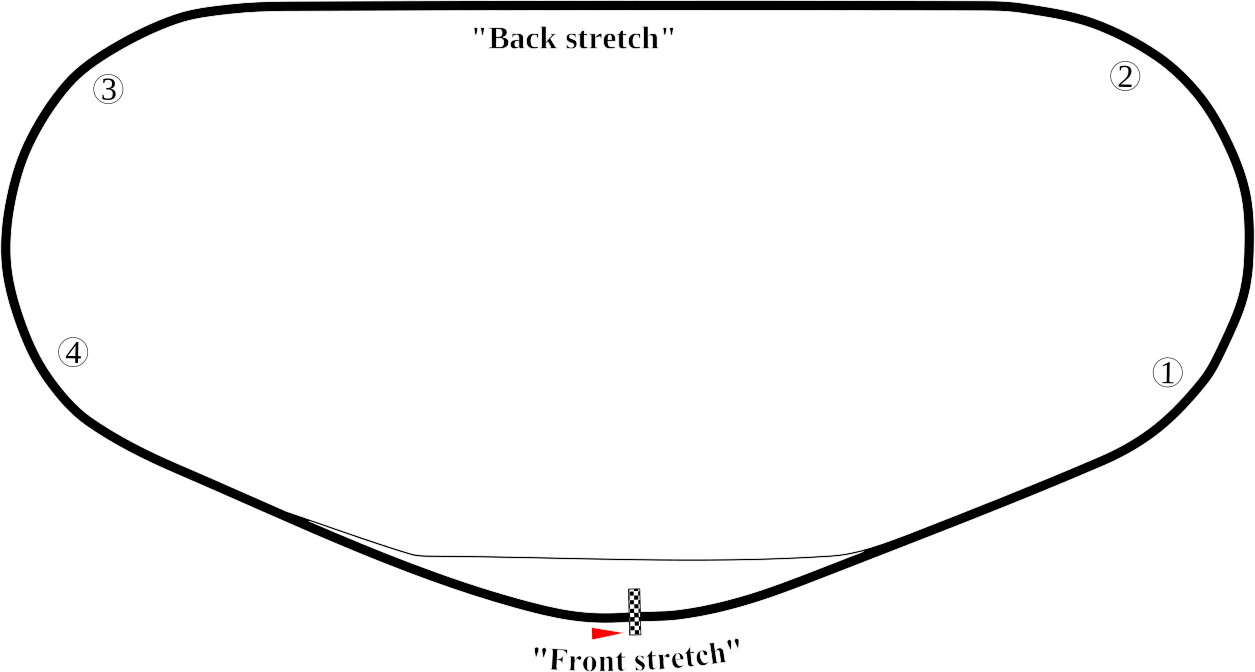
Daytona International Speedway located in Daytona Beach Florida is a...
Connecticut is a state in the New England region of...
France officially the French Republic is primarily in Western Europe...
A car also known as an automobile is a wheeled...

Canada is a North American country spanning from the Atlantic...
Trending

3 hours ago Kevin Bacon Seeks Fan Assistance Following Recent Heartbreaking Personal Loss
3 hours ago Tacoma Grocery Owner Extradited from India Over $600K Food Stamp Fraud Scheme

4 hours ago Elizabeth Hurley and Billy Ray Cyrus Announce Their Engagement

4 hours ago Fabio Wardley Praises Anthony Joshua's Aura Ahead of Daniel Dubois Boxing Match

4 hours ago Ariel Winter Reveals Modern Family Connection to New Boyfriend Introduced by Nolan Gould
4 hours ago Jessica Tarlov's Role as a Prominent Political Commentator and The Five Host
Popular

Ilhan Omar is a prominent American politician currently serving as...
Ken Paxton is an American politician and lawyer serving as...

Elon Musk is a visionary entrepreneur and engineer known for...
Michael Joseph Jackson the King of Pop was a highly...

Jameis Winston is an American football quarterback currently playing for...

Cristiano Ronaldo widely considered one of the greatest footballers captains...