


Kuala Lumpur (KL), the capital of Malaysia, is its most populous city, covering 243 sq km and home to over 2 million people as of 2024. Greater Kuala Lumpur, encompassing the Klang Valley, forms an urban area of over 8.8 million people as of 2024. KL is one of Southeast Asia's fastest-growing metropolitan regions regarding population and economic development.
1900: Kuala Lumpur Population
In 1900, Kuala Lumpur's population was 30,000.


1900: Population of Kuala Lumpur in 1900
In 1900, the population of Kuala Lumpur was 30,000.
1903: Expansion of Kuala Lumpur in 1903
In 1903, Kuala Lumpur expanded to encompass 20 square kilometers.
1912: Tauchang Riot
In 1912, the tauchang riot began during the Chinese New Year with the cutting of pigtails and ended with rioting and factional fighting lasting several days.
1920: Population of Kuala Lumpur in 1920
By 1920, the population of Kuala Lumpur increased to 80,000 due to the rubber industry boom.
1920: Kuala Lumpur Population
In 1920, the rubber boom led to a population increase in Kuala Lumpur to 80,000.
1924: Expansion of Kuala Lumpur in 1924
By 1924, Kuala Lumpur had expanded to 52 square kilometers.
1931: Kuala Lumpur Inhabitants
In 1931, 61% of Kuala Lumpur's 111,418 inhabitants were Chinese.
December 1938: Birthplace of Hashing
In December 1938, Kuala Lumpur is where Hashing began. A group of British colonial officers and expatriates started meeting on Monday evenings to run, patterned after the British Paper Chase.
January 1942: Capture of Kuala Lumpur by Imperial Japanese Army
On January 11, 1942, Kuala Lumpur was captured by the Imperial Japanese Army.
1942: Empire of Japan
August 1945: Surrender of Japanese Forces in Kuala Lumpur
On August 15, 1945, Seishirō Itagaki, commander in chief of the Japanese Seventh Area Army in Singapore and Malaysia, surrendered to the British administration in Kuala Lumpur.
1945: Federated Malay States
From 1945 to 1946, Kuala Lumpur was part of the Federated Malay States.
1946: Malayan Union
From 1946 to 1948, Kuala Lumpur was part of the Malayan Union.
1947: Kuala Lumpur Inhabitants
In 1947, 63.5% of Kuala Lumpur's population was Chinese.
1948: Kuala Lumpur Becomes a Municipality in 1948
By the time it became a municipality in 1948, Kuala Lumpur had expanded to 93 square kilometers.
1948: Federation of Malaya
From 1948 to 1963, Kuala Lumpur was part of the Federation of Malaya.
1948: Start of the Malayan Emergency
In 1948, the Malayan Emergency began, leading to the establishment of New Villages on the outskirts of Kuala Lumpur.
1948: Kuala Lumpur Municipal Council
In 1948, the Sanitary Board eventually became the Kuala Lumpur Municipal Council.
1949: Establishment of the University of Malaya
The University of Malaya (UM) was established in 1949 and is the oldest university in Malaysia.
February 1952: First Municipal Election in Kuala Lumpur
On February 16, 1952, the first municipal election in Kuala Lumpur was held.
1953: Petaling Jaya Mukim
Since 1953, Petaling Jaya was a mukim of the Kuala Lumpur district.
August 1957: Independence of the Federation of Malaya
On August 31, 1957, the Federation of Malaya gained its independence from British rule, with the declaration ceremony held at the Merdeka Stadium.
1957: Increase in Malay population
Between 1947 and 1957, the population of Malays in Kuala Lumpur increased from 12.5 to 15%, while the proportion of Chinese dropped.
1960: Kuala Lumpur Officially Became the Capital
Kuala Lumpur officially became the capital of the Malayan federation under the Federal Capital Act 1960.
1960: End of the Malayan Emergency
The Malayan Emergency, which began in 1948, ended in 1960.
1960: Districts of Selangor
Until 1960, Kuala Lumpur was one of the six districts of Selangor.
April 1961: Federal Capital Commissioner Administration
From April 1, 1961, Kuala Lumpur was administered by a corporation sole called the Federal Capital Commissioner.
September 1963: Formation of Malaysia
On September 16, 1963, after the formation of Malaysia, Kuala Lumpur officially remained the capital.
1965: Asian Basketball Championship
In 1965, Kuala Lumpur hosted the official Asian Basketball Championship.
1965: Sultan Abdul Aziz Shah Airport became the main international gateway
In 1965, Sultan Abdul Aziz Shah Airport, also known as Subang Airport, served as the main international gateway to Kuala Lumpur.
May 1969: 13 May Incident
On May 13, 1969, race riots broke out in Kuala Lumpur, resulting in significant casualties and leading to major changes in the country's economic policy.
1970: Suspension of Local Government Elections
Since the suspension of local government elections in 1970, the mayor of Kuala Lumpur has been appointed by the Federal Territories Minister.
February 1972: Kuala Lumpur Achieves City Status
On February 1, 1972, Kuala Lumpur achieved city status, becoming the first settlement in Malaysia to be granted this status after independence.
1972: Awarding City Status
In 1972, Kuala Lumpur was awarded city status, after which executive power transferred to the Lord Mayor (Datuk Bandar).
February 1974: Kuala Lumpur Becomes a Federal Territory
On February 1, 1974, Kuala Lumpur became a federal territory, expanding to 96 square miles.
1974: Kuala Lumpur as a Federal Territory in 1974
In 1974, Kuala Lumpur became a Federal Territory expanding to 243 square kilometers.
1974: Formation of the First Federal Territory
In 1974, Kuala Lumpur was split off from Selangor to form the first Federal Territory governed directly by the Malaysian federal government.
1974: End of Kuala Lumpur as District of Selangor
Until 1974, Kuala Lumpur was one of the seven districts of Selangor.
September 1975: Bas Mini KL Operated
From September 23, 1975 the Kuala Lumpur Mini-Bus Service began operation.
1977: Asian Basketball Championship
In 1977, Kuala Lumpur hosted the official Asian Basketball Championship.
1978: Cessation of Kuala Lumpur as Capital of Selangor
In 1978, Kuala Lumpur ceased to be the capital of Selangor after Shah Alam was declared the new state capital.
1980: Foreign Residents in Kuala Lumpur
In 1980, foreign residents accounted for 1% of Kuala Lumpur's population.
1980: Kuala Lumpur Population
In 1980, the population of Kuala Lumpur reached over a million, with 52% Chinese, 33% Malay, and 15% Indian.
1980: Population Under 15 years old
In 1980, the proportion of people below 15 years old was 33% in Kuala Lumpur.
1984: Recreational and sports facilities land use
In 1984, Total open space for recreational and sports facilities land use in the city has increased significantly by 5.86 square kilometres (1,450 acres)
1985: Asian Basketball Championship and Malaysia's national basketball team
In 1985, Kuala Lumpur hosted the official Asian Basketball Championship, and the city's basketball supporters cheered Malaysia's national basketball team to a Final Four finish.
May 1990: Centennial Celebration of Kuala Lumpur Local Council
On May 14, 1990, Kuala Lumpur celebrated the centennial of the local council, introducing the new federal territory flag and anthem.
1991: Elderly age group.
In 1991, the elderly age group, 60 years old and above was 4% in Kuala Lumpur.
1995: KTM Komuter Introduced
In 1995, the KTM Komuter, a commuter rail service owned and operated by Keretapi Tanah Melayu (KTM), was introduced as the first rail transit system to provide local rail services in Kuala Lumpur and the surrounding Klang Valley suburban areas.
1996: First metro lines opened
In 1996, the first metro lines in the form of a light rapid transit (LRT) line was opened.
1997: 1997 FIFA World Youth Championships
In 1997, Kuala Lumpur hosted the FIFA World Youth Championships.
1997: Tourist Arrivals
In 1997, tourist arrivals in Kuala Lumpur was 6,210,900.
July 1998: Bas Mini KL discontinued
On July 1, 1998, the Kuala Lumpur Mini-Bus Service was discontinued, replaced by the Intrakota bus services.
1998: Tourist Arrivals Increased
In 1998 during the Asian financial crisis, tourist arrivals increased from 6,210,900 in 1997 to 10,221,600 in 2000, or 64.6%.
1998: KLIA opened
In 1998, Kuala Lumpur International Airport (KLIA) opened.
1998: 1998 Commonwealth Games
In 1998, Kuala Lumpur hosted the Commonwealth Games.
1999: Kuala Lumpur as host city for the Formula One World Championship
From 1999, Kuala Lumpur was one of the host cities for the Formula One World Championship.
1999: LRT Kelana Jaya Line opened
In 1999, the LRT Kelana Jaya Line was opened.
1999: Relocation of Government Branches to Putrajaya
In early 1999, the executive and judicial branches of the Malaysian federal government were relocated from Kuala Lumpur to Putrajaya, although some sections of the political bodies remained in Kuala Lumpur.
2000: Literacy Rate in Kuala Lumpur
According to government statistics, Kuala Lumpur had a literacy rate of 97.5% in 2000.
2000: Companies with headquarters in Kuala Lumpur
In 2000, Most of the country's largest companies have their headquarters in Kuala Lumpur
2000: Increase Recreational space
In 2000, Total open space for recreational and sports facilities land use in the city has increased significantly to 15.8 square kilometres (3,900 acres).
2000: Population Under 15 years old
In 2000, the proportion of people below 15 years old fell to slightly less than 27% in Kuala Lumpur.
2000: Tourist Arrivals Increased
In 2000, tourist arrivals in Kuala Lumpur increased to 10,221,600.
2000: Kuala Lumpur Census
In the 2000 census, Chinese outnumbered Bumiputeras in Kuala Lumpur at 43% compared to 38%.
2000: Foreign Residents in Kuala Lumpur
In the 2000 census, foreign residents accounted for about 8% of Kuala Lumpur's population.
2000: Introduction of Mega Sale Event
Since 2000, the Malaysian Ministry of Tourism introduced a mega sale event for shopping in Malaysia to boost Kuala Lumpur as a leading shopping destination in Asia.
February 2001: Putrajaya Declared a Federal Territory
On February 1, 2001, Putrajaya was declared a Federal Territory and the seat of the federal government, with administrative and judicial functions shifting from Kuala Lumpur.
April 2001: KL Sentral added
On April 16, 2001, KL Sentral was added and served as the new transport hub of the Klang Valley Integrated Transit System.
2001: 2001 Southeast Asian Games
In 2001, Kuala Lumpur hosted the Southeast Asian Games.
August 2003: KL Monorail Opening
On August 31, 2003, the KL Monorail opened with 11 stations running 8.6 km on two parallel elevated tracks.
2005: Rapid Bus replaced Intrakota bus services
In 2005, Rapid Bus replaced Intrakota bus services.
January 2006: Rapid Bus revamp begins
In January 2006, Rapid Bus began the first phase of the revamp of its bus network, introducing 15 City Shuttle bus routes which served major areas in the Central Business District (CBD) of Kuala Lumpur.
2006: Public transportation utilisation rates
In 2006, public transportation utilisation rates were low, with only 16 percent of the population using public transport.
2006: Shopping Contribution to Tourism Receipts
In 2006, shopping in Malaysia contributed RM7.7 billion (US$2.26 billion), accounting for 20.8% of the RM31.9 billion tourism receipts.
2006: Government announced LRT Sri Petaling Line and the LRT Kelana Jaya Line extentions
In 2006, the government announced the extentions for the LRT Sri Petaling Line and the LRT Kelana Jaya Line, as well as upgrading of all the existing to communications-based train control (CBTC) signalling systems.
December 2007: Companies Listed in Forbes 2000
As of December 2007, excluding Petronas, 14 Kuala Lumpur-based companies were listed in Forbes 2000.
2008: Rapid Bus Operations
In 2008, Rapid Bus operated 167 routes with 1,400 buses covering 980 residential areas with a ridership of about 400,000 per day.
2008: GDP of Kuala Lumpur in 2008
In 2008, the gross domestic product (GDP) for Kuala Lumpur was estimated at RM73,536 million with an average annual growth rate of 5.9 per cent.
2009: A1 Grand Prix Folded
The open-wheel auto racing A1 Grand Prix was held in Kuala Lumpur until the series folded in 2009.
2010: Kuala Lumpur Census
According to the 2010 census, the Malay population in Kuala Lumpur increased to 44.7% (45.9% Bumiputera), exceeding the Chinese population of 43.2%.
2010: World Tallest 50 Urban Agglomeration 2010 Projection
According to the World Tallest 50 Urban Agglomeration 2010 Projection, Kuala Lumpur ranks 10th among cities with the most buildings above 100 meters.
2010: Foreign Residents in Kuala Lumpur
In 2010, foreign residents accounted for 9.4% of Kuala Lumpur's population.
2010: Statistics from the 2010 Census
Statistics from the 2010 Census indicate that 87.4% of the Chinese population identify as Buddhists, with significant minorities of adherents identifying as Christians (7.9%), Chinese folk religions (2.7%) and Muslims (0.6%). The majority of the Indian population identifies as Hindus (81.1%), with significant minorities identifying as Christians (7.8%), Muslims (4.9%) and Buddhists (2.1%).
2012: English Instruction in Schools
As of 2012, English was still the language of instruction for mathematics and the natural sciences for certain schools in Kuala Lumpur.
2012: First Future Music Festival Asia
Since 2012, the Future Music Festival Asia has been held in Kuala Lumpur.
July 2013: Market Capitalization of Bursa Malaysia
As of July 5, 2013, the market capitalisation of Bursa Malaysia stood at US$505.67 billion.
2014: Completion of MATRADE Centre
In 2014, the new 93,000 square meter MATRADE Centre was completed, further expanding MICE tourism in Kuala Lumpur.
2015: GDP of Kuala Lumpur in 2015
By 2015, the GDP of Kuala Lumpur had reached RM160,388 million, representing 15.1% of the total GDP of Malaysia.
2015: 128th IOC Session
In 2015, Kuala Lumpur hosted the 128th IOC Session where the IOC elected Beijing as the host city of the 2022 Winter Olympics and Lausanne as the host city of the 2020 Winter Youth Olympics.
2015: Construction of Kuala Lumpur Street Circuit
In 2015, the Kuala Lumpur Street Circuit was constructed to host the Kuala Lumpur City Grand Prix motor racing event.
December 2016: First MRT line opened
On December 16, 2016, the first MRT line was opened in the Klang Valley.
2016: Kuala Lumpur Dragons Champions
In 2016, the Kuala Lumpur Dragons became the Champions of the ASEAN Basketball League.
2016: Average Monthly Household Income in 2016
In 2016, the average monthly household income in Kuala Lumpur was RM9,073, growing at a pace of approximately 6% a year.
2017: Klang Valley Metropolitan Population
As of 2017, the wider Klang Valley metropolitan area, including Kuala Lumpur, has an estimated population of 7.25 million.
2017: 2017 Southeast Asian Games
In 2017, Kuala Lumpur hosted the Southeast Asian Games.
2017: End of Formula One World Championship
In 2017, Kuala Lumpur's time as one of the host cities for the Formula One World Championship ended.
2018: Population Expansion of Kuala Lumpur
From 1960 to 2018, the population of Kuala Lumpur expanded considerably, doubling in size every 13 years.
April 2019: Cashless journey implementation
Effective April 10, 2019, all Rapid KL buses began implementing a fully cashless journey for all routes by stages, in which the busses accept Touch n Go cards only.
May 2019: Fully cashless journey implementation
By May 27, 2019, the fully cashless journey systems were fully implemented in Rapid KL buses.
2019: Kuala Lumpur Ranked 6th Most-Visited City
In 2019, Kuala Lumpur was ranked the 6th most-visited city in the world according to the Mastercard Destination Cities Index.
2019: The Exchange 106 Surpasses Petronas Towers
In 2019, The Exchange 106 surpassed the Petronas Towers as the tallest building in the country by 1.7 meters.
2019: QS World University Rankings 2019
In QS World University Rankings 2019, the University of Malaya was ranked the best university in Malaysia, the 22nd-best in Asia, and third in Southeast Asia.
June 2020: Rapid Bus collaboration with Google Transit
On June 18, 2020, Rapid Bus released a new feature in collaboration with Google Transit: real-time location of bus in Google Maps.
2020: Lausanne elected as the host city of the Winter Youth Olympics
During the 128th IOC Session held in Kuala Lumpur in 2015, Lausanne was elected as the host city of the 2020 Winter Youth Olympics.
2020: Foreign Residents in Kuala Lumpur
In the 2020 census, foreign residents accounted for 10.5% of Kuala Lumpur's population.
2020: Parliamentary Constituencies and Population
Kuala Lumpur's eleven parliamentary constituencies, with 2020 population, area, density and percentage of the total are congruent with administrative subdivisions under the authority of the Kuala Lumpur City Hall authority.
2022: Beijing elected as the host city of the Winter Olympics
During the 128th IOC Session held in Kuala Lumpur in 2015, Beijing was elected as the host city of the 2022 Winter Olympics.
August 2024: Appointment of Current Mayor
Since August 15, 2024, Maimunah Mohd Sharif has been in office as the current mayor.
2024: Kuala Lumpur Population
As of 2024, Kuala Lumpur has a population of 2.076 million.
2026: LRT Shah Alam Line launch
The LRT Shah Alam Line is currently under construction and is scheduled to launch in 2026.
2030: MRT Circle Line completion
The MRT Circle Line is being planned and is scheduled to be completed by 2030 and will loop around the city.
Mentioned in this timeline

Basketball is a team sport played on a rectangular court...
Google LLC is a multinational technology corporation specializing in a...
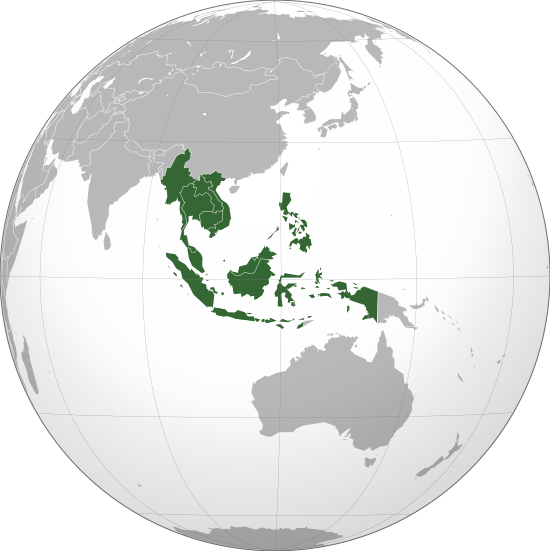
The Association of Southeast Asian Nations ASEAN is a regional...
FIFA or the F d ration Internationale de Football Association...
Japan is an East Asian island country located in the...

KPMG is a multinational professional services network headquartered in London...
Trending
4 hours ago Amber Alerts Issued for Missing Children in California and Indiana
5 hours ago College Football Week 8 Analysis and Rankings Overview

2 days ago Cher's Former Miami Beach Waterfront Estate Real Estate History

6 hours ago Justin Bieber Launches Exclusive Immersive Audio Experience Pop-Up in Seoul
6 hours ago Chris Brown faces sentencing for London nightclub bottle attack

6 hours ago Beyoncé Reunites With Destiny's Child Members During Jay-Z Concert at SoFi Stadium
Popular

Ilhan Omar is a prominent American politician currently serving as...
Ken Paxton is an American politician and lawyer serving as...

Elon Musk is a visionary entrepreneur and engineer known for...
Barack Obama the th U S President - was the...

Greg Abbott is the current and th Governor of Texas...
Michael Joseph Jackson the King of Pop was a highly...