


Lindenwood University, located in St. Charles, Missouri, is a private university established in 1832 by George Champlin Sibley and Mary Easton Sibley as The Lindenwood School for Girls. Notably, it stands as the second-oldest higher education institution west of the Mississippi River, marking its historical significance in American education.
1900: New Buildings Constructed
In 1900, Lindenwood University began an expansion phase, with the construction of new buildings that would continue into the early 20th century.


1913: Lindenwood Accredited as Junior College
In 1913, Lindenwood was officially accredited as a junior college by the North Central Association, marking a significant step in its academic development.
1918: $4 Million Bequest
In 1918, Lindenwood received a substantial $4 million bequest from the estate of Margaret Leggat Butler, enabling the establishment of a permanent endowment and transition to a four-year curriculum.
1919: Army ROTC Founded
Officially founded in 1919 and with roots tracing to the 1890s, the Gateway Battalion is one of the oldest Army ROTC programs in the nation.
1920: New Buildings Constructed
By 1920, Lindenwood University's expansion included the construction of four new buildings since the turn of the century.
1921: Roemer Hall Constructed
In 1921, Roemer Hall was constructed and became the main administration building on campus.
1921: Lindenwood Accredited
Since 1921, Lindenwood has been accredited by the Higher Learning Commission (HLC) or its predecessor.
1929: Butler Library Constructed
In 1929, the Margaret Leggat Butler Library was constructed.
1929: Margaret Leggat Butler Library Built
The Margaret Leggat Butler Library was built in 1929.
1948: Robert A. Taft Spoke
In 1948, Robert A. Taft spoke at Lindenwood about the Taft–Hartley Act and his candidacy for the 1948 GOP nomination.
1969: Lindenwood Becomes Co-Educational
In 1969, Lindenwood transitioned to a co-educational institution and was renamed Lindenwood Colleges, establishing separate colleges for men and women.
1970: John Danforth Visited
In 1970, John Danforth visited Lindenwood during his campaign for the US Senate seat representing Missouri.
1970: Evening Classes Started
In 1970, Lindenwood began offering evening classes, expanding educational opportunities for non-traditional students.
1973: Leonor K. Sullivan Visited
In 1973, Leonor K. Sullivan visited Lindenwood as the first woman in Congress from Missouri.
1976: Stadium Built by St. Louis Cardinals
In 1976, the St. Louis Cardinals NFL football team constructed Harlen C. Hunter Stadium as a training camp location.
1980: NAIA Membership
In 1980, Lindenwood became a member of the NAIA (National Association of Intercollegiate Athletics).
1983: John Ashcroft Campaign Stop
In 1983, John Ashcroft made a campaign stop at Lindenwood before becoming Missouri's Governor in 1984.
1983: Colleges Merged
In 1983, Lindenwood Colleges, Lindenwood College for Men, and Lindenwood College for Women were merged into Lindenwood College.
1984: John Ashcroft Elected Governor
In 1984, John Ashcroft was elected governor of Missouri.
1985: Richard Gephardt Spoke
In 1985, Richard Gephardt spoke at Lindenwood as a U.S. Representative of Missouri.
1988: Eagleton and Kissinger Spoke
In 1988, Thomas Eagleton and Henry Kissinger spoke at Lindenwood.
1989: Spellmann Hired as President
In 1989, with Lindenwood College facing bankruptcy and low enrollment, Dennis Spellmann was hired as the new president to implement significant changes.
1990: Barger arrives at Lindenwood
In 1990, Brett Barger first arrived at the St. Charles campus as a student.
1992: Greek System Returns
In 1992, the college announced that two sororities and three fraternities would be established on campus, marking the modern era of the Greek system at Lindenwood.
1993: Joined American Midwest Conference
From 1993–94 to 1995–96, Lindenwood was a member of the American Midwest Conference.
1993: Mary Ambler Archives Founded
In 1993, the Mary Ambler Archives were founded and are part of the Missouri Digital Heritage Initiative and the State Historical Society of Missouri.
1995: Competed in American Midwest Conference
From 1993–94 to 1995–96, Lindenwood was a member of the American Midwest Conference.
1995: Jim Talent Visited
In 1995, Jim Talent visited LU as a U.S. congressman from Missouri.
1996: Joined HAAC
From 1996–97 to 2010–11, Lindenwood was a member of the National Association of Intercollegiate Athletics (NAIA) and competed within the Heart of America Conference (HAAC).
1997: Dora Boyd de Perez Balladares Visited
In 1997, Dora Boyd de Perez Balladares, First Lady of Panama visited the university.
1997: Name Change to Lindenwood University
In 1997, Lindenwood College officially changed its name to Lindenwood University, reflecting its expanded programs and institutional growth.
1997: Robert F. Hyland Performance Arena Built
In 1997, the 3,270-seat Robert F. Hyland Performance Arena was built.
2002: "Pork for Tuition" Program Started
In 2002, Lindenwood began the controversial "Pork for Tuition" program, allowing rural families to pay tuition with livestock.
2002: Spellmann Campus Center Built
In 2002, the Spellmann Campus Center was built at the heart of the Lindenwood campus.
2005: Peggy Ellis at St. Louis University
Since 2005, Peggy Ellis served as the associate dean of graduate studies at the St. Louis University nursing school.
2006: Dennis Spellmann's Death
In 2006, Dennis Spellmann died; during his tenure, the university's endowment had grown to over $50 million.
February 9, 2007: James Evans Became President
On February 9, 2007, James Evans became Lindenwood's 21st president.
2007: Doctoral Programs Launched
In 2007, Lindenwood began offering doctoral programs, starting with a Doctorate of Education program.
2007: Barat Academy Facility Opened
In 2007, the Barat Academy facility opened.
2007: Lindenwood Sports Hall of Fame
Since 2007 Lindenwood Athletics has been honoring previous student-athletes or contributors of the athletic department with the Lindenwood Sports Hall of Fame.
2008: Plans to Expand Belleville Facilities
In 2008, Lindenwood University announced plans to expand facilities at Lindenwood University – Belleville and increased academic programs.
2008: Lindenwood Speaker Series Begins
In 2008, Lindenwood University began the Lindenwood Speaker series.
2008: Reynolds Hall and Pfremmer Hall Constructed
In 2008, Reynolds Hall and Pfremmer Hall were constructed between the new president's residence and LU Commons.
2008: J. Scheidegger Center for the Arts Opened
In 2008, the J. Scheidegger Center for the Arts opened at a cost of $32 million on the southeast edge of campus.
May 2009: Construction for Evans Commons Began
In May 2009, construction began for the $20 million Evans Commons student center.
2009: St. Louis City Location Opened
In 2009, Lindenwood opened a St. Louis City Location at 1409 Washington Avenue.
2009: Evans Commons Construction Started
In 2009, construction began on Evans Commons.
2009: Sibley Day Held
Since 2009, Sibley Day has been held as a new tradition at Lindenwood.
2009: LU-Belleville began offering courses
Starting in the fall of 2009, LU-Belleville began offering courses in business administration, communications, criminal justice, and health management.
July 12, 2010: Accepted into NCAA Division II
On July 12, 2010, Lindenwood was accepted into NCAA Division II.
September 24, 2010: Approved as Member of MIAA
On September 24, 2010, Lindenwood was approved as a member of the MIAA.
2010: Endowment Reached $148 Million
By 2010, Lindenwood University's endowment had reached $148 million.
2010: New President's House Opened
In 2010, the new president's house, known as Lindenwood House, opened on a hill overlooking the Sports Complex and much of the campus.
2010: Business School Accredited
Since 2010, LU's School of Business and Entrepreneurship has been accredited by the Accreditation Council for Business Schools and Programs.
February 2011: Lindenwood Town Center Approved
In February 2011, the St. Charles City Council approved a resolution supporting the Lindenwood Town Center, a $30 million development.
August 2011: Evans Commons Opened
In August 2011, the 119,000-square-foot Evans Commons facility opened.
November 2011: Belleville Campus Transitions to Stand-Alone College
In November 2011, Lindenwood University-Belleville completed the transition from a satellite campus to a full-fledged, stand-alone college.
2011: Howard J. Wall Joins Lindenwood
In 2011, Howard J. Wall joined Lindenwood as director of the Institute for the Study of Economics and the Environment.
2011: Barat Academy Evicted
In 2011, the Barat Academy was evicted and relocated to a smaller property.
March 10, 2012: Ron Paul visits Lindenwood
On March 10, 2012, the university hosted 2012 GOP Presidential candidate, Ron Paul at the Hyland Arena.
2012: Affiliation with NCAA
In 2012–2013 academic year the affiliation with NCAA took place.
2012: Barat Academy Property Purchased
In the fall of 2012, Lindenwood University announced its purchase of the 28-acre property that was previously home to the Barat Academy.
2013: Competed in MIAA
From 2013–14 to 2018–19, Lindenwood competed in the D-II Mid-America Intercollegiate Athletics Association (MIAA).
2013: Affiliation with NCAA
In 2012–2013 academic year the affiliation with NCAA took place.
2013: Hammond Institute Founded
In 2013, the John W. Hammond Institute for Free Enterprise was founded at Lindenwood.
2013: Nursing and Allied Health Sciences Program Opens
In the fall of 2013, Lindenwood's Nursing and Allied Health Sciences program opened in the former Barat Academy facility.
May 2014: Plans Approved for New Library
In May 2014, the Lindenwood University Board of Directors approved plans for a new 100,000-square-foot Library and Academic Resources Center.
August 1, 2015: Brett Barger becomes interim president
On August 1, 2015, Brett Barger was appointed interim president of the Belleville campus.
October 2015: Barger Appointed President
In October 2015, Brett Barger's interim title was removed and he was appointed president of the Lindenwood University Belleville campus.
2015: Construction of New Facility Announced
In 2015, Lindenwood announced the construction of a new Academic Resources Center to replace the Margaret Leggat Butler Library.
April 2016: Daniel Boone Historic Site Donated
In April 2016, Lindenwood University donated the Daniel Boone historic site to the people of St. Charles County.
August 2017: New Library Opens
August 2017 marked the official opening of Lindenwood's new library building, the Library and Academic Resources Center (LARC).
2018: Competed in MIAA
From 2013–14 to 2018–19, Lindenwood competed in the D-II Mid-America Intercollegiate Athletics Association (MIAA).
2018: Women's Bowling Team Wins Championship
In 2018, the Lindenwood women's bowling team won the national USBC Intercollegiate Team Championships.
September 2019: Best College Rankings Released
In September 2019, the 2020 U.S. News & World Report Best College rankings were released, ranking Lindenwood #293–381 among national universities.
2019: Competed in GLVC
From 2019-20 to 2021-22, The Lions previously competed in the Great Lakes Valley Conference (GLVC) of the NCAA Division II ranks
2019: LU-Belleville to cease undergraduate programs
In 2019, the Lindenwood University Board of Trustees announced that LU–Belleville would cease to offer traditional semester-based undergraduate programs after the 2019–20 academic year due to "ongoing financial and enrollment challenges".
2020: Lindenwood Ranked by U.S. News & World Report
In 2020, U.S. News & World Report ranked Lindenwood #293-381 among national universities.
2020: LU-Belleville Departed AMC
The Lindenwood University at Belleville sports teams competed in the National Association of Intercollegiate Athletics (NAIA) and its American Midwest Conference (AMC) until 2020.
2021: Competed in GLVC
From 2019-20 to 2021-22, The Lions previously competed in the Great Lakes Valley Conference (GLVC) of the NCAA Division II ranks
2021: Lindenwood Enrollment
In 2021, Lindenwood University reported an enrollment of 6,992 students across its nine colleges and schools.
2022: Lindenwood Joins Ohio Valley Conference
In 2022, Lindenwood became a member of the NCAA Division I ranks, primarily competing in the Ohio Valley Conference (OVC) for most of its sports since the 2022–23 academic year.
2023: Dorsey College Acquired
In 2023, Lindenwood University acquired Dorsey College, a for-profit trade school with seven campuses in Michigan. The school also made large cutbacks removing nine staff positions and ten sports programs including men's tennis, lacrosse, and wrestling.
2023: Athletic Teams Discontinued
In 2023, the university discontinued 10 athletic teams.
Mentioned in this timeline

The Great Lakes are a chain of five large interconnected...
The rapid advancement of artificial intelligence continues to dominate the...
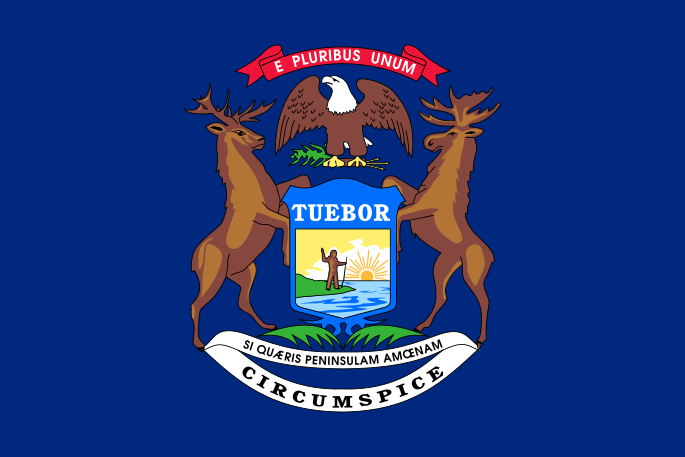
Michigan is a state in the Great Lakes region of...

Football commonly known as soccer in many regions is the...

Justice in its broadest sense is the concept of treating...

St Louis is an independent city located in Missouri near...
Trending
4 hours ago Miomir Kecmanovic Wins Match Despite Racket Smashing Incident

4 hours ago Katie Boulter Family Background and Recent Tennis Circuit Updates
4 hours ago Violent Cost-of-Living Protests Erupt in Central Milan

4 hours ago Philippines Summons Chinese Envoy Over Alleged Threats and Diplomatic Tensions

4 hours ago Kevin Bacon Seeks Public Assistance to Locate Sentimental Missing FedEx Package

5 hours ago Quentin Tarantino Final Tenth Film Script Completed Before Pursuing Other Projects
Popular

Ilhan Omar is a prominent American politician currently serving as...

Ken Paxton is an American politician and lawyer serving as...

Elon Musk is a visionary entrepreneur and engineer known for...

Michael Joseph Jackson the King of Pop was a highly...

Cristiano Ronaldo widely considered one of the greatest footballers captains...

Greta Thunberg is a Swedish climate activist who gained international...