History of Magic Johnson in Timeline


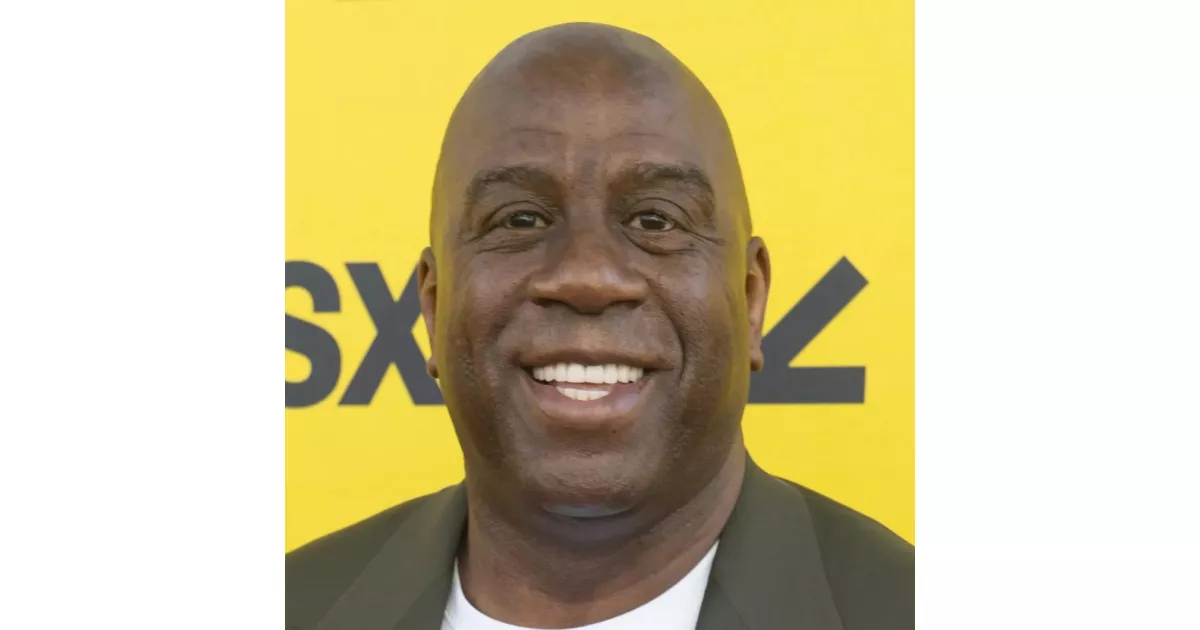
Earvin "Magic" Johnson Jr., is a celebrated American businessman and former professional basketball player, widely considered the greatest point guard ever. Drafted first overall by the Los Angeles Lakers in 1979 after a national championship with Michigan State, he led the Lakers to five NBA championships during the 'Showtime' era. Johnson's career was marked by an abrupt retirement in 1991 following his HIV diagnosis. He made several comebacks, including the 1992 All-Star Game where he won MVP, and a brief stint in 1996, before his final retirement.
1 hour ago : Magic Johnson's NBA warning: Lakers face title contention challenges against Thunder, Spurs.
Magic Johnson warned the NBA that the Lakers might not contend for titles soon, facing challenges from the Thunder and Spurs. Their performance raises concerns among fans and analysts alike.


August 14, 1959: Earvin "Magic" Johnson Jr. Born
On August 14, 1959, Earvin "Magic" Johnson Jr., an American businessman and former professional basketball player, was born.
1969: Celtics' Last Consecutive Title
In 1969, the Celtics won consecutive titles in the NBA Finals. This was a benchmark that the Lakers aimed to achieve in the 1987-88 season, as mentioned by coach Pat Riley.
1977: Named to the McDonald's All-American team
In 1977, Magic Johnson was named to the inaugural McDonald's All-American team, which played in the Capital Classic.
1978: NCAA Tournament Berth
In 1978, Magic Johnson, playing with future NBA draftees, led the Spartans to a berth in the NCAA tournament, where they reached the Elite Eight.
1979: NCAA Finals Against Larry Bird
In 1979, Magic Johnson faced Larry Bird in the NCAA finals, beginning a well-documented friendship and rivalry.
1979: Drafted First Overall by the Los Angeles Lakers
In 1979, Magic Johnson was drafted first overall by the Los Angeles Lakers, marking a significant milestone in his career.
1979: NBA Draft and Championship with Michigan State
In 1979, Magic Johnson won a national championship with the Michigan State Spartans. Later that year, he was selected first overall in the NBA draft by the Los Angeles Lakers.
1980: Johnson dispute with Westhead
Early in the 1981–82 season, Magic Johnson had a heated dispute with Westhead, who Johnson said made the Lakers "slow" and "predictable".
1980: NBA Finals Victory and MVP Award
In 1980, the Lakers reached the NBA Finals and faced the Philadelphia 76ers. Magic Johnson led the Lakers to a 123–107 win in Game 6, recording 42 points, 15 rebounds, and 7 assists. He became the only rookie to win the NBA Finals MVP award.
1980: Lakers compiled a 60–22 record
The Lakers compiled a 60–22 record in the regular season
1981: Knee Injury and Playoff Upset
Early in the 1980–81 season, Magic Johnson was sidelined after he suffered torn cartilage in his left knee, missing 45 games. He returned before the start of the 1981 playoffs, but the Lakers were upset by the Houston Rockets in the first round.
1981: Birth of Andre Johnson
In 1981, Magic Johnson fathered a son, Andre Johnson, with Melissa Mitchell. Andre was raised by his mother but visited Magic each summer and later worked for Magic Johnson Enterprises.
1981: Signed a 25-Year Contract with the Lakers
In 1981, after the 1980–81 season, Magic Johnson signed a 25-year, $25 million contract with the Lakers, which was the highest-paying contract in sports history up to that point.
1982: Double-Double Season and Finals Appearance
During the 1982–83 NBA season, Magic Johnson began his first of nine consecutive double-double seasons, averaging 16.8 points, 10.5 assists, and 8.6 rebounds per game. The Lakers reached the Finals.
1982: NBA Finals Victory and Second Finals MVP
In 1982, the Lakers faced Philadelphia in the NBA Finals, and Magic Johnson won his second NBA Finals MVP award after a triple-double in Game 6, helping the Lakers defeat the Sixers 4–2.
1982: Named Finals MVP
In the 1982 NBA Finals, Magic Johnson was named the Finals MVP, averaging just 16.2 points. It was the lowest average of any Finals MVP award recipient in the three-point shot era.
1984: NBA Finals Rivalry Peak
From 1984 to 1987, the rivalry between Johnson and Bird reached its peak as the Boston Celtics and Los Angeles Lakers met in the NBA Finals three out of four times, with the Lakers winning two.
1984: Friendship Forged in Converse Ad
In 1984, despite their on-court rivalry, Magic Johnson and Larry Bird became close friends while filming a Converse shoe advertisement, where they were depicted as enemies.
1984: Regular Season Averages
In the 1984–85 regular season, Magic Johnson averaged 18.3 points, 12.6 assists, and 6.2 rebounds per game, leading the Lakers into the 1985 NBA Finals.
1985: Creation of "A Midsummer Night's Magic" Charity Event
In 1985, Magic Johnson created "A Midsummer Night's Magic", an annual charity event that included a celebrity basketball game and a black-tie dinner. The proceeds went to the United Negro College Fund, and this event continued for twenty years.
1985: NBA Finals Victory Against the Celtics
In 1985, the Lakers defeated the Boston Celtics in six games in the NBA Finals. Abdul-Jabbar and Magic Johnson both highlighted the Finals win as the pinnacle of their careers.
1985: Averaged a Double-Double
In the 1985–86 NBA season, Magic Johnson again averaged a double-double, with 18.8 points, 12.6 assists, and 5.9 rebounds per game.
1987: Riley's Promise to Defend NBA Title
In 1987, before the NBA season, Lakers coach Pat Riley publicly declared that the team would defend their NBA title. This set a high expectation, as no team had won consecutive titles since the Celtics in 1969.
1988: Lakers Win NBA Championship
In 1988, Magic Johnson and the Lakers won the NBA Championship, defeating the Detroit Pistons in a grueling series. Despite facing a physical Pistons team known as the "Bad Boys", the Lakers prevailed in seven games, securing Johnson's fifth and final NBA title.
1988: Lakers Reach the 1989 NBA Finals
In the 1988-89 season, Magic Johnson and the Lakers reached the 1989 NBA Finals for the second consecutive year. Unfortunately, they would face the Detroit Pistons again in the finals, where they would ultimately lose.
1989: Magic Johnson Wins Second MVP Award
In 1989, Magic Johnson earned his second MVP award after averaging 22.5 points, 12.8 assists, and 7.9 rebounds per game. The Lakers reached the 1989 NBA Finals but were swept by the Detroit Pistons after Johnson sustained a hamstring injury.
1989: Johnson Plays Without Abdul-Jabbar
In the 1989-90 NBA season, Magic Johnson played without Abdul-Jabbar for the first time, leading the Lakers to the Western Conference semifinals.
1990: PepsiCo Bottling Operation Investment
In 1990, Magic Johnson and Earl Graves Sr. acquired a significant stake in the Washington, D.C. PepsiCo bottling operation, establishing it as the largest minority-owned facility within PepsiCo in the United States.
1990: Johnson Wins Third MVP Award, Lakers Bow Out of Playoffs
In 1990, Magic Johnson secured his third MVP award after averaging 22.3 points, 11.5 assists, and 6.6 rebounds per game. However, the Lakers were eliminated in the Western Conference semifinals by the Phoenix Suns, marking their earliest playoff exit in nine years.
October 1991: Johnson Plays in McDonald's Open, Named Tournament MVP
In October 1991, Magic Johnson played with the Lakers in the McDonald's Open in Paris, France. He was named the tournament MVP after helping the Lakers win gold.
November 7, 1991: Magic Johnson Announces HIV Diagnosis and Retirement
On November 7, 1991, Magic Johnson publicly announced that he had tested positive for HIV and would retire immediately from basketball. He reassured the public that his wife and unborn child were not infected and pledged to dedicate his life to battling the disease.
November 1991: Creation of the Magic Johnson Foundation
Following his HIV diagnosis announcement in November 1991, Magic Johnson established the Magic Johnson Foundation to combat HIV, later broadening its scope to include other charitable endeavors.
1991: Formation of Magic Johnson All-Stars
After leaving the NBA in 1991, Magic Johnson formed the Magic Johnson All-Stars, a barnstorming team that traveled around the world playing exhibition games.
1991: Buss supports Johnson after HIV Diagnosis
In 1991, Lakers owner Jerry Buss supported Magic Johnson after Johnson revealed his HIV diagnosis, keeping Johnson close to the organization.
1991: Abrupt Retirement Due to HIV
In 1991, Magic Johnson abruptly retired from the NBA after announcing that he had contracted HIV.
1991: Magic Johnson Foundation Founded
In 1991, Magic Johnson founded the Magic Johnson Foundation. This foundation eventually encompassed "A Midsummer Night's Magic", a charity event benefiting the United Negro College Fund.
1991: Marriage to Cookie Kelly
In 1991, Magic Johnson married Earlitha "Cookie" Kelly at the Union Missionary Baptist Church in Lansing. Guests included Isiah Thomas, Mark Aguirre, and Herb Williams.
1991: Lakers Face Chicago Bulls in NBA Finals
In 1991, the Lakers, led by Magic Johnson, reached the NBA Finals and faced Michael Jordan and the Chicago Bulls. Despite Johnson's efforts, including two triple-doubles, the Bulls won the series 4–1. Johnson averaged 18.6 points, 12.4 assists, and 8 rebounds per game in what would be the last championship series of his career.
1992: Johnson Announces NBA Comeback, Then Retires Again
Before the 1992-93 NBA season, Magic Johnson announced his intention to return to the NBA. However, after practicing and playing in pre-season games, he retired again before the regular season started due to controversy and concerns from other players regarding his HIV status.
1992: Aborted Comeback
In 1992 Magic Johnson had aborted a comeback due to controversy over his HIV status. In 1996, he finally retired for good.
1992: Appearance at Bird's Retirement Ceremony
In 1992, Magic Johnson appeared at Larry Bird's retirement ceremony and described Bird as a "friend forever."
1992: Appointment to National Commission on AIDS
In 1992, Magic Johnson joined the National Commission on AIDS, a committee formed by Congress and the Bush Administration; however, he resigned after eight months due to disagreements with the White House's approach and policies on AIDS.
1992: Johnson Competes in Barcelona Olympics
In 1992, Magic Johnson participated in the Barcelona Summer Olympics as part of the U.S. "Dream Team." The team dominated the competition, winning the gold medal with an 8–0 record. Johnson averaged 8.0 points per game and used the opportunity to inspire HIV-positive individuals.
1992: All-Star Game Return and Second Retirement
In 1992, Magic Johnson returned to play in the All-Star Game, winning the All-Star MVP Award. He retired again after fellow players protested his return.
1992: Publication of Autobiography "Magic Johnson: My Life"
In 1992, Magic Johnson's autobiography, titled "Magic Johnson: My Life", was published.

1992: Buss Pays Voided Contract
In 1992, despite Magic Johnson's retirement voiding a $14 million contract, Lakers owner Jerry Buss insisted that Johnson still be paid.
1992: Johnson Plays in NBA All-Star Game
In 1992, despite his recent retirement, Magic Johnson was voted in by fans to start in the NBA All-Star Game. Controversy arose due to concerns about his HIV status, but he played and led the West team to a victory, earning the All-Star MVP award.
1992: "A Midsummer Night's Magic" Raises $1.3 Million
In 1992, the "A Midsummer Night's Magic" event, following Johnson's appearance in the Olympics, raised over $1.3 million for the United Negro College Fund. The event featured a celebrity basketball game led by Johnson, Shaquille O'Neal, and Spike Lee.
1993: Johnson Becomes Lakers Coach
Near the end of the 1993-94 NBA season, Magic Johnson returned to the NBA as the coach for the Lakers, replacing Randy Pfund. Johnson took the job after being encouraged by owner Jerry Buss.
June 1994: Johnson Purchases Share of the Lakers
In June 1994, after resigning as coach of the Lakers, Magic Johnson purchased a 5% share of the team.
1994: Jud Heathcote stepped down as coach of the Spartans
After the 1994–95 season, Jud Heathcote stepped down as coach of the Spartans.
1994: Minority Ownership of the Lakers
In 1994, Magic Johnson became a minority owner of the Lakers, investing over $10 million for part ownership. He also assumed the role of team vice president.
1994: Johnson Forms Magic Johnson All-Stars
In 1994, Magic Johnson formed the Magic Johnson All-Stars, a team composed of former NBA and college players, and toured various countries, playing competitive basketball.
June 8, 1995: Jud Heathcote All-Star Tribute Game
On June 8, 1995, Magic Johnson returned to the Breslin Center to play in the Jud Heathcote All-Star Tribute Game, where he led all scorers with 39 points.
1995: Johnson Begins Intense Workouts
During his retirement, starting in 1995, Magic Johnson began intense workouts to help his fight against HIV, significantly increasing his strength and weight.
1995: Adoption of Daughter Elisa
In 1995, Magic Johnson and his wife, Cookie, adopted a daughter named Elisa.
1995: Celebrity Game to Honor Jud Heathcoate
In 1995, Magic Johnson played in a celebrity game to honor coach Jud Heathcoate.
January 29, 1996: Johnson Returns to the Lakers
On January 29, 1996, at the age of 36, Magic Johnson made his official return to the Los Angeles Lakers during the 1995-96 NBA season. His first game back was the following day against the Golden State Warriors.
1996: Johnson Retires Permanently
After the Lakers lost in the first round of the playoffs, in 1996, Magic Johnson initially considered returning for another season or joining another team. However, he ultimately decided to retire permanently, stating he was "going out on my terms."
1996: All-Stars Amass Record of 55-0
By 1996, when Magic Johnson returned to the Lakers, the Magic Johnson All-Stars had achieved a record of 55-0. Johnson was earning as much as $365,000 per game playing with the team.
1996: Named one of the 50 Greatest Players in NBA History
In 1996, Magic Johnson was honored as one of the 50 Greatest Players in NBA History.
1996: Final Return and Retirement
In 1996, at age 36, Magic Johnson returned to play 32 games for the Lakers before retiring for the third and final time.
1997: Deal with Fox
In 1997, Magic Johnson Entertainment, his production company, signed a deal with Fox.
1998: The Magic Hour Cancellation
In 1998, Magic Johnson hosted a late-night talk show called "The Magic Hour" on the Fox network, but it was canceled after two months due to low ratings.
1999: Joins M7 Borås
In 1999, Magic Johnson joined the Swedish squad M7 Borås and was undefeated in five games. He also became a co-owner, but the project failed after one season.
1999: Main Speaker at UN World AIDS Day Conference
In 1999, Magic Johnson was the main speaker at the United Nations (UN) World AIDS Day Conference, and has since served as a United Nations Messenger of Peace.
2000: Magic Johnson Music Venture
In 2000, Magic Johnson launched Magic Johnson Music, a joint venture with MCA, initially named Magic 32 Records. R&B artist Avant was signed as its first act. He also co-promoted Janet Jackson's Velvet Rope Tour.
November 2001: Johnson Plays Against Michigan State
In November 2001, at the age of 42, Magic Johnson played with the All-Stars against his alma mater, Michigan State, in his hometown of Lansing for the first meaningful game in 22 years. Johnson had a triple-double, but his team lost by two points.
November 1, 2002: Johnson Plays Second Exhibition Game Against Michigan State
On November 1, 2002, Magic Johnson played a second exhibition game against Michigan State with the Canberra Cannons, defeating the Spartans 104–85.
2002: Enshrined into the Naismith Memorial Basketball Hall of Fame
In 2002, Magic Johnson was inducted into the Naismith Memorial Basketball Hall of Fame for his individual career.
2004: HIV Announcement Named Seventh-Most Memorable Moment by ESPN
In 2004, ESPN named Magic Johnson's HIV announcement as the seventh-most memorable moment of the previous 25 years, highlighting the significant impact of his announcement on public awareness and perception of HIV.
2004: Sale of Magic Johnson Theaters
In 2004, Magic Johnson and Ken Lombard sold Magic Johnson Theaters to Loews Cineplex Entertainment.
2005: Bought the Williamsburgh Savings Bank Tower
In 2005, Magic Johnson was part of a syndicate that bought the Williamsburgh Savings Bank Tower in Brooklyn for $71 million.
2005: End of "A Midsummer Night's Magic"
In 2005, Magic Johnson's yearly charity event "A Midsummer Night's Magic" ended after twenty years of raising money for the United Negro College Fund.
2006: Rated Greatest Point Guard of All Time
In 2006, ESPN.com rated Magic Johnson as the greatest point guard of all time.
2006: Creation of Sodexo-Magic
In 2006, Magic Johnson created a contract food service with Sodexo USA called Sodexo-Magic.
2006: Endorsement of Phil Angelides
In 2006, Magic Johnson publicly endorsed Phil Angelides for Governor of California.
2007: Conversion of the Williamsburgh Savings Bank Tower
In 2007, Magic Johnson and partners converted the Williamsburgh Savings Bank Tower into luxury condominiums.
2008: Joins ESPN's NBA Countdown
In 2008, Magic Johnson became a studio analyst for ESPN's NBA Countdown.
2008: Support for Hillary Clinton's Presidential Campaign
In 2008, Magic Johnson supported Hillary Clinton during her presidential campaign.
2009: Collaboration on 'When the Game Was Ours'
In 2009, Magic Johnson and Larry Bird collaborated with journalist Jackie MacMullan on a non-fiction book titled "When the Game Was Ours", detailing their rivalry and friendship.

October 2010: Sale of Lakers Ownership Stake
In October 2010, Magic Johnson sold his ownership stake in the Lakers to Patrick Soon-Shiong, but remained with the team as an unpaid vice president.
2010: Endorsement of Barbara Boxer
In 2010, Magic Johnson endorsed Barbara Boxer in her race for re-election to the U.S. Senate.
2010: Second Hall of Fame Induction
In 2010, Magic Johnson had his second induction into the Naismith Memorial Basketball Hall of Fame as a member of the Dream Team.
2010: End of Starbucks Partnership
In 2010, Magic Johnson sold his remaining interest in Starbucks stores back to the company, ending a successful twelve-year partnership.
2010: First Magic Johnson Theater Closes
In 2010, the first Magic Johnson Theater, located in the Baldwin Hills Crenshaw Plaza, closed.
August 2011: Johnson Regrets Initial Retirement
In August 2011, Magic Johnson stated in an interview that he regretted retiring after being diagnosed with HIV in 1991, noting that if he had known what he knew then, he would not have retired.
2011: Re-opening of Magic Johnson Theater
In 2011, the first Magic Johnson Theater, previously closed, re-opened as Rave Cinema 15.
2011: Frontline Interview on AIDS Activism
In a 2011 interview with Frontline, Magic Johnson recalled a promise he made to AIDS activist Elizabeth Glaser before her death, where she convinced him to become the face of the disease and educate people about it.
January 2012: Joins Dodgers Ownership Bid
In January 2012, Magic Johnson joined with Guggenheim Partners and Stan Kasten in a bid for ownership of the Los Angeles Dodgers baseball team.
March 2012: Dodgers Ownership Secured
In March 2012, Magic Johnson's ownership group was announced as the winner of the proceedings to buy the Los Angeles Dodgers, paying $2 billion for the team.
2012: Endorsement of Barack Obama
In 2012, Magic Johnson endorsed Barack Obama for president.
2012: Launch of Aspire TV Network
In 2012, Magic Johnson launched a cable TV network called Aspire, featuring programming targeted at black audiences.
2013: Endorsement of Wendy Greuel
In 2013, Magic Johnson endorsed and appeared in campaign ads for unsuccessful Los Angeles mayoral candidate Wendy Greuel.
2013: Death of Jerry Buss
In 2013, Magic Johnson's mentor and close friend, Lakers owner Jerry Buss, passed away from cancer. Johnson expressed deep emotion, stating, "Without Dr. Jerry Buss, there is no Magic."
2014: Sells stake in the Dragons
In 2014, Magic Johnson and Peter Guber sold their stake in the Dayton Dragons. Also, Johnson was named one of ESPNW's Impact 25.
2014: Involved in buying the Los Angeles Sparks
In 2014, Together with Guggenheim, Magic Johnson was also involved in buying the Los Angeles Sparks of the WNBA.
2015: Acquisition of EquiTrust Life Insurance Company
In 2015, Magic Johnson completed his planned acquisition for a majority, controlling interest in EquiTrust Life Insurance Company, which manages $14.5 billion in annuities, life insurance and other financial products.
2015: Endorsement of Hillary Clinton (Second Campaign)
In 2015, Magic Johnson once again endorsed Hillary Clinton in her second presidential campaign.
August 22, 2016: Fundraiser for Hillary Clinton
On August 22, 2016, Magic Johnson hosted a fundraiser for Hillary Clinton's presidential campaign.
2016: WNBA Championship as Owner
In 2016, Magic Johnson won the WNBA championship as the owner of the Los Angeles Sparks.
February 2017: Return to the Lakers as Advisor
In February 2017, Magic Johnson returned to the Lakers organization as an advisor to Jeanie Buss.
February 21, 2017: Appointed Lakers President of Basketball Operations
On February 21, 2017, Magic Johnson replaced Jim Buss as the president of basketball operations for the Los Angeles Lakers.
2018: Co-ownership of Los Angeles FC
In 2018, Magic Johnson announced co-ownership of a Major League Soccer (MLS) expansion franchise, Los Angeles FC, which began play
2018: Lakers sign LeBron James
In 2018, Magic Johnson as the president of basketball operations for the Los Angeles Lakers reached an agreement with free agent LeBron James on a four-year contract.
April 9, 2019: Resignation from the Lakers
On April 9, 2019, Magic Johnson resigned from his position as the president of basketball operations for the Los Angeles Lakers, citing his desire to return to his role as an NBA ambassador.
2019: NBA Lifetime Achievement Award
In 2019, Magic Johnson received the NBA Lifetime Achievement Award, shared with Larry Bird.
2020: Dodgers Win World Series
In 2020, the Los Angeles Dodgers, co-owned by Magic Johnson, won the World Series.
2021: Selected to NBA 75th Anniversary Team
In 2021, Magic Johnson was selected to the NBA 75th Anniversary Team.
2022: Unsuccessful bid on the Denver Broncos
In 2022, Magic Johnson held talks with other groups interested in buying the Miami Dolphins and Las Vegas Raiders before meeting and joining Josh Harris on an unsuccessful bid on the Denver Broncos.
2022: MLS Cup Win
In 2022, Magic Johnson's Los Angeles FC won the MLS Cup.
2022: NBA Western Conference Finals MVP trophy is named after Magic Johnson
In 2022, to commemorate the NBA's 75th anniversary, the NBA began awarding MVPs for the conference finals; the Western Conference Finals MVP trophy is named after Magic Johnson.
2023: Becomes a Billionaire
According to Forbes, in 2023, Magic Johnson became a billionaire.
2023: Investment in Washington Commanders
In 2023, Magic Johnson invested $240 million in a group that purchased the Washington Commanders of the NFL.
September 2024: Joins Ownership Group of Washington Spirit
In September 2024, Magic Johnson joined the ownership group of the Washington Spirit of the National Women's Soccer League (NWSL).
2024: Dodgers Win the World Series
In 2024, the Los Angeles Dodgers, co-owned by Magic Johnson, won the World Series.
October 8, 2025: Named Grand Marshal of the 2026 Rose Parade
On October 8, 2025, the Pasadena Tournament of Roses Association announced that Magic Johnson would be the Grand Marshal of the 2026 Rose Parade.
2025: equivalent to $89,000,000
In 1981, Magic Johnson signed a contract with the Lakers for $25 million, equivalent to $89,000,000 in 2025
2025: Ranked as 4th greatest player of all time
In 2025, Bleacher Report also listed Magic Johnson among the greatest players of all time, placing him 4th.
2025: Awarded the Presidential Medal of Freedom
In 2025, Magic Johnson received the Presidential Medal of Freedom, the highest civilian award of the United States.
2025: Dodgers Win the World Series
In 2025, the Los Angeles Dodgers, co-owned by Magic Johnson, won the World Series.
2026: Presided over Rose Parade and Participated in Rose Bowl Ceremony
In 2026, Magic Johnson presided over the Rose Parade as Grand Marshal and participated in the pre-game ceremony at the Rose Bowl.
Mentioned in this timeline
Basketball is a team sport played on a rectangular court...
Michael Jordan widely regarded as one of basketball's greatest players...
LeBron James nicknamed King James is an American professional basketball...
Starbucks is an American multinational coffeehouse chain established in Seattle...
Barack Obama the th U S President - was the...
Hillary Diane Rodham Clinton is a prominent American politician lawyer...
Trending
4 minutes ago Santa Rosa Island Wildfire Threatens Rare Wildlife and National Park Lands
1 hour ago Magic Johnson's NBA warning: Lakers face title contention challenges against Thunder, Spurs.
2 hours ago Paul McCartney's New Album Celebrated with Bar Name Change; Punk Influence Noted.
2 hours ago Jon Stewart criticizes Trump's China visit and presidency in scathing commentary.
3 hours ago Andrew Rannells & Allison Janney in 'Miss You, Love You' Trailer: Funeral Plans
3 hours ago Paul Mescal and Jessie Buckley Reunite for New Romance Movie After Hamnet Success
Popular
Thomas Massie is a Republican politician and engineer representing Kentucky's...

Ken Paxton is an American politician and lawyer serving as...
William Franklin Graham III known as Franklin Graham is an...

Michael Joseph Jackson the King of Pop was a highly...
Sir David Attenborough is a highly acclaimed English broadcaster natural...
Chip Roy is an American attorney and politician currently serving...