


A meteorite is a space rock that survives its passage through Earth's atmosphere and lands on the surface. Entering the atmosphere, it becomes a meteor, creating a bright streak of light or fireball. Very bright meteors are called bolides. Meteorites vary in size, and large ones can create impact craters. Studying meteorites provides valuable insights into the solar system's composition and history, as they are remnants of asteroids, planets, or even moons.
1912: Meteorites Found in Antarctica
Between 1912 and 1964, a few meteorites were found in Antarctica.


1915: Iron Meteorite Found in Sinagua Burial Cyst
In 1915, a 61-kilogram iron meteorite was found in a Sinagua burial cyst near Camp Verde, Arizona, respectfully wrapped in a feather cloth, indicating that some Native Americans treated meteorites as ceremonial objects.
1959: Příbram Meteorite Fall Observed and Recovered
In 1959, the Příbram meteorite fell in Czechoslovakia (now the Czech Republic). Two cameras captured images of the fireball, which were used to determine the location of the stones and calculate an accurate orbit for the recovered meteorite. This was the first time such a calculation was performed for a recovered meteorite.
1963: Prairie Network Established by Smithsonian Astrophysical Observatory
In 1963, the Smithsonian Astrophysical Observatory operated the Prairie Network in the midwestern US to study infalling meteorites.
1964: Meteorites Found in Antarctica
Between 1912 and 1964, a few meteorites were found in Antarctica.
1967: Meteorites Discovered in Roosevelt County, New Mexico
In 1967, after the discovery of a few meteorites in Roosevelt County, New Mexico, a public awareness campaign resulted in the finding of nearly 100 new specimens in the next few years.
1969: Japanese Antarctic Research Expedition Finds Meteorites
In 1969, the 10th Japanese Antarctic Research Expedition found nine meteorites on a blue ice field near the Yamato Mountains, leading to the realization that ice sheets might concentrate meteorites.
1971: Meteorite Observation and Recovery Project Started in Canada
In 1971, the Meteorite Observation and Recovery Project (MORP) began in Canada to study meteorite falls.
1971: Systematic Searches for Meteorites Started in Australia
Systematic searches for meteorites in Australia began around 1971 in the Nullarbor Plain region of Western Australia and South Australia.
1973: More Meteorites Found in the Same Place in Antarctica
In 1973, a dozen other specimens were found in the same place as the 1969 discovery in Antarctica, prompting a dedicated expedition in 1974.
1974: Japanese Expedition Launched to Search for Meteorites in Antarctica
In 1974, a Japanese expedition was launched dedicated to the search for meteorites in Antarctica. This team recovered nearly 700 meteorites.
1974: Meteorite Specimens Collected Since 1974
Since 1974, the combined efforts of expeditions have produced more than 23,000 classified meteorite specimens, with thousands more unclassified.
1975: Prairie Network Operated by Smithsonian Astrophysical Observatory Ended
In 1975, the Prairie Network, operated by the Smithsonian Astrophysical Observatory, ended its operation in the midwestern US after observing meteorite falls since 1963.
1977: Innisfree Meteorite Recovered by the Meteorite Observation and Recovery Project
In 1977, the Meteorite Observation and Recovery Project (MORP) in Canada recovered a single meteorite, Innisfree.
1985: Meteorite Observation and Recovery Project Ended in Canada
In 1985, the Meteorite Observation and Recovery Project (MORP) ended in Canada, after recovering a single meteorite, Innisfree.
1986: German Team Discovered Meteorites while Prospecting for Oil
In 1986, a German team discovered about 65 meteorites on a flat desert plain in Libya while installing a network of seismic stations for oil prospecting.
1989: Meteorites Recovered from Libya and Algeria
In 1989, a desert enthusiast recovered about 100 meteorites from several distinct locations in Libya and Algeria after seeing photographs of meteorites in Antarctica.
1990: EUROMET Consortium Starts Systematic Searches for Antarctic Meteorites
Starting in the 1990/91 season, European teams, beginning with a consortium called "EUROMET", conducted systematic searches for Antarctic meteorites.
1999: Meteorite Collection in Oman
In 1999, meteorite hunters discovered that the desert in southern and central Oman were also favorable for the collection of many specimens.
2000: Antarctic Scientific Exploration of China Conducts Meteorite Searches
Since 2000, the Antarctic Scientific Exploration of China has conducted successful meteorite searches.
2002: Discovery and Orbit Calculations for the Neuschwanstein Meteorite
In 2002, observations by the European Fireball Network led to the discovery and orbit calculations for the Neuschwanstein meteorite.
2003: Article by Harvey on Meteorites Published
For more information about meteorite expeditions see the article by Harvey published in 2003.
May 2006: First Stony Meteorite Found in Association with Large Impact Crater
In May 2006, the first discovery of a stony meteorite found in association with a large impact crater, the Morokweng impact structure in South Africa, was reported.
2007: Korean Program (KOREAMET) Launched
In 2007, a Korean program (KOREAMET) was launched and collected a few meteorites.
2007: Modern Meteorite Taxonomy Summarized
In 2007, a review paper by Krot et al. summarized the modern classification and taxonomy of meteorites, which include stony meteorites (chondrites and achondrites), iron meteorites, and stony-iron meteorites.
2009: Meteorites Found in Oman
As of mid-2009, the gravel plains in the Dhofar and Al Wusta regions of Oman had yielded about 5,000 meteorites.
2015: Complex Organic Compounds Formed Under Outer Space Conditions
In 2015, NASA scientists reported that complex organic compounds found in DNA and RNA, including uracil, cytosine, and thymine, could be formed in the laboratory under outer space conditions, using starting chemicals, such as pyrimidine, found in meteorites.
2018: Meteorites Found to Contain Liquid Water and Prebiotic Substances
In 2018, researchers discovered that 4.5 billion-year-old meteorites found on Earth contained liquid water along with prebiotic complex organic substances, potentially the ingredients for life.
January 2019: Meteoritical Bulletin Database Lists Confirmed Falls
As of January 2019, the Meteoritical Bulletin Database listed 1,180 confirmed meteorite falls.
2019: Sugar Molecules Detected in Meteorites
In 2019, scientists reported detecting sugar molecules, including ribose, in meteorites for the first time, suggesting that chemical processes on asteroids can produce some organic compounds fundamental to life.
July 2024: Meteorite Crashes into Residential Property in Marshfield
In July 2024, a meteorite was recorded by security footage crashing into a residential property in Marshfield, Prince Edward Island. It is believed to be the first time such an event has been captured on camera and the sound of the crash recorded. It was subsequently registered as the Charlottetown meteorite, named after the city near to where it landed.
Mentioned in this timeline
NASA the National Aeronautics and Space Administration is the U...

Arizona is a state in the Southwestern United States part...

China officially the People's Republic of China PRC is located...
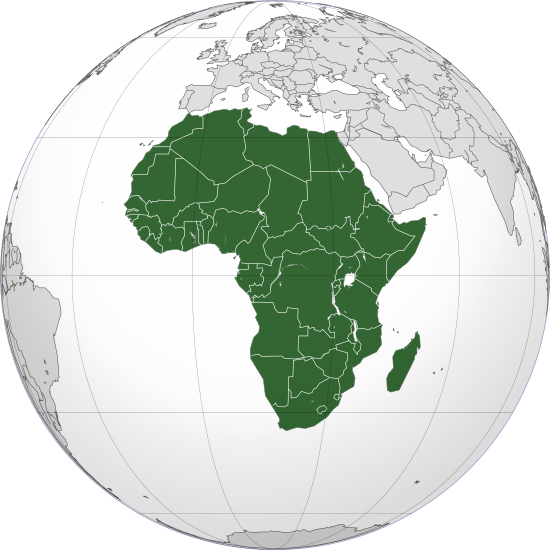
Africa is the second-largest and second-most populous continent home to...

Australia officially the Commonwealth of Australia is a country encompassing...

Canada is a North American country spanning from the Atlantic...
Trending

4 hours ago Tennis Updates and Prediction Market Trends Featuring Professional Players
5 hours ago WTA China Open Beijing Tennis Match Predictions and Updates

5 hours ago 2026 Bahrain Grand Prix Unexpectedly Held at Malaysia's Sepang International Circuit
6 hours ago Leylah Fernandez Clinches First Tennis Title of the Season in Singapore

6 hours ago Tennis Match Prediction Markets for October 2026 Events

7 hours ago Tennis Prediction Markets for Upcoming Professional Matches
Popular

Jameis Winston is an American football quarterback currently playing for...

Ken Paxton is an American politician and lawyer serving as...

Sylvester Stallone is an iconic American actor screenwriter and filmmaker...

Shakira Isabel Mebarak Ripoll the Queen of Latin Music is...

Elon Musk is a visionary entrepreneur and engineer known for...

Bernie Sanders is a prominent American politician and the senior...