


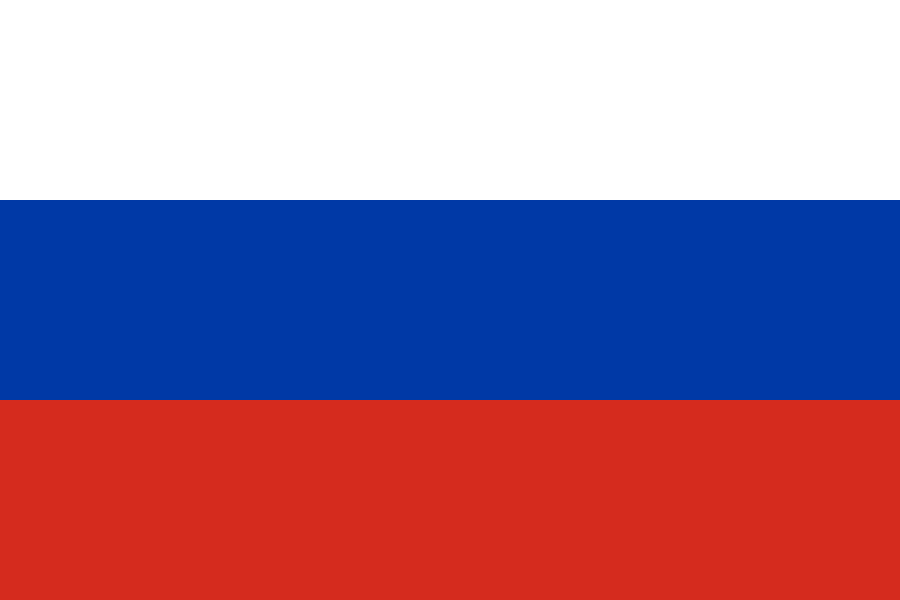
Russia is the world's largest country, spanning Eastern Europe and Northern Asia. Defined by its vast geography, rich cultural history, and complex political evolution, it transitioned from the Russian Empire to the Soviet Union and eventually into the modern Russian Federation. Moscow serves as the capital and political center. Historically, the nation has been a major global power, characterized by its significant influence in literature, science, space exploration, and classical arts. However, its history is also marked by profound turbulence, including the 1917 Revolution, involvement in two World Wars, and the long-standing Cold War rivalry with the West. Today, Russia maintains a significant global presence through its massive energy reserves, military capabilities, and status as a permanent member of the UN Security Council. Despite its cultural contributions, the nation faces ongoing geopolitical tensions and internal socioeconomic challenges that continue to shape its trajectory on the world stage.
4 hours ago : Zelenskyy Faces Political Turmoil Following Controversial Sacking of Defence Minister
Ukrainian President Zelenskyy is embroiled in a political crisis following the dismissal of his defence minister, sparking protests and internal friction regarding military strategy and leadership rivalry amidst the ongoing conflict.


1905: The Revolution of 1905
Triggered by a humiliating defeat in the Russo-Japanese War, the Revolution of 1905 occurred as a major uprising against the imperial government.
1906: The Russian Constitution of 1906
Following the 1905 unrest, the Russian Constitution of 1906 was established to introduce reforms, such as the creation of the State Duma and the legalization of political parties.
1914: Russia enters World War I
In 1914, Russia officially entered World War I to support its ally Serbia following Austria-Hungary's declaration of war, leading the nation to fight on multiple fronts while geographically isolated from its Triple Entente allies.
1916: The Brusilov Offensive
During 1916, the Imperial Russian Army conducted the Brusilov Offensive, a significant military operation that nearly resulted in the total collapse and destruction of the Austro-Hungarian Army.
1917: The Russian Revolution and Abdication of Nicholas II
In 1917, mounting public distrust caused by the economic and human costs of the war culminated in the Russian Revolution; Tsar Nicholas II was forced to abdicate, and the monarchy was replaced by a Provisional Government that declared Russia a republic.
1917: The Russian Revolution
In 1917, the Russian Revolution took place, resulting in the formal abolition of the Russian monarchy and the establishment of the Russian SFSR, which became the world's first socialist state.
1917: End of the reign of Nicholas II
In 1917, the reign of the final Russian emperor, Nicholas II, concluded, marking a pivotal transformation in the nation's political landscape.
1918: Proclamation of the Russian SFSR
In 1918, following the Russian Revolution, the Russian SFSR was proclaimed. This state title adopted the adjective 'Rossiyskaya' instead of 'Russkaya' to emphasize its character as a multinational entity rather than one defined by specific ethnic dimensions.
1918: Dissolution of the Russian Constituent Assembly
On 19 January 1918, the Russian Constituent Assembly formally declared Russia a democratic federal republic, but the body was dissolved by the All-Russian Central Executive Committee on the following day, 20 January 1918.
1921: Russian Famine Commencement
Beginning in 1921, the Russian famine emerged as a catastrophic event in the aftermath of the civil war, ultimately claiming the lives of up to five million people by the time it concluded in 1922.
December 1922: Formation of the Soviet Union
On 30 December 1922, Vladimir Lenin and his associates established the Soviet Union by unifying the Russian SFSR with the Byelorussian, Transcaucasian, and Ukrainian republics into a single sovereign state.
1922: Conclusion of the Russian Famine
By 1922, the Russian famine, which had started in 1921, reached its end after causing the deaths of up to five million individuals amid the devastation caused by the preceding civil war.
1922: Establishment of the Soviet Union
Following the conclusion of the Russian Civil War in 1922, Russia became the largest and most influential constituent republic of the newly formed Soviet Union.
1924: Establishment of the Troika after Lenin's death
Following the death of Vladimir Lenin in 1924, a leadership group known as a troika was designated to govern the Soviet Union, marking the beginning of a power struggle that would eventually lead to the rise of Joseph Stalin.
1929: Exile of Leon Trotsky
In 1929, Leon Trotsky, the primary advocate for world revolution, was officially exiled from the Soviet Union, allowing Joseph Stalin to solidify his policy of Socialism in One Country as the dominant state ideology.
1932: Beginning of the Soviet Famine
In 1932, the Soviet Union entered a devastating period of famine caused by the disorganization of agricultural collectivization, state-mandated policies, and severe drought conditions.
1933: Peak and Conclusion of the Soviet Famine
By 1933, the ongoing famine—resulting from the rapid transition to a command economy and forced agricultural shifts—reached a tragic conclusion, having claimed the lives of between 5.7 and 8.7 million people across the Soviet Union.
September 1939: Soviet Invasion of Poland
On 17 September 1939, the Soviet Union invaded Poland following a secret protocol established in the Molotov–Ribbentrop Pact with Nazi Germany. This period also saw the subsequent Soviet invasion of Finland and the occupation and annexation of the Baltic states and parts of Romania.
June 1941: German Invasion of the Soviet Union
On 22 June 1941, Germany initiated a massive invasion of the Soviet Union, marking the beginning of the Eastern Front, which would become the largest theatre of conflict during World War II.
1941: Beginning of the Siege of Leningrad
In 1941, German and Finnish forces established a land blockade around Leningrad, initiating a long-term siege that resulted in mass starvation and over a million deaths by 1944, though the city maintained its resistance.
1941: The Start of the Great Patriotic War
In 1941, the Soviet Union entered the period known as the Great Patriotic War, marking the beginning of their involvement in the major conflict of World War II.
1942: Battle of Stalingrad
During the winter of 1942-1943, the Red Army dealt a major defeat to German forces at the Battle of Stalingrad, marking a critical turning point in the war.
1943: Battle of Kursk
In the summer of 1943, Soviet forces achieved a decisive victory against the German army at the Battle of Kursk, further pushing back the invaders.
1944: Conclusion of the Siege of Leningrad
After a grueling blockade that began in 1941, the land siege of Leningrad was finally broken in 1944, ending a period of extreme hardship and loss for the city's population.
May 1945: Capture of Berlin
Following a successful offensive through Eastern and Central Europe, the Red Army captured Berlin in May 1945, effectively ending major combat operations in the European theater.
August 1945: Invasion of Manchuria
In August 1945, the Red Army invaded Manchuria to oust Japanese forces from Northeast Asia, providing a significant contribution to the broader Allied victory over Japan.
1945: Conclusion of the Great Patriotic War and Rise to Superpower Status
By 1945, the Great Patriotic War concluded, leaving the Soviet Union as a newly emerged superpower despite the loss of 26-27 million lives and the establishment of the foundation for the United Nations Security Council.
1946: Beginning of the Soviet Famine
Following the massive destruction of infrastructure and economic stability during the war, the Soviet Union faced a severe famine starting in 1946.
1947: Continuation of the Soviet Famine
The Soviet famine, which began in 1946 as a result of war-torn economic conditions, continued throughout 1947, highlighting the devastating aftermath of the conflict.
1953: Death of Joseph Stalin and Initiation of De-Stalinization
Following the death of Joseph Stalin in 1953, a period of collective leadership ensued, leading to Nikita Khrushchev's rise to power. Khrushchev initiated the de-Stalinization policy, which resulted in the release of numerous political prisoners from Gulag labor camps and marked the beginning of a period of reduced state repression known as the Khrushchev Thaw.
1957: Launch of Sputnik 1
In 1957, the Soviet Union successfully launched Sputnik 1, the world's first artificial satellite, marking the beginning of the Space Age.
April 1961: First human orbit by Yuri Gagarin
On 12 April 1961, Russian cosmonaut Yuri Gagarin became the first human being to orbit the Earth while traveling aboard the Vostok 1 spacecraft.
1964: Ousting of Khrushchev
In 1964, Nikita Khrushchev was ousted from power, leading to a transition toward a period of collective leadership before Leonid Brezhnev eventually assumed control of the Soviet Union.
1965: Kosygin Reform
The Kosygin reform was introduced in 1965, marking an attempt to implement partial decentralization within the structure of the Soviet economy.
1979: Soviet Invasion of Afghanistan
In 1979, Soviet forces invaded Afghanistan following a communist-led revolution in the country, an event that marked the beginning of the long-standing Soviet–Afghan War.
1985: Introduction of Glasnost and Perestroika
Starting in 1985, Mikhail Gorbachev initiated a series of liberal reforms known as glasnost (openness) and perestroika (restructuring) to modernize the Soviet government and address long-standing economic stagnation.
May 1988: Soviet Withdrawal from Afghanistan
Beginning in May 1988, the Soviet Union commenced its withdrawal from Afghanistan, driven by significant international opposition, constant guerrilla warfare, and a decline in support from the Soviet public.
June 1991: Election of Boris Yeltsin
In June 1991, Boris Yeltsin achieved a historic milestone by becoming the first directly elected President of the Russian SFSR, marking a significant shift in Russian political leadership.
August 1991: Failed Coup d'état
In August 1991, members of Mikhail Gorbachev's government attempted a coup to preserve the Soviet Union; however, the failed attempt inadvertently accelerated the collapse of the Communist Party of the Soviet Union.
December 1991: Dissolution of the Soviet Union
On 25 December 1991, the Soviet Union was officially dissolved, resulting in the emergence of Russia and fourteen other independent post-Soviet states as sovereign nations.
1991: Soviet Economic Crisis
By 1991, the Soviet Union, which had previously held the position of the world's second-largest economy, entered a period of severe economic crisis and decline.
1991: Emergence of the Russian Federation
Following the formal dissolution of the Soviet Union in 1991, the Russian SFSR transitioned into the sovereign Russian Federation.
1993: Adoption of the New Constitution
After a period of constitutional crisis in 1993, Russia ratified a new constitution that officially established the nation as a semi-presidential republic.
1999: Rise of Vladimir Putin
Beginning in 1999, Vladimir Putin assumed a dominant role in the Russian political landscape, eventually leading to a shift toward an authoritarian regime.
2008: Russia-Georgia War
In 2008, Russia engaged in a military conflict against Georgia as part of its ongoing regional military involvement.
2014: Invasion of Ukraine and Annexation of Crimea
In 2014, Russia initiated a war with Ukraine, which included the controversial and internationally unrecognized annexation of the Crimean peninsula.
2022: Full-Scale Invasion of Ukraine
In 2022, Russia launched a full-scale invasion of Ukraine, leading to the annexation of four additional Ukrainian regions and a prolonged period of intense warfare.
Mentioned in this timeline
Basketball is a team sport played on a rectangular court...
Vladimir Putin is a prominent Russian politician who has significantly...
SpaceX founded by Elon Musk in is a private aerospace...
Ukraine is a country in Eastern Europe the second-largest on...
The Union of Soviet Socialist Republics USSR existed from to...
FIFA or the F d ration Internationale de Football Association...
Trending
4 hours ago Wall Street Analyst Research Calls and Market Analysis
3 hours ago Heightened Iran-US Conflict and Military Operations in the Gulf Region
4 hours ago Germany Proposes EU Force to Replace UN Peacekeeping Mission in Southern Lebanon
3 hours ago White House Insiders Express Frustration with DHS Official Troy Edgar
3 hours ago William Shatner Debuts Heavy Metal Band The *uckers at Riot Fest
4 hours ago Terence Crawford Wins Best Fighter Award at 2026 ESPYS
Popular
Lindsey Graham is a prominent American politician serving as the...

Cristiano Ronaldo widely considered one of the greatest footballers captains...
Mitch McConnell is a prominent American politician and the longest-serving...

Elon Musk is a visionary entrepreneur and engineer known for...

Candace Owens is an American conservative political commentator author and...
Bernie Sanders is a prominent American politician and the senior...