History of Sri Lanka in Timeline


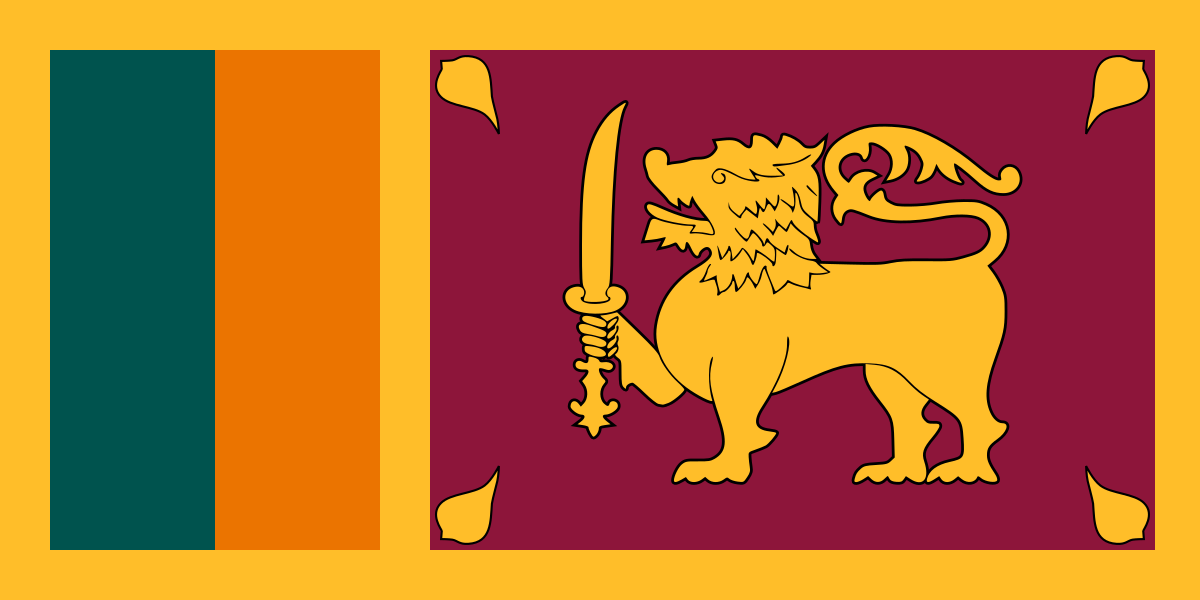
Sri Lanka, an island nation in South Asia, is located in the Indian Ocean, near India. Its capital is Sri Jayawardenepura Kotte, while Colombo is its largest city. The population is around 22 million, primarily Sinhalese speakers, with a significant Tamil minority. Other ethnic groups include Moors, Indian Tamils, Burghers, Malays, Chinese, and Vedda. Formerly known as Ceylon, Sri Lanka shares maritime borders with the Maldives and India.
1903: Release of First Music Album
In 1903, the first music album, Nurthi, was recorded and released through Radio Ceylon, marking a milestone in Sri Lankan music history.


1905: Publication of First Modern-Day Novel
In 1905, the first modern-day novel, "Meena" by Simon de Silva, was published, marking a significant moment in Sri Lankan literature.
1906: First documented case of malaria
In 1906, the first case of the malaria outbreak in Ceylon was documented, although the outbreak started in the early 1900s.
1911: Discovery of the Galle Trilingual Inscription
In 1911, S. H. Thomlin discovered the Galle Trilingual Inscription at Galle; the stele is now preserved in the Colombo National Museum.
1919: Formation of the Ceylon National Congress
In 1919, major Sinhalese and Tamil political organisations united to form the Ceylon National Congress, under the leadership of Ponnambalam Arunachalam.
1923: Establishment of Radio Ceylon
In 1923, Edward Harper established Radio Ceylon, now known as the Sri Lanka Broadcasting Corporation, which is the oldest-running radio station in Asia.
1931: Donoughmore reforms
In 1931, the Donoughmore reforms repudiated the communal representation and introduced universal adult franchise.
1935: Establishment of LSSP
In 1935, the Lanka Sama Samaja Party (LSSP) was established, making it the oldest political party in Sri Lanka.
1937: Demand for 50-50 representation
In 1937, Tamil leader G. G. Ponnambalam demanded a 50–50 representation (50% for the Sinhalese and 50% for other ethnic groups) in the State Council.
1942: Proposed Reforms to Education System
In 1942, a special education committee proposed extensive reforms to establish an efficient and quality education system for the people of Sri Lanka.
1944: Formation of All Ceylon Tamil Congress
In 1944, G. G. Ponnambalam founded the All Ceylon Tamil Congress (ACTC).
1944: Soulbury reforms
In 1944, the Soulbury reforms did not meet Tamil leader G. G. Ponnambalam's demand for a 50–50 representation in the State Council.
1945: Establishment of Free Education System
In 1945, Sri Lanka established a free education system from primary to tertiary levels, largely due to the initiative of C. W. W. Kannangara and A. Ratnayake.
1946: Establishment of UNP
In 1946, D. S. Senanayake established the United National Party (UNP).
1947: Beginning of Sri Lankan Cinema
In 1947, the movie "Kadawunu Poronduwa (The Broken Promise)", produced by S. M. Nayagam of Chitra Kala Movietone, marked the beginning of Sri Lankan cinema.
February 1948: Independence proclaimed
In February 1948, independence was proclaimed, with the Soulbury constitution ushering in dominion status, and D. S. Senanayake became the first Prime Minister of Ceylon.
1948: Influence of Socialism
From 1948 to 1977, socialism strongly influenced the government's economic policies in Sri Lanka.
1948: Olympic Silver Medal for Duncan White
In 1948, Duncan White won a silver medal at the London Olympics for the men's 400 metres hurdles, marking a significant achievement for Sri Lanka.
1948: Independence as the Dominion of Ceylon
In 1948, Sri Lanka achieved independence as the Dominion of Ceylon.
1948: Focus of Armed Forces
Since independence in 1948, the primary focus of the armed forces in Sri Lanka has been internal security.
1949: Formation of Illankai Tamil Arasu Kachchi
In 1949, a dissident group led by S.J.V. Chelvanayakam broke away from the All Ceylon Tamil Congress and formed the Illankai Tamil Arasu Kachchi (ITAK), also known as the Federal Party.
1949: Start of Sri Lanka-China Relations
Sri Lanka-China relations started as soon as the People's Republic of China was formed in 1949.
1950: Colombo Plan Proposed
In 1950, Sri Lankan Finance Minister J. R. Jayewardene and Australian Foreign Minister Sir Percy Spencer proposed the Colombo Plan.
July 1951: Establishment of SLFP
In July 1951, S. W. R. D. Bandaranaike founded the Sri Lanka Freedom Party (SLFP).
1951: San Francisco Peace Conference
At the San Francisco Peace Conference in 1951, Sri Lanka argued for a free Japan and refused to accept payment of reparations.
1952: Rubber-Rice Pact Signed
In 1952, Sri Lanka and China signed an important Rubber-Rice Pact.
1955: Sri Lanka Joins the United Nations
In 1955, Sri Lanka became a member of the United Nations.
1955: Asian-African Conference
Sri Lanka played a vital role at the Asian–African Conference in 1955, which was an important step in the crystallisation of the Non-Aligned Movement.
1956: Forest Cover in 1956
In 1956, 44.2 percent of Sri Lanka's land area was covered by forests.
1956: Release of Rekava
In 1956, Lester James Peiris directed and released the movie "Rekava (Line of Destiny)", which gained global acclaim.
1956: Election of S. W. R. D. Bandaranaike and Sinhala Only Act
In 1956, S. W. R. D. Bandaranaike was elected prime minister and introduced the controversial Sinhala Only Act, recognizing Sinhala as the only official language.
1956: Change in Policies by Bandaranaike Government
In 1956, the Bandaranaike government significantly changed the pro-western policies set by the previous UNP government.
1956: British Royal Navy stationed at Trincomalee
In 1956, the British Royal Navy remained stationed at Trincomalee.
1956: SLFP Victory in 1956 Parliamentary Election
In 1956, the Sri Lanka Freedom Party (SLFP) secured its first victory by defeating the ruling United National Party (UNP) in the parliamentary election.
1958: Partial reversal of the Sinhala Only Act
In 1958, the Sinhala Only Act was partially reversed, but the bill posed a grave concern for the Tamil community.
1959: Assassination of Bandaranaike
In 1959, Prime Minister Bandaranaike was assassinated by an extremist Buddhist monk.
1959: Cuba Recognized and Che Guevara's Visit
In 1959, the Bandaranaike government recognized Cuba under Fidel Castro, and shortly afterward, Che Guevara paid a visit to Sri Lanka.
July 1960: Sirimavo Bandaranaike Becomes Prime Minister
Following the parliamentary election in July 1960, Sirimavo Bandaranaike became the prime minister, and the world's first elected female head of government.
1960: Sirimavo Bandaranaike becomes prime minister
In 1960, Sirimavo Bandaranaike took office as prime minister.
1962: Attempted coup d'état
In 1962, Sirimavo Bandaranaike's government withstood an attempted coup d'état.
1964: Release of Gamperaliya
In 1964, Lester James Peiris directed and released the movie "Gamperaliya (The Changing Village)", contributing to his global recognition.
1964: Sirima-Shastri Pact
The Sirima-Shastri Pact was signed between Sri Lankan and Indian leaders in 1964 in an attempt to solve the long-standing dispute over the status of plantation workers of Indian origin.
1965: Foundation of Janatha Vimukthi Peramuna
In 1965, Rohana Wijeweera founded the Janatha Vimukthi Peramuna, a Marxist–Leninist political party.
1968: Release of Golu Hadawatha
In 1968, Lester James Peiris directed and released the movie "Golu Hadawatha (Cold Heart)".
1970: Release of Nidhanaya
In 1970, Lester James Peiris directed and released the movie "Nidhanaya (The Treasure)", adding to his list of globally acclaimed films.
1971: Marxist insurrection
In 1971, Ceylon experienced a Marxist insurrection, which was quickly suppressed.
1972: Becoming a republic
In 1972, Sri Lanka became a republic, transitioning away from its previous status as the Dominion of Ceylon.
1972: Creation of Tamil United Front
In 1972, the All Ceylon Tamil Congress (ACTC) and Illankai Tamil Arasu Kachchi (ITAK) created the Tamil United Front, which was later renamed the Tamil United Liberation Front.
1972: Name changed to "Free, Sovereign and Independent Republic of Sri Lanka"
In 1972, the formal name of the country was changed to "Free, Sovereign and Independent Republic of Sri Lanka".
1973: World Billiards Championship Won by Muhammad Lafir
In 1973, Muhammad Lafir won the World Billiards Championship, achieving the highest feat by a Sri Lankan in a Cue sport.
1974: Sirima-Gandhi Pact and Cession of Kachchatheevu
In 1974, the Sirima-Gandhi Pact was signed, and Kachchatheevu, a small island in Palk Strait, was formally ceded to Sri Lanka.
1975: Assassination of Jaffna Mayor Alfred Duraiyappah
In 1975, the assassination of Jaffna Mayor Alfred Duraiyappah by the Liberation Tigers of Tamil Eelam (LTTE) marked a crisis point.
1976: Fifth NAM Summit in Colombo
In 1976, the fifth Non-Aligned Movement (NAM) summit was held in Colombo.
1977: Introduction of Free Market Economy
In 1977, the free market economy was introduced to Sri Lanka, incorporating privatization, deregulation, and the promotion of private enterprise.
1977: J. R. Jayawardene swept to power
In 1977, the government of J. R. Jayawardene swept to power and introduced a new constitution, a free-market economy, and a powerful executive presidency.
September 1978: Name changed to "Democratic Socialist Republic of Sri Lanka"
On September 7, 1978, the formal name of the country was changed to the "Democratic Socialist Republic of Sri Lanka".
1978: Constitution of 1978
The 13th Amendment of the 1978 constitution established provincial councils in Sri Lanka.
1979: All-Time High Movie Attendance
In 1979, Sri Lanka experienced an all-time high in movie attendance, after which it began a steady decline.
1979: Introduction of Broadcast Television
In 1979, broadcast television was introduced in Sri Lanka with the launch of the Independent Television Network.
1980: UN Human Rights Council Documentation
Since the Working Group came into being in 1980, the UN Human Rights Council has documented over 12,000 named individuals who have disappeared after detention by security forces in Sri Lanka.
1981: Foundation of Sri Lanka Muslim Congress
In 1981, the Sri Lanka Muslim Congress, the largest Muslim political party in Sri Lanka, was founded.
1983: Start of civil war and anti-Tamil race riots
Beginning in 1983, an LTTE attack on 13 soldiers resulted in the start of a civil war, and anti-Tamil race riots took place.
1983: Start of civil war
In 1983, the prolonged civil war between the Tamil separatist militant organisation Liberation Tigers of Tamil Eelam and the Sri Lankan Armed Forces began.
1985: First peace talks
In 1985, the Sri Lankan government and Tamil insurgents held the first of four rounds of peace talks without success.
1987: Establishment of Provincial Councils
In 1987, the 13th Amendment of the 1978 constitution established provincial councils in Sri Lanka.
1987: Indo-Sri Lanka Accord signed and IPKF deployed
In 1987, the Indo-Sri Lanka Accord was signed and the Indian Peace Keeping Force (IPKF) was deployed in northern Sri Lanka to stabilise the region by neutralising the LTTE.
1989: Merger of Northern and Eastern Provinces
Between 1989 and 2006, the Northern and Eastern provinces were temporarily merged to form the North-East Province.
October 1990: LTTE expels Sri Lankan Moors
In October 1990, the LTTE expelled Sri Lankan Moors (Muslims by religion) from northern Sri Lanka.
1992: Private Television Networks Begin Broadcasting
In 1992, private television networks began broadcasting in Sri Lanka, ending the state's monopoly on television broadcasting.
1995: South Asian Gold Cup Victory
In 1995, the Sri Lanka national football team won the South Asian Gold Cup.
March 1996: Cricket World Cup Victory
On 17 March 1996, the Sri Lanka national cricket team won the 1996 Cricket World Cup, defeating Australia in the final.
1999: Forest Cover in 1999
In 1999, the forest cover in Sri Lanka was 29.6 percent.
2000: Olympic Silver Medal for Susanthika Jayasinghe
In 2000, Susanthika Jayasinghe won a silver medal at the Sydney Olympics for the women's 200 metres, contributing to Sri Lanka's Olympic history.
October 2001: Formation of Tamil National Alliance
In October 2001, Tamil political parties were succeeded by the Tamil National Alliance.
2002: Norwegian-mediated ceasefire agreement
In 2002, the Sri Lankan government and LTTE signed a Norwegian-mediated ceasefire agreement.
2004: Role of mangrove ecosystem in tsunami
In 2004, Sri Lanka's mangrove ecosystem played a vital role in buffering the force of the waves in the Indian Ocean tsunami.
2005: Economic Changes Since 2005
From 2005 to 2011, the per capita income of Sri Lanka doubled, and poverty dropped from 15.2% to 7.6%.
2006: End of North-East Province Merger
Between 1989 and 2006, the Northern and Eastern provinces were temporarily merged to form the North-East Province.
2006: Resumption of fighting
In 2006, both LTTE and the government resumed fighting.
2007: Cricket World Cup Runners-Up
In 2007, Sri Lanka became the runners-up of the Cricket World Cup.
2008: Government backs out of ceasefire
In 2008, the government officially backed out of the ceasefire.
2008: Gallup Poll on Religion
In a 2008 Gallup poll, Sri Lanka was ranked as the third most religious country in the world, with 99% of Sri Lankans stating that religion was an important part of their daily life.
May 2009: End of civil war
In May 2009, the Sri Lanka Armed Forces defeated the LTTE, bringing an end to the 26-year long civil war.
2009: End of Civil War
"Out of Silence" documents torture that continued long after the end of the civil war in 2009.
2009: ICC World Twenty20 Runners-Up
In 2009, Sri Lanka became the runners-up of the ICC World Twenty20.
July 2010: Muralitharan Achieves 800 Test Wickets
In July 2010, Muttiah Muralitharan achieved the record of 800 wickets in Test Cricket, in a Test Match against India that Sri Lanka won by 10 wickets.
2010: New York Times List
In 2010, The New York Times placed Sri Lanka at the top of its list of 31 places to visit.
2010: Forest Cover in 2010
In 2010, forest cover in Sri Lanka had decreased to 28.7 percent of the country's land area.
2010: Gini Coefficient
Income inequality dropped in recent years, indicated by a Gini coefficient of 0.36 in 2010.
2010: GDP Growth in Northern Province
With the end of the war, the Northern Province of Sri Lanka reported a record 22.9% GDP growth in 2010.
July 2011: Registered Political Parties in July 2011
As of July 2011, there were 67 registered political parties in Sri Lanka.
2011: Economic Changes Since 2005
From 2005 to 2011, the per capita income of Sri Lanka doubled, and poverty dropped from 15.2% to 7.6%, unemployment rate dropped from 7.2% to 4.9%, market capitalisation of the Colombo Stock Exchange quadrupled, and the budget deficit doubled.
2011: Cricket World Cup Runners-Up
In 2011, Sri Lanka became the runners-up of the Cricket World Cup.
2011: Plan to rename organisations with "Ceylon"
In 2011, the Sri Lankan government announced a plan to rename organizations over which it has authority that still use the name Ceylon.
2012: ICC World Twenty20 Runners-Up
In 2012, Sri Lanka became the runners-up of the ICC World Twenty20.
2012: Carrom World Championship Victory
In 2012, Sri Lanka won the Carrom World Championship titles.
2012: Freedom from Torture Report
In 2012, the UK charity Freedom from Torture reported receiving 233 referrals of torture survivors from Sri Lanka and published "Out of the Silence", documenting evidence of torture continuing after the civil war.
May 2013: UN Human Rights Commissioner Visit
In May 2013, UN Human Rights Commissioner Navanethem Pillay visited Sri Lanka and reported concerns about undermined democracy, eroded rule of law, military involvement in civilian life, and harassment of those who met with her.
2014: ICC World Twenty20 Victory
In 2014, the Sri Lanka national cricket team won the ICC World Twenty20 played in Bangladesh, beating India in the final.
2015: Mahinda Rajapaksa Loses Presidential Election
President Mahinda Rajapaksa lost the 2015 presidential elections, ending his ten-year presidency.
April 2016: IMF Bailout Loan
In April 2016, the International Monetary Fund (IMF) agreed to provide Sri Lanka with a US$1.5 billion bailout loan after Sri Lanka met a set of criteria aimed at improving its economy.
November 2016: IMF Report on Initial Disbursement
In November 2016, the IMF reported that the initial disbursement to Sri Lanka was larger than planned, totaling US$162.6 million (SDR 119.894 million). The agency's evaluation was cautiously optimistic about the future of Sri Lanka's economy.
2016: World Giving Index Ranking
In 2016, Sri Lanka ranked 5th in the World Giving Index.
2016: Carrom World Championship Victory
In 2016, Sri Lanka won the Carrom World Championship titles.
2018: Political Parties Split
After 2018, two major political parties split from the existing coalitions: The Samagi Jana Balawegaya split from the United National Party (UNP), and the Sri Lanka Podujana Peramuna split from the United People's Freedom Alliance (UPFA).
2018: Frontier Market Classification
As of 2018, S&P Dow Jones Indices classifies Sri Lanka as a frontier market.
2018: China Bails Out Sri Lanka
In 2018, China agreed to bail out Sri Lanka with a loan of $1.25 billion to help manage foreign debt repayment spikes expected between 2019 and 2021.
2018: Carrom World Championship Victory
In 2018, Sri Lanka won the Carrom World Championship titles.
April 2019: Sri Lanka Easter bombings and anti terrorist operation
In April 2019, the Sri Lanka Easter bombings were carried out by the terrorist group National Thowheeth Jama'ath resulting in the death of 261 innocent people, later in April 2019 an anti terrorist operation was carried out against the National Thowheeth Jama'ath by the Sri Lanka Army with the operation being successful and National Thowheeth Jama'ath's insurgency ending.
November 2019: Gotabaya Rajapaksa Wins Presidential Election
In November 2019, Gotabaya Rajapaksa won the presidential election and was sworn in as the new president of Sri Lanka.
2019: Start of Economic Troubles
In 2019, economic troubles in Sri Lanka began, leading to a severe economic crisis.
2019: Worsening Economy
The economy of Sri Lanka started worsening since 2019, which contributed to the political crisis of 2022.
July 2020: Human Rights Watch Report
On 29 July 2020, Human Rights Watch reported that the Sri Lankan government targeted lawyers, human rights defenders, and journalists to suppress criticism.
July 2020: WHO Declares Elimination of Rubella and Measles
On 8 July 2020, the World Health Organization (WHO) declared that Sri Lanka had successfully eliminated rubella and measles ahead of their 2023 target.
August 2020: Sri Lanka People's Front Victory
In August 2020, the Sri Lanka People's Front obtained a landslide victory and a clear majority in the parliamentary elections, with five members of the Rajapaksa family winning seats, and Mahinda Rajapaksa becoming the new prime minister.
2020: Media Landscape in Sri Lanka
As of 2020, Sri Lanka had 192 newspapers, 25 TV stations, and 58 radio stations in operation.
2020: GDP Composition in 2020
As of 2020, the service sector made up 59.7% of Sri Lanka's GDP, the industrial sector 26.2%, and the agriculture sector 8.4%.
June 2021: Ban on Inorganic Fertilisers and Pesticides
In June 2021, Sri Lanka imposed a nationwide ban on inorganic fertilisers and pesticides, a decision that was welcomed by some but criticized by scientists and farmers who warned of potential economic and agricultural collapse.
August 2021: Declaration of food emergency
In August 2021, a food emergency was declared in Sri Lanka.
September 2021: Economic Crisis Declared
In September 2021, Sri Lanka declared a major economic crisis, leading to the resignation of the Chief of its Central Bank and the declaration of emergency regulations by the Parliament to ban "food hoarding".
November 2021: Abandonment of Organic Farming Plan
In November 2021, Sri Lanka abandoned its plan to become the world's first organic farming nation due to rising food prices and protests against the plan.
December 2021: Agricultural Damage and Fertilizer Ban Lifted
As of December 2021, significant damage had been done to Sri Lanka's agricultural production, leading to substantial price increases for vegetables. The ban on fertilizer was partially lifted for certain crops due to the crisis.
June 2022: Muttiah Muralitharan's Record
As of June 2022, Muttiah Muralitharan held the highest aggregate of wickets in Test Cricket with a record 800 wickets.
June 2022: Declaration of the collapse of the Sri Lankan economy
In June 2022, Prime Minister Ranil Wickremesinghe declared the collapse of the Sri Lankan economy in parliament.
July 2022: Storming of President's House and resignation of President
In July 2022, the President's House was stormed, and President Gotabaya Rajapaksa fled and resigned, marking the first time a Sri Lankan president resigned mid-term.
July 2022: Ranil Wickremesinghe Elected President
On 20 July 2022, Ranil Wickremesinghe was elected as the ninth President of Sri Lanka via a parliamentarian election.
July 2022: Parliament elects new president Ranil Wickremesinghe
On July 20, 2022, Parliament elected Ranil Wickremesinghe as the new president, who took oath as the ninth President of Sri Lanka.
2022: Political Crisis of 2022
In 2022, a political crisis started in Sri Lanka due to the power struggle between President Gotabaya Rajapaksa and the Parliament, along with anti-government protests and a worsening economy since 2019.
2022: Janatha Vimukthi Peramuna Gains Popularity
Since 2022, the third wing party Janatha Vimukthi Peramuna has gained popularity in Sri Lanka.
2023: Increase in Tourist Arrivals
In the first half of 2023, tourist arrivals showed significant improvements, setting the stage for the recovery observed in 2024.
September 2024: Anura Kumara Dissanayake sworn in as president
On September 23, 2024, Anura Kumara Dissanayake was sworn in as Sri Lanka's new president after winning the presidential election as a left-wing candidate.
November 2024: NPP receives two-thirds majority
On November 14, 2024, President Anura Kumara Dissanayake's National People's Power (NPP) received a two-thirds majority in parliament in Sri Lankan parliamentary election.
2024: Global Peace Index 2024
According to the 2024 Global Peace Index, Sri Lanka is the 100th most peaceful country in the world.
2024: Anura Kumara Dissanayake Defeats Ranil Wickremesinghe
In 2024 presidential elections, Anura Kumara Dissanayake defeated President Ranil Wickremesinghe.
2024: Tourism Industry Recovery
In 2024, Sri Lanka's tourism industry showed strong recovery, reaching over $1.5 billion in revenue in the first half of the year, a 78% increase year-on-year. Tourist arrivals also increased to 1.01 million, up 62% from the same period in 2023.
2025: ICC Men's Test Team Rankings
In 2025, Sri Lanka was ranked 6th in the ICC Men's Test Team Rankings with a rating of 86.
2025: Global Innovation Index Ranking
In 2025, Sri Lanka was ranked 93rd in the Global Innovation Index.
Mentioned in this timeline
India officially the Republic of India is a South Asian...
San Francisco is the fourth-most populous city in California and...
China officially the People's Republic of China PRC is located...
Japan is an East Asian island country located in the...
Malaria is a mosquito-borne infectious disease transmitted by Anopheles mosquitoes...
Australia officially the Commonwealth of Australia is a country encompassing...
Trending
2 months ago Hunter Biden Living Abroad Amidst Mounting Legal Issues: A New Chapter?

3 months ago Kelly Ripa and Mark Consuelos attend the 2026 Oscars, sparking relationship speculation.
4 months ago State Department restricts passport application processing at nonprofit libraries, creating accessibility concerns.

11 days ago AMC Theatres and Telemundo to broadcast FIFA World Cup 2026 on big screens.
2 months ago Dune: Part Three IMAX Tickets On Sale; Darker, Action-Packed Conclusion Promised.
2 months ago Katherine Schwarzenegger Pratt faces criticism for comments about Chris Pratt; fans react.
Popular
Graham Cunningham Platner is an American oyster farmer and Marine...

Ken Paxton is an American politician and lawyer serving as...

Michael Joseph Jackson the King of Pop was a highly...
William Franklin Graham III known as Franklin Graham is an...
Ron Harper is a retired American professional basketball player who...
Peter Thiel is a German-American entrepreneur venture capitalist and conservative...