


An airline is a company that provides air transport services for traveling passengers and freight. These entities operate fleets of aircraft to connect cities, countries, and continents, functioning as a critical component of global infrastructure and commerce. Airlines generally operate within a highly regulated framework, managing complex logistics including flight scheduling, air traffic control coordination, maintenance protocols, and passenger services. They are categorized into various models, such as full-service legacy carriers, which offer comprehensive amenities and global networks, and low-cost carriers, which focus on efficiency and affordability. The industry is defined by its reliance on sophisticated technology, fuel management, and international safety standards. By bridging vast distances in hours, airlines facilitate international tourism, business connectivity, and the rapid movement of goods, acting as a primary engine for global economic integration.
8 hours ago : Passenger Arrested Following Indecent Acts Aboard American Airlines Flight
A female passenger was arrested after undressing and performing indecent acts on an American Airlines flight. Crew members reported the disruptive behavior to pilots, leading to law enforcement intervention upon the plane's arrival.


October 10, 1909: Founding of Compagnie générale transaérienne
On October 10, 1909, the Compagnie générale transaérienne (CGT) was established, marking its position as the oldest airline company and a foundational entity for the future Air France.
November 16, 1909: Founding of DELAG
On November 16, 1909, DELAG, the Deutsche Luftschiffahrts-Aktiengesellschaft, was officially founded as the world's first commercial passenger airline.
June 1910: Launch of DELAG airship services
In June 1910, DELAG commenced its commercial passenger flight operations utilizing airships manufactured by the Zeppelin Company.
April 1911: Launch of cargo operations
In April 1911, the Compagnie générale transaérienne initiated its first cargo transportation services.
March 1913: Inauguration of regular passenger flights
Starting in March 1913, the airline began conducting weekly return fixed-wing flights, marking the commencement of its regular passenger operations.
January 1, 1914: First Scheduled Commercial Airline Flight
On January 1, 1914, pilot Tony Jannus performed the first-ever scheduled commercial airline flight for the St. Petersburg-Tampa Airboat Line. The 23-minute journey across Tampa Bay carried a former St. Petersburg mayor as its first passenger in a Benoist XIV biplane.
January 1914: Launch of the St. Petersburg–Tampa Airboat Line
In January 1914, the St. Petersburg–Tampa Airboat Line officially commenced operations in the United States, becoming the first fixed-wing scheduled airline service. The inaugural route was piloted by Tony Jannus, who transported passengers between St. Petersburg and Tampa, Florida.
1916: Formation of Aircraft Transport and Travel
In 1916, George Holt Thomas established Aircraft Transport and Travel (AT&T), which served as the original predecessor to the modern British Airways.
1917: Establishment of Deutsche Luft-Reederei
In 1917, Deutsche Luft-Reederei (DLR) was established, becoming the first German airline to utilize heavier-than-air aircraft.
1918: U.S. Post Office Begins Air Mail Experiments
In 1918, the United States Post Office Department secured Congressional funding to initiate experimental air mail services, utilizing Curtiss Jenny aircraft previously acquired by the United States Army Air Service.
February 1919: Start of DLR Operations
In February 1919, Deutsche Luft-Reederei began its flight operations, marking the commencement of regularly scheduled air service in its first year.
March 1919: World's First International Commercial Aviation Service
On 22 March 1919, the Société Générale des Transports Aériens, founded by the Farman brothers, launched the world's first international commercial aviation service, operating a weekly route between Paris and Brussels.
July 15, 1919: Cross-Channel Proving Flight
On July 15, 1919, Lt. H Shaw piloted an Airco DH.9 on a proving flight from RAF Hendon to Paris–Le Bourget Airport in 2 hours and 30 minutes, marking a significant milestone despite minimal government support.
July 1919: First Transatlantic Passenger Flight by HM Airship R34
Beginning on July 2, 1919, the British HM Airship R34 achieved a historic aviation milestone by completing the first-ever transatlantic journey carrying passengers, traveling from Scotland to New York and returning safely.
August 25, 1919: Inauguration of Daily International Service
On August 25, 1919, the company launched the world's first daily international air service, operating between Hounslow Heath Aerodrome and Le Bourget, Paris, using DH.16 aircraft.
November 1919: First British Civil Airmail Contract
In November 1919, Aircraft Transport and Travel secured the first British civil airmail contract, utilizing six RAF Airco DH.9A aircraft to facilitate mail delivery between Hawkinge and Cologne.
1919: Establishment of Handley Page Transport
In 1919, Handley Page Transport was founded to operate a passenger service between London and Paris, utilizing their converted Type O/400 bombers that were capable of carrying 12 passengers.
1920: KLM Inaugural Flight
In 1920, the Dutch airline KLM conducted its first-ever flight from Croydon Airport in London to Amsterdam. The flight utilized a leased DH-16 aircraft to transport two British journalists and a shipment of newspapers, marking the beginning of the airline's history under its original name.
1920: Return of Airmail Aircraft
In 1920, the six Airco DH.9A aircraft that had been on loan from the Royal Air Force for the mail service were returned.
1921: Expansion and New Competitor
By 1921, the DLR network had expanded to over 3000 km, and Junkers Luftverkehr also began its flight operations during this same year.
1921: KLM Scheduled Service Launch
Following its establishment and initial operations, KLM successfully initiated its first scheduled air services in 1921.
1921: Establishment of the Chief Administration of the Civil Air Fleet
In 1921, the Soviet Union formally established the Chief Administration of the Civil Air Fleet, which subsequently facilitated the creation of the joint venture Deruluft to manage air transport between Russia and the West.
January 1923: Formation of Air Union
On 1 January 1923, two French airline companies completed a merger to establish a new entity known as Air Union.
July 1923: Launch of Dobrolyot Air Service
On July 15, 1923, the domestic air service company Dobrolyot initiated its first operations, establishing a flight route between Moscow and Nizhni Novgorod.
September 1923: Establishment of Aero O/Y
On 12 September 1923, the charter officially establishing Aero O/Y, which is known today as Finnair, was signed in Helsinki, Finland.
March 1924: Aero O/Y Fleet Acquisition and Inaugural Flight
On 14 March 1924, Aero O/Y took delivery of its first aircraft, the Junkers F.13 D-335. Shortly after, on 20 March 1924, the company conducted its first flight between Helsinki, Finland, and Tallinn, Estonia.
November 1924: Delivery of the Handley Page W8f City of Washington
On 3 November 1924, Imperial Airways received the Handley Page W8f City of Washington, which marked the company's first order of a brand new airliner.
1924: Formation of Imperial Airways
In 1924, Imperial Airways was established through the merger of four smaller companies—Instone Air Line Company, British Marine Air Navigation, Daimler Airway, and Handley Page Transport—to help British aviation compete against subsidized French and German carriers while expanding trade routes across the British Empire.
1924: Junkers Luftverkehr Independence
In 1924, the division known as Junkers Luftverkehr officially became a separate company from its parent manufacturer, Junkers.
April 1925: In-flight Movie Screening Premiere
In April 1925, the film The Lost World made history as the first motion picture to be screened for passengers aboard a scheduled airliner flight while traveling the London-Paris route.
1926: Surveying of International Flight Routes
In 1926, Alan Cobham conducted critical survey flights establishing routes from the UK to Cape Town and Melbourne, while also charting early paths to British India and the Far East.
1926: Creation of Deutsche Lufthansa
In 1926, the German airline Deutsche Lufthansa was established through the merger of two existing airlines, including Junkers Luftverkehr. This foundation allowed the company to become a significant investor in international carriers like Varig and Avianca during that year.
1927: Formation of Aéropostale
In 1927, the existing air mail service was acquired and rebranded as Aéropostale, receiving significant capital investment to transform it into a major international airline.
1927: Launch of Regular Air Services
The year 1927 marked the beginning of regular airline services connecting London to Cairo and Basra.
1929: Extension of Air Routes to Karachi
In 1929, the established airline network saw a significant expansion with the extension of flight services to include Karachi.
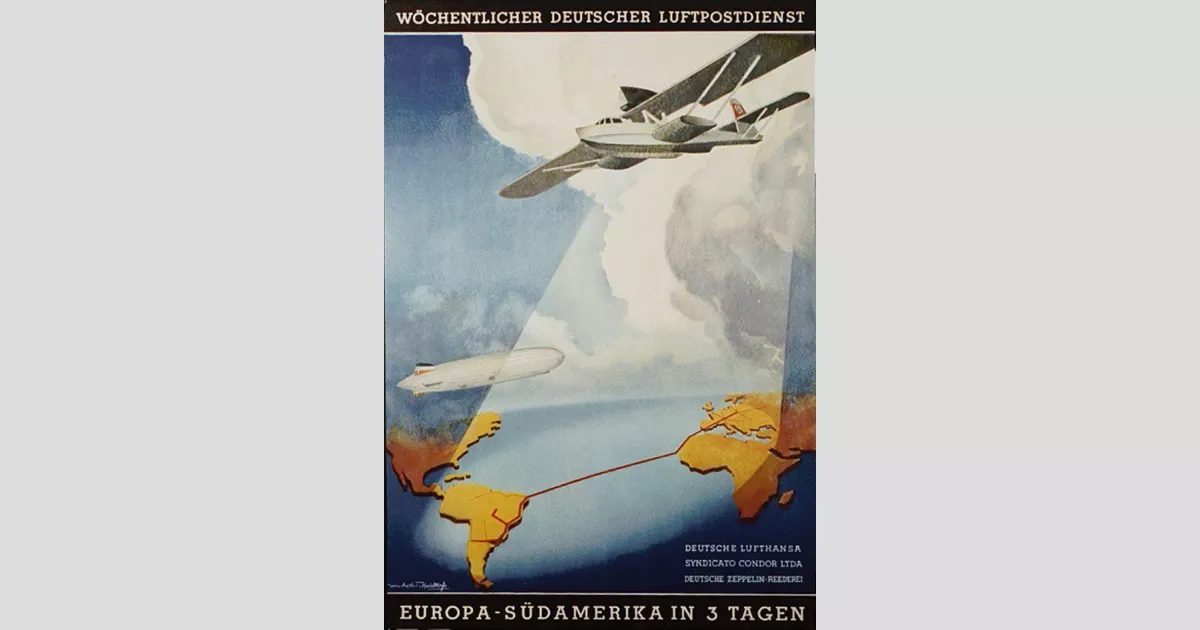
1931: Graf Zeppelin South America Service Launch
Starting in 1931, the Graf Zeppelin airship began providing a regular passenger service between Germany and South America that operated on a bi-weekly basis until 1937.
1932: Consolidation of Soviet Aviation as Aeroflot
Beginning in 1932, all Soviet aviation operations were consolidated and conducted under the official brand name Aeroflot.
1932: Inauguration of London-Australia Service
The London-Australia air service was officially inaugurated in 1932, utilizing the Handley Page HP 42 aircraft for the route.
May 1933: Formation of Air France
On 17 May 1933, Air Union merged with four additional French aviation companies to officially form Air France, which continues to serve as the national flagship carrier.
1933: Bankruptcy and Merger into Air France
Following its bankruptcy in 1933, the Aéropostale carrier was nationalized and subsequently merged into the national airline, Air France.
1935: End of DELAG operations
By 1935, DELAG concluded its regular commercial passenger service, marking the end of its operational history that began in 1910.
March 1936: Expansion to Hong Kong
On 14 March 1936, following the creation of a new branch line from Penang, passengers were able to depart London on a service reaching Hong Kong.
1936: Inauguration of Hindenburg Passenger Service
In 1936, the airship Hindenburg officially entered passenger service, successfully completing 36 transatlantic crossings before its final flight.
May 1937: Hindenburg Disaster at Lakehurst
On May 6, 1937, the Hindenburg airship suffered a catastrophic crash while landing at Lakehurst, New Jersey, ending its period of service.
1938: Berlin to Kabul Air Service Commencement
A new weekly air transport route linking Berlin and Kabul, Afghanistan, was established and began operations in 1938.
September 1956: Inauguration of Sustained Regular Jet Services
On 15 September 1956, Aeroflot made history by becoming the world's first airline to provide sustained, regular commercial jet service using the Tupolev Tu-104 aircraft.
2008: Alitalia Faces Financial Struggles Amid Rising Oil Prices
During the early part of 2008, the Italian national airline, Alitalia, experienced significant financial distress, which was largely exacerbated by a sharp and rapid increase in global oil prices.
2008: Closure of Chalk's International Airlines
In 2008, the long-standing carrier Chalk's International Airlines ceased operations, ending its run as the oldest continuously operating airline in the United States.
Mentioned in this timeline

Warren Buffett a highly successful American investor and philanthropist is...

California is a U S state on the Pacific Coast...
Southwest Airlines is a major U S airline headquartered in...
FedEx Corporation originally Federal Express is a multinational conglomerate based...

The Union of Soviet Socialist Republics USSR existed from to...

India officially the Republic of India is a South Asian...
Trending
4 hours ago Dan Orlovsky Analyzes Patrick Mahomes' Remarkable Return to Kansas City Chiefs
5 hours ago Fenerbahçe Faces Gaziantep FK in Süper Lig Match Amid Marco Asensio Transfer Updates
5 hours ago Inter faces Udinese in Serie A clash with new lineup adjustments

7 hours ago Boston Celtics Sign Former Lottery Pick Devin Carter to Compete for Roster Spot

7 hours ago Macklemore Removed From Ed Sheeran Tour Following Controversial Free Palestine Stage Remarks

8 hours ago Passenger Arrested Following Indecent Acts Aboard American Airlines Flight
Popular

Ken Paxton is an American politician and lawyer serving as...

Michael Joseph Jackson the King of Pop was a highly...

Charlie Kirk was a prominent American right-wing political activist entrepreneur...

JD Vance is an American politician author and venture capitalist...

Dolly Parton is a celebrated American singer-songwriter actress philanthropist and...

Steve Irwin the Crocodile Hunter was a passionate Australian zookeeper...