


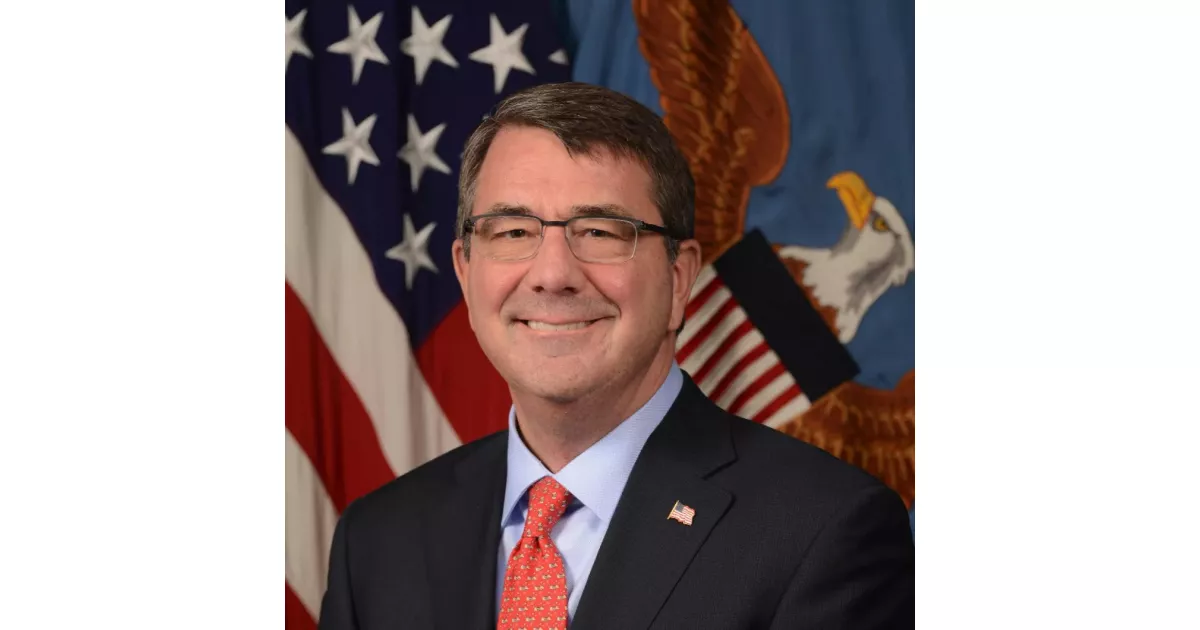
Ashton Baldwin Carter served as the 25th United States Secretary of Defense from February 2015 to January 2017. Prior to this role, he held various positions within the Department of Defense, including Deputy Secretary of Defense and Under Secretary of Defense for Acquisition, Technology & Logistics. His career also included time in academia, notably as Director of the Belfer Center for Science & International Affairs at Harvard Kennedy School. Carter's tenure as Secretary of Defense was marked by significant events and challenges, including the ongoing fight against ISIS and the development of the Third Offset Strategy focusing on technological advancements in warfare. His expertise in defense policy and international affairs shaped his leadership in the Department of Defense.
September 24, 1954: Birth of Ashton Carter
Ashton Baldwin Carter was born on September 24, 1954.


1966: Carter Graduates from Highland Elementary
Ash Carter graduated from Highland Elementary School in 1966.
1972: Carter Graduates from Abington Senior High
Ash Carter graduated from Abington Senior High School in 1972.
1975: Carter Attends University of Edinburgh and Works at Fermilab
Ashton Carter attended the University of Edinburgh and worked as a research associate at Fermi National Accelerator Laboratory in 1975.
1976: Carter Graduates from Yale and Works at Brookhaven
Ashton Carter graduated from Yale with a BA in Physics and Medieval History and worked at Brookhaven National Laboratory in 1976.
1979: Carter Receives DPhil from Oxford
Ashton Carter earned his Doctor of Philosophy (DPhil) in theoretical physics from the University of Oxford in 1979.
1979: Carter's Postdoctoral Fellowship at Rockefeller University Begins
Ashton Carter started his postdoctoral fellowship at Rockefeller University in 1979.
1980: Carter's Postdoctoral Fellowship at Rockefeller University Ends
Ashton Carter concluded his postdoctoral fellowship at Rockefeller University in 1980.
1982: Carter's Research Fellowship at MIT Begins
Ashton Carter began his research fellowship at the MIT Center for International Studies in 1982.
1984: Carter begins teaching at Harvard
Ashton Carter began teaching at Harvard University as an assistant professor in 1984.
1984: Carter's Research Fellowship at MIT Ends
Ashton Carter completed his research fellowship at the MIT Center for International Studies in 1984.
1984: Carter Joins Harvard Kennedy School
In 1984, Ashton Carter joined the Kennedy School of Government at Harvard University.
1986: Carter becomes Associate Professor at Harvard
Ashton Carter became an associate professor at Harvard University in 1986.
1987: Carter Receives Ten Outstanding Young Americans Award
Ash Carter was awarded the Ten Outstanding Young Americans award from the United States Junior Chamber in 1987.
1988: Carter becomes Professor and Associate Director at Harvard
Ashton Carter became a professor and associate director of the Center for Science and International Affairs at Harvard's Kennedy School in 1988.
1989: Carter inducted into Abington Senior High Hall of Fame
Ash Carter was inducted into the Abington Senior High School's Hall of Fame in 1989.
1990: Carter becomes Director of Center for Science and International Affairs
Ashton Carter assumed the role of director of the Center for Science and International Affairs at Harvard's Kennedy School in 1990.
1990: Carter Chairs International Security Editorial Board
From 1990 to 1993, Ash Carter served as chairman of the editorial board of International Security.
1993: Carter becomes Assistant Secretary of Defense
Ashton Carter began serving as Assistant Secretary of Defense for International Security Policy in 1993.
1993: Carter's time as Director at Harvard Ends
Ashton Carter concluded his role as director at Harvard's Center for Science and International Affairs in 1993.
1993: Carter Concludes Chairmanship of International Security Editorial Board
In 1993, Ash Carter concluded his role as chairman of the editorial board of International Security.
1994: Carter oversees Nuclear Posture Review and Agreed Framework
In 1994, Ashton Carter oversaw the Nuclear Posture Review and the Agreed Framework with North Korea.
1995: Carter oversees Extension of Nuclear Non-Proliferation Treaty
In 1995, Ashton Carter oversaw the extension of the Nuclear Non-Proliferation Treaty.
1996: Carter's time as Assistant Secretary of Defense ends
Ashton Carter finished his service as Assistant Secretary of Defense for International Security Policy in 1996.
1996: Carter concludes role as Assistant Secretary of Defense
Ashton Carter's term as Assistant Secretary of Defense for International Security Policy ended in 1996.
1997: Co-chairs Catastrophic Terrorism Study Group
In 1997, Ash Carter and John M. Deutch co-chaired the Catastrophic Terrorism Study Group, emphasizing the need for greater focus on terrorism.
1998: Publishes Article on Catastrophic Terrorism
In 1998, Carter, Deutch, and Philip Zelikow published an article on catastrophic terrorism in Foreign Affairs.
2000: Concludes Deputy Role at North Korea Policy Review
In 2000, Ash Carter finished serving as deputy to William J. Perry at the North Korea Policy Review, during which he traveled to Pyongyang.
2001: Serves on Committee on Science and Technology for Countering Terrorism
In 2001-2002, Ash Carter served on the National Academy of Sciences Committee on Science and Technology for Countering Terrorism, advising on the creation of the Department of Homeland Security.
2003: Carter Supports Iraq Invasion
In 2003, Ash Carter supported the invasion of Iraq.
2006: Carter Authors Report on Preventing Iran's Nuclear Armament
In 2006, Ash Carter wrote a report for the Carnegie Endowment for International Peace advocating the use, or threat, of force to prevent Iran from acquiring nuclear weapons.
April 2009: Carter becomes Under Secretary of Defense
Ashton Carter started as Under Secretary of Defense for Acquisition, Technology, and Logistics in April 2009.
October 2011: Carter becomes Deputy Secretary of Defense
Ashton Carter assumed the role of Deputy Secretary of Defense in October 2011.
April 4, 2013: Carter Affirms "Shift to Asia" Initiative
On April 4, 2013, Ashton Carter affirmed the "Shift to Asia" initiative as a priority.
December 2013: Carter's time as Deputy Secretary of Defense Ends
Ashton Carter finished serving as Deputy Secretary of Defense in December 2013.
December 2013: Carter concludes work as Deputy Secretary of Defense
Ashton Carter's work as Deputy Secretary of Defense concluded in December 2013.
2013: Carter Awarded Joint Distinguished Civilian Service Award
In 2013, Ash Carter received the Chairman of the Joint Chiefs of Staff Joint Distinguished Civilian Service Award.
December 5, 2014: Carter Nominated for Secretary of Defense
Ashton Carter was nominated by President Obama to be Secretary of Defense on December 5, 2014.
February 1, 2015: Carter Approved by Senate Committee
Ashton Carter's nomination as Secretary of Defense was approved unanimously by the Senate Armed Services Committee on February 1, 2015.
February 2015: Carter becomes Secretary of Defense
Ashton Carter assumed the position of Secretary of Defense in February 2015.
May 2015: Carter warns China on Island-Building
In May 2015, Ashton Carter warned China about its island-building activities in the South China Sea.
December 2015: Controversy Over Carter's Use of Personal Email
In December 2015, a controversy emerged surrounding Ash Carter's use of a personal email account for official business during his tenure as Secretary of Defense.
2015: Carter Named Fellow in the American Physical Society
Ash Carter was named a Fellow in the American Physical Society (Forum on Physics & Society) in 2015.
January 2016: Military Roles Opened to Women
In January 2016, under Ash Carter's leadership, the Department of Defense lifted gender restrictions on all military roles, despite opposition from the Marine Corps.
June 2016: Transgender Individuals Allowed to Serve Openly in the Military
In June 2016, Ash Carter announced that transgender individuals could openly serve in the military.
2016: Carter Opens All Military Occupations to Women
In 2016, Ashton Carter lifted gender restrictions on all military occupations, enabling qualified women to serve in roles previously unavailable to them.
January 2017: Carter's Tenure as Secretary of Defense Ends
Ashton Carter concluded his role as Secretary of Defense in January 2017.
2020: Carter Joins General Electric Board of Directors
In 2020, Ash Carter became an independent director on the General Electric board of directors.
2020: Trump Contests 2020 Election Results
In 2020, following the presidential election, Donald Trump contested the results and sought to overturn them, leading to a period of political tension. Carter and other former secretaries of defense opposed Trump's actions in January 2021.
January 2021: Former Defense Secretaries Oppose Trump's Election Interference
In January 2021, Ash Carter and other former secretaries of defense published a Washington Post op-ed opposing President Trump's attempts to involve the military in overturning the 2020 election results.
April 2021: Carter Joins Tanium and PCAST
In April 2021, Ash Carter joined the Tanium Board of Directors and also became a member of the President's Council of Advisors on Science and Technology (PCAST).
October 24, 2022: Death of Ashton Carter
Ashton Carter passed away on October 24, 2022.
Mentioned in this timeline

Donald John Trump is an American politician media personality and...

China officially the People's Republic of China PRC is located...

Iraq officially the Republic of Iraq is a country in...

Syria officially the Syrian Arab Republic is a West Asian...

Iran formerly known as Persia is a sovereign state in...

North Korea officially the Democratic People's Republic of Korea DPRK...
Trending

3 hours ago Titans Face Pressure Over Cam Ward Disrespecting Warren Moon Legacy

3 hours ago Nate Bargatze Live Comedy Show Performance Details

3 hours ago Daniel Dubois and Fabio Wardley Square Off in High-Stakes Heavyweight World Title Rematch
4 hours ago North Korea Conducts Submarine Missile Tests and AI Torpedo Trials

4 hours ago Mads Mikkelsen Announced as Villain Lead for Call of Duty: Modern Warfare 4

4 hours ago Victor Wembanyama Pursues Defensive Excellence and Championship Glory for San Antonio Spurs
Popular

Ilhan Omar is a prominent American politician currently serving as...

Ken Paxton is an American politician and lawyer serving as...

Elon Musk is a visionary entrepreneur and engineer known for...

Michael Joseph Jackson the King of Pop was a highly...

Jameis Winston is an American football quarterback currently playing for...

Cristiano Ronaldo widely considered one of the greatest footballers captains...