


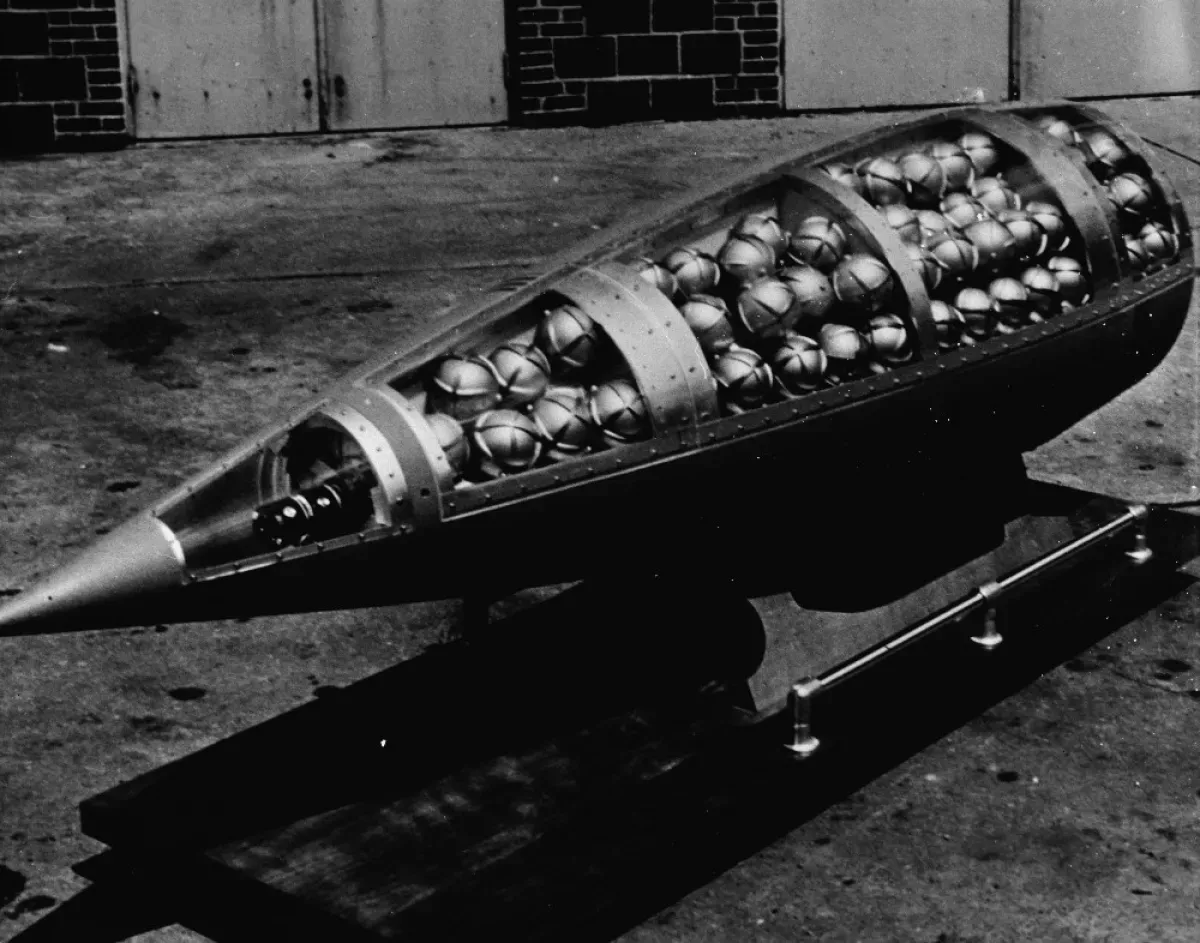
Cluster munitions are air-dropped or ground-launched weapons that release numerous submunitions. Typically, these are cluster bombs containing bomblets designed to target personnel and vehicles. Other types are designed to destroy infrastructure such as runways or power lines. Due to their wide dispersal pattern and potential for unexploded ordnance, they pose significant risks to civilians even after conflicts end, leading to international concerns and efforts to ban or restrict their use.
1939: Soviet Union used Molotov bread basket in the Winter War
In 1939, the Soviet Union used the so-called Molotov bread basket, one of the earliest examples of incendiary cluster bombs, in the Winter War.


1973: End of US Cluster Bombing of Laos
In 1973, the United States' cluster bombing of Laos stopped. However, unexploded munitions continued to cause casualties.
1978: IDF Use of Cluster Bombs in South Lebanon
During the South Lebanon conflict in 1978, the IDF used cluster bombs provided by the United States, which, according to US President Jimmy Carter, violated the legal agreement between Israel and the US.
1980: Convention on Certain Conventional Weapons
Protocol V to the 1980 Convention, 28 November 2003 occasionally address some of the problems associated with the use of cluster munitions, in particular Article 9, which mandates States Parties to "take generic preventive measures aimed at minimising the occurrence of explosive remnants of war".
1982: Use of BL755 Cluster Bombs in Falklands War
In 1982, Sea Harriers of the Royal Navy dropped BL755 cluster bombs on Argentinian positions during the Falklands War.
1991: Cluster Bomb Use During Gulf War
In 1991, during the Gulf War, the United States, France, and the United Kingdom dropped 61,000 cluster bombs, containing 20 million submunitions. The US accounted for 57,000 of these droppings. It was estimated that 1.2 to 1.5 million submunitions did not explode.
1992: Use of Cluster Munitions in Nagorno-Karabakh Conflict Begins
Starting in 1992 and continuing until 1994, the armed conflict between Azerbaijan and Armenia in Nagorno Karabakh led to the use of cluster munitions against military and civilian targets in the region.
1993: US Military Developing New Cluster Bombs
As of 1993, the US military was developing new cluster bombs that it claimed could have a much lower (less than 1%) dud rate. Sensor-fused weapons may provide a viable, if costly, alternative to cluster munitions.
1994: Use of Cluster Munitions in Nagorno-Karabakh Conflict Ends
Between 1992 and 1994, the armed conflict between Azerbaijan and Armenia in Nagorno Karabakh led to the use of cluster munitions against military and civilian targets in the region.
1997: Ottawa Treaty Ban on Anti-Personnel Land Mines
In 1997, the Ottawa Treaty banned anti-personnel land mines. A new multilateral process similar to the Ottawa Treaty began with an announcement in November 2006 in Geneva by the Government of Norway to work towards a new treaty prohibiting cluster munitions.
May 1999: NATO Attack with Cluster Bombs in Central City
On 7 May 1999, between 11:30 and 11:40, a NATO attack was carried out with two containers of cluster bombs, falling in the central part of the city.
1999: NATO Bombing of Yugoslavia
During the NATO bombing of Yugoslavia in 1999, about 2,000 cluster bombs containing 380,000 sub-munitions were dropped on Yugoslavia, with the Royal Air Force dropping 531 RBL755 cluster bombs. Both the Americans and the British utilized cluster bombs.
2000: US-Made MLRS Dud Rate Studied
As of 2000, studies showed that US-made MLRS with M26 warhead and M77 submunitions had a much higher dud rate than the supposed 5%. The rate in acceptance tests ranged from 2% to a high of 23%.
2001: Use of Yellow Packaging for US Rations in Afghanistan
In 2001, during the War in Afghanistan (2001–2021), US forces dropped humanitarian rations from airplanes with similar yellow-colored packaging as the BLU-97/B cluster bomblets, creating confusion with children. The rations packaging was later changed to avoid the confusion.
April 2003: Cluster Bomblets Fail to Explode in Baghdad
On 7 April 2003, during the attack on Baghdad, many cluster bomblets failed to explode on impact and later exploded when touched by civilians. Reports indicated that the Pentagon presented a misleading picture of the extent of cluster weapon use and civilian casualties.
November 2003: Establishment of the Cluster Munition Coalition
On 13 November 2003, the Cluster Munition Coalition (CMC) was established to increase pressure for governments to come to an international treaty on cluster munitions and to address the impact of these weapons on civilians.
November 2003: Protocol on explosive remnants of war
Protocol V to the 1980 Convention, 28 November 2003 occasionally address some of the problems associated with the use of cluster munitions, in particular Article 9, which mandates States Parties to "take generic preventive measures aimed at minimising the occurrence of explosive remnants of war".
2003: US Suspends Operational Use of Cluster Munitions
According to the US State Department, the US suspended operational use of cluster munitions in 2003.
2003: First Combat Use of CBU-97 Sensor-Fused Weapon
In 2003, the US CBU-97 sensor-fuzed weapon, a type of smart submunition, was first used in combat during Operation Iraqi Freedom, the invasion of Iraq.
2003: Cluster Munitions Used in Iraq During Operation Iraqi Freedom
In 2003, the United States and its allies attacked Iraq with 13,000 cluster munitions containing two million submunitions during Operation Iraqi Freedom.
February 2005: Handicap International Calls for Cluster Munition Prohibition
Since February 2005, Handicap International called for cluster munitions to be prohibited and collected hundreds of thousands of signatures to support its call. 98% of 13,306 recorded cluster munitions casualties that are registered with Handicap International are civilians, while 27% are children.
2005: BankTrack Report on Financing of Cluster Munition Production
According to BankTrack, an international network of NGOs, in 2005–2012 many major banks and other financial corporations either directly financed, or provided financial services to companies producing cluster munition. BankTrack released a report in 2012.
February 2006: Belgium Announces Ban on Cluster Munitions
In February 2006, Belgium announced its decision to ban cluster munitions by law.
June 2006: Belgium Bans Cluster Munitions
In June 2006, Belgium was the first country to issue a ban on the use (carrying), transportation, export, stockpiling, trade and production of cluster munitions.
November 2006: Announcement of a New Multilateral Process
In November 2006, the Government of Norway announced in Geneva that it would convene an international meeting in early 2007 in Oslo to work towards a new treaty prohibiting cluster munitions. This new flexible multilateral process was similar to the one that led to the ban on anti-personnel land mines in 1997.
2006: Hezbollah Fired Cluster Munitions into Israel
During the 2006 war, Hezbollah fired Chinese-manufactured cluster munitions against Israeli civilian targets, using 122 mm rocket launchers, hitting Kiryat Motzkin, Nahariya, Karmiel, Maghar, and Safsufa. A total of 113 rockets and 4,407 submunitions were fired into Israel.
2006: Ongoing Contamination in Iraq
From 2003 to 2006, the country of Iraq remained one of the most contaminated by unexploded cluster munition bomblets, posing a threat to both US military personnel and local civilians.
2006: Israel Used Cluster Bombs in the 2006 Lebanon War
February 2007: Launch of the Oslo Process
In February 2007, Stoltenberg's Second Cabinet launched an initiative known as the Oslo Process to prohibit cluster munitions.
February 2007: International Meeting in Oslo
In February 2007, forty-nine governments attended a meeting in Oslo reaffirming their commitment to a new international ban on cluster munitions.
April 2007: ICRC Experts Meeting on Cluster Munitions
In April 2007, the ICRC held an experts meeting on cluster munitions. The meeting clarified technical, legal, military and humanitarian aspects of the weapon, contributing to the development of an international response.
June 2007: US Drops Opposition to CCW Limitation Negotiations
In June 2007, the US dropped its initial opposition to any CCW limitation negotiations on cluster munitions. Measures were taken to address humanitarian concerns of their use and to make the weapons no longer viable after the end of a conflict.
December 2007: Vienna Meeting on Cluster Munitions
From December 4-7, 2007, further meetings regarding cluster munitions took place in Vienna.
2007: Deliberations on cluster munitions begin within the Convention on Certain Conventional Weapons
After a reversal in the US position, in 2007 deliberations did begin on cluster munitions within the Convention on Certain Conventional Weapons.
February 2008: Wellington Declaration on Cluster Munitions
From February 18–22, 2008, a declaration in favor of negotiations on a draft convention was adopted by more than 80 countries in Wellington.
May 2008: Dublin Diplomatic Conference and Adoption of Convention on Cluster Munitions
In May 2008, after around 120 countries subscribed to the Wellington Declaration, the Dublin Diplomatic Conference was held from May 19 to 30. At the end of this conference, 107 countries agreed to adopt the Convention on Cluster Munitions, banning cluster munitions.
May 2008: Agreement on the Convention on Cluster Munitions
In May 2008, more than 100 countries agreed to the text of the resulting Convention on Cluster Munitions which sets out a comprehensive ban on these weapons.
May 2008: Convention on Cluster Munitions Adopted
In May 2008, the Convention on Cluster Munitions was adopted in Dublin, Ireland, prohibiting cluster munitions for nations that ratified it.
May 2008: US Military Reliance on Cluster Munitions
In May 2008, then-Acting Assistant Secretary of State for Political-Military Affairs Stephen Mull stated that the US military relies upon cluster munitions as an important part of their war strategy.
May 2008: Adoption of the Convention on Cluster Munitions in Dublin
Until the adoption of the Convention on Cluster Munitions in Dublin in May 2008 cluster bombs were not banned by any international treaty and were considered legitimate weapons by some governments.
July 2008: US Policy to Eliminate Unsafe Cluster Bombs
In July 2008, United States Defense Secretary Robert M. Gates implemented a policy to eliminate by 2018 all cluster bombs that do not meet new safety standards.
November 2008: European Parliament Resolution on Cluster Munitions
In November 2008, ahead of the signing Conference in Oslo, the European Parliament passed a resolution calling on all European Union governments to sign and ratify the Convention.
December 2008: US Army Ceases Procurement of GMLRS Cluster Rockets
In December 2008, the US Army ceased procurement of GMLRS cluster rockets due to a submunition dud rate as high as five percent.
December 2008: Norway and Ireland ratify Convention on Cluster Munitions
Norway and Ireland have national legislation prohibiting cluster munitions and were able to deposit their instruments of ratification to the Convention on Cluster Munitions immediately after signing it in Oslo on 3 December 2008.
December 2008: Signing of the Convention on Cluster Munitions
On 3–4 December 2008, 94 states signed the Convention on Cluster Munitions in Oslo, an international treaty stemming from the Oslo Process to prohibit cluster munitions.
December 2008: Opening for Signature of the Convention on Cluster Munitions
On December 3–4, 2008, the Convention on Cluster Munitions was opened for signature in Oslo, where it was signed by 94 countries.
2008: Convention on Cluster Munitions as the single international standard
The discussions within the Convention on Certain Conventional Weapons ended with no result in November 2011, leaving the 2008 Convention on Cluster Munitions as the single international standard on the weapons.
March 7, 2009: Cluster Bomb Incident in Valayanmadam
On March 7, 2009, a cluster bomb incident in Valayanmadam, Sri Lanka, resulted in significant civilian casualties and injuries, as documented in a US Department of State report.
May 2009: US Department of State Report on Sri Lanka
In May 2009, the US Department of State prepared a report on incidents in Sri Lanka between January and May 2009 that could constitute violations of international humanitarian law or crimes against humanity, documenting the use of cluster munitions by Sri Lanka’s government forces.
2009: Pax Christi Report on Financial Institutions Financing Cluster Munition Production
According to Pax Christi, a Netherlands-based NGO, in 2009, around 137 financial institutions financed cluster munition production.
2009: Cluster Bombs Continue to Cause Casualties in Laos
As of 2009, cluster bombs and other unexploded munitions continued to cause over 100 casualties per year to Laotian civilians, decades after the US bombing stopped in 1973.
2009: US Use of Cluster Munitions in Yemen
In 2009, Amnesty International published a report that the US used cluster munitions in Yemen during the al-Majalah camp attack.
2009: Export Moratorium on Cluster Weapons
Starting with the Omnibus Appropriations Act, 2009 (P.L. 111-8) annual Consolidated Appropriations Act legislation has placed export moratorium language on cluster weapons since then.
February 2010: Burkina Faso Ratifies Convention on Cluster Munitions
On February 16, 2010, Burkina Faso became the 30th state to ratify the Convention on Cluster Munitions, reaching the number of states required for the Convention to enter into force.
August 2010: Convention on Cluster Munitions Enters into Force
In August 2010, the Convention on Cluster Munitions entered into force as binding international law for ratifying states, six months after being ratified by 30 states.
2010: Armenia and Azerbaijan Not Members of Cluster Munitions Convention
According to the Cluster Munition Monitor report in 2010, neither Armenia nor Azerbaijan had acceded to become a member of the Convention on Cluster Munitions.
2010: Continued Contamination in Nagorno-Karabakh
As of 2010, 93 square kilometers remained off-limits in Nagorno-Karabakh due to contamination with unexploded cluster ordnance.
April 2011: Reports of Cluster Bomb Use by Gaddafi's Forces
In April 2011, it was reported that Colonel Gaddafi's forces had used cluster bombs during the battle of Misrata in the conflict with rebel forces. These reports were denied by the government, and the Secretary of State of the US, Hillary Clinton said she was "not aware" of the specific use of cluster or other indiscriminate weapons in Misurata.
May 2011: Defense Security Cooperation Agency Memorandum on Cluster Munitions
On May 19, 2011, the Defense Security Cooperation Agency issued a memorandum prohibiting the sale of all but the CBU-97B CBU-105 Sensor Fuzed Weapon because the others have been demonstrated to have a unexploded ordnance rate of greater than 1%.
November 2011: End of discussions within the Convention on Certain Conventional Weapons
The discussions within the Convention on Certain Conventional Weapons ended with no result in November 2011, leaving the 2008 Convention on Cluster Munitions as the single international standard on the weapons.
2011: Initial Reports of Cluster Bombs in Syria
During the Syrian uprising, a few videos of cluster bombs first appeared in 2011.
July 2012: US Test Fire of GMLRS Unitary Warhead Rockets
In July 2012, the US fired at a target area with 36 Guided Multiple Launch Rocket System (GMLRS) unitary warhead rockets. Analysis indicated that capability gaps existed as cluster munitions require approval by the Combatant Commander which reduced the advantage of responsive precision fire.
October 2012: Human Rights Watch Report on Cluster Munitions in Syria
On 13 October 2012, Human Rights Watch reported on the increasing frequency of cluster bomb videos in Syria, with Eliot Higgins compiling a list of videos showing cluster munition remnants in Syria's various governorates.
December 2012: Use of PTAB-2.5M Bomblets on Civilian Targets in Syria
In December 2012, PTAB-2.5M bomblets, designed by the Soviet Union for use on tank and troop formations, were used on civilian targets in Mare' in Syria by the Syrian government.
2012: BankTrack Report on Financing of Cluster Munition Production
According to BankTrack, an international network of NGOs, in 2005–2012 many major banks and other financial corporations either directly financed, or provided financial services to companies producing cluster munition. BankTrack released a report in 2012.
2012: Unexploded Cluster Bombs Found in Sri Lanka
In 2012, unexploded cluster bombs were found in Sri Lanka, according to Allan Poston, the technical advisor for the UN Development Program’s mine action group.
December 2013: Outbreak of South Sudanese Civil War
On 15 December 2013, the South Sudanese Civil War erupted in the capital Juba before spreading to other parts of the country.
February 2014: Cluster Bomb Remnants Discovered in South Sudan
In February 2014, a UN de-mining team discovered cluster bomb remnants on a section of road near Bor, the Jonglei state capital, which had seen heavy fighting during the South Sudanese Civil War.
October 2014: Cluster Munition Use in Donetsk, Ukraine
In early October 2014, Human Rights Watch reported that Ukrainian government forces used cluster munitions in populated areas in Donetsk city. Circumstances also indicated that anti-government forces might have been responsible for the use of cluster munitions.
April 2016: Renewed Hostilities and Cluster Bomb Use in Nagorno-Karabakh
During renewed hostilities in April 2016, HALO Trust reported the use of cluster bombs by Azerbaijan in the villages of Nerkin Horatagh and Kiçik Qarabəy. Azerbaijan reported that Armenian forces had used cluster munition against Azerbaijani civilians during this period.
2016: Evidence of Cluster Bomb Use in Sri Lanka
In 2016, The Guardian published an article providing photographic evidence and testimonies indicating the use of Russian-made cluster bombs in areas declared as "no-fire zones" in Sri Lanka.
November 2017: Pentagon Postpones Ban on Cluster Bombs
On November 30, 2017, the Pentagon put off indefinitely their planned ban on using cluster bombs after 2018, as they had been unable to produce submunitions with failure rates of 1% or less.
September 2018: Status of the Convention on Cluster Munitions
As of September 26, 2018, a total of 120 states had joined the Convention on Cluster Munitions, including 104 States parties and 16 signatories.
2018: Target Date for US Elimination of Unsafe Cluster Bombs
By 2018, the United States aimed to eliminate all cluster bombs that did not meet new safety standards, according to a policy implemented in July 2008 by Defense Secretary Robert M. Gates.
2018: Original Deadline for US Ban on Cluster Bombs
In November 2017, the Pentagon put off indefinitely their planned ban on using cluster bombs after 2018, as they had been unable to produce submunitions with failure rates of 1% or less.
2018: Pentagon Policy for Cluster Munitions
Pentagon policy was to have all cluster munitions used after 2018 to have a submunition unexploded ordnance rate of less than one percent.
August 2019: Use of Cluster Munitions by Non-State Actors
As of August 2019, cluster munitions have been used in conflicts by non-state actors in at least six countries.
August 2019: Status of Cluster Munition Contamination in Colombia and Georgia
As of August 2019, it was unclear whether Colombia and Georgia were contaminated by cluster munitions. Several other countries had completed clearance of contaminated areas in previous years.
2020: Cluster Munition Use During 2020 Nagorno-Karabakh War
During the 2020 Nagorno-Karabakh war, the Armenian-populated city of Stepanakert was bombarded, with Human Rights Watch reporting the use of cluster munitions by the Azerbaijani Army in residential neighborhoods. Human Rights Watch also identified Azerbaijani usage of cluster munitions in Hadrut. Human Rights Watch also reported the use of cluster munitions by the Armenian forces during the months-long bombardment of Tartar, missile attacks on Barda and on Goranboy. Amnesty International confirmed Armenian forces used cluster munitions in Barda, resulting in the deaths of 25 Azerbaijani civilians, according to Azerbaijan.
2021: Use of Yellow Packaging for US Rations in Afghanistan
In 2001, during the War in Afghanistan (2001–2021), US forces dropped humanitarian rations from airplanes with similar yellow-colored packaging as the BLU-97/B cluster bomblets, creating confusion with children. The rations packaging was later changed to avoid the confusion.
February 2022: Convention on Cluster Munitions Membership Update
As of February 2022, 123 states had joined the Convention on Cluster Munitions, including 110 states parties and 13 signatories.
February 2022: Russian Cluster Munitions Use in Ukraine
In February 2022, Russian forces used cluster munitions in attacks in Ukraine. On February 24, a Tochka missile with a cluster munition warhead hit near a hospital in Vuhledar, killing four civilians. On February 25, cluster munitions were used in an attack on Okhtyrka, killing people including a child, and against Kharkiv, killing at least nine civilians.
March 2022: First Reported Use of Cluster Munition by Ukrainian Troops
In early March 2022, The New York Times reported the first use of a cluster munition by Ukrainian troops during the invasion near Husarivka farm. It landed close to the Russian army's headquarters. According to the report, nobody died in that strike.
March 2022: Cluster Munition Attack in Donetsk
On March 14, 2022, an attack with a Tochka-U missile equipped with cluster sub-munitions was reported in the city of Donetsk. HRMMU confirmed at least 15 civilian deaths, and 36 injured in this incident.
March 2022: UN Reports on Russian Cluster Munitions Use
On March 30, 2022, the United Nations High Commissioner for Human Rights announced credible reports indicating that Russian armed forces had used cluster munitions in populated areas of Ukraine at least 24 times since the conflict began on February 24.
September 2022: Stockpiles of Cluster Munitions
As of September 2022, at least 51 countries have stockpiles of cluster munitions. Countries listed in bold have signed and ratified the Convention on Cluster Munitions, agreeing in principle that their stockpiles should be destroyed.
December 2022: Ukraine Seeks US Cluster Munitions
On December 7, 2022, it was revealed that Ukraine was seeking access to US stockpiles of cluster munitions, due to a shortage of ammunition for HIMARS type and 155 mm artillery systems.
2022: Use of cluster munitions by Russian Armed Forces in Ukraine
In 2022, Human Rights Watch reported the Russian Armed Forces' use of cluster munitions during the invasion of Ukraine. The HRMMU documented 16 credible allegations of cluster munition use by Russian forces in populated areas, resulting in civilian casualties and damage.
2022: Report on Failure Rate of Russian Cluster Bombs in Ukraine
In July 2023, it was reported that the failure rate of Russian cluster bombs during the 2022 Russian invasion of Ukraine was at 40 percent or more.
July 2023: Report on Failure Rate of Russian Cluster Bombs in Ukraine
In July 2023, it was reported that the failure rate of Russian cluster bombs during the 2022 Russian invasion of Ukraine was at 40 percent or more.
July 2023: Putin Threatens Reciprocal Action on Cluster Munitions
On July 16, 2023, Russian President Vladimir Putin claimed Russia had "sufficient stockpiles" of its own cluster munitions and threatened to take "reciprocal action" if Ukraine used US-supplied cluster munitions against Russian forces in Ukraine.
July 2023: Ukraine Begins Using US-Supplied Cluster Munitions
On July 20, 2023, The Washington Post reported that Ukrainian forces had begun to use US-supplied cluster munitions against Russian forces in the south-east of the country, according to Ukrainian officials.
July 2023: US Approves Cluster Munition Provision to Ukraine
On July 6, 2023, US President Joe Biden approved providing DPICM cluster munitions to Ukraine, bypassing US law. The munitions are for use in the counteroffensive to liberate Russian-occupied areas. Despite concerns about failure rates, the US claims improved versions will be provided.
August 2023: Countries and territories affected by cluster munitions
As of August 2023, numerous countries and disputed territories have been affected by cluster munitions. Affected nations are listed in the provided document.
February 2024: Status of Cluster Munition Production
As of February 2024, countries marked with an Asterisk (*) officially ceased production of cluster munitions; countries marked with two asterisks (**) unofficially ceased production of cluster munitions.
Mentioned in this timeline

Vladimir Putin is a prominent Russian politician who has significantly...

Hillary Diane Rodham Clinton is a prominent American politician lawyer...

Joe Biden served as the th President of the United...

Ukraine is a country in Eastern Europe the second-largest on...

Jimmy Carter the th U S President - was a...

Azerbaijan officially the Republic of Azerbaijan is a transcontinental landlocked...
Trending

3 hours ago George Clooney Addresses Tragic Death of Presley Gerber
2 days ago Jackie Young Leads Las Vegas Aces in High-Stakes WNBA Semifinal Playoff Games

3 hours ago Showrunners Discuss Potential Return of Tom Selleck to Boston Blue Spinoff

3 hours ago Comics Unleashed Surpasses The Tonight Show in Recent TV Ratings Battle

3 hours ago Ryan Reynolds' Private Texts Against Justin Baldoni Surface Amid Blake Lively Legal Battle

3 hours ago Actor Jacob Batalon Celebrates Birthday Today
Popular

Ken Paxton is an American politician and lawyer serving as...

Cristiano Ronaldo widely considered one of the greatest footballers captains...

Michael Joseph Jackson the King of Pop was a highly...

Elon Musk is a visionary entrepreneur and engineer known for...

Jameis Winston is an American football quarterback currently playing for...

Shakira Isabel Mebarak Ripoll the Queen of Latin Music is...