


A convenience store is a compact retail establishment that offers a variety of everyday necessities in one location. These items typically include convenience foods, groceries, drinks, tobacco products, lottery tickets, non-prescription medications, personal hygiene products, and reading materials like newspapers and magazines. Convenience stores aim to provide quick and easy access to frequently needed items, catering to immediate needs and impulse purchases.
6 hours ago : Buc-ee's Secures Trademark Settlements and $850,000 Award in Multiple Infringement Lawsuits
Buc-ee's has successfully reached settlements in multiple trademark infringement lawsuits, including a case involving an Ohio gas station. The company was awarded $850,000 as part of these legal resolutions, strengthening its brand protection efforts against unauthorized logo usage.


1900: Co-operative shops in the UK
By 1900, the number of co-operative shops in the UK had reached 1,439.
1927: First chain convenience store opens in Dallas, Texas
In 1927, the Southland Ice Company, which eventually became 7-Eleven, opened the first chain convenience store in the United States in Dallas, Texas.
1939: J.J. Lawson starts a store at his dairy plant
In 1939, J.J. Lawson, a dairy owner, started a store at his dairy plant near Akron, Ohio, to sell his milk.
1950: Shops Act 1950
Under the Shops Act 1950, Sunday trading was illegal for most traders in the UK, with exceptions only allowed for small shops selling perishable items such as milk, bread, butter, fresh meat and vegetables, and most shops that were not off-licences (i.e. selling alcohol) had to close at 20:00.
1951: Circle K founded
In 1951, Circle K, another large company-owned convenience store chain, was founded.
1963: First 24-hour store opened in Las Vegas
In 1963, the first 24-hour convenience store opened in Las Vegas.
1966: US convenience store industry recorded $1 billion in sales
In 1966, the US convenience store industry recorded $1 billion in sales for the first time.
1969: Only 2,500 stores had self-serve at the pump
By 1969, only 2,500 convenience stores in the US had self-service gasoline pumps.
1974: Number of convenience stores in Japan
In 1974, Japan had 1,000 convenience stores.
1976: First convenience store in Mexico
In 1976, the first convenience store in Mexico, Super 7 (now a 7-Eleven), was opened in Monterrey, Nuevo León.
1982: 7-Eleven Opens in Singapore
In 1982, 7-Eleven began its presence in Singapore when it opened its first shop by Jardines under a franchise agreement with Southland Corporation of the United States.
1982: Lotte opens first convenience store in Seoul
In 1982, Lotte opened a convenience store in Seoul, marking the beginning of convenience stores in the Republic of Korea.
1983: Introduction of Myshop and One Plus in Singapore
In 1983, other convenience shops such as Myshop, belonging to a Japanese company, and One Plus, belonging to Emporium Holdings, appeared in Singapore.
1984: 7-Eleven opens first store in the Philippines
In 1984, the first 7-Eleven store in the Philippines opened in Quezon City. It is run by the Philippine Seven Corporation (PSC).
1984: 7-Eleven Expansion and Challenges for Other Chains in Singapore
In 1984, the number of 7-Eleven outlets continued to increase in Singapore, while other chains like One Plus faced difficulties expanding and Myshop sold out due to a lack of demand.
1985: 7-Eleven faces difficulty in Singapore
In 1985, 7-Eleven in Singapore had difficulty finding favorable locations and failed to meet its one-shop-a-month target.
1986: New HDB tendering system improves 7-Eleven's situation in Singapore
In 1986, a new Housing & Development Board (HDB) tendering system in Singapore allowed 7-Eleven to secure shops without bidding too high a price.
1988: Growth of convenience stores after the 1988 Summer Olympics
In 1988, after the Summer Olympics in Seoul, convenience stores saw growth in South Korea with the first 7-Eleven opening.
1989: Dairy Farm International Holdings acquires 7-Eleven chain
In 1989, Dairy Farm International Holdings acquired the 7-Eleven chain from Jardines in Singapore.
1989: Legislation in New Zealand prohibiting alcohol sales by dairies
In 1989, legislation in New Zealand prohibited the sales of alcohol by dairies, which blurred the distinction between dairies, superettes, and groceries.
1990: Rise in shop thefts in 7-Eleven
In 1990, there was a rise in the number of shop thefts in 7-Eleven. The shoplifters were usually teenagers who stole small items such as chocolates, cigarettes and beer. Security measures were stepped up, which successfully lowered the crime rate by 60%.
1991: Seven & I Holdings Co. acquired 7-Eleven (US)
In 1991, Seven & I Holdings Co., the parent company of 7-Eleven Japan, acquired 7-Eleven (US) from Southland Corporation.
1994: Sunday Trading Act 1994
The Sunday Trading Act 1994 in the UK allowed large-format shops to open on Sunday for not more than six hours.
1996: Number of convenience stores in Japan increases
In 1996, Japan had 47,000 convenience stores, increasing by 1,500 annually.
1999: Establishment of Cheers in Singapore
In 1999, Cheers was established in Singapore by local corporation NTUC FairPrice, adopting 7-Eleven's 24/7 model and taking similar security measures.
2004: Number of 7-Eleven and Cheers outlets in Singapore
In 2004, figures from the Singapore Department of Statistics showed there were 338 7-Eleven shops and 91 Cheers outlets.
2005: Singaporeans' Late-Night Habits
A 2005 economic review by PwC reported that 54% of Singaporeans stayed up past midnight, contributing to the popularity of 24-hour convenience shops.
2007: Sheetz tried to find a loophole in Pennsylvania to sell alcohol
In 2007, Altoona, Pennsylvania–based Sheetz tried to find a loophole by classifying part of one of their prototype stores in Altoona as a restaurant to permit alcohol sales, but state courts promptly overruled this decision.
2009: Am/Pm Japan acquired by Family Mart
2009: FreshStop Established in South Africa
In 2009, FreshStop, SA's oldest and largest convenience store chain, opened in South Africa.
2011: Gas stations with convenience stores generated $326 billion in revenue
In 2011, approximately 47,195 gas stations with convenience stores generated $326 billion in revenue in the US.
2015: Coco Store acquired by Family Mart
In 2015, Coco Store was acquired by Family Mart.
2015: Consumers' co-operatives market share in the UK
In 2015, consumers' co-operatives accounted for approximately 6% of the UK grocery market.
2016: Circle K Sunkus acquired by Family Mart
2017: Australian convenience channel merchandise sales valued at $8.4 billion
In 2017, the Australian convenience channel merchandise sales were valued at $8.4 billion, excluding petrol sales, according to the AACS State of the Industry Report.
2018: Australian Convenience Store Industry
In mid-2018, the Australian convenience store industry comprised over 6,000 stores and employed well over 40,000 people. The majority of stores are small businesses, either independently owned or operated under franchise or licence agreement.
July 2020: FamilyMart milestone in Malaysia
As of July 2020, FamilyMart opened its 200th store in Malaysia.
July 2021: Convenience Stores in Japan
According to data from July 2021, there were 55,931 convenience stores in Japan, with 7-Eleven leading with 12,467 stores, followed by Lawson with 9,562, and FamilyMart with 7,604.
2021: Increase in convenience stores in Seoul
As of 2021, the number of convenience stores in Seoul has increased by about four times compared to 15 years ago.
2023: Convenience stores in South Korea
As of the end of 2023, there are about 55,000 convenience stores in South Korea.
2023: Growth of the Greek Convenience Retail Sector
In 2023, the Greek convenience retail sector experienced substantial growth, with the small-format retail sector reaching an estimated €5.15 billion turnover.
2024: Market share competition between CU, GS25 and 7-Eleven in South Korea
In 2024, CU and GS25 are competing for the first or second place in market share in South Korea, followed by 7-Eleven.
November 2025: FreshStop expansion in South Africa
In November 2025, FreshStop is expected to have reached a total of 330 locations in South Africa.
2025: FamilyMart expansion plans in Malaysia
By 2025, FamilyMart aims to open 1,000 stores in Malaysia.
Mentioned in this timeline
The United States of America is a federal republic primarily...
Texas is the second-largest U S state by area and...
New Zealand is an island country in the southwestern Pacific...

Las Vegas Nevada is the state's most populous city and...
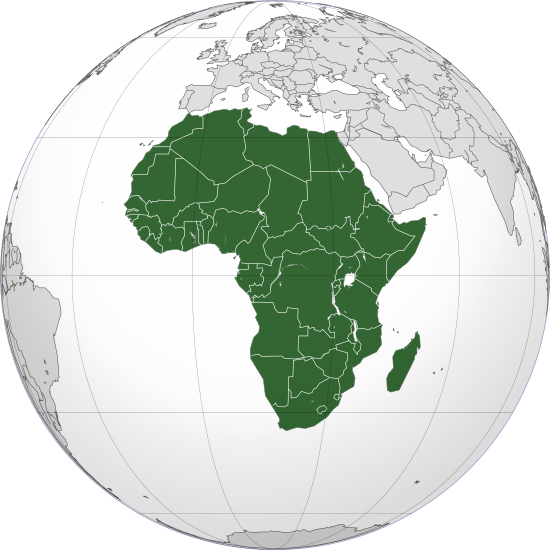
Africa is the second-largest and second-most populous continent home to...
Japan is an East Asian island country located in the...
Trending
18 days ago Fidelity Investments Expands Tech ETF Strategy, Hires New Director, and Settles Data Breach Case
6 hours ago Asian Games Welcome Ceremony Features Flag Bearers From China and Japan

6 hours ago Dodgers Closer Edwin Díaz Returns From Injured List Before Giants Series

6 hours ago Jada Pinkett Smith Celebrates 55th Birthday With Will Smith and Family
6 hours ago Buc-ee's Secures Trademark Settlements and $850,000 Award in Multiple Infringement Lawsuits
6 hours ago Record Diesel Prices Squeeze US Businesses and Farmers Amid Economic Strain
Popular

Stan Lee - was a pivotal figure in the comic...

Ken Paxton is an American politician and lawyer serving as...

Michael Joseph Jackson the King of Pop was a highly...

Shakira Isabel Mebarak Ripoll the Queen of Latin Music is...

Kash Patel is an American lawyer who currently serves as...

Mitch McConnell is a prominent American politician and the longest-serving...