


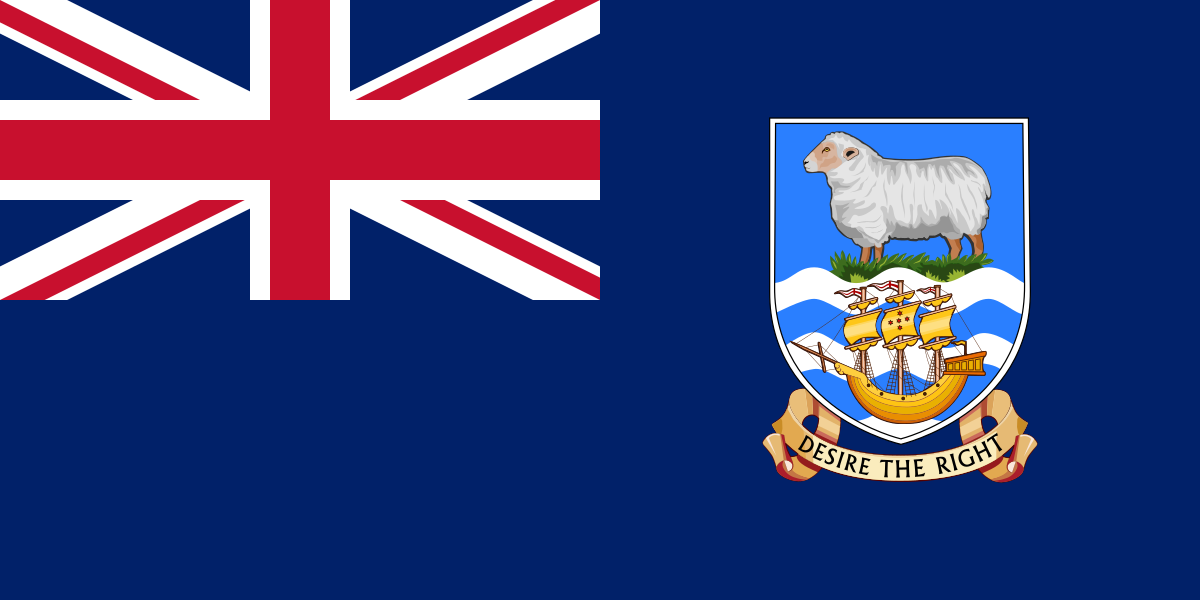
The Falkland Islands are an archipelago in the South Atlantic Ocean, located 300 miles east of South America. The islands consist of East Falkland, West Falkland, and 776 smaller islands, covering an area of 4,700 square miles. The Falklands are a British Overseas Territory with internal self-governance, while the UK handles defense and foreign affairs. Stanley, on East Falkland, is the capital and largest settlement.
1908: Falkland Islands Dependencies
Starting in 1908, the Falklands governed territories as the Falkland Islands Dependencies.


December 1914: Battle of the Falkland Islands
In December 1914, the Battle of the Falkland Islands took place, where a Royal Navy fleet defeated an Imperial German squadron.
1914: End of the Wrecking Trade
By 1914, with the opening of the Panama Canal, the Wrecking Trade effectively ended due to the replacement of sail ships by steamships and the low cost of coal in South America.
December 1939: Battle of the River Plate
Following the December 1939 Battle of the River Plate, the battle-damaged HMS Exeter steamed to the Falklands for repairs.
1942: Battalion redeployed to the Falklands
In 1942, amid fears of a Japanese seizure of the archipelago, a battalion en route to India was redeployed to the Falklands as a garrison.
1965: UN General Assembly
In 1965, at the 20th session of the United Nations General Assembly, the Fourth Committee determined that, in all languages other than Spanish, all UN documentation would designate the territory as Falkland Islands (Malvinas).
1965: UN General Assembly Resolution 2065
In 1965, the UN General Assembly passed Resolution 2065, calling for bilateral negotiations between the UK and Argentina.
1971: Agreement on trade ties
In 1971, an agreement on trade ties between the archipelago and the mainland was reached.
1972: Airfield at Stanley built
In 1972, Argentina built a temporary airfield at Stanley.
1977: Sovereignty negotiations limited
By 1977, Falklander dissent and tensions limited sovereignty negotiations between the UK and Argentina.
1981: End of sovereignty talks
Substantive sovereignty talks ended by 1981, and the dispute escalated with passing time.
April 1982: Argentine military forces invaded the islands
In April 1982, Argentine military forces invaded the Falkland Islands.
April 1982: Falklands War began
In April 1982, the Falklands War began when Argentine military forces invaded the Falklands and other British territories in the South Atlantic.
1982: Economic activity focused on oil field exploration and tourism
Since the end of the Falklands War in 1982, the islands' economic activity increasingly focused on oil field exploration and tourism.
1983: Initial attempts to clear the mines ceased
Due to the large number of deminer casualties, initial attempts to clear the mines ceased in 1983.
1983: British Citizenship Granted
In 1983, full British citizenship was given to Falkland Islanders under the British Nationality (Falkland Islands) Act 1983.
1983: British Nationality (Falkland Islands) Act
In 1983, the British Nationality (Falkland Islands) Act was passed, granting Falkland Islanders British citizenship.
1985: Dissolution of Falkland Islands Dependencies
In 1985, the Falkland Islands Dependencies were dissolved.
1990: Diplomatic relations re-established
In 1990, Argentina and the UK re-established diplomatic relations, but neither has agreed on the terms of future sovereignty discussions.
2001: Exploration efforts
As of 2001, oil exploration efforts had yet to find exploitable reserves.
2008: Ferry links West and East Falkland
Since 2008, a ferry links West and East Falkland.
2009: Landmine clearance work restarted
In 2009, landmine clearance work restarted in accordance with the UK's obligations under the Ottawa Treaty.
2009: Gordon Brown met with Cristina Fernández de Kirchner
In 2009, the British prime minister, Gordon Brown, met with the Argentine president, Cristina Fernández de Kirchner, and said that there would be no further talks over the sovereignty of the Falklands.
2009: 2009 Constitution
Under the 2009 Constitution, the islands have full internal self-government; the UK is responsible for foreign affairs.
2010: High Human Development Index
Based on 2010 data, the islands have a high Human Development Index of 0.874 and a moderate Gini coefficient for income inequality of 34.17.
2012: Falkland Islands Population Census
According to the 2012 census, the average daily population of the Falklands was 2,932, excluding military personnel serving in the archipelago and their dependents.
2012: Sapper Hill Corral was cleared of mines
In 2012, Sapper Hill Corral was cleared of mines, allowing access to an important historical landmark for the first time in 30 years.
2012: Falkland Islands Census: Religious Affiliation
In the 2012 census, most islanders identified themselves as Christian (66 per cent), followed by those with no religious affiliation (32 per cent).
March 2013: Falkland Islands held a referendum on its political status
In March 2013, the Falkland Islands held a referendum on its political status where 99.8% of votes cast favoured remaining a British overseas territory.
2013: Sovereignty referendum
In 2013, a sovereignty referendum was held where almost all votes cast favored remaining a UK overseas territory.
2013: General election
Since the 2013 general election, members of the Legislative Assembly have received a salary and are expected to work full-time and give up all previously held jobs or business interests.
2014: Inflation was calculated
In 2014, inflation was calculated at 1.4%.
2016: Falkland Islands Census
The 2016 census indicated that 43% of residents were born on the archipelago.
October 2020: Demining was completed
Demining was completed in October 2020.
2020: Left the European Union
In 2020, as a territory of the United Kingdom, the Falklands left the European Union.
2021: Population data
In 2021, the population of the Falkland Islands was recorded as 3,662 inhabitants.
2023: Economy of the Falkland Islands ranked
As of 2023, the economy of the Falkland Islands is ranked the 221st largest out of 229 in the world by GDP (PPP).
2023: Oil exploration
By 2023, oil exploration was still proceeding off the shelf of the islands with a deepwater project led by Rockhopper Exploration.
May 2024: Milei expressed general acceptance and tolerance for British rule
In May 2024, newly elected Argentine president Javier Milei, expressed general acceptance and tolerance for British rule, for the time being.
2024: Stephen Doughty, UK minister responsible for the Falkland Islands
Since 2024, Stephen Doughty has been the UK minister responsible for the Falkland Islands, administering British foreign policy regarding the islands.
April 2025: Andrea Clausen took up the post of Chief Executive
On 1 April 2025, Andrea Clausen took up the post of Chief Executive of the Government.
July 2025: Governor Colin Martin-Reynolds appointed
In July 2025, Colin Martin-Reynolds was appointed Governor of the Falkland Islands.
December 2025: Rockhopper Exploration and Navitas Petroleum sanction Sea Lion Field development
In December 2025, Rockhopper Exploration and Navitas Petroleum sanctioned Phase 1 of the Sea Lion Field development, aiming to produce 170 mmbbls with first oil planned for 2028. Argentina rejected these plans.
April 2026: Pentagon communication indicated reviewing support for the UK’s sovereignty claim
On 24 April 2026, Reuters reported that a leaked internal Pentagon communication indicated that the United States was considering reviewing its support for the United Kingdom’s sovereignty claim over the Falkland Islands.
2028: Planned first oil from Phase 1 of Sea Lion Field
In 2028, the first oil from Phase 1 of the Sea Lion Field was planned. Argentina immediately rejected these plans with the Argentine foreign ministry stating that Argentina would safeguard its sovereign rights and interests.
Mentioned in this timeline
The United States of America is a federal republic primarily...

The lion Panthera leo is a large cat species native...
India officially the Republic of India is a South Asian...
Inflation in economics signifies a rise in the average price...
Argentina is a country located in the southern cone of...

War is defined as an armed conflict involving the armed...
Trending
3 hours ago Fed Official John Williams Debates Potential Interest Rate Adjustments for 2027
3 hours ago Apple Prepares to Debut New iPad Mini and Touchscreen MacBook in Late October
3 hours ago Caty McNally Stages Comeback Win Over Yuliia Starodubtseva at WTA Wuhan Open

3 hours ago Bleach Celebrates Anime Finale With New Apparel Collection and Special Nationwide Promotional Campaign

3 hours ago Dayana Yastremska Faces Iva Jovic at WTA Wuhan Open

4 hours ago Hugh Jackman's Cinematic Legacy and Humanitarian Efforts with Laughing Man Foundation
Popular

Ken Paxton is an American politician and lawyer serving as...

Ilhan Omar is a prominent American politician currently serving as...

Jameis Winston is an American football quarterback currently playing for...

Cristiano Ronaldo widely considered one of the greatest footballers captains...

Michael Joseph Jackson the King of Pop was a highly...

Kimberly Guilfoyle is an American television personality and former prosecutor...