


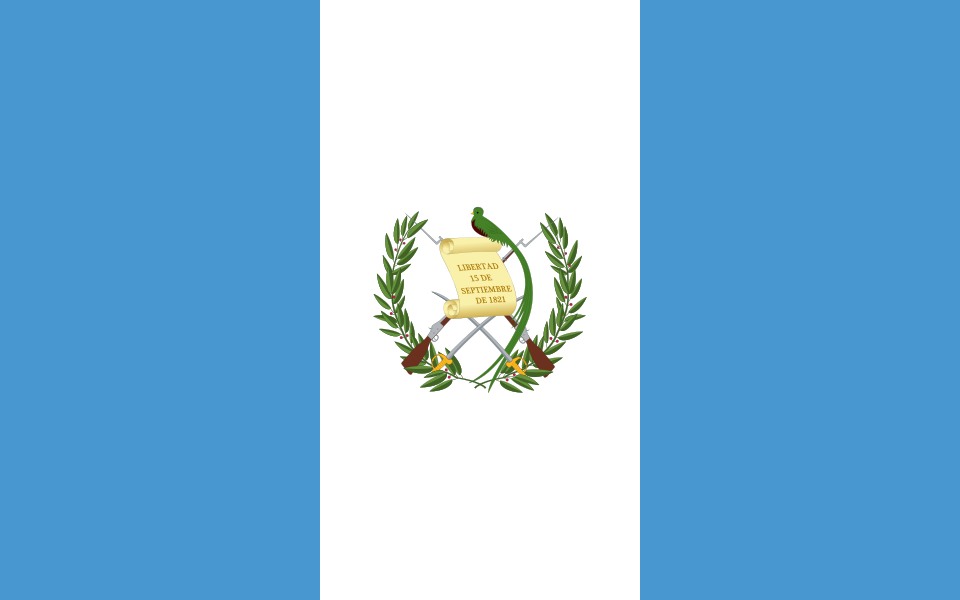
8 hours ago : Severe Drought Devastates Crops Across Guatemala Prompting Emergency Government Response Strategy
Severe drought in Guatemala has destroyed vast agricultural lands, impacting over 226,000 hectares. This record-breaking climate crisis threatens farmer survival, leading the government to launch a five-axis emergency plan to mitigate the ongoing agricultural disaster and provide necessary support to affected communities.


1900: Population of Guatemala
In 1900, Guatemala had a population of 885,000.
1904: Contract Signed with UFCO
In 1904, Estrada Cabrera signed a contract with UFCO's Minor Cooper Keith that gave the company tax exemptions, land grants, and control of all railroads on the Atlantic side.
1906: Revolts Against Estrada Cabrera's Rule
In 1906, Estrada Cabrera faced serious revolts against his rule that were supported by the governments of some of the other Central American nations, but Estrada succeeded in putting them down. Elections were held by the people against the will of Estrada Cabrera and thus he had the president-elect murdered in retaliation.
1907: Assassination Attempt on Estrada Cabrera
In 1907, Estrada Cabrera narrowly survived an assassination attempt when a bomb exploded near his carriage. It has been suggested that the extreme despotic characteristics of Estrada did not emerge until after an attempt on his life in 1907.
1917: Guatemala City Earthquake
In 1917, Guatemala City was badly damaged in the Guatemala earthquake.
1919: National Football Federation Established
In 1919, the National Football Federation of Guatemala was established.
April 1920: Estrada Cabrera Removed from Office
In April 1920, Estrada Cabrera was removed from office after the national assembly charged that he was mentally incompetent, and appointed Carlos Herrera in his place on 8 April 1920.
1920: Carlos Herrera Becomes President
In 1920, Carlos Herrera became President of Guatemala.
September 1921: Guatemala Joins Federation of Central America
On September 9, 1921, Guatemala joined with El Salvador and Honduras in the Federation of Central America.
1921: José María Orellana Becomes President
In 1921, Carlos Herrera was succeeded by José María Orellana as the President of Guatemala.
1921: Census Records Used as Scrap Paper
In 1921, the census records for the year were used as scrap paper.
January 1922: Guatemala Leaves Federation of Central America
On January 14, 1922, Guatemala left the Federation of Central America. They were part of the Federation with El Salvador and Honduras.
1926: Lázaro Chacón González Becomes President
In 1926, José María Orellana was succeeded by Lázaro Chacón González as the President of Guatemala.
1929: The Great Depression Damages Guatemalan Economy
In 1929, The Great Depression began and badly damaged the Guatemalan economy, causing a rise in unemployment, and leading to unrest among workers and laborers.
1931: Jorge Ubico Wins Election
In 1931, Jorge Ubico won the election, in which he was the only candidate. After his election his policies quickly became authoritarian.
1931: End of Lázaro Chacón González's Term
In 1931, Lázaro Chacón González term as president of Guatemala ended.
1941: Guatemala acts on American instructions
In 1941, when the US declared war against Germany, Ubico acted on American instructions and arrested all people in Guatemala of German descent. He also permitted the US to establish an air base in Guatemala, with the stated aim of protecting the Panama Canal.
July 1944: Ubico Forced to Resign
On July 1, 1944 Ubico was forced to resign from the presidency in response to a wave of protests and a general strike inspired by brutal labor conditions among plantation workers.
October 1944: Overthrow of General Juan Federico Ponce Vaides
On October 20, 1944, General Juan Federico Ponce Vaides, Ubico's chosen replacement, was forced out of office by a coup d'état led by Major Francisco Javier Arana and Captain Jacobo Árbenz Guzmán. About 100 people were killed in the coup.
1944: Overthrow of Jorge Ubico and Initiation of a Decade-Long Revolution
In 1944, authoritarian leader Jorge Ubico was overthrown by a pro-democratic military coup. This event initiated a decade-long revolution in Guatemala that led to social and economic reforms.
1944: Manuel Barillas peacefully hands over power to his successor
Manuel Barillas was unique among liberal presidents of Guatemala between 1871 and 1944, because he handed over power to his successor peacefully. In 1944, When election time approached, he sent for the three Liberal candidates to ask them what their government plan would be.
1945: Foundation of The Institute Indigents ta National (NH)
In 1945, the Guatemalan government founded The Institute Indigents ta National (NH) to teach literacy to Mayan children in their mother tongue.
1947: Guatemalan Olympic Committee Founded
In 1947, the Guatemalan Olympic Committee was founded and recognized by the International Olympic Committee.
1950: Jacobo Árbenz Guzmán Wins Election
In 1950, the largely free and fair elections were won by Jacobo Árbenz Guzmán, Arévalo's defense minister.
1950: Immigration to Guatemala
Up to 1950, Guatemala was the Central American country that received the most immigrants, behind Costa Rica.
1952: Summer Olympics Participation
Guatemala participated in the 1952 Summer Olympics.
1952: Operation PBFortune Authorized
In 1952, US President Harry Truman authorized Operation PBFortune to topple Árbenz, with the support of Nicaraguan dictator Anastasio Somoza García, but the operation was aborted when too many details became public.
1952: Partnership with the Summer Institute of Linguistics
In 1952, the SIL (Summer Institute of Linguistics) partnered with the Guatemalan Ministry of Education, leading to the printing and publishing of numerous written works in Mayan languages and advancement in the translation of the New Testament.
1952: Decree 900 Passed
In 1952, Árbenz's most important policy was Decree 900, a sweeping agrarian reform bill which transferred uncultivated land to landless peasants.
August 1953: Operation PBSuccess Authorized
In August 1953, Eisenhower authorized the CIA to carry out Operation PBSuccess.
June 1954: Árbenz Resigns
On June 27, 1954, Árbenz resigned. The resignation followed an invasion of Guatemala on June 18, 1954 by a force of 480 men led by Carlos Castillo Armas, backed by a heavy campaign of psychological warfare.
July 1954: Castillo Armas Becomes President
On July 7, 1954, Carlos Castillo Armas became president following negotiations in San Salvador.
1954: U.S.-Backed Military Coup Ends Revolution
In 1954, a U.S.-backed military coup ended the decade-long revolution in Guatemala and installed a dictatorship.
July 1957: Assassination of Carlos Castillo Armas
On July 26, 1957, Carlos Castillo Armas was assassinated by Romeo Vásquez, a member of his personal guard.
November 1960: Failed Revolt Against Ydigoras' Government
On November 13, 1960, a group of left-wing junior military officers led a failed revolt against Ydigoras' government. The rebels formed MR-13.
1960: Start of the Guatemalan Civil War
In 1960, Guatemala entered a bloody civil war fought between the U.S.-backed government and leftist rebels. The civil war was characterized by genocidal massacres of the Maya population perpetrated by the Guatemalan military and lasted for 36 years.
1961: Guatemala Provides Airstrips for Bay of Pigs Invasion
In 1961, Ydigoras authorized the training of 5,000 anti-Castro Cubans in Guatemala. He also provided airstrips in the region of Petén for what later became the US-sponsored, failed Bay of Pigs Invasion.
February 1962: Attack on United Fruit Company Offices
On February 6, 1962, the offices of the United Fruit Company were attacked. The attack sparked sympathetic strikes and university student walkouts throughout the country.
March 1963: Guatemalan Air Force Attacks Military Bases
On March 31, 1963, the Guatemalan Air Force attacked several military bases. The coup was led by his Defense Minister, Colonel Enrique Peralta Azurdia.
1965: Spanish Becomes Official Language
In 1965, Spanish became the official language of Guatemala, leading to programs to accelerate the move of Mayan students to Spanish.
1966: Julio César Méndez Montenegro Elected President
In 1966, Julio César Méndez Montenegro was elected president of Guatemala under the banner "Democratic Opening". During this time, rightist paramilitary organizations, such as the "White Hand" (Mano Blanca), and the Anticommunist Secret Army (Ejército Secreto Anticomunista) were formed.
1967: CONCACAF Championship Win
In 1967, the Guatemala national football team won the CONCACAF Championship.
1968: Summer Olympics Participation
Guatemala participated in every edition of the Summer Olympics since 1968.
1970: Carlos Manuel Arana Osorio Elected President
In 1970, Colonel Carlos Manuel Arana Osorio was elected president of Guatemala.
1972: Guerrilla Movement Enters the Country
In 1972, members of the guerrilla movement entered Guatemala from Mexico and settled in the Western Highlands.
1974: Kjell Laugerud García Defeats Efraín Ríos Montt in Disputed Election
In 1974, General Kjell Laugerud García defeated General Efraín Ríos Montt in the election. Ríos Montt claimed the victory was fraudulent.
February 1976: Major Earthquake
On February 4, 1976, a 7.5 magnitude earthquake struck Guatemala, killing more than 25,000 people. The earthquake was caused by the Motagua Fault, part of the boundary between the Caribbean and North American tectonic plates.
February 1976: Major Earthquake Destroys Cities
On February 4, 1976, a major earthquake destroyed several cities and caused more than 25,000 deaths, especially among the poor, whose housing was substandard.
1978: Romeo Lucas García Assumes Power
In 1978 General Romeo Lucas García assumed power in Guatemala in a fraudulent election.
1979: US President Jimmy Carter orders ban on military aid
In 1979, US President Jimmy Carter, due to widespread human rights abuses, ordered a ban on all military aid to the Guatemalan Army.
January 1980: Spanish Embassy Takeover and Fire
On January 31, 1980, indigenous K'iche' activists occupied the Spanish Embassy to protest army massacres, leading to a deadly assault by Guatemalan forces and a fire that killed almost everyone inside. The Spanish ambassador disputed the government's version of events, leading Spain to sever diplomatic ties with Guatemala.
1980: Expansion of Bilingual Education
In 1980, an experimental program was created in which children were instructed in their mother tongue until they were fluent enough in Spanish.
July 1982: Plan de Sanchez Massacre
On July 18, 1982, the Plan de Sanchez Massacre occurred, where 188 Achi-Maya people were killed.
1982: Guerrilla Groups Merge and Guatemalans Flee to Mexico
In 1982, four guerrilla groups merged to form the URNG, influenced by guerrilla movements in El Salvador, Nicaragua, and Cuba. Due to the Army's "scorched earth" tactics, over 45,000 Guatemalans fled to Mexico.
1982: Overthrow of Government and Rise of Ríos Montt
In 1982, the Guatemalan government was overthrown and General Efraín Ríos Montt became president of the military junta, continuing a campaign of violence and repression.
1982: Efrain Rios Montt's 17-Month Rule Begins
The government presented evidence of over 100 incidents involving at least 1,771 deaths, 1,445 rapes, and the displacement of nearly 30,000 Guatemalans during his 17-month rule from 1982 to 1983.
1983: Efrain Rios Montt's 17-Month Rule Ends
The government presented evidence of over 100 incidents involving at least 1,771 deaths, 1,445 rapes, and the displacement of nearly 30,000 Guatemalans during Efrain Rios Montt's 17-month rule from 1982 to 1983.
1984: Growth of The Church of Jesus Christ of Latter-day Saints
In 1984, The Church of Jesus Christ of Latter-day Saints had 40,000 members in Guatemala.
1986: Free Election won by Vinicio Cerezo Arévalo
In 1986, after Ríos Montt was overthrown, Óscar Humberto Mejía Victores called for an election, which was won by Vinicio Cerezo Arévalo of the Christian Democracy Party.
1987: Bilingual Education Made Official
In 1987, bilingual education was made official in Guatemala.
1988: Winter Olympics Edition
Guatemala appeared in a single Winter Olympics edition in 1988.
September 1991: Guatemala Recognizes Belize's Independence
On September 6, 1991, Guatemala recognized Belize's independence, but the territorial dispute between the two countries is not resolved.
1992: Rigoberta Menchú Awarded Nobel Peace Prize
In 1992, Rigoberta Menchú was awarded the Nobel Peace Prize for her efforts in raising international awareness about the government-sponsored genocide against the indigenous population of Guatemala.
1995: Catholic Archdiocese of Guatemala begins the Recovery of Historical Memory (REMHI) project
In 1995, the Catholic Archdiocese of Guatemala initiated the Recovery of Historical Memory (REMHI) project to document and confront the history of the country's civil war.
1996: End of Guatemalan Civil War
In 1996, the Guatemalan Civil War concluded with a peace accord between the guerrillas and the government, negotiated by the United Nations. The agreement involved disarmament of guerrilla fighters and land allocation.
1996: Peace Accords and Foreign Investment
In 1996, the peace accords that ended the decades-long civil war removed a major obstacle to foreign investment, leading to increased tourism revenue.
1997: Healthcare Access Extended
Since the end of the Guatemalan Civil War in 1997, the Ministry of Health has extended healthcare access to 54% of the rural population.
April 1998: REMHI presents "Guatemala: Nunca Más!" report
In April 1998, REMHI presented the report "Guatemala: Nunca Más!", summarizing testimonies from thousands of witnesses and victims, and attributing 80% of the atrocities to the Guatemalan Army and its collaborators.
April 1998: Murder of Bishop Juan José Gerardi Conedera
In April 1998, two days after announcing the release of the Recovery of Historical Memory Project report, Bishop Juan José Gerardi Conedera was murdered.
1998: Growth of The Church of Jesus Christ of Latter-day Saints
By 1998, The Church of Jesus Christ of Latter-day Saints grew to 164,000 members in Guatemala and continues to expand.
1998: Hurricane Mitch
In 1998, Guatemala was affected by Hurricane Mitch.
1999: US President Bill Clinton Acknowledges Support for Guatemalan Military
In 1999, US President Bill Clinton acknowledged that the US was wrong to have supported the Guatemalan military forces involved in civilian killings.
1999: Historical Clarification Commission Concludes State Actions Constituted Genocide
In 1999, the Historical Clarification Commission concluded that actions by the Guatemalan state during the civil war constituted genocide, attributing over 93% of human rights violations to the military government and estimating that Maya Indians accounted for 83% of the victims.
2000: FIFA Futsal World Cup Participation
In 2000, Guatemala participated for the first time in the FIFA Futsal World Cup as hosts.
2001: Religious Demographics
Between 2001 and 2012, the Catholic Church in Guatemala declined from 55% to 47.9% of people. The Protestant population grew from 30% to 38.2%.
2001: Convictions in Bishop Gerardi Murder Case
In 2001, three Army officers were convicted of the murder of Bishop Gerardi and sentenced to 30 years in prison. A priest was also convicted as an accomplice and sentenced to 20 years.
2003: Language Law
According to the Language Law of 2003, twenty-one Mayan languages, Xinca, and Garifuna are recognized as national languages in Guatemala.
July 2004: Inter-American Court Condemns Plan de Sanchez Massacre
In July 2004, the Inter-American Court condemned the July 18, 1982, massacre of 188 Achi-Maya in Plan de Sanchez. The court ruled that the Guatemalan Army had committed genocide during the 1980s scorched-earth campaign.
October 2005: Hurricane Stan
In October 2005, Guatemala was hit by Hurricane Stan, which caused significant flooding and mudslides, resulting in more than 1,500 deaths.
March 2006: Ratification of DR-CAFTA
In March 2006, Guatemala's congress ratified the Dominican Republic–Central America Free Trade Agreement (DR-CAFTA) between several Central American nations and the US.
2007: Femicide Rate in Guatemala
From 2007 to 2012, Guatemala had a femicide rate of around 9.1 murders for every 100,000 women.
2008: FIFA Futsal World Cup Participation
Guatemala played in the FIFA Futsal World Cup in 2008.
2008: Guatemala Recognizes Femicide as a Crime
In 2008, Guatemala became the first country to officially recognize femicide, the murder of a female because of her sex, as a crime.
2008: CONCACAF Futsal Championship Win
In 2008, the Guatemala national futsal team won the CONCACAF Futsal Championship as hosts.
2008: Tourism Revenue
In 2008, tourism was estimated at $1.8 billion to the Guatemalan economy.
2009: Economic Crisis
In 2009, Guatemala experienced an economic crisis due to falling demands from the United States and other Central American markets, and the slowdown in foreign investment.
2009: New York Grand Jury Indicts Alfonso Portillo
In 2009, a New York grand jury indicted ex-President Alfonso Portillo for embezzlement.
2009: Grand Prix de Futsal Participation
Since 2009, Guatemala has participated in every Grand Prix de Futsal.
January 2010: Arrest of Alfonso Portillo
In January 2010, ex-President Alfonso Portillo was arrested while attempting to flee Guatemala.
May 2010: Acquittal of Alfonso Portillo
In May 2010, Alfonso Portillo was acquitted by a panel of judges, leading to criticism from the Guatemalan Attorney-General and the International Commission Against Impunity in Guatemala (CICIG).
2010: GDP (PPP) and Economic Sectors
In 2010, Guatemala's Gross Domestic Product (GDP) in purchasing power parity (PPP) was estimated at US$70.15 billion. The service sector was the largest component of GDP at 63%, followed by the industry sector at 23.8% and the agriculture sector at 13.2%. Inflation was 3.9%.
2010: Guatemalan Economy Growth
In 2010, the Guatemalan economy grew by 3%, recovering gradually from the 2009 crisis.
2011: Otto Pérez Molina Elected President
In 2011, Otto Pérez Molina was elected president of Guatemala, along with Roxana Baldetti as vice-president.
January 2012: Efrain Rios Montt Appears in Court on Genocide Charges
In January 2012, former dictator Efrain Rios Montt appeared in a Guatemalan court on genocide charges. The government presented evidence of widespread atrocities during his rule.
January 2012: Otto Pérez Molina and Roxana Baldetti begin their term in office
On January 14, 2012, Otto Pérez Molina and Roxana Baldetti began their term in office.
2012: Guatemala Wins First Olympic Medal
At the 2012 Summer Olympics in London, Erick Barrondo won Guatemala's first-ever Olympic medal in the men's 20 kilometer walk.
2012: Religious Demographics
Between 2001 and 2012, the Catholic Church in Guatemala declined from 55% to 47.9% of people. The Protestant population grew from 30% to 38.2%.
2012: Femicide Rate in Guatemala
From 2007 to 2012, Guatemala had a femicide rate of around 9.1 murders for every 100,000 women.
2012: Runner-up in CONCACAF Futsal Championship
In 2012, Guatemala's national futsal team was the runner-up in the CONCACAF Futsal Championship as hosts.
2012: Literacy Rates Increase
In 2012, literacy rates among the population aged 15 and above in Guatemala were 74.5%.
2012: Healthcare Spending and Options
In 2012, the per-capita average annual healthcare spending was only $368. Guatemalan patients choose between indigenous treatments or Western medicine when they engage with the health system.
May 2013: Rios Montt Found Guilty of Genocide
On May 10, 2013, Rios Montt was found guilty of genocide and sentenced to 80 years in prison, marking the first time a national court had convicted a former head of state of genocide.
2013: Ministry of Health Lacked Financial Means
As of 2013, the Ministry of Health in Guatemala lacked the financial means to monitor or evaluate its programs.
2014: Grand Prix de Futsal Semifinals
In 2014, Guatemala reached the semifinals in the Grand Prix de Futsal.
2014: Consideration of Legalizing Poppy and Marijuana Production
In 2014, the Guatemalan government was considering ways to legalize poppy and marijuana production, hoping to tax production and use tax revenues to fund drug prevention programs and other social projects.
January 2015: Montt's trial resumed
In January 2015, Montt's trial resumed after the conviction was overturned.
April 2015: United Nations Report Implicates High-Profile Politicians
In April 2015, a United Nations anti-corruption agency report implicated high-profile politicians, including Baldetti's private secretary, in corruption.
August 2015: Guatemalan court ruled that Rios Montt could stand trial for genocide and crimes against humanity
In August 2015, a Guatemalan court ruled that Rios Montt could stand trial for genocide and crimes against humanity, but that he could not be sentenced due to his age and deteriorating health.
August 2015: Arrest of Baldetti and Impeachment Request for Pérez Molina
On August 21, 2015, evidence presented by CICIG and the Attorney General led to the arrest of former vice president Baldetti and an impeachment request for President Pérez Molina. Despite public pressure, Pérez Molina initially refused to resign.
September 2015: Resignation and Impeachment of Pérez Molina
In September 2015, amid protests and accusations of corruption, President Pérez Molina resigned and was summoned to the Justice Department for the La Linea corruption case.
September 2015: Decline in Manuel Baldizón's Electoral Prospects
In September 2015, due to bribery-related accusations against legislators and members of his party, Manuel Baldizón's electoral prospects declined significantly, and he filed accusations against the CICIG leader.
September 2015: Otto Pérez Molina Resigns
On September 2, 2015, Otto Pérez Molina resigned as President of Guatemala due to a corruption scandal and was replaced by Alejandro Maldonado until January 2016.
October 2015: Jimmy Morales Elected President
In October 2015, Jimmy Morales, a former TV comedian, was elected as the new president of Guatemala.
2015: Release of Ixcanul
In 2015, Guatemalan director Jayro Bustamante gained international recognition with his film Ixcanul.
January 2016: Alejandro Maldonado replaced by Jimmy Morales
In January 2016, Alejandro Maldonado was replaced as president of Guatemala by Jimmy Morales. Congress appointed Alfonso Fuentes Soria as the new vice president to replace Maldonado.
January 2016: Jimmy Morales Took Office
In January 2016, Jimmy Morales took office as president of Guatemala.
June 2016: Corruption Case Dubbed 'Cooperacha' Unveiled
In June 2016, a United Nations-backed prosecutor unveiled a corruption case called "Cooperacha", where officials pooled funds to buy luxurious gifts, like motorboats, for Molina.
2016: Bronze Medal in CONCACAF Futsal Championship
In 2016, the Guatemala national futsal team won the bronze medal in the CONCACAF Futsal Championship.
December 2017: Guatemala to Move Embassy to Jerusalem
In December 2017, President Morales announced that Guatemala would move its embassy in Israel to Jerusalem.
2017: Guatemala Signs UN Treaty on the Prohibition of Nuclear Weapons
In 2017, Guatemala signed the United Nations Treaty on the Prohibition of Nuclear Weapons.
2018: Census Results
According to the 2018 Census, 56% of the population of Guatemala is Ladino, and 43.6% are Indigenous Guatemalans.
August 2019: Giammattei Wins Presidential Election
In August 2019, Alejandro Giammattei won the presidential election with his "tough-on-crime" agenda.
2019: Forest Landscape Integrity Index
In 2019, Guatemala had a Forest Landscape Integrity Index mean score of 3.85/10, ranking it 138th globally out of 172 countries.
2019: Release of Temblores and La Llorona
In 2019, Guatemalan director Jayro Bustamante released the films Temblores and La Llorona (The Weeping Woman).
January 2020: Alejandro Giammattei Replaced Jimmy Morales as President
In January 2020, Alejandro Giammattei replaced Jimmy Morales as the president of Guatemala.
January 2020: Alejandro Giammattei assumes office
In January 2020, Alejandro Giammattei succeeded Jimmy Morales as president of Guatemala.
November 2020: Hurricane Eta
In November 2020, Guatemala was impacted by Hurricane Eta, which was responsible for more than 100 people missing or killed, with the final tally still uncertain.
November 2020: Protests Against President Alejandro Giammattei
In November 2020, large protests and demonstrations occurred in Guatemala against President Alejandro Giammattei and the legislature, due to cuts in educational and health spending.
2021: Population of Guatemala
In 2021, Guatemala had a population of 17,608,483.
August 2023: Bernardo Arévalo Wins Presidential Election
In August 2023, Bernardo Arévalo won Guatemala's presidential election, but the outgoing administration attempted to prevent him from taking power.
2023: Opposition Efforts to Weaken Arévalo's Administration
In 2023, Arévalo's opposition sought to weaken his administration through prosecutions of Semilla party members and indigenous leaders of the 2023 protests that led to his election being upheld.
2023: Bernardo Arévalo Wins Presidential Election
In 2023, Guatemala held democratic elections, which were won by Bernardo Arévalo.
2023: Poverty Rate
In 2023, the CIA World Fact Book estimates that 56.0% of the population of Guatemala is living in poverty.
January 2024: Bernardo Arévalo Assumed Office
In January 2024, Bernardo Arévalo assumed the office of president of Guatemala.
January 2024: Arévalo's Inauguration Delayed
In January 2024, Bernardo Arévalo was scheduled to assume the role as the 52nd president of Guatemala. His inauguration, however, was delayed due to the event's commission failing to approve a congressional delegation.
February 2024: Creation of Special Group Against Extortion (GECE)
In February 2024, President Arévalo and Minister of the Interior Francisco Jiménez announced the creation of the Special Group Against Extortion (GECE), a special force within the National Civil Police (PNC) aimed at combatting violent crime and extortions. The GECE will consist of 400 motorized officers who will patrol different regions of the country.
April 2024: Presidential Salary Reduction
In April 2024, President Arévalo reduced the presidential salary by 25%, fulfilling a campaign promise. Vice President Herrera also announced a 25% reduction in her salary. This made the head of state of Guatemala no longer the highest-paid president in Latin America.
2024: Literacy Rates Increase
By 2024, literacy rates among the population aged 15 and above increased to 82.1% due to strides in education.
2024: Estimated GDP (PPP) per capita
In 2024, Guatemala's estimated GDP (PPP) per capita is US$10,998.
2024: Bronze Medal in CONCACAF Futsal Championship
In 2024, the Guatemala national futsal team won the bronze medal in the CONCACAF Futsal Championship.
2024: Global Hunger Index Ranking
In the 2024 Global Hunger Index (GHI), Guatemala ranks 81st out of 127 countries with sufficient data, with a GHI score of 18.8, indicating a moderate level of hunger.
2025: Global Innovation Index Ranking
Guatemala was ranked 123rd in the Global Innovation Index in 2025.
Mentioned in this timeline
Bill Clinton served as the nd U S President from...
An earthquake is a sudden intense shaking of the Earth's...
FIFA or the F d ration Internationale de Football Association...
The Dominican Republic is a Caribbean nation located on the...
Football commonly known as soccer in many regions is the...
Spain officially the Kingdom of Spain is a large country...
Trending
3 hours ago Princess Catherine Embarks on New Royal Engagements During London Fashion Week and Scotland Visit

4 hours ago Eva Lys Wins Thrilling Comeback Match at WTA Sao Paulo Tournament
4 hours ago Jameson Williams Reflects on Subpar Performance Against New Orleans Saints
2 days ago US Attorney General Todd Blanche Addresses Media at White House Press Briefing
12 days ago Multiple Earthquakes Reported Off Oregon Coast and Near Castle Rock
4 hours ago Chris Olave and Chase Young Added to New Orleans Saints Injury Report
Popular
Stan Lee - was a pivotal figure in the comic...

Ken Paxton is an American politician and lawyer serving as...

Michael Joseph Jackson the King of Pop was a highly...
Charlie Kirk was a prominent American right-wing political activist entrepreneur...
JD Vance is an American politician author and venture capitalist...
Kash Patel is an American lawyer who currently serves as...