



The Landsat program is the longest-running project for acquiring satellite imagery of Earth. Initiated as a joint NASA/USGS program, it began with the launch of the Earth Resources Technology Satellite (later renamed Landsat 1) on July 23, 1972. The program continues to this day, most recently with the launch of Landsat 9 on September 27, 2021. Landsat provides essential data for monitoring and understanding changes in land cover, land use, and the environment over time.
1960: Monitoring Earth's atmosphere
Since 1960, weather satellites had been monitoring Earth's atmosphere, however, there was little appreciation of terrain data from space until the mid-1960s.


1965: Proposal for a remote sensing satellite program
In 1965, William T. Pecora, director of the USGS, proposed a remote sensing satellite program to gather data about Earth's natural resources.
1966: Program conceived as result of Mercury and Gemini orbital photography
In 1966, the remote sensing satellite program was conceived as a direct result of the demonstrated utility of the Mercury and Gemini orbital photography to Earth resource studies.
1969: Initiation of the first Multispectral Scanners (MSS)
In 1969, the Hughes Aircraft Company from the Santa Barbara Research Center initiated, designed, and fabricated the first three Multispectral Scanners (MSS).
1970: NASA gets the green light to build a satellite
Finally, by 1970, NASA had a green light to build a satellite, and Landsat 1 was launched within only two years.
1970: Urban Development Studies following economic reform
Following the economic reform of 1970 in Beijing, Landsat imagery gives an insight into the type of urban development, and studies aspects of social and political change through visible change, this gave rise to the development of ring roads in the 1980s.
1970: Completion of the first MSS prototype
In the fall of 1970, the first MSS prototype, designed by Virginia Norwood, was completed within nine months and tested by scanning Half Dome at Yosemite National Park.
1972: Start of the uninterrupted Landsat time series
In 1972, Landsat imagery began providing one of the longest uninterrupted time series available from any single remote sensing program.
1975: Landsat imagery used to find high yield fishery areas
In 1975, some satellite data of the eastern portion of the Mississippi sound and another area off the coast of the Louisiana coast was run through classification algorithms to rate areas as high and low probability fishing zones. The algorithms yielded a classification that was proven with in situ measurements to be over 80% accurate.
1975: Name changed to Landsat
In 1975, the Earth Resources Technology Satellites Program was renamed to Landsat.
1979: Transfer of Landsat operations to NOAA
In 1979, Jimmy Carter's Presidential Directive 54 transferred Landsat operations from NASA to the National Oceanic and Atmospheric Administration (NOAA), recommended development of a long-term operational system, and recommended transition to private sector operation of Landsat.
1986: Observation of Columbia glacier retreat since Landsat 4
Since Landsat 4 in 1986, glacier retreat on a big scale can be traced back to previous Landsat missions, and this information can be used to augment climate change knowledge, the Columbia glacier retreat can be observed in false-composite images.
September 1988: Use of Landsat imagery for Yellowstone fires analysis
In September 1988, Landsat imagery was used to estimate the area affected by the Yellowstone fires and helped determine why the fire spread so quickly, revealing the impact of preservation practices versus clear-cut activities.
1989: NOAA directs Landsat 4 and 5 to be shut down
In 1989, NOAA directed that Landsat 4 and Landsat 5 be shut down due to funding issues.
1990: Congress provided only half of the year's funding to NOAA
In 1990, Congress provided only half of the year's funding to NOAA, requesting that agencies that used Landsat data provide the funding for the other six months of the upcoming year.
1991: Congress provided only half of the year's funding to NOAA
In 1991, Congress provided only half of the year's funding to NOAA, requesting that agencies that used Landsat data provide the funding for the other six months of the upcoming year.
October 1992: Passage of the Land Remote Sensing Policy Act
In October 1992, Congress passed the Land Remote Sensing Policy Act, authorizing the procurement of Landsat 7 and assuring the continued availability of Landsat digital data and images.
1992: EOSAT ceased processing Landsat data
In 1992, various efforts were made to procure funding for follow-on Landsats and continued operations, but by the end of the year, EOSAT ceased processing Landsat data.
October 1993: Launch failure of Landsat 6
Landsat 6 was launched on October 1993, but was lost in a launch failure.
1994: EOSAT resumed processing Landsat data
In 1994, EOSAT resumed processing Landsat 4 and 5 data.
2005: Discovery of new species using Landsat imagery
In 2005, Landsat imagery assisted in the discovery of new species in Mozambique. Conservation scientist Julian Bayliss found great diversity of wildlife as well as three new species of butterflies and a new snake species using Landsat-generated satellite images.
2007: Publication of the OSTP Plan for a National Land Imaging Program
The OSTP Plan for a National Land Imaging Program was published in 2007 following Landsat 8 re-authorization, recognizing the Landsat satellite system as foundational to U.S. space, earth observation, and geospatial management and policy.
February 2013: Launch of Landsat 8
On February 2013, Landsat 8 launched from Vandenberg Air Force Base on an Atlas V 401 rocket, assembled in Arizona by Orbital Sciences Corporation.
April 2015: Commencement of work on Landsat 9
In April 2015, NASA and the USGS announced that work on Landsat 9 had commenced, with funding allocated in the president's FY2016 budget, for a planned launch in 2023.
2015: Report on the top applications of Landsat imagery
In 2015, the Landsat Advisory Group reported that the top 16 applications of Landsat imagery produced savings of approximately 350 million to over 436 million dollars each year for various sectors.
2019: Proposed launch of a low-cost thermal infrared satellite
In 2019, a funding was proposed for the development of a low-cost thermal infrared (TIR) free-flying satellite for launch in 2019 to ensure data continuity by flying in formation with Landsat 8.
2020: Senate advised NASA to plan for launch no later than 2020
In 2020, United States Senate appropriators advised NASA to plan for a launch no later than 2020.
September 2021: Launch of Landsat 9
On September 2021, Landsat 9, the most recent satellite in the Landsat program, was launched.
September 27, 2021: Launch of Landsat 9
Landsat 9 launched on September 27, 2021.
2021: Continued Landsat time series with the launch of Landsat 9
In 2021, the successful launch of Landsat 9 ensures the continuation of the Landsat time series.
2023: Planned launch in 2023
NASA and the USGS announced that work on Landsat 9 had commenced, with funding allocated in the president's FY2016 budget, for a planned launch in 2023.
2030: Planned Launch of Landsat Next
Landsat Next is planned to launch in late 2030/early 2031 and will measure 26 spectral bands.
2031: Planned Launch of Landsat Next
Landsat Next is planned to launch in late 2030/early 2031 and will measure 26 spectral bands.
Mentioned in this timeline
The United States of America is a federal republic primarily...

Jimmy Carter the th U S President - was a...

NASA the National Aeronautics and Space Administration is the U...

Arizona is a state in the Southwestern United States part...

Virginia a state in the Southeastern and Mid-Atlantic regions of...
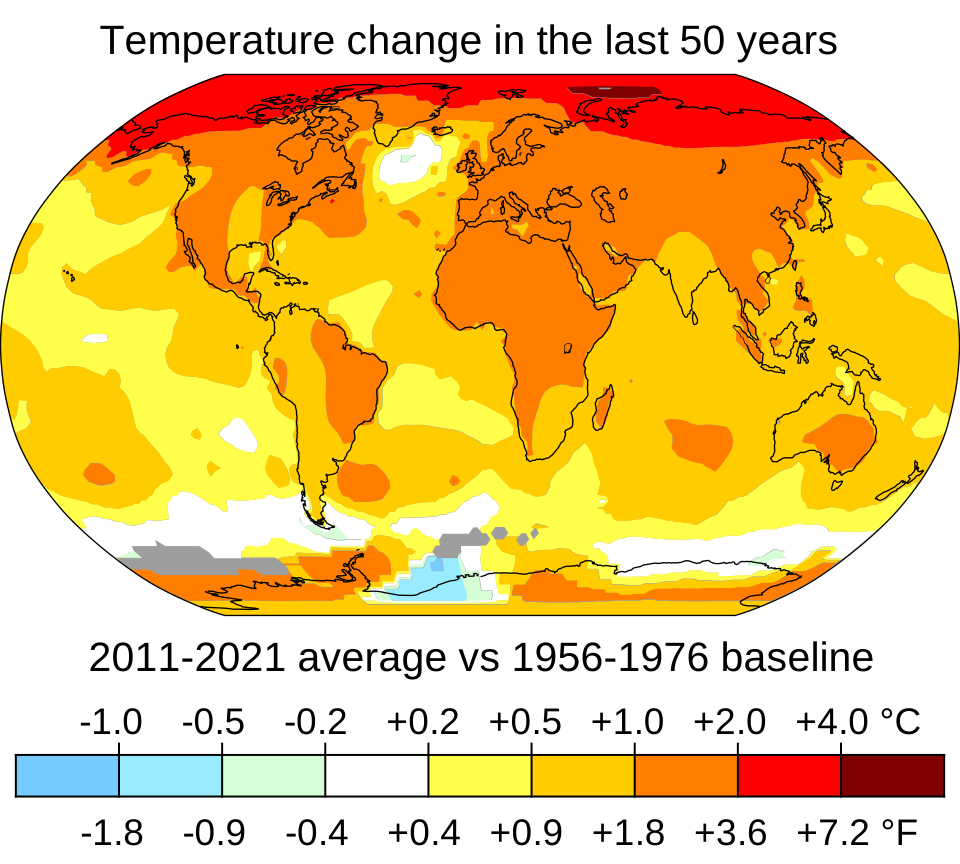
Climate change refers to long-term shifts in global temperatures and...
Trending

5 days ago Arnold Schwarzenegger Childhood Home Transformed Into Dedicated Museum in Austria

4 hours ago Citibank Navigates Hiring Shifts, Expansion in China, and Stock Valuation Forecasts

4 hours ago Two Teenage Girls Arrested for Alleged Corona High School Shooting Plot
5 hours ago Catherine Breed Makes History Swimming Entire 900-Mile California Coastline

5 hours ago League of Legends Patch 26.21 Introduces ARAM Mayhem and New Augments
5 hours ago U.S. and Israel Coordinate Potential Renewed Strike Plans Against Iran
Popular

Ken Paxton is an American politician and lawyer serving as...

Ilhan Omar is a prominent American politician currently serving as...

Michael Joseph Jackson the King of Pop was a highly...

Elon Musk is a visionary entrepreneur and engineer known for...

Cristiano Ronaldo widely considered one of the greatest footballers captains...

Linda Ronstadt is a versatile American singer renowned for her...