


Lesotho, a landlocked kingdom in Southern Africa, is entirely surrounded by South Africa. It's the largest of three sovereign enclaves globally. Located in the Maloti Mountains, it features the highest peak in Southern Africa. Its area spans over 30,000 km2, with a population of approximately 2.3 million. Maseru serves as both its capital and largest city.
1903: Council appointed to advise British Resident Commissioner
In 1903, a council was appointed to advise the British Resident Commissioner on which laws would be best for governing the Basotho.


1905: Railway line built to connect Maseru
In 1905, a railway line was built to connect Maseru to the railway network of South Africa.
1935: Peter Nixon born
Peter Nixon, the geologist that discovered Kimberlite pipes in Lesotho was born in 1935.
December 1957: Discovery of Kimberlite Pipes
On December 14, 1957, the Letšeng-la-Terae Kimberlite Pipes – the Main Pipe and the Satellite Pipe – were discovered by graduate geologist Peter H. Nixon.
October 1966: Independence gained
On 4 October 1966, Basutoland gained its independence from the United Kingdom and became the Kingdom of Lesotho.
1966: Independence achieved
In 1966, Lesotho achieved independence after being a protectorate and crown colony of the United Kingdom.
1967: Discovery of the Lesotho Brown diamond
In 1967, a 601-carat diamond (Lesotho Brown) was discovered in the mountains by a Mosotho woman.
January 1970: Ruling BNP lost the first post-independence general elections
In January 1970, the ruling BNP lost the first post-independence general elections, with 23 seats to the Basotho Congress Party's (BCP) 36. Prime Minister Jonathan refused to cede power to BCP, instead declaring himself prime minister and imprisoning the BCP leadership.
January 1970: BNP rule ends
The Basotho National Party (BNP) ruled from 1966 until January 1970, after which a de facto government led by Leabua Jonathan ensued.
1978: LLA rescued from their Tanzanian base
In 1978, deprived of arms and supplies by the David Sibeko faction of PAC, the 178-strong LLA was rescued from their Tanzanian base by the financial assistance of a Maoist PAC officer and launched a guerrilla war.
September 1981: Attacks on BCP sympathizers
On 4 September 1981, the family of Benjamin Masilo was attacked, resulting in the death of his three-year-old grandson. Four days later, Edgar Mahlomola Motuba, the editor of the newspaper "Leselinyana la Lesotho", was abducted from his home, together with two friends, and murdered.
1982: De Beers Closed Letšeng Mine
In 1982, De Beers closed the Letšeng mine.
1986: Jonathan sacked in coup
After Jonathan was sacked in a 1986 coup, the Transitional Military Council that came to power granted executive powers to King Moshoeshoe II.
1986: Lesotho Highlands Water Project commencement
In 1986, the 21-year, multibillion-dollar Lesotho Highlands Water Project (LHWP) commenced, designed to transfer water from the Orange River system to South Africa.
1987: King forced into exile
In 1987, King Moshoeshoe II was forced into exile, and his son was installed as King Letsie III in his place.
1991: Lekhanya ousted
In 1991, Major General Justin Metsing Lekhanya was ousted and replaced by Major General Elias Phisoana Ramaema.
1992: King Moshoeshoe II returned
King Moshoeshoe II returned from exile in 1992.
1992: Moshoeshoe II returned from exile
Moshoeshoe II returned from exile in 1992 as an ordinary citizen.
1993: Power handed over
In 1993, Major General Elias Phisoana Ramaema handed over power to a democratically elected government of BCP.
1993: Constitutional government restored
Lesotho's constitutional government was restored in 1993 after seven years of military rule.
August 1994: Military-backed coup
In August 1994, Letsie III staged a military-backed coup that deposed the BCP government after it refused to reinstate his father, Moshoeshoe II, according to Lesotho's constitution.
1995: Percentage of population below USD $1.25/day
In 1995, 48% of Lesotho's population was living below USD $1.25 per day.
1995: King Moshoeshoe II reinstated
In 1995, King Moshoeshoe II was reinstated.
1995: Letsie III abdicated
In 1995, Letsie III abdicated in favor of his father and ascended the throne again when Moshoeshoe II died.
January 1996: Death of Moshoeshoe II
Moshoeshoe II died on 15 January 1996 at the age of 57 in a supposed road accident.
1997: BCP split over leadership disputes
In 1997, the ruling BCP split over leadership disputes. Mokhehle formed a new party, the Lesotho Congress for Democracy (LCD).
August 1998: Opposition protests
In August 1998, opposition protests "intensified", culminating in a demonstration outside the royal palace.
December 1998: Interim Political Authority created
In December 1998, an Interim Political Authority (IPA), charged with reviewing the electoral structure in the country, was created.
1998: LNSS established
The Lesotho National Security Service (LNSS) was established in modern form by the National Security Services Act of 1998.
May 1999: SADC forces withdrew
By the time the SADC forces withdrew in May 1999, much of Maseru "lay in ruins", and the southern provincial capital towns of Mafeteng and Mohale's Hoek had lost over a third of their commercial real estate.
2000: Literacy Study
According to a study conducted by the Southern and Eastern Africa Consortium for Monitoring Educational Quality in 2000, 37% of grade 6 pupils in Lesotho are at or above reading level 4, "Reading for Meaning."
May 2002: LCD won the elections
In May 2002, elections were held, and LCD won, gaining 54% of the vote.
2003: Percentage of population below USD $1.25/day
By 2003, the percentage of Lesotho's population living below USD $1.25 per day fell to 44%.
2004: Manufacturing sector surpasses government employees
In mid-2004, employment in Lesotho's manufacturing sector reached over 50,000, mostly female, marking the first time that manufacturing sector workers outnumbered government employees.
August 2006: Discovery of the Lesotho Promise diamond
In August 2006, a 603-carat white diamond, the Lesotho Promise, was discovered at the Letšeng-la-Terae mine.
2006: Estimate of population with disabilities
According to the 2006 census of Lesotho, around 4% of the population is thought to have some sort of disability.
2006: Married Persons Equality Act
The Married Persons Equality Act was passed in 2006, giving equal rights to wives regarding their husbands, abolishing the husband's marital power.
2007: Drought and UN advice for state of emergency
In 2007, Lesotho experienced a drought and was advised by the United Nations to declare a state of emergency to get aid from international organizations.
2007: Average earnings in textile sector
In 2007, the average earnings of an employee in the textile sector in Lesotho were US$103 per month, with an official minimum wage of US$93 per month for a general textile worker.
December 2008: Signing of U.N. Convention on the Rights of Persons with Disabilities
On December 2, 2008, Lesotho became the 42nd country in the world to sign the U.N. Convention on the Rights of Persons with Disabilities.
2008: Highest rape rate
According to the U.N., in 2008 Lesotho had the highest rape rate of any country (91.6 reported rapes per 100,000 people). International data from UNODC also found the incidence of rape recorded in 2008 by the police to be the highest in Lesotho out of any country in the study.
2008: Ibrahim Index of African Governance
In 2008 Lesotho was ranked 12th out of 48 sub-Saharan African countries in the Ibrahim Index of African Governance.
2008: Exports reached 487 million dollars
In 2008, Lesotho exported goods worth 487 million dollars, mainly to the US.
2008: Average gross national income per capita
In 2008, Lesotho's average gross national income per capita was US$83 per month.
2008: Setback in the diamond sector
In 2008, Lesotho's diamond sector underwent a setback as a result of the world recession.
2008: Discovery of a 478-carat diamond
In 2008, another 478-carat diamond was discovered at the Letšeng-la-Terae mine.
2009: GDP growth slows to 0.9%
In 2009, Lesotho's GDP growth slowed to 0.9% due to the global economic crisis, a loss of textile exports and jobs, reduced diamond mining and exports, a drop in SACU revenues, and a reduction in worker remittances.
2009: Adult literacy rate
In a 2009 report, adult literacy in Lesotho was as high as 82%.
2009: D.H.S. survey on domestic violence
In the 2009 D.H.S. survey, 15.7% of men in Lesotho said that a husband is justified in hitting or beating his wife if she refuses to have sex with him, while 16% said a husband is justified in using force to have sex.
May 2010: Charter Movement delivered a petition
In May 2010, the Charter Movement delivered a petition to the South African High Commission requesting integration.
2010: Self-sufficiency in electricity production
By 2010, completion of the first phase of the Lesotho Highlands Water Project made Lesotho almost completely self-sufficient in electricity production and generated approximately US$70 million from the sale of electricity and water to South Africa.
2010: Rebound in the diamond sector
In 2010, Lesotho's diamond sector rebounded.
December 2011: Religious demographics
In December 2011, it was estimated that more than 95% of the population of Lesotho was Christian, with Catholics representing 49.4%, Protestants 18.2%, Pentecostals 15.4%, Anglicans 5.3%, and other Christians an additional 1.8%. Non-Christian religions represent 9.6% of the population, and those of no religion 0.2%.
2011: Dwindling garment sector employment
By mid-2011, employment in Lesotho's garment sector had dwindled to about 45,000 due to international competition. It was the largest formal sector employer in Lesotho in 2011.
2011: Diamond exports reached US$230 million
In 2011, Lesotho's diamond exports reached US$230 million.
August 2014: Alleged abortive military coup
On 30 August 2014, an alleged abortive military "coup" took place, forcing the Prime Minister Thomas Thabane to flee to South Africa for three days.
2014: Recognition of Kosovo
From 2014 up until 2018, Lesotho recognised the Republic of Kosovo.
2014: Diamond production estimate
In 2014, it was estimated that Lesotho's Letšeng, Mothae, Liqhobong, and Kao mines combined would produce 240,000 carats of diamonds, worth US$300 million.
October 2018: Late start of the rainy season
In October 2018, the rainy season in Lesotho started a month later than normal.
2018: Highest suicide rate
According to World Health Organization data, Lesotho has had the world's highest age-standardized rate of suicide since 2018.
2018: Adult H.I.V./A.I.D.S. prevalence rate
As of 2018, Lesotho's adult H.I.V./A.I.D.S. prevalence rate of 23.6% was the second-highest in the world.
2018: Recognition of Kosovo
From 2014 up until 2018, Lesotho recognised the Republic of Kosovo.
2018: Inspiration for Wakanda
Ryan Coogler, director of the 2018 film Black Panther, stated that his depiction of Wakanda was inspired by Lesotho. Basotho blankets became more known as a result of the film.
February 2019: Below-average rainfall amounts
In February 2019, Lesotho recorded below-average amounts of rain, with rainfall between October 2018 and February 2019 ranging from 55% to 80% below normal rates.
March 2019: Humanitarian Assistance Prediction
In March 2019, The Lesotho Vulnerability Assessment and Analysis Committee reported that nearly 488,000 people would need humanitarian assistance because of the drought.
July 2019: Start of period of food insecurity
Starting in July 2019, it was expected that 640,000 people in Lesotho would be affected by food insecurity due to unproductive harvests and rising food prices as a result of the drought.
2019: Signed UN treaty on the Prohibition of Nuclear Weapons
In 2019, Lesotho signed the UN treaty on the Prohibition of Nuclear Weapons.
May 2020: First COVID-19 case reported
On 13 May 2020, according to the health ministry, Lesotho became the last African nation to report a COVID-19 case.
May 2020: Thomas Thabane stepped down as prime minister
On 19 May 2020, Thomas Thabane formally stepped down as prime minister of Lesotho following months of pressure after he was named as a suspect in the murder of his ex-wife.
June 2020: End of period of food insecurity
By June 2020, 640,000 people in Lesotho were expected to be affected by food insecurity as a result of "unproductive harvests as well as the corresponding rise in food prices because of the drought".
November 2020: First Lesotho film submission for Academy Award
In November 2020, This Is Not a Burial, It's a Resurrection became the first Lesotho film to be submitted for the Academy Award for Best International Feature Film.
2020: South African finance minister suggested confederation
In 2020, after prime minister Tom Thabane resigned due to impeachment threats and a warrant of arrest for the murder of his wife, the South African finance minister suggested a confederation between Lesotho, Eswatini, and South Africa as a solution.
2020: Gender Gap Report
The World Economic Forum's 2020 Gender Gap Report ranks Lesotho 88th worldwide for gender parity.
2021: Literacy rate
As of 2021, Lesotho has one of the highest rates of literacy in Africa at 81%.
2021: Adult H.I.V. prevalence rate
In 2021, Lesotho had a 22.8% H.I.V. prevalence rate among people between 15 and 49 years of age.
October 2022: Sam Matekane sworn in as Prime Minister
On 28 October 2022, Sam Matekane was sworn in as Lesotho's new Prime Minister after forming a new coalition government.
2022: Life expectancy and Infant Mortality
In 2022, Lesotho was considered among the "Low Human Development" countries with a life expectancy of 50.3 years for men and 55.9 for women and an infant mortality rate of about 8.3%.
2022: Moeketsi Majoro resigned
In 2022, Moeketsi Majoro resigned after a vote of "no-confidence" in Parliament.
January 2025: Start of second Trump administration
The second Trump administration started on January 20, 2025.
April 2025: US imposes tariffs
On April 2, 2025, the US government classified Lesotho as allegedly hindering trade and imposed an import tariff of 50 percent, leading to factory closures.
August 2025: Tariff reduced
On 1 August 2025, the tariff was reduced to 15 percent.
2025: Global Innovation Index ranking
Lesotho was ranked 132nd in the Global Innovation Index in 2025.
Mentioned in this timeline
China officially the People's Republic of China PRC is located...
Africa is the second-largest and second-most populous continent home to...
The World Health Organization WHO is a specialized agency of...
War is defined as an armed conflict involving the armed...
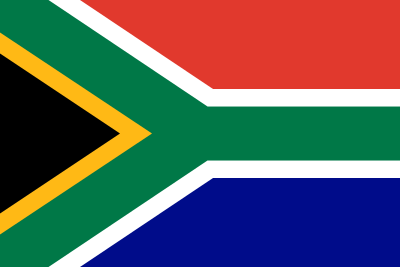
South Africa located at the southern tip of the African...
Ryan Coogler is an acclaimed American filmmaker recognized for his...
Trending
1 month ago Celebrities Stranded Following Emergency Plane Landing in Albuquerque
5 hours ago BYU Fans Roast Notre Dame And CJ Carr With Viral College GameDay Signs

4 hours ago Gunner Stockton Returns for Georgia Bulldogs Following Early Injury Scare

4 hours ago Paris Hilton Hosts UNSTOPPABLE Summit to Empower Neurodivergent Creators Regarding ADHD
5 hours ago Nicki Minaj Advocates for Persecuted Christians in Nigeria
5 hours ago Utah Jazz Claim Center Tony Bradley Off Waivers to Fill Final Roster Spot
Popular

Ilhan Omar is a prominent American politician currently serving as...
Ken Paxton is an American politician and lawyer serving as...
Michael Joseph Jackson the King of Pop was a highly...
Elon Musk is a visionary entrepreneur and engineer known for...

Jameis Winston is an American football quarterback currently playing for...
Cristiano Ronaldo widely considered one of the greatest footballers captains...