


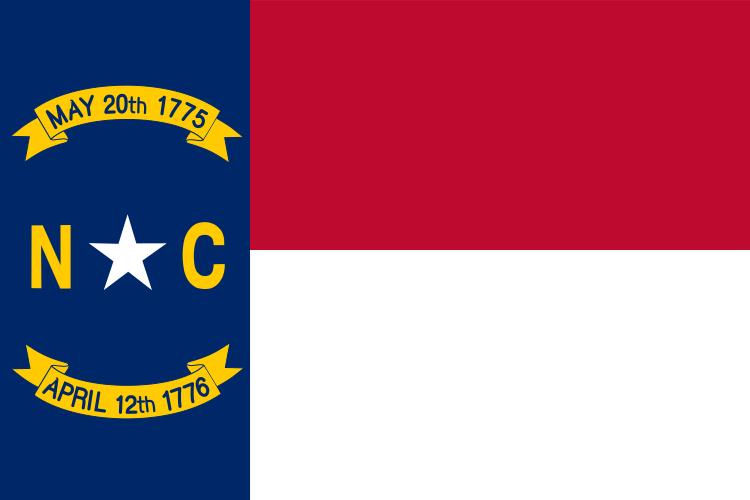
North Carolina is a diverse U.S. state situated on the Atlantic coast, characterized by its varied geography ranging from the Appalachian Mountains in the west to the Outer Banks barrier islands in the east. Historically significant as the site of the first successful powered flight by the Wright brothers at Kitty Hawk, the state maintains a strong cultural and economic presence. It is divided into three primary regions: the coastal plain, the central Piedmont, and the mountains. Raleigh, the state capital, along with Durham and Chapel Hill, forms the Research Triangle, a global hub for technology, biotechnology, and top-tier academic institutions. North Carolina is known for its robust agricultural output, particularly tobacco and sweet potatoes, as well as its significant contributions to banking and finance, with Charlotte serving as a major national financial center. With a growing population, a mild climate, and a blend of urban development and natural beauty, North Carolina remains a pivotal state in both the American South and the broader national economy.
8 hours ago : Heavy Rain and Tornado Risks Threaten North Carolina Regions
Severe weather alerts issued for North Carolina as heavy rains, potential flooding, damaging winds, and tornadoes threaten the Charlotte and Eastern regions, prompting urgent safety concerns and forecast tracking.


December 17, 1903: The Wright Brothers' First Powered Flight
On December 17, 1903, Orville and Wilbur Wright achieved a historic milestone at Kitty Hawk, North Carolina, by successfully conducting the world's first controlled, sustained flight of a powered, heavier-than-air aircraft.
1954: Hurricane Hazel Landfall
In 1954, Hurricane Hazel made landfall in North Carolina as a powerful Category 4 storm, establishing itself as the strongest hurricane to ever hit the state throughout its recorded history.
1956: Governor Hodges' Meeting for Research Triangle Park
During a pivotal 1956 meeting, Governor Luther H. Hodges facilitated discussions that led to the formation of the Research Triangle Park, a move credited with significantly improving North Carolina's economic prosperity.
1959: Establishment of Research Triangle Park
In 1959, Research Triangle Park was officially established in North Carolina, situated near Raleigh, Durham, and Chapel Hill, eventually becoming the largest research park in the United States.
1960: The Greensboro sit-ins
In 1960, the Greensboro sit-ins occurred as a vital protest within the Civil Rights Movement, aiming to secure full equality for Black Americans.
1964: Passage of the Civil Rights Act of 1964
In 1964, the federal Civil Rights Act was passed, which played a crucial role in restoring the constitutional rights and political voice of black citizens in North Carolina who had been disenfranchised.
1965: Passage of the Voting Rights Act of 1965
The Voting Rights Act of 1965 was enacted, providing the federal enforcement necessary to secure the voting rights of black Americans in North Carolina following decades of systemic disenfranchisement.
1986: Archaeological Confirmation of Joara
Starting in 1986, archaeological findings at the site of Joara provided physical evidence that confirmed the historical existence of the 16th-century Spanish settlement and the fort established by Juan Pardo.
1988: Establishment of the Charlotte Hornets
In 1988, North Carolina welcomed its first professional sports franchise when the Charlotte Hornets officially joined the National Basketball Association (NBA).
1992: Election of African American U.S. Representative
In 1992, North Carolina reached a significant milestone when another African American was elected as a U.S. Representative, marking a shift in the state's political representation.
1995: Carolina Panthers Debut
The Carolina Panthers, a National Football League (NFL) franchise based in Charlotte, played their inaugural season in 1995.
1996: Discovery of the Queen Anne's Revenge
In 1996, the maritime research company Intersal, Inc. successfully located the wreckage of what is believed to be the Queen Anne's Revenge, the historic flagship used by the pirate Blackbeard, leading to its inclusion on the U.S. National Register of Historic Places.
1997: Relocation of the Carolina Hurricanes
In 1997, the Carolina Hurricanes of the National Hockey League (NHL) completed their move to Raleigh, adopting team colors identical to those of the NC State Wolfpack.
2010: North Carolina Vital Statistics Baseline
In 2010, North Carolina recorded 122,302 births and 78,604 deaths, establishing a demographic baseline for the decade.
2010: 2010 North Carolina Census Racial Demographics
In 2010, the U.S. census recorded the racial makeup of North Carolina, showing the population was 68.5% White, 21.5% Black or African American, 8.4% Hispanic or Latin, 4.3% other race, 2.2% Multiracial, 2.2% Asian American, and 1% Native Hawaiian and Pacific Islander.
April 2011: Historic North Carolina Tornado Outbreak
In April 2011, North Carolina experienced its most severe tornado outbreak on record, during which thirty confirmed tornadoes struck the Eastern Piedmont and Sandhills regions, resulting in the tragic loss of at least 24 lives.
2012: North Carolina Demographic Residency Analysis
Data collected in 2012 regarding residency in North Carolina showed that 58.5% of the population was born in the state, 33.1% were born in other states, 1.0% were born abroad or in U.S. territories, and 7.4% were foreign-born.
2018: Top Countries of Origin for North Carolina Immigrants
As of 2018, data indicated that the primary countries of origin for individuals immigrating to North Carolina included Mexico, India, Honduras, China, and El Salvador.
September 2019: Hurricane Dorian Strikes North Carolina
During September 2019, the region was impacted by the arrival of Hurricane Dorian, which brought significant weather disturbances to North Carolina.
April 2020: Start of Migration Tracking Period
Beginning in April 2020, North Carolina initiated a period of significant population growth primarily driven by migration, which would continue through July 2024.
2020: Wake County Becomes North Carolina's Most Populous County
Following the 2020 census, Wake County officially surpassed Mecklenburg County as the most populous county in North Carolina, recording 1,129,410 residents compared to Mecklenburg's 1,115,482.
2020: North Carolina County Population Milestone
In 2020, Wake County and Mecklenburg County were confirmed as the most populous counties in North Carolina, with Wake County reaching 1,135,576 residents and Mecklenburg County reaching 1,118,967 residents.
2020: United States Census Population Determination
In 2020, the United States Census Bureau officially recorded the population of North Carolina as 10,439,388 residents.
2020: 2020 Census Population Count
In 2020, the official census recorded the total population of North Carolina at 10,439,388 residents.
2020: 2020 North Carolina Census Racial Demographics
The 2020 census revealed a demographic shift in North Carolina, reporting that non-Hispanic whites made up 62.2% of the population, followed by 20.5% Black or African American, 6.8% multiracial Americans, 5.9% other race, 3.3% Asians, 1.2% American Indian and Alaska Natives, and 0.1% Native Hawaiian and other Pacific Islanders.
2021: International Migration Low Point
During the 2020–2021 period, international migration represented less than 10% of the total net migration in North Carolina due to the impacts of the COVID-19 pandemic.
2021: Peak Pandemic Mortality
During the height of the COVID-19 pandemic in 2021, North Carolina experienced a significant increase in deaths, reaching a total of 118,040.
2021: North Carolina Demographic Baseline
In 2021, North Carolina recorded specific population data including 582,801 residents aged 0–4 and 326,449 residents aged 75–79, establishing a baseline for the state's age-structure shifts observed through 2024.
2021: Beginning of Multi-Year Population Growth
Starting in 2021, North Carolina began a period of significant growth, with the population recorded at 10,551,162 at the beginning of this phase.
2022: HUD Annual Homeless Assessment Report for North Carolina
In 2022, the U.S. Department of Housing and Urban Development (HUD) released its Annual Homeless Assessment Report, which estimated that approximately 9,382 individuals were experiencing homelessness throughout the state of North Carolina.
2022: Stabilization of Demographic Trends
Starting in 2022, birth and death rates in North Carolina began to level off, with annual births averaging approximately 121,000 and deaths near 109,000.
July 2023: Start of Yearly Migration Peak
Between July 2023 and July 2024, North Carolina saw a surge in domestic migration, adding 82,000 net residents moving from other states, marking the second-highest increase in the U.S.
July 2023: Beginning of Annual Natural Population Growth Measurement
Between July 2023 and July 2024, a natural increase in the population occurred, with the state adding approximately 12,000 residents through the difference in births and deaths.
2023: North Carolina CSA Population Milestone
As of 2023, North Carolina reached a demographic milestone by establishing four major combined statistical areas (CSA), each maintaining a population exceeding 1 million residents.
2023: National Population Ranking Achievement
Between 2023 and 2024, North Carolina achieved the fourth-largest population increase in the United States, cementing its rank as the ninth-most populous state.
2023: Research Triangle Population Estimate
During 2023, the Research Triangle combined metropolitan area reached an estimated population of 2,368,947, ranking as the second-most populous region in North Carolina.
2023: North Carolina Municipal Population Baseline
During the 2023 calendar year, North Carolina experienced population growth and distribution shifts that led to Charlotte becoming the largest city in the state, with Raleigh holding the position of the second-largest city.
July 2024: End of Migration Tracking Period
By July 2024, North Carolina had experienced a total population growth of 573,000 residents through net migration since April 2020, accounting for 95% of the state's total growth.
July 2024: Contribution of Natural Increase to Population Growth
By July 2024, the natural population increase of 12,000 residents was calculated to have accounted for 8% of North Carolina's total population growth over the preceding twelve-month period.
2024: Charlotte Metropolitan Area Population Estimate
As of 2024, the Charlotte metropolitan area reached an estimated population of 2,883,370, solidifying its status as the state's most populous metro area.
2024: North Carolina Population Growth and Age Shifts
By 2024, North Carolina saw significant shifts in its age demographics, with the population of children aged 0–4 rising to 604,897, the 75-79 age group growing to 394,209, and the population of residents aged 85 and older reaching 181,248.
2024: Peak Population Metric
By 2024, North Carolina's population reached 11,046,024, maintaining its position as the ninth-most populous state in the nation.
2024: Release of 2023 North Carolina Population Estimates
In 2024, the U.S. Census Bureau officially released the population estimates for municipalities across North Carolina for the year 2023, identifying Charlotte and Raleigh as the state's two most populous cities.
Mentioned in this timeline

Basketball is a team sport played on a rectangular court...

Donald John Trump is an American politician media personality and...

Barack Obama the th U S President - was the...

Bill Clinton served as the nd U S President from...

George W Bush the rd U S President - is...

Joe Biden served as the th President of the United...
Trending

3 hours ago Oil Prices Surge Past $100 Following Escalating Tensions in the Red Sea
3 hours ago Karoline Leavitt Returns to White House Briefing Room Podium After Maternity Leave
3 hours ago Alexander Bublik Faces Alex Molcan at ATP Kitzbuhel 2026

3 hours ago US House Votes to Restrict President Trump's Military Authority Regarding Iran Conflict
3 hours ago Global Oil Prices Surge Past $100 as Markets Face Significant Volatility

4 hours ago Martha Stewart Recommends Stylish Counter Stools and Her Favorite Universal Lipstick Shade
Popular

Nancy Grace is an American legal commentator and television journalist...

Lindsey Graham is a prominent American politician serving as the...

Cristiano Ronaldo widely considered one of the greatest footballers captains...

Buc-ee's is an American chain of large country stores gas...

JD Vance is an American politician author and venture capitalist...

Bernie Sanders is a prominent American politician and the senior...