


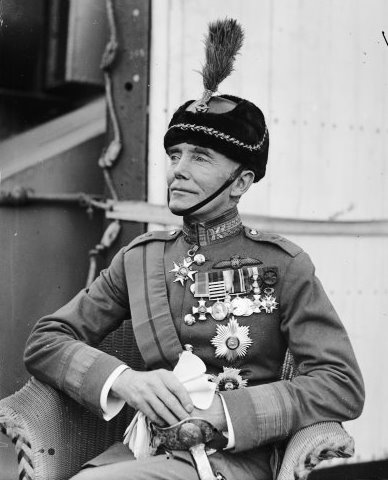
Sir Philip Woolcott Game (1876–1961) was a distinguished British military officer and colonial administrator. A career soldier, he reached the rank of Air Vice-Marshal in the Royal Air Force before retiring to serve in various high-level governmental capacities. He is best known for his tenure as the Governor of New South Wales, Australia, during the Great Depression. His term was marked by a significant constitutional crisis involving his dismissal of Premier Jack Lang in 1932, an event that remains a pivotal moment in Australian political history. Following his Australian service, Game served as the Commissioner of the Metropolitan Police in London from 1935 to 1945, overseeing the force during the challenging years of the Second World War and the Blitz. Throughout his career, Game was recognized for his disciplined approach, integrity, and adherence to constitutional norms during periods of intense social and political upheaval.
February 1901: Officer in Charge at Queen Victoria's Funeral
During February 1901, Philip Game served as the officer in charge of the gun carriage that transported the coffin of Queen Victoria at her funeral service.


June 1901: Promotion to Captain
On June 1901, Philip Game received a promotion to the rank of captain while serving in the military.
July 1902: Appointed Divisional Adjutant
In July 1902, Game was appointed to the position of divisional adjutant of the IX division Royal Field Artillery, based in Middelburg, Cape Colony.
August 1908: Marriage to Gwendolen Margaret Hughes-Gibb
On 11 August 1908, Philip Game married Gwendolen Margaret Hughes-Gibb, the daughter of Francis Hughes-Gibb of Dorset.
1910: Staff College Attendance
In 1910, Philip Game attended the Staff College in Camberley to further his military education and professional development.
February 1912: Promotion to Major
On 15 February 1912, Philip Game was promoted to the rank of major as part of his ongoing military career.
1918: Transition to the Royal Air Force
Upon the creation of the Royal Air Force in 1918, Game transferred from his previous military branch to the newly established service.
1922: Abolition of the Queensland Legislative Council
In 1922, the Queensland Legislative Council was abolished, a political maneuver that served as the inspiration for Lang's attempts to do the same in New South Wales.
1925: Beginning of Lang's term of office
In 1925, Lang began a term of office that eventually led to constitutional conflicts with the Governor regarding the Legislative Council.
1927: End of Lang's term of office
By 1927, Lang's term of office concluded, marked by ongoing political disputes concerning the structure of the Legislative Council.
January 1929: Sudden Retirement
On January 1, 1929, at the age of 52, Game retired suddenly from his military post, reportedly due to speculation surrounding his potential appointment as Chief of the Air Staff.
1929: Retirement from Military Service
After a distinguished military career reaching the rank of air vice-marshal, Philip Game retired from the Royal Air Force in 1929.
June 1930: Knight of Grace Appointment
On 30 June 1930, King George V appointed Philip Game as a Knight of Grace of the Venerable Order of St John.
October 1930: State Election and Change of Government
In October 1930, the State elections resulted in the defeat of the Bavin Nationalist Government, leading to Labor Party leader Jack Lang becoming the Premier.
November 1930: Lang's attempt to abolish the NSW Legislative Council
In November 1930, Premier Lang introduced two bills aimed at abolishing the NSW Legislative Council, but his request for additional appointments to ensure their passage was refused by Philip Game.
June 1931: Refusal of Council Appointments
In June 1931, Philip Game denied Lang's request for 80 appointments to the council, offering only 21 instead, which limited the government's ability to pass controversial debt-defaulting legislation.
July 1931: Philip Game's voluntary salary reduction
In July 1931, as a personal gesture of support for economic recovery during a period of financial instability, Philip Game instructed the Treasury to reduce his monthly salary by 25%.
November 1931: Compromise on Council Appointments
On 19 November 1931, Philip Game agreed to 25 appointments for Lang, fearing that further refusal might eventually force him to grant enough appointments to push through extremist legislation permanently.
March 1932: The Opening of the Sydney Harbour Bridge and Ribbon-Cutting Controversy
In March 1932, Philip Game navigated a political controversy regarding the opening of the Sydney Harbour Bridge. While Jack Lang intended to cut the ribbon, inciting anger from the King and the New Guard, Game supported Lang's right to perform the ceremony. The event escalated on 19 March 1932 when Francis de Groot slashed the ribbon before the official ceremony; the ribbon was subsequently repaired, allowing Lang to proceed with the opening while Game attended and delivered a commemorative speech.
May 1932: Privy Council Dismissal of Lang's Appeal
On 31 May 1932, the Judicial Committee of the Privy Council dismissed the New South Wales government's appeal, effectively ruling that the bills to abolish the Legislative Council could not proceed without a public referendum, thus resolving a constitutional crisis for Philip Game.
1933: Referendum on Legislative Council Reform
In 1933, a referendum was passed that replaced the previously appointed Legislative Council with a council elected by the whole parliament, a reform championed by Premier Bertram Stevens following the earlier failure of Lang's abolition plans.
1936: Metropolitan Police leadership during the abdication crisis
In 1936, Philip Game served as the Commissioner of the Metropolitan Police throughout the politically and socially significant abdication crisis of King Edward VIII.
February 1961: Death of Philip Game
Philip Game passed away in February 1961 at the age of 84, having retired to Kent with his wife, Gwendoline.
February 1961: Death of Sir Philip Woolcott Game
Sir Philip Woolcott Game, a prominent Royal Air Force commander and former public official, passed away in February 1961.
1972: Death of Gwendolen Margaret Hughes-Gibb
In 1972, Gwendolen Margaret Hughes-Gibb, the wife of Philip Game, passed away.
26 March 1931: Legislative Council blocks Reduction of Interest Bill
On 26 March 1931, the Legislative Council successfully blocked the passage of the Reduction of Interest Bill, which had been proposed by Lang's government to default on overseas debt payments, by voting to postpone the bill's reading for six months.
28 March 1931: Federal Labor Party expels NSW Labor Party
Due to fundamental disagreements regarding financial policy and the administration's stance, the Federal Labor Party officially expelled the New South Wales Labor Party on 28 March 1931.
29 March 1931: Game assesses Lang's political viability
On 29 March 1931, Philip Game informed the Dominions Secretary, James Henry Thomas, that he saw no compelling reason to dismiss Lang at that time, as he was not convinced that Lang would necessarily lose an election if one were called.
Mentioned in this timeline

India officially the Republic of India is a South Asian...

Australia officially the Commonwealth of Australia is a country encompassing...
France officially the French Republic is primarily in Western Europe...
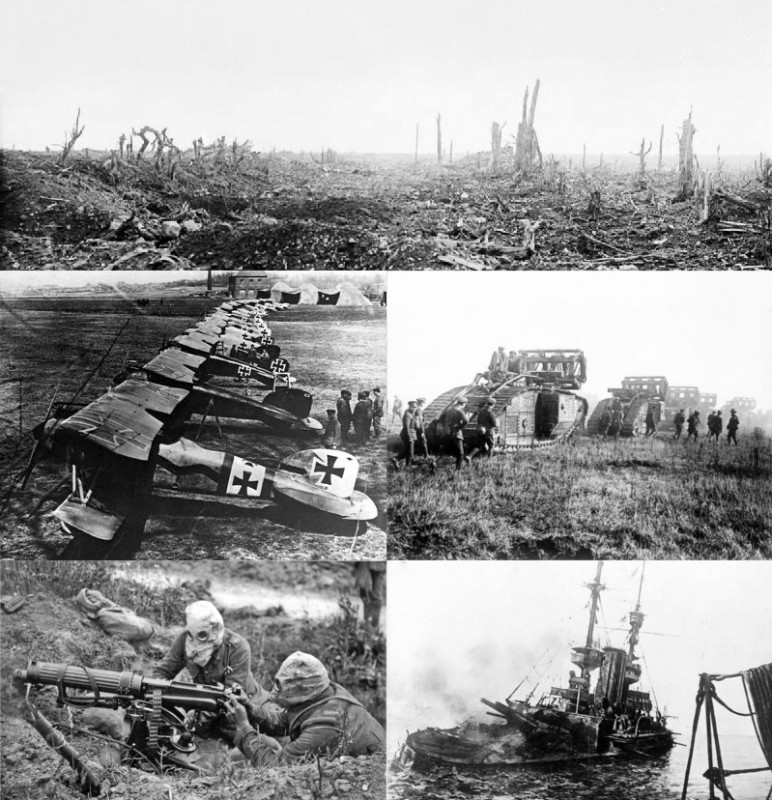
World War I a global conflict between the Allies and...
War is defined as an armed conflict involving the armed...

An empire is a political structure consisting of a dominant...
Trending

3 hours ago Jalen Hurts Out For Season Following Discovery Of Blood Clots
3 hours ago Dallas Mavericks Waive Veteran Center Dwight Powell from Roster

3 hours ago KJ Lacey Gains Attention Amid Struggles for Texas Quarterback Arch Manning

3 hours ago Stellantis and Leapmotor Begin B10 Electric SUV Production in European Zaragoza Facility

29 days ago Cooper Rush Steps Up for Falcons Amid Michael Penix Jr Injury Concerns

4 hours ago Caleb Wilson Embraces Michael Jordan’s Legacy as New Chicago Bulls Franchise Player
Popular

Ilhan Omar is a prominent American politician currently serving as...

Ken Paxton is an American politician and lawyer serving as...

Elon Musk is a visionary entrepreneur and engineer known for...

Michael Joseph Jackson the King of Pop was a highly...

Cristiano Ronaldo widely considered one of the greatest footballers captains...

MrBeast the professional name of Jimmy Donaldson is the most-subscribed...