


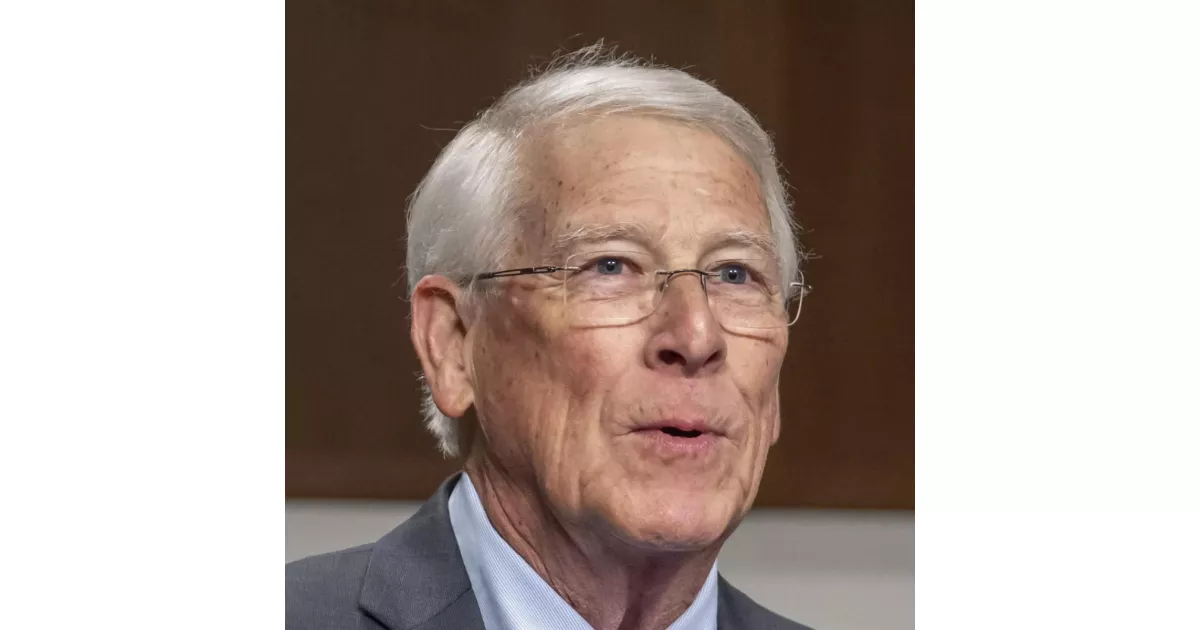
Roger Wicker is an American politician currently serving as the senior United States Senator from Mississippi since 2007. A Republican, he previously served as a U.S. Representative for Mississippi's 1st congressional district from 1995 to 2007 and as a Mississippi State Senator from 1988 to 1995. Before entering politics, Wicker was an officer in the Air Force.
July 5, 1951: Roger Wicker Born
On July 5, 1951, Roger Frederick Wicker was born. He later became an American politician, attorney, and Air Force officer.


1969: Graduated from Pontotoc High School
In 1969, Roger Wicker graduated from Pontotoc High School, marking the completion of his secondary education.
1973: Earned Bachelor's Degree
In 1973, Roger Wicker earned a bachelor's degree in journalism and political science from the University of Mississippi.
1975: Earned J.D. Degree
In 1975, Roger Wicker earned a J.D. degree from the University of Mississippi School of Law, completing his formal legal education.
1976: Jimmy Carter carried the district
In 1976, Jimmy Carter carried the district, representing the only time since 1956 that the district supported the Democratic nominee for president.
1976: Joined the United States Air Force
In 1976, Roger Wicker became an officer in the United States Air Force, marking the start of his military career.
1980: Joined United States Air Force Reserves
In 1980, Roger Wicker transitioned to the United States Air Force Reserves after serving as an officer. He also began working as a political counselor to Congressman Trent Lott.
1980: Member of Air Force Reserve Command
Starting in 1980, Roger Wicker became a member of the Air Force Reserve Command.
1986: Other candidate in election
Larry Cobb ran for US House of Representatives and came fifth with 4,162 votes (15.48%) in 1986.
1987: Elected to Mississippi State Senate
In 1987, Roger Wicker was elected to the Mississippi State Senate, representing the 6th district, which included Tupelo, marking his entry into state politics.
1988: Represented 6th district
In 1988, Roger Wicker began representing the 6th district, which included Tupelo, in the Mississippi State Senate.
1990: Other candidate in election
Bill Bowlin ran for US House of Representatives and took the remaining 1,147 votes (4.27%) in 1990.
1992: Other candidate in election
Clyde E. Whitaker ran for US House of Representatives and came fourth with 4,602 votes (17.12%) in 1992.
1992: United States-Hong Kong Policy Act
The Hong Kong Human Rights and Democracy Act updates the United States–Hong Kong Policy Act of 1992.
1994: Amended state Medicaid bill
In 1994, Roger Wicker amended a state Medicaid bill to authorize the Mississippi Attorney General to contract private attorneys on contingency.
1995: Served in the House of Representatives
In 1995, Roger Wicker began his service in the U.S. House of Representatives, representing Mississippi's 1st congressional district.
2001: Mississippians Vote to Keep State Flag
In 2001, 64% of Mississippians voted to keep the existing state flag in a referendum.
2001: Wicker Supports Invasion of Afghanistan
In 2001, Roger Wicker supported the United States invasion of Afghanistan.
2003: Retired from the Air Force Reserve Command
In 2003, Roger Wicker retired from the Air Force Reserve Command as a lieutenant colonel.
2004: Defeated Reform Party nominee
In 2004, Roger Wicker defeated Reform Party nominee Barbara Dale Washer, receiving 219,328 votes (79.01%).
November 26, 2007: Trent Lott announced resignation
On November 26, 2007, Senator Trent Lott announced his resignation, which would lead to Roger Wicker's appointment to the Senate.
December 18, 2007: Lott vacated Senate seat
On December 18, 2007, Trent Lott officially vacated his Senate seat.
2007: Criticism after securing earmark
In 2007, Roger Wicker faced criticism after securing a $6 million earmark for a defense company whose executives had made significant contributions to his campaign.
December 31, 2007: Appointed to the Senate
On December 31, 2007, Mississippi Governor Haley Barbour appointed Roger Wicker to fill the Senate seat vacated by Trent Lott.
May 13, 2008: Special election
On May 13, 2008, a special election was held to fill the House vacancy caused by Wicker's resignation, which was won by Democratic nominee Travis Childers.
November 2008: Won special election to Senate
In November 2008, Roger Wicker won the special election against Democrat Ronnie Musgrove for the remainder of Trent Lott's term in the Senate.
2008: Won special election for the Senate
In 2008, Roger Wicker won a special election for the remainder of Trent Lott's term in the Senate, securing his position.
2009: Wicker Introduces Bill Allowing Guns on Amtrak
In 2009, Roger Wicker introduced a bill allowing Amtrak passengers to check unloaded and locked handguns in their luggage. The law passed by a vote of 68–30.
September 16, 2010: Nominated as representative to United Nations
On September 16, 2010, President Barack Obama announced his intent to nominate Roger Wicker as representative of the United States to the Sixty-fifth Session of the General Assembly of the United Nations.
2012: Worked to enact a bill imposing penalties on Russians
In 2012, Roger Wicker collaborated with Senator Ben Cardin to enact a bill that imposed penalties on Russians accused of human rights violations.
2012: Reelected to Senate
In 2012, Roger Wicker was reelected to a full term in the Senate, continuing his service as a U.S. Senator from Mississippi.
2012: NRA-PVF Endorses Wicker
In 2012, the National Rifle Association Political Victory Fund (NRA-PVF) endorsed Roger Wicker during the election.
2012: Wicker Receives Funding from Oil and Gas Industry
Since 2012, Roger Wicker has received over $200,000 from the oil and gas industry, according to OpenSecrets.
April 2013: Targeted during ricin letters attack
In April 2013, Roger Wicker was among the politicians targeted during the ricin letters bioterrorism attack when a letter addressed to him tested positive for ricin.
April 16, 2013: Letter tested positive for ricin
On April 16, 2013, a letter addressed to Roger Wicker tested positive for the poison ricin, as part of the April 2013 ricin letters bioterrorism attack.
July 2013: Proposed Senate meeting on filibuster rules
In July 2013, Roger Wicker proposed that the Senate meet to discuss a controversial change to filibuster rules.
November 13, 2014: Elected chair of National Republican Senatorial Committee
On November 13, 2014, Roger Wicker was elected chair of the National Republican Senatorial Committee for the 114th U.S. Congress.
2014: Introduced Hong Kong Human Rights and Democracy Act
In 2014, Roger Wicker joined Senator Sherrod Brown and Representative Chris Smith to introduce the Hong Kong Human Rights and Democracy Act.
2015: Wicker Seeks to Change Mississippi Flag
From 2015 Roger Wicker sought to change the Mississippi flag, calling it offensive to many of his "fellow citizens".
2015: Chaired National Republican Senatorial Committee
In 2015, Roger Wicker became the chair of the National Republican Senatorial Committee.
2015: Wicker Votes Against Climate Change Amendment
In 2015, Roger Wicker was the only U.S. senator to vote against an amendment declaring that climate change is real, with a final vote of 98 to 1.
2015: Wicker Votes Against Mandatory Background Checks
One day after the 2015 San Bernardino attack, Roger Wicker voted against a bill that would make background checks mandatory when a person buys a gun.
March 2016: Declined to consider Obama's Supreme Court nominee
In March 2016, Roger Wicker declined to consider Obama's Supreme Court nominee during a presidential election year.
March 2017: Co-sponsored Israel Anti-Boycott Act
In March 2017, Roger Wicker co-sponsored the Israel Anti-Boycott Act, which aimed to criminalize participation in boycotts against Israel.
December 2017: Wicker's Bipartisan Index Ranking
As of December 2017, Roger Wicker ranked 14th out of 98 in the Bipartisan Index compiled by The Lugar Center, which reflects a low level of partisanship.
2017: Deputy Republican whip
In 2017, Roger Wicker served as deputy Republican whip.
2017: Wicker Votes Against Obama's Executive Action on Gun Control
In 2017, Roger Wicker voted in favor of "a joint resolution of disapproval aimed at former President Barack Obama's executive action requiring the Social Security Administration (SSA) place beneficiaries on the National Instant Criminal Background Check System 'mental defective' list."
2017: Wicker Urges Trump to Withdraw from Paris Agreement
In 2017, Roger Wicker was one of 22 senators to sign a letter to President Trump urging him to withdraw the United States from the Paris Agreement.
2018: Became Senior Senator
In 2018, Roger Wicker became the senior senator for Mississippi after Thad Cochran resigned.
2018: Wicker Cosponsors United States-Israel Security Authorization Act
In 2018, Roger Wicker cosponsored the United States-Israel Security Authorization Act of 2018, which allocated military funding for Israel regardless of the Israeli–Palestinian conflict.
May 2020: Planned to introduce privacy bill
In May 2020, Roger Wicker and a group of Senate Republicans planned to introduce the COVID-19 Consumer Data Protection Act to regulate data collected by COVID-19 contact tracing apps.
September 2020: Supported immediate Senate vote
In September 2020, Roger Wicker supported an immediate Senate vote on Trump's nominee to fill the Supreme Court vacancy caused by Justice Ruth Bader Ginsburg's death.
2020: Wicker Supports Nullifying Vote on Mississippi Flag
In 2020, Roger Wicker supported nullifying the 2001 vote to keep the Mississippi flag and replacing it without a new referendum.
January 6, 2021: Wicker Votes to Certify Election, Capitol Attacked
On January 6, 2021, Roger Wicker initially announced his intention to certify the 2021 United States Electoral College vote count. He was participating in the certification when the U.S. Capitol was attacked by Trump supporters. After the Capitol was secured, Wicker voted to certify the count.
March 2021: Wicker Highlights Restaurant Relief in American Rescue Plan
In March 2021, after Congress passed the American Rescue Plan Act of 2021, Roger Wicker highlighted on social media that the bill awarded $28.6 billion of "targeted relief" to "independent restaurant operators" to "survive the pandemic", while neglecting to mention that he had voted against the bill.
May 28, 2021: Wicker Votes Against January 6 Commission
On May 28, 2021, Roger Wicker voted against creating an independent commission to investigate the January 6 United States Capitol attack.
2021: Wicker Criticizes U.S. Withdrawal from Afghanistan
In 2021, Roger Wicker called the U.S. withdrawal from Afghanistan "one of the biggest foreign policy catastrophes in my lifetime" and suggested a "Korea-like presence" would have been preferable. He also cosponsored legislation to end official diplomatic relations with Afghanistan's new Taliban government.
January 2022: Wicker Comments on Biden's Supreme Court Nominee
In January 2022, after President Joe Biden announced plans to appoint a black woman to the U.S. Supreme Court, Roger Wicker suggested to Mississippi radio host Paul Gallo that the nominee would be a "beneficiary" of an affirmative action "quota", drawing a rebuke from the White House.
February 2022: Wicker Supports No-Fly Zone Over Ukraine
In February 2022, Roger Wicker supported implementing a no-fly zone over Ukraine, an idea that the National Review deemed "a very bad idea".
November 2023: Wicker Initially Supports and Then Withdraws from Foreign Pollution Fee Act
In November 2023, Roger Wicker initially supported the Foreign Pollution Fee Act (S. 3198) before subsequently withdrawing his co-sponsorship.
2023: Wicker's Score from American Conservative Union
In 2023, Roger Wicker received a score of 68% from the American Conservative Union.
May 2024: Wicker Urges Johnson to Resist Greene's Efforts
In May 2024, Roger Wicker, along with John Thune, and John Cornyn urged Speaker Johnson not to agree to anything with Marjorie Taylor Greene, who was plotting to oust him, in order to save his position.
2024: Reelected to Senate
In 2024, Roger Wicker was reelected to the Senate, defeating Democratic nominee Ty Pinkins.
2026: Wicker Opposes ICE Detention Facility in Mississippi
In 2026, Roger Wicker opposed a Trump administration plan to establish a new Immigration and Customs Enforcement detention facility in Mississippi.
Mentioned in this timeline
Barack Obama the th U S President - was the...
Joe Biden served as the th President of the United...

Ukraine is a country in Eastern Europe the second-largest on...
Marjorie Taylor Greene MTG is an American politician and businesswoman...
The United States of America is a federal republic primarily...

Ruth Bader Ginsburg was an American lawyer and Supreme Court...
Trending

3 hours ago Jeremy Sochan Selected As Number One Overall Pick In The 2026 NBA G League Draft

4 hours ago Joao Pedro Discusses Cole Palmer Influence and Xabi Alonso Impact on Chelsea Career Path

4 hours ago Robert Whittaker Discusses Jiu-Jitsu Training Benefits and Jealousy Towards Khamzat Chimaev's Wrestling Skills
4 hours ago CJ Carr Supports Brother Tommy Carr During First Michigan Quarterback Start
4 hours ago Auburn Football Manages Byrum Brown's Health and Usage After Recent Injury Scare

4 hours ago NASCAR Faces Significant Challenges Amidst Declining TV Ratings and Shifting Fan Engagement
Popular

Ilhan Omar is a prominent American politician currently serving as...
Ken Paxton is an American politician and lawyer serving as...

Elon Musk is a visionary entrepreneur and engineer known for...
Michael Joseph Jackson the King of Pop was a highly...

Elizabeth Holmes is an American entrepreneur and the founder of...

Cristiano Ronaldo widely considered one of the greatest footballers captains...