



Slavery is a systemic practice in which individuals are owned as property, stripped of autonomy, and forced to perform labor. Throughout history, it has been prevalent in various civilizations, often justified by economic motives, racial hierarchies, or conquests. In the Atlantic slave trade, millions of Africans were forcibly transported to the Americas, creating an entrenched system of chattel slavery that fueled plantation economies for centuries. The institution was fundamentally defined by the dehumanization of enslaved people, who were denied basic human rights, subjected to physical violence, and stripped of their cultural identities. Global movements for abolition—driven by human rights arguments, economic shifts, and persistent resistance from enslaved people—eventually led to the formal legal prohibition of slavery worldwide. Despite these legislative bans, modern manifestations of forced labor, human trafficking, and bonded labor persist, highlighting the ongoing struggle for universal human liberty and dignity.


1900: Conclusion of centuries-long Indian Ocean and Saharan slave trade
By the year 1900, historical records indicate that approximately 5 million African people had been transported across the Red Sea, Indian Ocean, and Sahara Desert by Muslim slave traders since 1500, a period marked by the systemic commodification of human life to fulfill labor demands in the Middle East and surrounding regions.
1900: End of widespread slavery in the Senegambia region
By the year 1900, historical records indicate that nearly one-third of the total population in the Senegambia region had been subjected to slavery, marking the culmination of a period of widespread enslavement that lasted from 1300 to 1900.
1905: Nominal Abolition in French West Africa
In 1905, colonial France officially banned slavery throughout French West Africa, including the territory of Mauritania; however, this decree remained a purely nominal measure without significant enforcement.
1908: Persistence of Female Slave Trade
In 1908, the trade of women as slaves continued to persist within the borders of the Ottoman Empire.
1909: Legal Abolition of Slavery in China
In 1909, a law was drafted to legally abolish slavery as a recognized institution within China, marking a significant legislative step toward ending the practice.
1909: End of Circassian Slave Importation and Continued Reports of Slavery
The period of 1800 to 1909 marked the importation of approximately 200,000 slaves, primarily Circassians, into the Ottoman Empire. Additionally, in 1909, Gustaf Dalman reported that young boys were still available for purchase as slaves in the cities of Damascus and Cairo.
1910: Full Enactment of Anti-Slavery Legislation
The anti-slavery law originally drafted in 1909 was fully enacted in 1910, formally stripping slavery of its legal status in the nation.
1917: End of Ottoman Rule over the Middle East
In 1917, the centuries-long era during which the Ottoman Empire controlled the majority of the Middle East region came to an end.
1920: Publication of The Partition of Africa
In 1920, Keltie published The Partition of Africa, a work that provided historical analysis suggesting that for every slave successfully delivered to the coast by Arab traders, at least six individuals perished due to the conditions of the raids or the journey.
1922: End of Slavery in the Ottoman Empire
In 1922, the era of institutionalized slavery within the Ottoman Empire concluded, marking the end of a system that had existed under the empire's jurisdiction since 1517 and serving as a pivotal moment in the broader 20th-century abolition of slavery across Muslim-majority nations.
1924: Establishment of the Temporary Slavery Commission
In 1924, the League of Nations initiated the Temporary Slavery Commission to investigate and address the global issue of chattel slavery.
1926: Conclusion of the Temporary Slavery Commission
By 1926, the Temporary Slavery Commission, established by the League of Nations, finished its initial period of international investigation into chattel slavery.
1932: Formation of the Committee of Experts on Slavery
In 1932, the Committee of Experts on Slavery was convened to further examine the persistence of chattel slavery as part of international efforts.
1934: Inception of the Advisory Committee of Experts on Slavery
Starting in 1934, the Advisory Committee of Experts on Slavery began its multi-year mandate to monitor and report on slavery conditions globally.
1939: End of the Advisory Committee of Experts on Slavery mandate
The Advisory Committee of Experts on Slavery concluded its work in 1939, having served as a key international body for investigating chattel slavery during the late 1930s.
1949: Persistence of Slavery Practices
Despite previous legal prohibitions enacted in 1910, the practice of slavery continued to exist in various forms in China until at least 1949.
1950: Launch of the UN Ad Hoc Committee on Slavery
The United Nations established the Ad Hoc Committee on Slavery in 1950 to assess the remaining legal status of chattel slavery, which at that time persisted primarily in the Arabian Peninsula.
1951: Conclusion of the UN Ad Hoc Committee on Slavery
In 1951, the UN Ad Hoc Committee on Slavery finalized its report, identifying that legal chattel slavery was limited to countries such as Oman, Qatar, Saudi Arabia, the Trucial States, and Yemen.
1962: Abolition of Slavery in Saudi Arabia and Yemen
In 1962, both Saudi Arabia and Yemen officially abolished legal chattel slavery, marking a significant step in the eradication of the practice within the Arabian Peninsula.
1963: Abolition of Slavery in Dubai
Following regional trends, Dubai officially abolished the practice of legal chattel slavery in 1963.
1970: Final Abolition of Slavery in Oman
In 1970, Oman became the last nation in the Arabian Peninsula to officially abolish legal chattel slavery, effectively ending the state-sanctioned practice in the region.
1981: Official Abolition of Slavery in Mauritania
In 1981, Mauritania became the final nation globally to officially declare the abolition of slavery within its borders.
1981: Mauritania Abolishes Slavery
Mauritania became the last country in the world to officially abolish slavery in 1981, although the ban was not effectively enforced at the time.
2003: Study on Marriage by Abduction in Ethiopia
In 2003, a comprehensive study was conducted that revealed a significant human rights issue, finding that approximately 69% of marriages in Ethiopia were established through abduction, a practice often categorized as a form of modern-day slavery.
2007: Establishment of Legal Prosecution for Slaveholders
Building upon previous legislative efforts, Mauritania established legal mechanisms in 2007 to actively prosecute those who engaged in the practice of slaveholding.
2007: Human Rights Watch Child Soldier Estimation
In 2007, Human Rights Watch released data estimating that between 200,000 and 300,000 children were actively serving as soldiers in various global conflicts. The report also highlighted that the most prevalent form of child labor for girls under the age of 16 was domestic work, frequently resulting from parents in rural poverty sending their children to urban centers, a practice exemplified by the Haitian restavek system.
2007: Implementation of Legal Prosecution Mechanisms
In 2007, legal mechanisms were finally implemented to allow for the prosecution of individuals who practiced slavery, marking a shift from the 1981 ban toward potential enforcement.
2007: Global Profits from Modern Slavery
In 2007, researcher Siddharth Kara estimated that global slavery generated $91.2 billion in profits, ranking it as the second-largest global criminal enterprise after drug trafficking. During 2007, the average cost of a slave was approximately $340, while the average annual profit generated per slave was $3,175, with trafficked sex slaves accounting for 40% of those total annual profits.
2010: Start of Inmate Labor Protests
Beginning in 2010 and continuing through 2015, incarcerated individuals in the United States initiated labor strikes and work refusals to protest against forced labor conditions and advocate for fair pay.
2015: Consolidation of Haitian Slave Records in France
As of 2015, the historical records documenting slaves who arrived in Haiti from the trans-Atlantic journey or were born in the colony, which were previously held in Haitian archives and later transferred to the French Ministry of Defense and Ministry of Foreign Affairs, are permanently housed at The National Archives of France.
2015: Private Prison Industry Revenue
In 2015, the private prison companies CoreCivic and GEO Group, which held fifty percent of the private prison market share, generated a combined revenue of $3.5 billion from their operations.
2016: Continuing Prison Labor Strikes
In 2016, inmates across various U.S. facilities continued to organize and participate in work refusals to highlight the need for improved conditions and an end to compulsory labor systems.
2017: Federal Prison Industries Wage Report
During 2017, Federal Prison Industries maintained a compensation system for inmates that resulted in an average pay rate of $0.90 per hour for their labor.
2018: Inmate Labor Protest Wave
During 2018, U.S. prisoners engaged in further organized labor protests, seeking better pay and systemic reforms, with strike leaders frequently facing retaliation in the form of indefinite solitary confinement.
2019: Global Slavery Prevalence Report
In 2019, approximately 40 million individuals globally remained in conditions of enslavement, with 26 percent of these victims being children, highlighting the persistence of slavery despite its universal legal prohibition.
2020: US Prison Population Data
In 2020, the Prison Policy Initiative reported that the United States prison population reached 2.3 million individuals, noting that nearly all able-bodied inmates were required to engage in some form of labor.
Mentioned in this timeline
The United States of America is a federal republic primarily...

Saudi Arabia officially the Kingdom of Saudi Arabia KSA is...

Qatar is a country located on the Qatar Peninsula in...

China officially the People's Republic of China PRC is located...

Dubai is the most populous city in the United Arab...
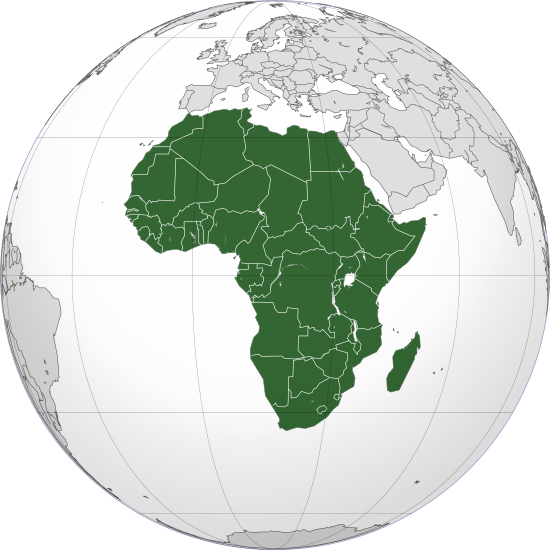
Africa is the second-largest and second-most populous continent home to...
Trending

3 hours ago Jaxson Hayes Delivers Strong Performance Amidst Shifting Rotation Roles

3 hours ago Billionaire Rick Jackson Enters Georgia Political Race Seeking Voter Support

3 hours ago Trent Alexander-Arnold Faces Uncertain Future Amid Real Madrid Exit Rumors

3 hours ago Eduardo Camavinga Absent From Real Madrid El Clásico Squad Due To Tactical Decision

4 hours ago Max Verstappen Criticizes Austin Track Bumps and COTA Boss Remarks
4 hours ago Darryn Peterson Makes Impactful Debut for the Utah Jazz During NBA Preseason
Popular

Ilhan Omar is a prominent American politician currently serving as...

Ken Paxton is an American politician and lawyer serving as...

Elon Musk is a visionary entrepreneur and engineer known for...

Michael Joseph Jackson the King of Pop was a highly...

Barack Obama the th U S President - was the...

Greg Abbott is the current and th Governor of Texas...