History of Florida in Timeline

Share: FB Share X Share Reddit Share Reddit Share
Florida

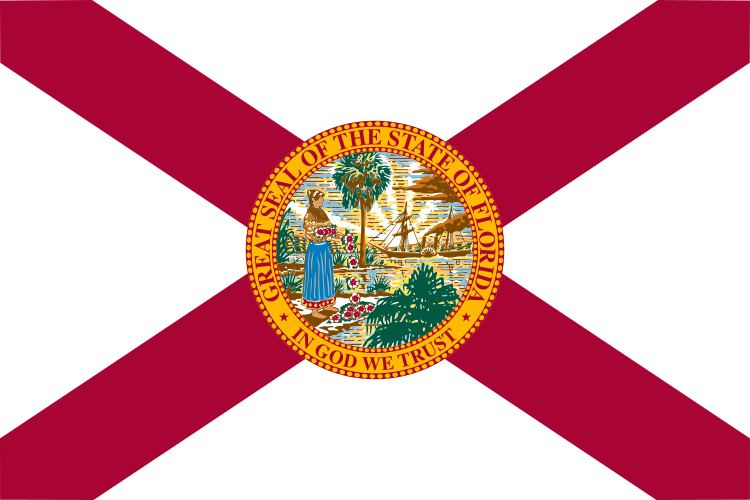
Florida, located in the southeastern United States, is a peninsula bordering the Gulf of Mexico and the Atlantic Ocean. Boasting the longest coastline in the contiguous US, it's the only state bordering both bodies of water. Florida is the third-most populous state with over 23 million residents and ranks seventh in population density. Spanning 65,758 square miles, it is the 22nd largest state. The Miami metropolitan area is its largest, with Jacksonville being the most populous city. Other major population centers include Tampa Bay, Orlando, Cape Coral, and Tallahassee, the state capital.

5 hours ago : Florida promotes AP class alternative bill and Duke Energy president makes journey.

Florida passed a bill promoting alternatives to AP classes. Lawmakers boosted state courses rivaling AP programs. Duke Energy's president shared his path from draftsman to president.

1900: Florida Population and African American Migration

In 1900, Florida's population was 528,542, with nearly 44% being African American. Around 40,000 blacks, approximately one-fifth of their 1900 population levels in Florida, left the state in the Great Migration.

1902: Early Skyscrapers Constructed in Jacksonville

Many of Florida's earliest skyscrapers were constructed in Jacksonville, dating as far back as 1902.

1905: State University System Founded

The State University System of Florida was founded in 1905, and is governed by the Florida Board of Governors.

1909: State Flower Chosen

The Florida state flower was chosen in 1909.

1910: Great Migration

Beginning in 1910, many African Americans migrated from Florida to northern cities during the Great Migration due to segregation, disfranchisement, and agricultural depression.

1925: Seaboard Air Line Extension

In 1925, the Seaboard Air Line ended the FEC's southeast Florida monopoly by extending its freight and passenger service to West Palm Beach.

1926: Devastating Hurricanes

In 1926, devastating hurricanes caused damage and contributed to the end of the Florida land boom.

1927: State Bird Chosen

The Florida state bird was chosen in 1927.

1928: Devastating Hurricanes

In 1928, devastating hurricanes caused damage and contributed to the end of the Florida land boom.

June 29, 1931: Hottest Temperature Recorded

On June 29, 1931, the hottest temperature ever recorded in Florida was 109 °F (43 °C) in Monticello.

1939: Florida's Description

In 1939, Florida was described as "still very largely an empty State."

1940: Great Migration Continues

The Great Migration continued in the 1940s as African Americans left Florida for better opportunities in the north.

1944: Franklin D. Roosevelt Carries Florida

2008 marked the first time since 1944, when Franklin D. Roosevelt carried the state for the fourth time, that Florida was carried by a Northern Democrat for president.

1945: Population Increase

After 1945, migration from the Rust Belt and the Northeast sharply increased Florida's population due to the growing availability of air conditioning, the climate, and a low cost of living.

1950: State Symbols Chosen After 1950

The majority of the symbols were chosen after 1950. Only the state flower, chosen in 1909, and the state bird, chosen in 1927, are not listed in the 2010 Florida Statutes.

1952: Voter Registration

From 1952 to 1964, most voters in Florida were registered Democrats, but the state voted for the Republican presidential candidate in every election except for 1964.

1952: Swing State

Since 1952, Florida has been listed as a swing state in presidential elections.

1954: William C. Cramer Elected

In 1954, William C. Cramer was the first post-Reconstruction era Republican elected to Congress from Florida.

1956: Construction of Florida's Turnpike Began

Before the construction of routes under the Federal Aid Highway Act of 1956, Florida began construction of a long cross-state toll road, Florida's Turnpike.

1956: Tallahassee Bus Boycott

In 1956, students at Florida A&M University organized a bus boycott in Tallahassee, mirroring the Montgomery bus boycott, to protest racial segregation.

1957: Tallahassee Bus Boycott Success

In 1957, the bus boycott organized by students at Florida A&M University in Tallahassee succeeded in integrating the city's buses.

1957: First Section of Florida's Turnpike Completed

In 1957, the first section of Florida's Turnpike, from Fort Pierce south to the Golden Glades Interchange, was completed.

1960: Decline in African American Population

By 1960, the proportion of African Americans in Florida's population had declined to 18% due to the Great Migration.

1960: Sit-ins Against Segregated Seating

In 1960, students in Florida held sit-ins to protest against segregated seating at local lunch counters.

1960: Population Location

Since the 1960 census, the center of population has been located in Polk County.

1964: Voter Registration

From 1952 to 1964, most voters in Florida were registered Democrats, but the state voted for the Republican presidential candidate in every election except for 1964.

1964: St. Augustine Motel Incident and Civil Rights Act

In 1964, an incident at a St. Augustine motel pool, where the owner poured acid into the water during a demonstration, influenced the passage of the 1964 Civil Rights Act.

1965: Voting Rights Act

In 1965, Congress passed and President Lyndon B. Johnson signed the Voting Rights Act of 1965, providing for oversight of state practices and enforcement of constitutional voting rights for African Americans and other minorities.

1965: Civil Rights Movement Legislation

In 1965, federal legislation was enacted to enforce protection of constitutional suffrage for African Americans in Florida, a result of the Civil Rights Movement.

1966: Miami Dolphins Added to American Football League

Florida gained its first permanent major-league professional sports team in 1966 when the American Football League added the Miami Dolphins.

1966: Claude R. Kirk Jr. Elected Governor

In 1966, Claude R. Kirk Jr. was elected as the first post-Reconstruction Republican governor of Florida.

1968: Edward J. Gurney Elected Senator

In 1968, Edward J. Gurney was elected as the state's first post-reconstruction Republican US senator.

1970: Democrats Take Office

In 1970, Democrats took the governorship and the open US Senate seat in Florida.

1970: White Population Percentage

In 1970, non-Hispanic whites constituted nearly 80% of Florida's population.

1972: Mandatory Auto Insurance Enacted

In 1972, Florida made personal injury protection auto insurance mandatory for drivers, becoming the second in the U.S. to enact a no-fault insurance law. The ease of payments led to a major increase in insurance fraud.

1972: Water Resource Control

Since 1972, all potable water resources in Florida have been controlled by the state government through five regional water authorities.

1973: First Recorded Coral Bleaching

The first recorded coral bleaching incident on the Florida Reef was in 1973.

1974: Florida's Turnpike Completed

In 1974, Florida's Turnpike was completed after a second section north through Orlando to Wildwood and a southward extension around Miami to Homestead.

1974: Jacksonville Held State Height Record

Jacksonville last held a state height record from 1974 to 1981.

1976: Resumption of Executions

Since the resumption of executions by the U.S. Supreme Court in 1976, 128 convicted murderers were executed in the state of Florida.

1976: Presidential Support

Through 2004, the majority of registered voters in Florida were Democrats, but it continued to support Republican presidential candidates except in 1976, when the Democratic nominee was from the South.

1978: First Disapproval of Casinos

In 1978, Florida disapproved casinos (outside of sovereign Seminole and Miccosukee tribal areas).

1980: Center of Population Movement

Between 1980 and 2010, the center of population of Florida moved less than 5 miles (8 km) to the east and approximately 1 mile (1.6 km) to the north.

1980: English Ancestry

In the 1980 United States census, the largest ancestry group reported in Florida was English with 2,232,514 Floridians claiming they were of English or mostly English American ancestry.

May 8, 1981: Winter Park Sinkhole Appeared

Winter Park Sinkhole, in central Florida, appeared May 8, 1981. It was approximately 350 feet (107 m) wide and 75 feet (23 m) deep.

1981: Mangrove Plant Communities

In 1981, Florida mangrove plant communities covered an estimated 430,000 to 540,000 acres (1,700 to 2,200 km) in Florida.

1981: Jacksonville Held State Height Record

Jacksonville last held a state height record from 1974 to 1981.

1984: Lottery Approved

In 1984, Florida approved its lottery by amending the constitution.

1986: Second Disapproval of Casinos

In 1986, Florida disapproved casinos (outside of sovereign Seminole and Miccosukee tribal areas).

1988: Federal Corruption Convictions

From 1988 to 2007, there were 800 federal corruption convictions in Florida, more than any other state.

1988: Official Language

In 1988, English was affirmed as the state's official language in the Florida Constitution.

1991: Sports Franchise Tax Breaks

Since 1991, Florida has given professional sports franchises some subsidies in the form of tax breaks.

1992: State Sided With Presidential Election Loser

In 1992, Florida sided with the loser of the presidential election.

1992: Hurricane Andrew

In 1992, Hurricane Andrew struck Florida in August, causing more than $25 billion in damages, making it the costliest weather disaster in U.S. history at the time.

1994: Third Disapproval of Casinos

In 1994, Florida disapproved casinos (outside of sovereign Seminole and Miccosukee tribal areas).

1995: Legislature Modifies Chapter 921

In 1995, the Florida legislature modified Chapter 921 to provide that felons should serve at least 85% of their sentence.

1996: Bellwether State

Florida is sometimes considered a bellwether state in presidential elections because every candidate who won the state from 1996 until 2016 won the election.

1996: Additional Teams in Division I FBS

Since 1996, Florida has added four additional teams to the ranks of Division I FBS: UCF Knights, South Florida Bulls, Florida Atlantic Owls and FIU Panthers.

1996: Presidential Support

Through 2004, the majority of registered voters in Florida were Democrats, but it continued to support Republican presidential candidates except in 1996, when the Democratic nominee was from the South.

1998: Voter Demographics

In 1998, Democratic voters dominated areas of Florida with a high percentage of racial minorities and transplanted white liberals, while Republicans dominated throughout much of the rest of Florida.

2000: Urbanization

In 2000, 89 percent of Florida's population lived in urban areas, compared to 79 percent across the U.S.

2000: Pivotal Role in Election

In the closely contested 2000 election, Florida played a pivotal role.

2001: 9/11 Terrorist Attacks

The June 2016 Orlando Nightclub Shooting was the deadliest terrorist attack in the U.S. since the September 11 attacks in 2001.

2002: Felony Disenfranchisement Study

A 2002 study in the American Sociological Review concluded that if the state's 827,000 disenfranchised felons had voted at the same rate as other Floridians, Democratic candidate Al Gore would have won Florida—and the presidency.

2004: Slot Machines Approved in Certain Counties

In 2004, Florida approved slot machines in Broward and Miami-Dade County.

2004: Presidential Support

Through 2004, the majority of registered voters in Florida were Democrats, but it continued to support Republican presidential candidates.

2005: Hurricane Katrina Surpasses Hurricane Andrew

In 2005, Hurricane Katrina surpassed Hurricane Andrew as the costliest weather disaster in U.S. history.

2006: Hurricane Strikes

From 1851 to 2006, Florida was struck by 114 hurricanes, 37 of which were major (category 3 and above).

2006: Sinkhole Damage Claims

From 2006 through 2010, sinkhole damage claims on property in Florida exceeded a total of $2 billion.

2007: Federal Corruption Convictions

From 1988 to 2007, there were 800 federal corruption convictions in Florida, more than any other state.

2008: Energy Consumption

As of 2008, approximately 4% of energy in Florida was generated through renewable resources.

2008: Delegates Stripped of Votes in Primaries

In 2008, delegates of both the Republican and Democratic Florida primary elections had half of their votes stripped during the conventions in August. This penalty was due to violations of the national rules of both parties.

2008: Military Retirees

In 2008, there were 186,102 military retirees living in the state of Florida.

2008: Obama Carries Florida

In the 2008 presidential election, Barack Obama carried the state of Florida as a northern Democrat.

2009: Florida Panther Deaths

In 2009, a record 23 Florida panthers were killed, mainly by automobile collisions, leaving about 100 individuals in the wild.

2009: Medicaid Patients in Florida

In 2009, there were 2.7 million Medicaid patients in Florida.

2010: Asian Ancestry

As of 2010, people of Asian ancestry accounted for 2.4% of Florida's population.

2010: Sinkhole Damage Claims

From 2006 through 2010, sinkhole damage claims on property in Florida exceeded a total of $2 billion.

2010: Car Crash Averages by Age Group

In 2010, Florida drivers between 15 and 19 years of age averaged 364 car crashes a year per ten thousand licensed drivers, while drivers 70 and older averaged 95 per 10,000.

2010: Voters Approve Fair District Amendments

In 2010, more than 63% of Florida state voters approved Amendments 5 and 6 to the state constitution, known as the Fair District Amendments, aimed at ensuring fairness in districting.

2010: Hispanic or Latino ancestry

In 2010, people of Hispanic or Latino ancestry accounted for 22.5% (4,223,806) of Florida's population, with Cuban and Puerto Rican being the largest groups.

2010: Largest Denominations

In 2010, the three largest denominations in Florida were the Catholic Church, the Southern Baptist Convention, and the United Methodist Church.

2010: Undocumented Immigrant Population

In 2010, undocumented immigrants constituted an estimated 5.7% of the population in Florida, the sixth-highest percentage of any U.S. state, with an estimated 675,000 illegal immigrants in the state.

2010: Republican Dominance Solidified

In the 2010 elections, Republicans solidified their dominance in Florida by winning the governorship and maintaining majorities in both houses of the state legislature. They also gained four previously Democratic-held seats, resulting in a 19–6 Republican majority in the federal House of Representatives delegation.

2010: State Symbols Listed

Only the two oldest symbols—the state flower (chosen in 1909), and the state bird (chosen in 1927)—are not listed in the 2010 Florida Statutes.

2010: United States census

Reapportionment following the 2010 United States census gave the state two more seats in the House of Representatives.

2010: Cost of Caring for Medicaid Clients

The cost of caring for 2.3 million Medicaid clients in Florida in 2010 was $18.8 billion, nearly 30% of Florida's budget.

2011: Elderly Population

As of 2011, Florida contained the highest percentage of people over 65 (17.3%) in the U.S.

2011: Highest Auto Insurance Fraud in U.S.

In 2011, Florida had the highest auto insurance fraud in the U.S., estimated at close to $1 billion. The fraud was particularly centered in the Miami-Dade and Tampa areas.

2011: Gasoline Consumption

In 2011, there were about 9,000 retail gas stations in Florida. Floridians consumed 21 million gallons of gasoline daily, ranking third in national use behind California and Texas.

July 1, 2012: State Growth

For the 12-month period ending July 1, 2012, Florida was the seventh-fastest-growing state in the U.S.

2012: Revised Congressional Districts Challenged

As a result of the 2010 United States census, Florida gained two House of Representative seats in 2012. The legislature issued revised congressional districts, which were immediately challenged in court by supporters of the Fair District Amendments.

2012: Population Near Coastline

In 2012, 75% of the population of Florida lived within 10 miles (16 km) of the coastline.

2012: Political Control

In 2012, Republicans controlled the governorship and most statewide elective offices in Florida, along with 17 of the state's 27 seats in the House of Representatives.

2012: Redistricting Announced

In 2012, The legislature's redistricting was announced and quickly challenged in court, on the grounds that it had unfairly benefited Republican interests.

2012: Trayvon Martin Killing and Activism

In 2012, the killing of Trayvon Martin by George Zimmerman in Sanford brought national attention to Florida's stand-your-ground laws and sparked African American activism, including the Black Lives Matter movement.

2012: Obama Carries Florida Again

In the 2012 presidential election, Barack Obama carried the state of Florida.

2013: Florida Refused to Participate in Affordable Care Act

In 2013, Florida refused to participate in providing coverage for the uninsured under the Affordable Care Act, known as Obamacare, and refused additional Federal funding for Medicaid. As a result, Florida is second only to Texas in the percentage of its citizens without health insurance.

December 2014: Population Exceeds New York

By December 2014, the Florida population exceeded 19.7 million, surpassing the population of the state of New York for the first time, making Florida the third most populous state.

2014: Felony Disenfranchisement Law Impact

According to The Sentencing Project, the effect of Florida's felony disenfranchisement law in 2014 was that more than one in ten Floridians and nearly one in four African-American Floridians were shut out of the polls because of felony convictions, even after completing sentences and parole/probation requirements.

2014: Court Rules Districts Redrawn Due to Gerrymandering

In 2014, after lengthy testimony, the court ruled that at least two Florida districts had to be redrawn due to gerrymandering.

July 2015: Florida Supreme Court Rules Against Lawmakers

In July 2015, the Florida Supreme Court ruled that lawmakers followed an illegal and unconstitutional process influenced by party operatives. The court ruled that at least eight districts had to be redrawn.

December 2, 2015: Court Accepts New Map of Congressional Districts

On December 2, 2015, a 5–2 majority of the Florida Supreme Court accepted a new map of congressional districts. The ruling affirmed the map previously approved by Leon County Judge Terry Lewis and made changes particularly in South Florida.

December 2015: Redistricting

In early December 2015, the Florida Supreme Court accepted a new map for congressional districts.

June 2016: Orlando Nightclub Shooting

In June 2016, a gunman killed 49 people at a gay nightclub in Orlando. It was the deadliest incident in the history of violence against LGBT people in the United States and the deadliest terrorist attack in the U.S. since the September 11 attacks in 2001.

2016: Bellwether State

Florida is sometimes considered a bellwether state in presidential elections because every candidate who won the state from 1996 until 2016 won the election.

2016: Florida's Tuition Costs Ranked

In 2016, Florida charged the second lowest tuition in the U.S. for four-year programs, at $26,000 for in-state students and $86,000 for out-of-state students.

2016: West Indian Population

In 2016, Florida had the highest percentage of West Indians in the United States at 4.5%, including people of Haitian and Jamaican ancestry.

2016: Expenditures Per Student

In 2016, Florida spent $8,920 for each student, ranking 43rd in the U.S. in expenditures per student.

2016: Florida College System Enrollment

In 2016, the Florida College System comprised 28 public community and state colleges with 68 campuses, with enrollment exceeding 813,000 students.

2016: State Switched Back to GOP in Presidential Election

In the 2016 presidential election, Florida switched back to the GOP.

September 2017: Influx of Puerto Ricans After Hurricane Maria

In September 2017, after Hurricane Maria devastated Puerto Rico, many Puerto Ricans began moving to Florida to escape the widespread destruction, with significant populations settling in Orlando, Tampa, Fort Lauderdale, and West Palm Beach.

2017: Las Vegas Shooting

The June 2016 Orlando Nightclub Shooting was the deadliest mass shooting by a single gunman in U.S. history until the 2017 Las Vegas shooting.

February 2018: Stoneman Douglas High School Shooting

In February 2018, 17 people were killed in a school shooting at Stoneman Douglas High School in Parkland, Florida, leading to new gun control regulations at both the state and federal level.

2018: Immigrant origins

In 2018, the top countries of origin for Florida's immigrants were Cuba, Haiti, Colombia, Mexico, and Jamaica.

2018: Changes in Republican and Democratic Representation

In the 2018 elections, the ratio of Republican to Democratic representation in Florida fell from 16:11 to 14:13. The U.S. Senate election and gubernatorial race were both closely contested.

July 1, 2019: Florida Population Estimate

On July 1, 2019, the U.S. Census Bureau estimated that the population of Florida was 21,477,737.

2019: Out-of-State Movers

As of 2019, Florida was the recipient of the largest number of out-of-state movers in the country.

2019: University System Students

During the 2019 academic year, 346,604 students attended one of the twelve universities in the State University System of Florida.

2020: Florida Census

According to the 2020 census, Florida's population was 21.5 million, making it the most populous state in the southeastern United States and the third-most populous in the United States.

2020: Top Universities by Enrollment

As of 2020, three Florida universities are among the top 10 largest universities by enrollment in the United States: The University of Central Florida in Orlando (2nd), the University of Florida in Gainesville (4th), and Florida International University in Miami (8th).

2020: Population increase

By the 2020 census, its population increased to 21,538,187.

2020: Inter Miami Begins Play in MLS

Florida's most recent major-league team, Inter Miami, began play in MLS in 2020.

2020: State Sided With Presidential Election Winner

In 2020, Florida again sided with the GOP when Donald Trump headed the party's ticket. 2020 marked the first time Florida sided with the eventual loser of the presidential election since 1992.

2020: Florida Ranked Third Best for K-12 Education

In 2020, Florida was ranked the third best state in the U.S. for K-12 education, outperforming other states in 15 out of 18 metrics in Education Week's 2020 Quality Counts report.

2020: Hispanic and Latino Population

In 2020, Hispanic and Latinos of any race(s) made up 26.5% of the population in Broward County, Florida, while Native Hawaiians and Pacific Islanders made up 0.1%.

2020: Hardest State to Vote

In a 2020 study, Florida was ranked as the 11th hardest state for citizens to vote in.

2020: Independent Colleges and Universities

In the fall of 2020, the Independent Colleges and Universities of Florida reported that their member institutions served more than 158,000 students.

2020: Donald Trump Wins Florida

The 2020 election broke the bellwether streak when Donald Trump won Florida but lost the election.

June 24, 2021: Surfside Condominium Collapse

On June 24, 2021, a condominium in Surfside, Florida, near Miami, collapsed, resulting in at least 97 deaths. The Surfside collapse is tied as the third-deadliest structural engineering failure in United States history.

November 2021: Republican Voters Exceed Democrats

In November 2021, the total number of registered Republican voters in Florida exceeded the number of registered Democrats for the first time in Florida's history.

April 2022: New Election Law

In April 2022, the Florida legislature passed and the governor signed a new election law prohibiting Floridians from using ranked-choice voting in all federal, state and municipal elections.

2022: Homeless Population in Florida

According to HUD's 2022 Annual Homeless Assessment Report, there were an estimated 25,959 homeless people in Florida in 2022.

2022: DeSantis Wins Reelection by Landslide

In 2022, incumbent Governor DeSantis won reelection by a landslide against Democrat Charlie Crist. The unexpectedly large margin of victory led many pundits to question Florida's status as a swing state, and instead identify it as a red state.

2022: Largest Hospital Networks in Florida

In 2022, the largest hospital network in Florida is HCA Healthcare and the second largest is AdventHealth.

August 2023: Restrictions on Teaching Shakespearean Plays

In August 2023, restrictions have been placed on the teaching of Shakespearean plays and literature by Florida teachers in order to comply with state law.

2023: Universities in Association of American Universities

As of 2023, three universities in Florida are members of the Association of American Universities: University of Florida, University of Miami and University of South Florida.

2023: Largest Hospitals in Florida

In 2023, the largest hospitals in Florida were Jackson Memorial Hospital, AdventHealth Orlando, Tampa General Hospital, UF Health Shands Hospital and Baptist Hospital of Miami.

2023: Florida Approved School Curriculum Including PragerU Videos

In 2023, the state of Florida approved a public school curriculum including videos produced by conservative advocacy group PragerU. The videos liken climate change skeptics to those who fought Communism and Nazism, imply renewable energy harms the environment, and say global warming occurs naturally.

Loading Video...

2023: Medicaid Paid for Births

Medicaid paid for 42.2% of all births in Florida in 2023. The state also has a program for those not covered by Medicaid.

2023: Religious Makeup

The Pew Research Center survey in 2023 gave the religious makeup of Florida.

2024: High Rate of Uninsured Motorists

As of 2024, motorists in Florida have one of the highest rates of car insurance in the U.S., with 24% being uninsured.

2024: Florida's Economy Fourth-Largest in U.S.

As of 2024, the economy of the state of Florida is the fourth-largest in the United States, with a $1.647 trillion gross state product (GSP).

2024: Minority-Majority Status

In 2024, the state's non-Hispanic white population fell to 49.1%, making Florida the 9th state to reach majority-minority status.

May 2025: State Unemployment Rate

As of May 2025, the state of Florida's unemployment rate was 3.7%.

2025: Florida Ranked Third Best State for Business

In 2025, Florida ranked third on CNBC's list of top states for business, taking into account overall economy, infrastructure, and cost of doing business.

2025: Small Businesses Dominate and Rank First in Business Formations

In 2025, small businesses made up 99.8% of businesses in Florida and employed 39.6% of the state's work force. According to Business Observer, Florida ranked first among U.S. states for business formations, with 698,000 new businesses formed.

March 3, 2026: Inmates Awaiting Execution

As of March 3, 2026, 248 offenders are awaiting execution in Florida.