


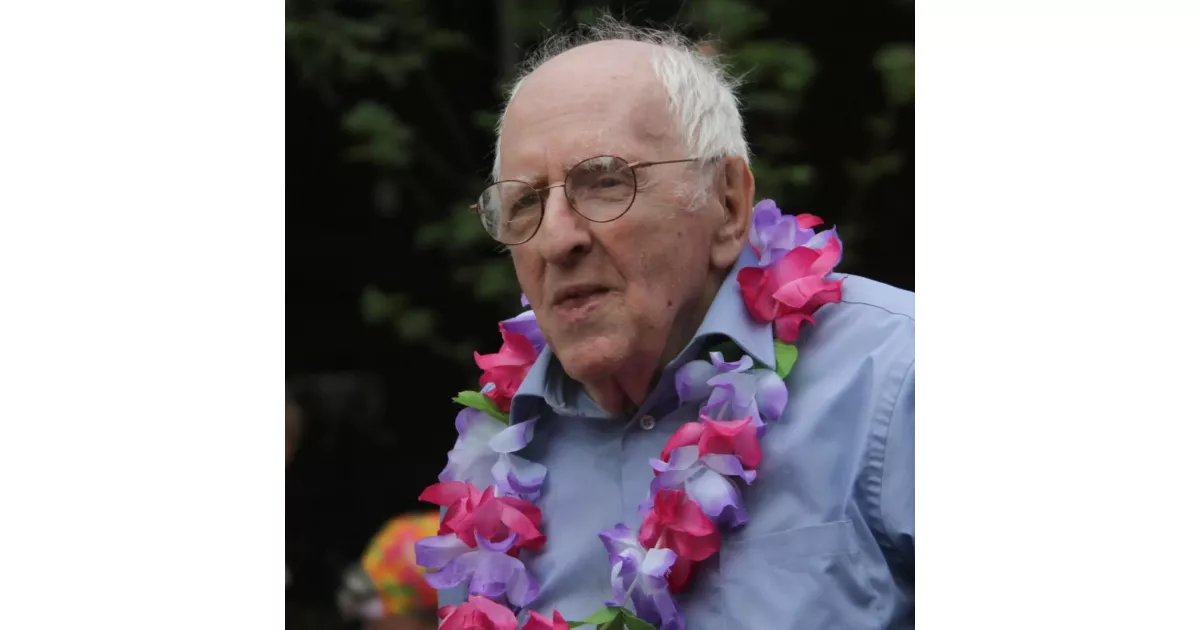
"Franklin Edward Kameny was a prominent figure in the fight for LGBTQ+ rights in the United States. Widely recognized for his impactful contributions, he is often hailed as a leading force in the gay rights movement. His tireless efforts helped advance equality and challenge discriminatory practices."
May 21, 1925: Birth of Frank Kameny
Frank Kameny, a prominent figure in the American gay rights movement, was born on May 21, 1925.


1941: Kameny Graduates High School and Begins College
In 1941, at the age of 16, Frank Kameny graduated from Richmond Hill High School and enrolled at Queens College to study physics.
1948: Kameny Earns Physics Degree
After serving in World War II, Frank Kameny completed his studies at Queens College and graduated with a bachelor's degree in physics in 1948.
1949: Kameny Receives Master's Degree from Harvard
Frank Kameny earned his master's degree in astronomy from Harvard University in 1949.
August 26, 1956: Arrest at Key Terminal
On August 26, 1956, while attending an American Astronomical Society meeting in San Francisco, Kameny was arrested at the Key Terminal, a known location for homosexual encounters, and charged with "lewd and indecent acts." He pleaded guilty and received a fine and probation.
1956: Kameny Completes Doctorate in Astronomy
Frank Kameny received his doctorate in astronomy from Harvard University in 1956, with his thesis focusing on variable stars.
July 1957: Kameny Hired and Subsequently Fired by Army Map Service
In July 1957, Frank Kameny was hired by the U.S. Army Map Service. However, when his San Francisco arrest came to light, he was questioned about his sexual orientation. His refusal to provide information led to his dismissal.
1957: Kameny Dismissed from Army Map Service
During the Lavender Scare in 1957, Frank Kameny was dismissed from his position at the U.S. Army's Army Map Service due to his homosexuality. This event propelled him to challenge discrimination against homosexuals.
January 1958: Kameny Barred from Federal Employment
In January 1958, Frank Kameny faced further consequences from his dismissal as he was officially barred from any future employment within the federal government.
1961: Co-founds Mattachine Society of Washington
In late 1961, Frank Kameny co-founded the Washington D.C. branch of the Mattachine Society, a national gay rights organization.
1963: Campaign Against Sodomy Laws and Homosexuality Classification
Frank Kameny and the Mattachine Society launched a campaign in 1963 to challenge D.C. sodomy laws and advocate for the removal of homosexuality as a mental disorder from the American Psychiatric Association's Diagnostic and Statistical Manual.
1963: Debate over Public Protest within Mattachine Society
In 1963, the Mattachine Society of Washington contemplated a public protest against the FBI's attempts to suppress the organization. While supportive of the idea, Kameny chose not to participate, fearing potential damage to his public image.
1964: Kameny Highlights Discrimination Against Homosexuals
In 1964, Frank Kameny argued that homosexuals experienced more severe discrimination than Black people due to a lack of federal protection and active government discrimination. He predicted that the success of the civil rights movement might inadvertently worsen discrimination against homosexuals.
1965: First White House Picket for Gay Rights
In 1965, Frank Kameny organized the first picket for gay rights in front of the White House. The protest, involving ten individuals, demanded federal employment rights, honorable discharges, and security clearances for homosexuals.
1967: Kameny Defends Government Employees and Challenges Discriminatory Practices
Frank Kameny took on the role of an amateur attorney, defending government employees who had their security clearances revoked based on allegations related to their sexual orientation. He challenged discriminatory hiring practices within the U.S. government through court hearings, using them as platforms to raise public awareness.
1968: Kameny Champions Homosexuality as Socially Beneficial
Frank Kameny publicly argued that homosexuality could be a positive force in society. He emphasized the morality and desirability of consensual homosexual acts for both individuals and society.
1968: Re-elected President of Mattachine Society
Frank Kameny was re-elected as president of the Mattachine Society of Washington in the 1968 election.
1968: "Gay is Good"
Inspired by Stokely Carmichael's "black is beautiful" slogan, Frank Kameny coined the phrase "Gay is Good" in 1968.
March 14, 1969: Arrest at Baltimore Bath House
On March 14, 1969, Frank Kameny was among a group of men arrested during a police raid on a Baltimore bath house known for homosexual activity. He was charged with participating in a "disorderly house" but avoided jail time.
1971: First Openly Gay Candidate for Congress
In 1971, Frank Kameny made history by becoming the first openly gay candidate to run for the United States Congress. He campaigned in the District of Columbia's inaugural election for a non-voting Congressional delegate. Although he lost to Democrat Walter E. Fauntroy, Kameny's campaign had a lasting impact. Following the election, Kameny and his team established the Gay and Lesbian Alliance of Washington, D.C. This organization continues to advocate for equal rights and engage in lobbying efforts.
1972: APA Debate on Homosexuality
In 1972, Frank Kameny and Barbara Gittings successfully urged the American Psychiatric Association (APA) to organize a debate titled "Psychiatry: Friend or Foe to the Homosexual?; A Dialogue" at their yearly meeting in Dallas. This event played a pivotal role in raising awareness and challenging the prevailing medical view of homosexuality.
December 15, 1973: Homosexuality Removed from DSM
On December 15, 1973, the American Psychiatric Association (APA) took a landmark step by removing homosexuality from its Diagnostic and Statistical Manual of Mental Disorders (DSM). This victory followed years of advocacy by individuals like Frank Kameny, who had tirelessly challenged the classification of homosexuality as a mental illness.
March 6, 1975: Leonard Matlovich Comes Out
On March 6, 1975, Leonard Matlovich, a decorated Technical Sergeant in the U.S. Air Force, made the courageous decision to come out as gay to his commanding officer. This act of defiance was a significant moment in the fight against the military's ban on homosexuals. Matlovich, who had an 11-year record of exemplary service, had been inspired by Kameny's ongoing efforts to challenge the military's discriminatory policies.
October 1975: Matlovich Discharged from Air Force
In October 1975, Leonard Matlovich was discharged from the Air Force because of his sexual orientation. This event marked a setback in the fight for gay rights in the military, as it demonstrated the ongoing resistance within the armed forces to accepting gay and lesbian service members.
March 26, 1977: First White House Meeting on Gay Rights
On March 26, 1977, a pivotal meeting took place at the White House marking the first time gay rights were formally discussed. Frank Kameny, alongside a group of gay and lesbian activists led by the National Gay Task Force, met with President Jimmy Carter's Public Liaison, Midge Costanza. During the meeting, they advocated for crucial changes in federal policies and laws affecting the LGBTQ+ community.
1980: Kameny Supports Jamie Shoemaker
In 1980, Frank Kameny extended his support to Jamie Shoemaker, an NSA linguist, who was facing pressure to resign after his superiors discovered his sexual orientation. Kameny's advocacy helped Shoemaker become the first openly gay government employee, marking a significant step towards greater LGBTQ+ inclusion in government service.
1980: Matlovich's Partial Legal Victory
In 1980, a federal district court issued a ruling ordering the reinstatement of Leonard Matlovich to the Air Force. This decision, however, was limited in scope and would have only applied to Matlovich's specific case. Believing that the Air Force would find other grounds to discharge him again, Matlovich opted to accept a financial settlement instead.
1981: Kameny Elected as Delegate for DC Statehood
In 1981, Frank Kameny was elected as a delegate to the District of Columbia Statehood Constitutional Convention, a significant step towards achieving statehood for Washington, D.C. Kameny remained a staunch supporter of D.C. statehood throughout his life, actively participating in local events and advocating for the city's right to full representation.
June 1988: Matlovich's Death and Kameny's Tribute
In June 1988, Leonard Matlovich passed away due to complications from AIDS. Frank Kameny, who had mentored Matlovich during his legal battles, served as an honorary pallbearer at his funeral and delivered a heartfelt speech at the graveside service held in Washington, D.C.'s Congressional Cemetery.
1993: Success in Overturning D.C. Sodomy Laws
In 1993, after decades of advocacy by Frank Kameny and others, D.C. sodomy laws were successfully overturned.
2006: Kameny and Gittings Receive John E. Fryer, MD Award
In 2006, Frank Kameny and Barbara Gittings were jointly honored with the inaugural John E. Fryer, MD Award by the American Psychiatric Association. This award recognized their significant contributions to the field of psychiatry and their tireless efforts to remove the stigma associated with homosexuality.
2006: Library of Congress Acquires Kameny's Papers
In 2006, the Library of Congress acquired Frank Kameny's extensive collection of personal papers. This acquisition ensured the preservation of valuable historical documents that shed light on Kameny's life, activism, and the broader struggle for LGBTQ+ rights.
November 2007: Kameny Criticizes Brokaw's Book
In November 2007, Frank Kameny wrote an open letter to NBC journalist Tom Brokaw and his publisher, Random House, expressing strong disapproval of Brokaw's book "Boom!: Voices of the Sixties Personal Reflections on the '60s and Today." Kameny criticized Brokaw for completely omitting the gay and lesbian rights movement of the 1960s.
2007: Kameny Defends Larry Craig
In 2007, Frank Kameny penned an open letter to the conservative publication WorldNetDaily, challenging their stance on the arrest of Idaho Senator Larry Craig for soliciting sex in a Minneapolis airport bathroom. Kameny, while disagreeing with Craig's political views and acknowledging his hypocrisy, argued that Craig had not committed a crime and should not face undue persecution.
2007: Erroneous Report of Kameny's Death
In 2007, The Advocate, a prominent LGBTQ+ publication, mistakenly reported Frank Kameny's death in their May 22 "Pride issue." The publication also incorrectly stated that Kameny had HIV. Realizing their error, The Advocate issued a retraction and an apology to Kameny.
2007: Kameny's Picket Signs in Smithsonian Exhibit
In 2007, the Smithsonian Institution's National Museum of American History featured Frank Kameny's picket signs from the 1965 White House pickets in their "Treasures of American History" exhibit. These picket signs symbolized the early days of the gay rights movement and the fight for LGBTQ+ equality.
February 2009: Kameny's Home Designated as Historic Landmark
In February 2009, Frank Kameny's residence in Washington, D.C., was officially recognized as a historical landmark by the District of Columbia's Historic Preservation Review Board. This designation honored Kameny's legacy as a pioneering activist and the pivotal role his home played in the early years of the gay rights movement.
June 29, 2009: US Government Apologizes to Kameny
On June 29, 2009, in a momentous occasion, John Berry, the Director of the Office of Personnel Management, issued a formal apology to Frank Kameny on behalf of the United States government. This apology acknowledged the injustice Kameny faced when he was fired from his government job in 1957 due to his sexual orientation. Berry, who is openly gay himself, presented Kameny with the Theodore Roosevelt Award, the highest honor bestowed by the OPM.
June 10, 2010: Street Renamed in Kameny's Honor
On June 10, 2010, Washington, D.C. mayor Adrian Fenty, with the support of a unanimous vote from the Dupont Circle Advisory Neighborhood Commission, unveiled new street signs officially designating a section of 17th Street N.W. as "Frank Kameny Way." This tribute commemorated Kameny's enduring legacy as a tireless advocate for LGBTQ+ rights and a prominent figure in the fight for equality.
December 10, 2010: Kameny Receives Humanitarian Award
On December 10, 2010, Frank Kameny was honored with the 2010 Cornelius R. "Neil" Alexander Humanitarian Award at a special luncheon held in the Caucus room of the Cannon House Office Building. This award recognized Kameny's exceptional contributions to human rights and his unwavering dedication to fighting for social justice.
December 22, 2010: Kameny Attends DADT Repeal Ceremony
On December 22, 2010, Frank Kameny was a guest of honor at a momentous ceremony where President Barack Obama signed the Don't Ask, Don't Tell Repeal Act of 2010. This legislation marked a historic step towards ending discrimination against LGBTQ+ service members. Kameny's presence at the ceremony underscored his pivotal role in the long fight for equality within the military.
September 30, 2011: Kameny's Last Public Speech
On September 30, 2011, Frank Kameny delivered his final public speech, addressing an LGBTQ+ group in Washington, D.C. Despite battling heart disease in his later years, Kameny remained a tireless advocate for LGBTQ+ rights, continuing to engage in public speaking and activism until his passing.
October 11, 2011: Death of Frank Kameny
Frank Kameny, a leading figure in the gay rights movement, passed away on October 11, 2011.
October 12, 2011: Rainbow Flag Flown at Half-Staff for Kameny
Following Frank Kameny's passing, the iconic giant rainbow flag, a powerful symbol of LGBTQ+ pride and activism, was flown at half-staff in his honor. The flag, located at the intersection of Market Street and Castro Street in San Francisco's Castro neighborhood, was lowered for 24 hours beginning on the afternoon of October 12, 2011, at the request of Gilbert Baker, the creator of the rainbow flag. This gesture served as a poignant tribute to Kameny's profound impact on the LGBTQ+ rights movement and his enduring legacy as a fearless advocate for equality.
November 2, 2011: National Register of Historic Places
On November 2, 2011, Frank Kameny's house was officially recognized for its historical significance and listed on the National Register of Historic Places.
January 2012: American Astronomical Society Posthumous Recognition
In January 2012, the American Astronomical Society honored Frank Kameny posthumously with a certificate of appreciation. The award recognized his lifelong dedication to advocating for equal rights for homosexual men and women, and the impact of his activism in removing discriminatory barriers that negatively affected the careers of many.
July 3, 2012: Asteroid Naming
On July 3, 2012, the International Astronomical Union and the Minor Planet Center bestowed a special honor to Frank Kameny. Asteroid (40463) was named "Frankkameny" in recognition of his contributions.
November 11, 2015: U.S. Veterans Administration Memorial Headstone Dedication
On Veterans Day, November 11, 2015, Frank Kameny was honored with a dedicated headstone at the Congressional Cemetery in Washington, D.C. The headstone, provided by the U.S. Veterans Administration, marks his memorial site and features the inscription "Gay is Good," a slogan Kameny coined.
June 2019: National LGBTQ Wall of Honor Induction
In June 2019, Frank Kameny was among the first fifty individuals to be inducted onto the National LGBTQ Wall of Honor. This newly established monument, located within the Stonewall National Monument in New York City, commemorates significant figures who have contributed to the fight for LGBTQ rights and equality.
June 2, 2021: Google Doodle
On June 2, 2021, in celebration of Pride Month, Google honored Frank Kameny with a commemorative Google Doodle, recognizing his significant contributions to the LGBTQ rights movement.
Mentioned in this timeline
Barack Obama the th U S President - was the...

Google LLC is a multinational technology corporation specializing in a...
The White House located at Pennsylvania Avenue NW in Washington...
Jimmy Carter the th U S President - was a...

The National Broadcasting Company NBC is a major American commercial...

San Francisco is the fourth-most populous city in California and...
Trending
4 hours ago Leylah Fernandez Secures Thrilling Comeback Victory Against Elise Mertens at Ningbo Open

4 hours ago Fast and Furious Franchise Leaving Netflix Platform
4 hours ago Singapore Airlines Adds New 8-Hour Route and Offers Business Class Travel Tips

4 hours ago Hera Mission Reaches Dimorphos Asteroid to Conduct Detailed Scientific Imaging Analysis

4 hours ago Katie Boulter Advances to Second Round at Japan Open After Emphatic Victory

4 hours ago Bleach: Thousand-Year Blood War The Calamity Anime Reaches High-Stakes Finale
Popular

Ilhan Omar is a prominent American politician currently serving as...

Ken Paxton is an American politician and lawyer serving as...

Elon Musk is a visionary entrepreneur and engineer known for...

Michael Joseph Jackson the King of Pop was a highly...

Cristiano Ronaldo widely considered one of the greatest footballers captains...

Linda Ronstadt is a versatile American singer renowned for her...