


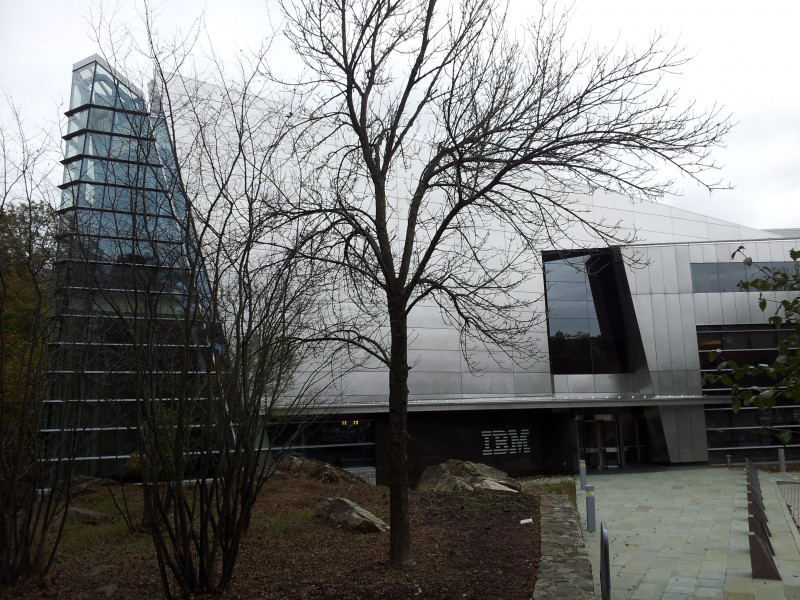
IBM, or International Business Machines Corporation, is a multinational technology company headquartered in Armonk, New York, operating in over 175 countries. A publicly traded company included in the Dow Jones Industrial Average, IBM is renowned as the world's largest industrial research organization. Notably, it held the record for the most annual U.S. patents by a business for 29 consecutive years (1993-2021), underscoring its commitment to innovation and technological advancement.
June 16, 1911: Amalgamation of four companies to form CTR
On June 16, 1911, the Computing-Tabulating-Recording Company (CTR) was formed through the amalgamation of four companies in New York State.


1911: Founding of the Computing-Tabulating-Recording Company (CTR)
In 1911, the Computing-Tabulating-Recording Company (CTR) was founded as a holding company of manufacturers of record-keeping and measuring systems, marking the beginning of what would become IBM.
1914: Thomas J. Watson, Sr. joins CTR
In 1914, Thomas J. Watson, Sr. joined the Computing-Tabulating-Recording Company (CTR) as general manager, later becoming president within 11 months.
February 14, 1924: Name changed to "International Business Machines"
On February 14, 1924, the company's name was changed to "International Business Machines", replacing the previous name Computing-Tabulating-Recording Company.
1924: Renaming to International Business Machines
In 1924, the Computing-Tabulating-Recording Company (CTR) was renamed "International Business Machines", marking a significant shift in the company's identity and global focus.
1933: Subsidiaries merged into IBM
By 1933, most of the subsidiaries of International Business Machines (IBM) had been merged into one company.
August 1943: Start of M1 Carbine rifle production during World War II
In August 1943, IBM began producing M1 Carbine rifles as a military contractor during World War II.
May 1944: End of M1 Carbine rifle production during World War II
In May 1944, IBM completed the production of approximately 346,500 M1 Carbine rifles used in World War II.
1945: Watson Scientific Computing Laboratory Founded
In 1945, IBM established the Watson Scientific Computing Laboratory at Columbia University in New York City, marking the beginning of its organized research efforts. This laboratory was created from a renovated fraternity house on Manhattan's West Side and served as IBM's first dedicated research facility.
1952: Introduction of the IBM 701
In 1952, IBM offered its first commercial stored-program computer, the vacuum tube based IBM 701.
1954: IBM sold mainframe computers
Since 1954, IBM has sold mainframe computers.
1956: Demonstration of artificial intelligence
In 1956, Arthur L. Samuel of IBM programmed an IBM 704 to play and "learn" from its own experience playing checkers.
1956: Introduction of the IBM 305 RAMAC
In 1956, IBM introduced the IBM 305 RAMAC, which featured the hard disk drive.
1957: Development of FORTRAN
In 1957, the FORTRAN scientific programming language was developed by IBM.
1958: Switch to transistorized designs with the 7000 and 1400 series
In 1958, IBM transitioned to transistorized designs with the 7000 and 1400 series computers.
1960: IBM Sponsors the Olympic Games
From 1960, IBM sponsored the Olympic Games.
1961: Development of SABRE and First computer song
In 1961, IBM developed the SABRE reservation system for American Airlines and also used the IBM 7094 to generate the first song sung completely by a computer using synthesizers, the song was Daisy Bell (Bicycle Built for Two).
1963: Support of NASA's Mercury flights
In 1963, IBM employees and computers assisted NASA in tracking the orbital flights of the Mercury astronauts.
1963: IBM Fellow award is offered
Since 1963, IBM has offered the IBM Fellow award based on technical achievement.
April 7, 1964: Launch of the IBM System/360
On April 7, 1964, IBM launched the IBM System/360, the first computer system family designed to cover a complete range of commercial and scientific applications.
1965: Participation in the Gemini flights
In 1965, IBM participated in the Gemini flights, providing support for space exploration.
1966: Participation in the Saturn flights
In 1966, IBM participated in the Saturn flights, contributing to space exploration efforts.
1969: Invention of the magnetic stripe card
In 1969, IBM engineer Forrest Parry invented the magnetic stripe card, which became widely used for credit/debit/ATM cards and other applications.
1969: Participation in the lunar mission
In 1969, IBM was involved in the lunar mission, further demonstrating its support for space exploration. IBM also developed and manufactured the Saturn V's Instrument Unit and Apollo spacecraft guidance computers.
1969: Antitrust Lawsuit
In 1969, The United States of America alleged that IBM violated the Sherman Antitrust Act by monopolizing or attempting to monopolize the general-purpose electronic digital computer system market.
1970: Launch of the IBM System/370
In 1970, IBM launched the IBM System/370, a successor to the System/360, which solidified IBM's dominance in the mainframe computer market.
1972: IBM introduces the "8-bar" logo
In 1972, graphic designer Paul Rand designed the current "8-bar" logo for IBM, as a replacement for a 13-bar logo.
1973: Leo Esaki wins the Nobel Prize
In 1973, Leo Esaki of IBM's Thomas J. Watson Research Center won the Nobel Prize for his work in semiconductors.
1974: Development of the Universal Product Code
In 1974, IBM engineer George J. Laurer developed the Universal Product Code.
1981: Introduction of financial swaps to the public
In 1981, IBM and the World Bank introduced financial swaps to the public through a swap agreement.
1981: Debut in the microcomputer market with the IBM Personal Computer
In 1981, IBM entered the microcomputer market with the IBM Personal Computer, which established an architecture that became the basis for most personal computers today.
1982: Dismissal of Antitrust Case
In 1982, the Department of Justice dropped the antitrust case against IBM, deeming it "without merit".
1985: Collaboration with Microsoft to develop OS/2
In 1985, IBM collaborated with Microsoft to develop a new operating system, which was released as OS/2, which ultimately failed in the marketplace.
1986: Gerd Binnig and Heinrich Rohrer win Nobel Prize
In 1986, Gerd Binnig and Heinrich Rohrer of IBM's Zurich Research Center won the Nobel Prize for their invention of the scanning tunneling microscope.
1987: Georg Bednorz and Alex Müller win Nobel Prize
In 1987, Georg Bednorz and Alex Müller, also of IBM's Zurich Research Center, won the Nobel Prize for their research in superconductivity.
1990: Release of Power microprocessors
In 1990, IBM released the Power microprocessors, which were designed into many console gaming systems, including Xbox 360, PlayStation 3, and Nintendo's Wii U.

1990: IBM scientists arrange xenon atoms to spell company initialism
In 1990, IBM scientists used a scanning tunneling microscope to arrange 35 individual xenon atoms to spell out the company initialism. This marked the first structure assembled one atom at a time.
1990: Honor Award from the National Building Museum for Van der Rohe's building in Chicago
Van der Rohe's IBM building in Chicago was recognized with the 1990 Honor Award from the National Building Museum.
1991: Spin-off of divisions into autonomous subsidiaries
In 1991, IBM began spinning off its divisions into autonomous subsidiaries, known as "Baby Blues", to streamline the company and attract external investment.
September 1992: Spin-off of microcomputer divisions into IBM PC Co.
In September 1992, IBM spun off its microcomputer personal computer manufacturing divisions into an autonomous wholly owned subsidiary known as the IBM Personal Computer Company (IBM PC Co.).
1993: Division of IBM PC Co. into business units
By the summer of 1993, the IBM PC Co. had divided into multiple business units itself, including Ambra Computer Corporation and the IBM Power Personal Systems Group.
1993: IBM held record for most annual U.S. patents
In 1993, IBM began a 29-year streak holding the record for the most annual U.S. patents generated by a business.
1993: IBM posts largest corporate loss in American history
In 1993, IBM reported an $8 billion loss, which was the largest corporate loss in American history at the time. Lou Gerstner was hired as CEO to turn the company around.
1995: IBM purchases Lotus Software
In 1995, IBM acquired Lotus Software, known for its Lotus 1-2-3 spreadsheet software.
1996: Cancellation of the Workplace OS project
In 1996, IBM cancelled the Workplace OS project despite significant investment.
1996: IBM becomes technology partner for the Masters Tournament and creates Masters.org
Since 1996, IBM has been the exclusive technology partner for the Masters Tournament. In 1996, IBM created the first Masters.org website.
1997: Deep Blue defeats Garry Kasparov
In 1997, IBM's chess computer Deep Blue defeated Chess World Champion Garry Kasparov in a six-round match.
1998: IBM began supporting Linux
In 1998, IBM began supporting Linux and invested billions of dollars in services and software based on Linux through the IBM Linux Technology Center, which includes over 300 Linux kernel developers.
1998: IBM creates the first course cam for the Masters Tournament
In 1998, IBM created the first course cam for the Masters Tournament.
1998: Merger of Personal Systems Group into IBM Global Services
In 1998, IBM merged the enterprise-oriented Personal Systems Group of the IBM PC Co. into IBM's Global Services personal computer consulting and customer service division.
2000: IBM Sponsors the Olympic Games
Until 2000, IBM sponsored the Olympic Games.
2001: IBM generates more than 3,000 patents in one year
In 2001, IBM became the first company to generate more than 3,000 patents in one year.
2002: Acquisition of PwC Consulting
In 2002, IBM acquired PwC Consulting, the consulting arm of PricewaterhouseCoopers, and merged it into IBM Global Services.
2003: IBM sponsors the National Football League
From 2003, IBM sponsored the National Football League.
September 14, 2004: End of business alliance between LG and IBM in South Korea
On September 14, 2004, LG and IBM announced the end of their business alliance in the South Korean market at the end of the year.
2004: Concerns raised regarding early pollution contribution in Endicott, New York
In 2004, concerns were raised related to IBM's contribution in its early days to pollution in its original location in Endicott, New York.
2005: Sale of microcomputer division to Lenovo
In 2005, IBM sold its microcomputer division to Lenovo, signaling a shift in focus towards computer services, software, supercomputers, and scientific research.
2008: IBM beats its own record with over 4,000 patents
In 2008, IBM beat its own record by generating over 4,000 patents in a single year.
2008: IBM occupies Pangu Plaza in Beijing
In Beijing, China, IBM occupies Pangu Plaza, overlooking Beijing National Stadium, home to the 2008 Summer Olympics.
2009: Acquisition of SPSS Inc. and National Medal of Technology and Innovation
In 2009, IBM acquired software company SPSS Inc. Also in 2009, IBM's Blue Gene supercomputing program was awarded the National Medal of Technology and Innovation by U.S. President Barack Obama.
2009: IBM creates first iPhone app with live streaming for Masters Tournament
In 2009, IBM created the first iPhone app with live streaming for the Masters Tournament.
2009: IBM owned SPSS
Since 2009, IBM has owned SPSS, a software package used for statistical analysis in the social sciences.
2011: IBM SoftLayer reports hosting over 81,000 servers
IBM SoftLayer, a dedicated server, managed hosting and cloud computing provider, reported hosting more than 81,000 servers for more than 26,000 customers in 2011.
2011: Watson debuted on Jeopardy!
IBM Watson debuted in 2011 on the American game show Jeopardy!, where it competed against champions Ken Jennings and Brad Rutter and won.
2011: Berkshire Hathaway's investment in IBM
In 2011, IBM became the first technology company Warren Buffett's holding company Berkshire Hathaway invested in, initially buying 64 million shares for $10.5 billion.
2011: Watson wins on Jeopardy! and IBM celebrates 100th anniversary
In 2011, IBM's artificial intelligence program Watson gained worldwide attention by winning against game-show champions Ken Jennings and Brad Rutter on Jeopardy! Also in 2011, IBM celebrated its 100th anniversary on June 16.
2012: Acquisition of Kenexa and Texas Memory Systems
In 2012, IBM announced it had agreed to buy Kenexa and Texas Memory Systems.
2012: IBM's R&D expenditure in 2012
In 2012, IBM's research and development expenditure was approximately $6.9 billion.
2012: LG sells Xnote
In 2012, LG sold Xnote, which was originally part of the joint venture between LG and IBM.
2012: IBM sponsors the National Football League
Until 2012, IBM sponsored the National Football League.
2014: IBM allocates $1 billion to Watson business unit
In 2014, IBM allocated $1 billion to establish a business unit specifically for Watson.
2014: Sale of x86 server division to Lenovo and major partnerships announced
In 2014, IBM announced the sale of its x86 server division to Lenovo for $2.1 billion, while continuing to offer Power ISA-based servers. Also in 2014, IBM announced major partnerships with companies like Apple Inc., Twitter, Facebook, Tencent, Cisco, UnderArmour, Box, Microsoft, VMware, CSC, Macy's, Sesame Workshop, and Salesforce.com.
2014: TrueNorth revealed
In 2014, IBM revealed TrueNorth, a neuromorphic CMOS integrated circuit, and announced a $3 billion investment over the following five years to design a neural chip that mimics the human brain.
2014: Accusations of using 'financial engineering'
In 2014, IBM was accused of using "financial engineering" to hit its quarterly earnings targets rather than investing for the longer term.
2015: Acquisition of Merge Healthcare, Cleversafe, and The Weather Company assets
In 2015, IBM announced three major acquisitions: Merge Healthcare for $1 billion, data storage vendor Cleversafe, and all digital assets from The Weather Company, including Weather.com and The Weather Channel mobile app.
2015: IBM invests in next-gen semiconductor and strategic imperatives
In 2015, IBM invested $3 billion to create a next-generation semiconductor and $4 billion to expand its "strategic imperatives," including cloud, analytics, mobile, security, and social technologies.
2015: Chip division transitions to fabless model
In 2015, IBM's chip division transitioned to a fabless model, offloading manufacturing to GlobalFoundries for semiconductor design.
April 2016: 14-year low in quarterly sales
In April 2016, IBM posted a 14-year low in quarterly sales.
2016: IBM operates in 174 countries
As of 2016, IBM operates in 174 countries with mobility centers and major campuses in various locations.
2016: Offerings fall into various categories
As of 2016, IBM's offerings fall into the categories of cloud computing, artificial intelligence, commerce, data and analytics, Internet of things (IoT), IT infrastructure, mobile, digital workplace and cybersecurity.
2016: Acquisition of Truven Health Analytics
In 2016, IBM bought Truven Health Analytics for $2.6 billion.
2016: IBM provides first live 4K feed in the United States for Masters Tournament
In 2016, IBM created the first-ever live 4K Ultra High Definition feed in the United States for a major sporting event.
2016: Launch of all-flash arrays
In 2016, IBM launched all-flash arrays designed for small and midsized companies, including software for data compression, provisioning, and snapshots.
2017: Berkshire Hathaway reduces IBM holdings
By the end of 2017, Berkshire Hathaway had reduced its IBM holdings by 94.5% to 2.05 million shares.
2017: IBM replaces Helvetica with IBM Plex
In 2017, IBM replaced Helvetica, its corporate typeface for 50 years, with the custom-designed IBM Plex.
2017: Tax Cuts and Jobs Act
In 2018, IBM along with 91 additional Fortune 500 companies had "paid an effective federal tax rate of 0% or less" as a result of the Tax Cuts and Jobs Act of 2017.
May 2018: Berkshire Hathaway completely exits IBM
By May 2018, Warren Buffet's Berkshire Hathaway was completely out of IBM.
October 2018: Announcement of Red Hat acquisition
In October 2018, IBM announced its intention to acquire Red Hat for $34 billion.
2018: Paid an effective federal tax rate of 0%
In 2018, IBM along with 91 additional Fortune 500 companies had "paid an effective federal tax rate of 0% or less" as a result of the Tax Cuts and Jobs Act of 2017.
January 2019: Introduction of IBM Q System One
In January 2019, IBM introduced its first commercial quantum computer: IBM Q System One.
July 9, 2019: Red Hat acquisition completed
On July 9, 2019, IBM's acquisition of Red Hat for $34 billion was completed.
February 2020: Pledge with Vatican for ethical AI
In February 2020, IBM's John Kelly III joined Brad Smith of Microsoft to sign a pledge with the Vatican to ensure the ethical use and practice of Artificial Intelligence (AI).
June 2020: IBM exited the facial recognition business
In June 2020, IBM announced that it was exiting the facial recognition business. IBM's CEO Arvind Krishna called for a national dialogue on the use of facial recognition technology.
October 2020: Divestiture of Managed Infrastructure Services unit into Kyndryl
In October 2020, IBM announced it would divest the Managed Infrastructure Services unit of its Global Technology Services division into a new public company named Kyndryl. Kyndryl will have 90,000 employees, 4,600 clients in 115 countries, and a $60 billion order backlog.
2020: Ranked No. 38 on the Fortune 500
In 2020, IBM ranked No. 38 on the Fortune 500 rankings of the largest United States corporations by total revenue.
December 31, 2020: IBM reported total CO2e emissions at 621 kilotons
IBM reported its total CO2e emissions (direct and indirect) for the twelve months ending December 31, 2020, at 621 kilotons (-324 /-34.3% year-on-year).
February 2021: Commitment to achieve net zero greenhouse gas emissions by 2030
In February 2021, IBM committed to achieve net zero greenhouse gas emissions by the year 2030.
2021: IBM holds record for most annual U.S. patents
As of 2021, IBM holds the record for most annual U.S. patents generated by a business for 29 consecutive years.
2021: Acquisition of Turbonomic
In 2021, IBM announced the acquisition of the enterprise software company Turbonomic for $1.5 billion.
2021: IBM held record for most patents generated by a business
In 2021, IBM held the record for most patents generated by a business for 29 consecutive years.
January 2022: Sale of Watson Health to Francisco Partners
In January 2022, IBM announced it would sell Watson Health to private equity firm Francisco Partners.
May 2022: Strategic Collaboration Agreement with Amazon Web Services
In May 2022, IBM announced a multi-year Strategic Collaboration Agreement with Amazon Web Services to make a variety of IBM software available as a service on AWS Marketplace.
2022: IBM holds 150,000 patents
As of 2022, IBM held 150,000 patents, but has also faced criticism as being a patent troll.
2022: IBM has over 297,900 employees worldwide
As of 2022, IBM is among the world's largest employers, with over 297,900 employees worldwide, approximately 160,000 of whom are tech consultants.
2022: Collaboration with Rapidus
In late 2022, IBM started a collaboration with new Japanese manufacturer Rapidus, which led GlobalFoundries to file a lawsuit against IBM the following year.
March 31, 2023: Vanguard Group holds 15.7% of IBM shares
As of March 31, 2023, Vanguard Group is the largest shareholder of IBM, holding 15.7% of total shares outstanding.
May 2023: IBM Reveals Watsonx
In May 2023, IBM unveiled Watsonx, a Generative AI toolkit powered by IBM's Granite models, with the option to integrate other publicly available LLMs. Watsonx offers various services for training and fine-tuning models using confidential data.
August 2023: Agreement to sell The Weather Company to Francisco Partners
In August 2023, IBM agreed to sell The Weather Company to Francisco Partners for an undisclosed sum.
November 16, 2023: Suspension of ads on Twitter
On November 16, 2023, IBM suspended ads on Twitter after ads were found next to pro-Nazi content.
December 2023: Acquisition of Software AG's StreamSets and webMethods platforms
In December 2023, IBM announced it would acquire Software AG's StreamSets and webMethods platforms for €2.13 billion ($2.33 billion).
February 1, 2024: Finalization of The Weather Company sale to Francisco Partners
The sale of The Weather Company to Francisco Partners was finalized on February 1, 2024, for $1.1 billion, with $750 million in cash, $100 million deferred over seven years, and $250 million in contingent consideration.
May 2024: Market capitalization valued over $153 billion
In May 2024, IBM's market capitalization was valued at over $153 billion.
October 2024: IBM introduces Granite 3.0
In October 2024, IBM introduced Granite 3.0, an open-source large language model designed for enterprise AI applications.
2024: IBM's consulting business valued at $20 billion
As of 2024, IBM, with 160,000 consultants globally, is among the ten largest consulting companies worldwide. Their consulting business, encompassing strategy, management, experience design, technology integration, and operations, is valued at $20 billion.
2024: The Weather Company was sold
IBM also owned The Weather Company, which provides weather forecasting and includes weather.com and Weather Underground, which was sold in 2024.
2024: IBM reports R&D expenditures of $7.48 billion
In 2024, IBM reported research and development expenditures of $7.48 billion, which represents an increase of approximately 10.3% compared to the previous year’s expenditure of $6.78 billion.
2024: Europe's first quantum data center opened
The quantum data center in Ehningen, Germany, operated by the Fraunhofer Society and announced in March 2020, was opened in 2024.
June 2025: Named in UN expert report regarding Israel's surveillance apparatus
In June 2025, IBM was named by a UN expert report as one of several companies "central to Israel's surveillance apparatus and the ongoing Gaza destruction."
December 8, 2025: Deal to acquire Confluent announced
On December 8, 2025, IBM announced a deal to acquire data-infrastructure company Confluent for approximately $11 billion. The deal is expected to help further advance the company's interests in AI.
2030: IBM committed to achieve net zero greenhouse gas emissions by 2030
In February 2021, IBM committed to achieve net zero greenhouse gas emissions by the year 2030.
Mentioned in this timeline
Apple Inc founded in and headquartered in Cupertino California is...

Tencent is a Chinese multinational technology conglomerate headquartered in Shenzhen...

Founded in by Mark Zuckerberg and his Harvard roommates Facebook...
PlayStation is a video game brand owned by Sony Interactive...
Xbox is a video gaming brand owned by Microsoft Gaming...

Warren Buffett a highly successful American investor and philanthropist is...
Trending

3 hours ago Chuck Lorre Reveals CBS Initially Rejected Melissa McCarthy for Mike & Molly Lead Role
3 hours ago New Mexico Judge Dismisses Criminal Charges Against Actor Timothy Busfield

3 hours ago DeVonta Smith Returns to Action for Eagles Week 6 Clash
3 hours ago Tesla Autopilot Crash Injures Two CHP Officers in Solano County

3 hours ago Mike Gansey Instrumental in Cleveland Cavaliers' Strategic James Harden Acquisition
4 hours ago Colts Tight End Tyler Warren Added to Week 6 Injury Report
Popular

Ilhan Omar is a prominent American politician currently serving as...

Ken Paxton is an American politician and lawyer serving as...

Elon Musk is a visionary entrepreneur and engineer known for...

Michael Joseph Jackson the King of Pop was a highly...

Jameis Winston is an American football quarterback currently playing for...

Cristiano Ronaldo widely considered one of the greatest footballers captains...