Childhood and Education Journey of Jürgen Habermas in Timeline


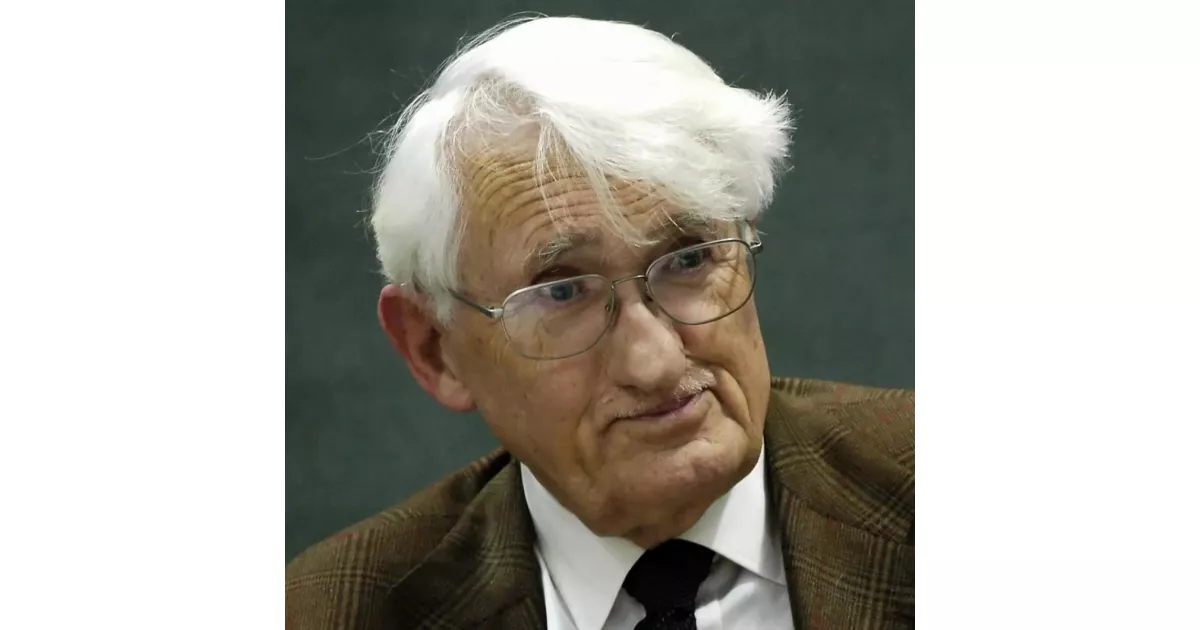
How education and upbringing influenced the life of Jürgen Habermas. A timeline of key moments.
Jürgen Habermas is a prominent German philosopher and social theorist known for his work on communicative rationality and the public sphere. A key figure in the tradition of critical theory and pragmatism, Habermas examines how rational discourse and open communication are essential for a democratic society. His theories explore how individuals can reach mutual understanding and consensus through reasoned argument, ultimately shaping political and social norms. Habermas's analysis of the public sphere emphasizes its role as a space for critical debate and the formation of public opinion, vital for the legitimacy of political power.
June 1929: Birth of Jürgen Habermas
In June 1929, Jürgen Habermas, a German philosopher and social theorist known for his work on communicative rationality and the public sphere, was born.


1929: Habermas Born in Düsseldorf
In 1929, Habermas was born in Düsseldorf, Rhine Province. He was born with a cleft palate and underwent corrective surgery twice during his childhood.
1933: Father Joins Nazi Party
In 1933, Habermas' father, Ernst Habermas, joined the Nazi Party and began advising it from 1939.
1935: Heidegger's Lectures
In 1935, Martin Heidegger's lectures (Introduction to Metaphysics) contained a reference to the "inner truth and greatness" of Nazism.
1939: Father Advised Nazi Party
From 1939, Ernst Habermas, Jürgen Habermas's father, advised the Nazi Party.
August 1944: Anti-Aircraft Warfare
From August 1944, Habermas's detachment waged anti-aircraft warfare against the Allied advances on the Siegfried Line.
1945: Germany's Opening to the West
Jürgen Habermas viewed that "Germany's opening to the West" had existed since 1945.
1949: Studies at Göttingen
In 1949, Jürgen Habermas began his studies at the University of Göttingen.
1950: Studies at Zurich
In 1950, Jürgen Habermas studied at the University of Zurich.
1951: Studies at Bonn
In 1951, Jürgen Habermas began his studies at the University of Bonn.
1953: Article in Frankfurter Allgemeine Zeitung
In 1953, Jürgen Habermas wrote an article for the Frankfurter Allgemeine Zeitung expressing outrage at the publication of Martin Heidegger's 1935 lectures which contained a reference to the "inner truth and greatness" of Nazism.
February 1954: Doctorate in Philosophy
In February 1954, Jürgen Habermas earned a doctorate in philosophy from the University of Bonn with his dissertation, "Das Absolute und die Geschichte. Von der Zwiespältigkeit in Schellings Denken".
1956: Research Assistant to Adorno
In 1956, Jürgen Habermas became Theodor W. Adorno's research assistant at the University of Frankfurt am Main's Institute for Social Research (IfS). He also studied philosophy and sociology under Adorno and Max Horkheimer at the IfS from 1956 to 1959.
1959: Studies at IfS Conclude
From 1956 to 1959, Habermas studied philosophy and sociology under Adorno and Max Horkheimer at the Institute for Social Research (IfS).
1959: Birth of Rebekka Habermas
In 1959, Jürgen Habermas's daughter, Rebekka Habermas, a historian of German social and cultural history, was born.
1961: Labeled a Neo-Marxist
Around the time of his habilitation in 1961, Karl-Otto Apel first labelled Jürgen Habermas a neo-Marxist.
1961: Privatdozent in Marburg
In 1961, Jürgen Habermas became a Privatdozent in Marburg.
1961: Habilitation Work
In 1961, Jürgen Habermas completed his habilitation in political science at the University of Marburg. His work was entitled Strukturwandel der Öffentlichkeit. Untersuchungen zu einer Kategorie der bürgerlichen Gesellschaft.
1962: Professor at Heidelberg University
In 1962, Jürgen Habermas accepted the position of "extraordinary professor" of philosophy at the University of Heidelberg.
1964: Returns to Frankfurt
In 1964, Jürgen Habermas returned to Frankfurt to take over Horkheimer's chair in philosophy and sociology.
1965: Reconciles with Horkheimer
In 1965, Jürgen Habermas reconciled with Horkheimer, who provided a glowing reference for him to the American Jewish Committee.
1969: Adorno's Death
Following Adorno's death in 1969, Habermas recommended Leszek Kołakowski to take up the role of director of the Institute for Social Research.
1971: Co-director at Max Planck Institute
In 1971, Jürgen Habermas accepted the position of co-director of the Max Planck Institute for the Study of the Scientific and Technical World in Starnberg and proclaimed his definitive break with the Frankfurt School of critical theory in a letter to Herbert Marcuse.
1979: Interview at Starnberg
In a 1979 interview at Starnberg, Jürgen Habermas commented that he valued being considered a Marxist and claimed to be "the last Marxist" as late as 1989.
July 1986: Criticism of German Historians
On 11 July 1986, Jürgen Habermas criticized Ernst Nolte, Michael Stürmer, Klaus Hildebrand and Andreas Hillgruber for "apologistic" history writing in regard to the Nazi era in the Die Zeit.
1989: "Last Marxist"
In a 1979 interview at Starnberg, Jürgen Habermas claimed to be "the last Marxist" as late as 1989.
2005: Election of Joseph Ratzinger as Pope Benedict XVI
Joseph Ratzinger, who dialogued with Habermas in January 2004, was elected as Pope Benedict XVI in 2005.
2017: Supports Macron
In 2017, Jürgen Habermas declared himself a supporter of Emmanuel Macron ahead of the French presidential election.
2023: Death of Rebekka Habermas
In 2023, Rebekka Habermas, daughter of Jürgen Habermas, died.
March 2026: Death in Starnberg
On 14 March 2026, Jürgen Habermas died in Starnberg at the age of 96, as announced by his publisher Suhrkamp Verlag.
March 2026: Death of Jürgen Habermas
On March 14, 2026, Jürgen Habermas died in Starnberg at the age of 96, as announced by his publisher Suhrkamp Verlag.
Mentioned in this timeline
The United States of America is a federal republic primarily...
Emmanuel Macron is the current President of France and Co-Prince...
Germany officially the Federal Republic of Germany is located in...

Iraq officially the Republic of Iraq is a country in...
Hamas is a Sunni Islamist Palestinian nationalist political organization with...
Israel is a Middle Eastern nation located on the eastern...
Trending

3 hours ago Alexander Bublik Faces Backlash After Intense Racket Smashing Outburst at Shanghai Masters

3 hours ago New Film Artificial Explores OpenAI Creators and Future of Humanity
3 hours ago KOSPI Shares Plunge Amid Tech Sell-Off and Global Economic Pressures

3 hours ago Russell Brand Appears in London Court for Rape and Sexual Assault Trial

5 hours ago Carlos Alcaraz Competes at Rolex Shanghai Masters Tournament

5 hours ago Alexander Bublik Faces Backlash Following Intense Racket Smashing Outburst at Shanghai Masters
Popular

Ken Paxton is an American politician and lawyer serving as...

Jameis Winston is an American football quarterback currently playing for...

Cristiano Ronaldo widely considered one of the greatest footballers captains...

Michael Joseph Jackson the King of Pop was a highly...

Elon Musk is a visionary entrepreneur and engineer known for...

Bernie Sanders is a prominent American politician and the senior...